TL;DR:
- Korean has a complex diversity of dialects and regional variations, with Seoul dialect as the standard.
- Learning Hangul, the logical Korean script, can be achieved in less than a week with consistent practice.
- Structured courses and real speaking practice are essential for progressing beyond beginner level in Korean.
Korean is the official language of both North and South Korea, but calling it “just one language” undersells its fascinating depth. Many learners arrive expecting a simple, uniform system and quickly discover a rich world of regional dialects, an elegantly logical writing script, and a grammar structure unlike anything in English. For Singaporeans curious about Korean culture, K-dramas, or career opportunities, understanding what the Korean language actually is sets the strongest possible foundation. This guide walks you through everything: the language’s core structure, its writing system, its regional varieties, and practical steps to start learning effectively right here in Singapore.
Table of Contents
- Understanding the Korean language: An overview
- The building blocks: Hangul and Korean writing
- Dialects and differences: How Korean varies regionally
- Effective strategies for learning Korean in Singapore
- Our perspective: The real path to fluency beyond the basics
- Start your Korean language journey now
- Frequently asked questions
Key Takeaways
| Point | Details |
|---|---|
| Korean is official | Korean is the official and main language of both North and South Korea with minor regional variations. |
| Hangul is beginner-friendly | Hangul, the Korean writing system, can be mastered in a few days and is logical for new learners. |
| Seoul dialect is standard | The Seoul dialect is standard and best for learning media, education, and daily conversation. |
| Combine learning methods | Self-study, classes, apps, and media immersion combine for faster and deeper language acquisition. |
| Cultural understanding matters | Knowing dialects and cultural context is key to fluency and enjoying Korean society and content. |
Understanding the Korean language: An overview
Koreans speak Korean, known in the language itself as Hangugeo (한국어) in the South and Joseoneo (조선어) in the North. It is the primary language for over 75 million native speakers worldwide, making it one of the most spoken languages in Asia. While Chinese and Japanese often dominate conversations about Asian language learning, Korean holds its own as a structurally distinct and culturally rich option.
To understand why Korean feels so different from English, you need to know three core features. First, Korean follows Subject-Object-Verb (SOV) word order. In English, you say “I eat rice.” In Korean, you say “I rice eat.” This flips how you build sentences entirely. Second, Korean is agglutinative, meaning grammatical meaning is added by stacking suffixes onto a root word rather than using separate words. Third, Korean uses an elaborate honorific system, where the way you speak changes depending on who you are talking to. Speaking to a friend sounds completely different from speaking to a manager or an elder.
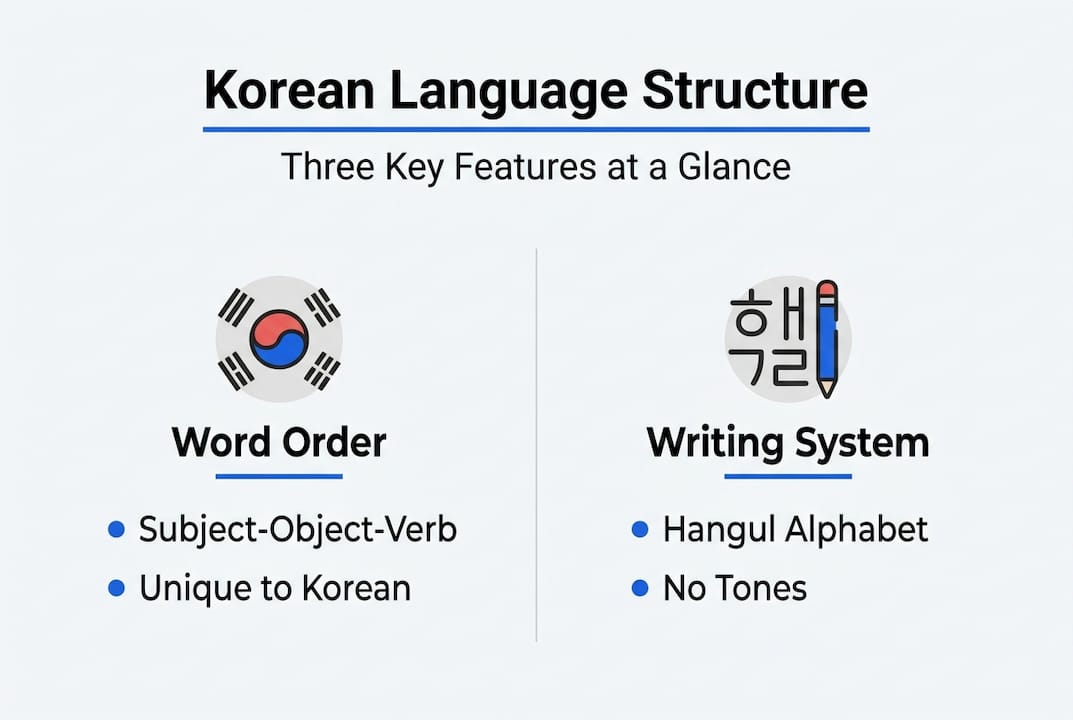
The Korean language structure also includes regional dialects, though the standard form based on Seoul is understood nationwide. You can explore the history of Korean to see how these features evolved over centuries.
How Korean compares to other major Asian languages:
| Feature | Korean | Japanese | Mandarin Chinese |
|---|---|---|---|
| Word order | SOV | SOV | SVO |
| Writing system | Hangul (alphabet) | Hiragana/Katakana/Kanji | Characters only |
| Honorifics | Extensive | Moderate | Minimal |
| Tones | None | Pitch accent | Yes (4 tones) |
| Grammar type | Agglutinative | Agglutinative | Isolating |
One thing that surprises many learners: Korean has no tones. Unlike Mandarin, where the pitch of a syllable changes its meaning, Korean relies on context and grammar instead. That is genuinely good news for English speakers.
The building blocks: Hangul and Korean writing
With an understanding of the Korean language’s foundation, it’s time to look at its script, Hangul, and how it underpins fluency. Hangul is widely regarded as one of the most logical and learnable writing systems ever created. Unlike Chinese characters, which number in the thousands, Hangul consists of just 14 basic consonants and 10 basic vowels that combine to form syllable blocks.
Those 24 letters can produce over 11,000 possible syllable combinations, which covers virtually every sound in the Korean language. The key insight is that Hangul is not written letter by letter the way English is. Instead, letters are grouped into syllable blocks. The word for Korea, 한국 (Hanguk), is written as two blocks: 한 and 국. Each block contains two or three letters stacked together. Once you recognize this pattern, reading speed increases dramatically.
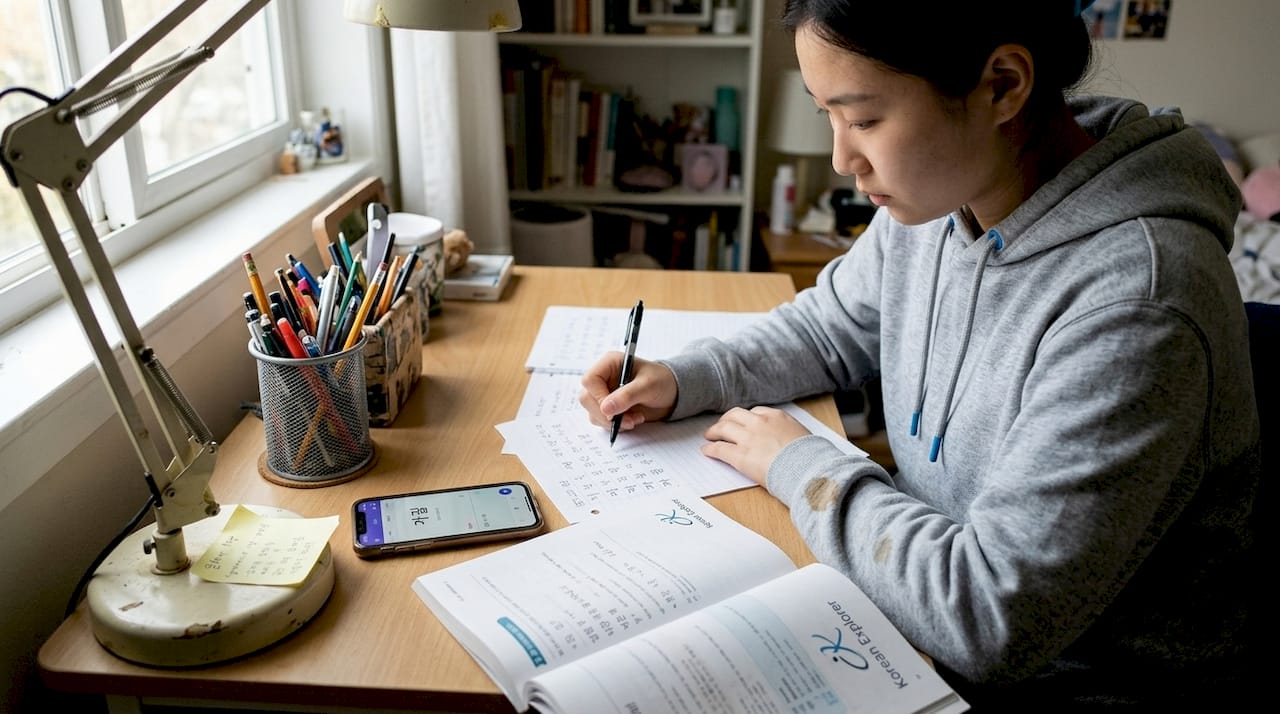
King Sejong the Great commissioned Hangul in 1443 specifically to increase literacy among ordinary Koreans. The script was designed with phonetic logic built in: the shapes of consonants actually mirror the position of the mouth and tongue when producing the sound. That is not a coincidence. It is intentional design.
Steps to learn Hangul as a beginner:
- Learn the 14 basic consonants and their sounds
- Learn the 10 basic vowels
- Practice combining one consonant and one vowel into a simple block
- Add final consonants (받침, batchim) to complete syllable blocks
- Read simple Korean words aloud, focusing on the block as a whole unit
- Practice daily for 15 to 20 minutes using flashcards or a Korean writing basics reference
Pro Tip: Do not practice Hangul letter by letter in isolation. Train your eye to see the whole syllable block at once. This mirrors how fluent readers process Korean and will cut your reading time in half within the first two weeks.
If you want a structured approach, learning resources that show you how to learn Hangul effectively can help you move from zero to readable in under a week.
Dialects and differences: How Korean varies regionally
Once you grasp Hangul, it’s important to know that not all Korean sounds or looks the same. Regional varieties add fascinating complexity to the language. South Korea alone has several distinct dialects, and the differences between North and South Korean are significant enough to cause real communication gaps.
The main South Korean dialects include:
- Seoul/Gyeonggi (Standard): The dialect used in media, education, and government. This is what you hear in K-dramas and news broadcasts.
- Gyeongsang (Southeast): Known for its rising intonation and often associated culturally with a more assertive, direct communication style.
- Jeolla (Southwest): Features softer, more melodic speech patterns and distinct vocabulary.
- Jeju: So different from Standard Korean that it is sometimes classified as a separate language. Many mainland Koreans cannot understand it without exposure.
As noted in dialect research, the Seoul/Gyeonggi dialect is the standard in the South, Pyongyang dialect serves as the norm in the North, and the Jeju dialect sits in a category almost entirely its own.
North and South Korean have diverged considerably since the 1950s. Vocabulary differences are striking: South Korea uses many English loanwords (컴퓨터, keompyuteo, for computer), while North Korea favors native Korean equivalents. Pronunciation, spelling conventions, and even the alphabet ordering differ between the two. You can read more about these North-South Korean differences to appreciate just how politically shaped language can be.
| Dialect | Region | Notable feature |
|---|---|---|
| Seoul/Gyeonggi | Capital area | Standard; used in all media |
| Gyeongsang | Busan, Daegu | Rising tone; direct style |
| Jeolla | Gwangju, Jeonju | Melodic; distinct endings |
| Jeju | Jeju Island | Near-unintelligible to mainlanders |
“Standard Seoul dialect is the essential foundation for media consumption, academic study, and professional communication in Korean.”
For learners in Singapore, the practical takeaway is clear: focus on the Seoul standard dialect. It is what you will hear in learning from K-dramas, travel, and any professional Korean context.
Effective strategies for learning Korean in Singapore
Now that you know how Korean varies, let’s look at how to learn effectively in Singapore using both modern methods and cultural insights. The good news: Singapore is genuinely well positioned for Korean learning, with access to structured courses, SkillsFuture funding, and a thriving Korean cultural community.
A step-by-step learning roadmap:
- Master Hangul first. Do not skip this. Trying to learn Korean through romanization (writing Korean sounds in English letters) creates bad habits that slow you down later.
- Build core vocabulary. Aim for 500 to 1,000 high-frequency words in your first three months.
- Study grammar systematically. Focus on sentence endings, particles, and verb conjugation, which carry most of the meaning in Korean.
- Train your listening daily. Use Korean podcasts, YouTube channels, or using Korean movies as active listening practice.
- Speak from week one. Even badly. Speaking early builds the neural pathways you need for fluency.
Apps like Duolingo and Anki help with vocabulary drilling, but structured learning with native speakers accelerates progress far beyond what self-study alone can achieve. Most learners reach basic conversational ability in 6 to 12 months with consistent daily practice.
Resources available in Singapore:
- Group and private Korean classes at accredited language schools
- Online classes for flexible scheduling
- TOPIK exam preparation for academic or professional certification
- SkillsFuture funding to offset course fees for eligible Singaporeans
Pro Tip: If you have been self-studying for more than three months and feel stuck, that is the self-study plateau. Joining a structured class with real feedback from a qualified instructor is the single fastest way to break through it. Check out beginner Korean lessons to understand what a structured curriculum looks like. For a broader view, the Korean learning in Singapore guide covers your options in detail.
Our perspective: The real path to fluency beyond the basics
Most language guides stop at “learn Hangul, study grammar, watch K-dramas.” That advice is not wrong, but it leaves out the uncomfortable part: the plateau that hits almost every learner between beginner and intermediate level.
Here is what we have seen repeatedly. Learners get comfortable with basic phrases and Hangul, then stop pushing into territory that feels awkward. They watch K-dramas passively instead of actively mimicking dialogue. They use apps as a comfort zone rather than a learning tool. The result is months of practice with little real progress.
The contrarian truth is that structured feedback beats volume of practice. Spending 30 minutes speaking with a qualified instructor who corrects your honorific usage in real time is worth more than three hours of solo app drilling. Cultural competence, knowing when to use formal versus informal speech, understanding what a dialect signals about a speaker’s background, is what separates functional Korean from truly fluent Korean.
Challenge yourself by mimicking real K-drama scenes out loud, not just watching them. Join a conversation club. Read about myths about learning Korean that might be slowing you down. Real fluency is not a vocabulary count. It is the ability to navigate culture, context, and connection.
Start your Korean language journey now
Understanding the Korean language is the first step. Taking action is what separates curious learners from fluent speakers.
At Korean Explorer, we offer Korean language courses built on a Seoul National University curriculum, taught by native Korean instructors who are fluent in English. Whether you are a complete beginner or preparing for the TOPIK test in Singapore, we have a structured path for you. Singaporeans can also tap into SkillsFuture Korean language funding to make quality Korean education even more accessible. Group classes, private sessions, and online options are all available across our Tanjong Pagar, Jurong, and Tampines centers.
Frequently asked questions
Is Korean the only language spoken in Korea?
Yes, Korean is the official dominant language, but regional dialects including the Jeju language exist and are sometimes not mutually intelligible with standard Korean.
How long does it take to learn basic Korean?
With daily practice, basic conversational ability takes 6 to 12 months; Hangul itself can be mastered in a week with structured classes covering basics in 8 to 12 weeks.
What is the most widely used Korean dialect?
The Seoul (Gyeonggi) dialect is the standard in South Korea and is the variety used in all media, education, and professional settings.
Do you need to know Korean to enjoy K-dramas?
No, but learning basic Korean phrases from K-drama immersion significantly improves your listening skills and cultural understanding of what you are watching.
Are Korean language courses in Singapore eligible for SkillsFuture funding?
Yes, many accredited Korean language courses in Singapore qualify for SkillsFuture credits, making structured learning more affordable for eligible Singaporeans.