TL;DR:
- Mastering Hangul early is essential for progressing in Korean learning.
- Consistent daily practice and real conversation boost fluency faster than apps alone.
- Structured courses and interaction with native speakers are crucial for breaking learning plateaus.
Millions of Singaporeans are drawn to Korean culture through music, dramas, and food, yet many hit a wall when they try to learn the language on their own. The problem is rarely motivation. It’s structure. Without a clear roadmap, self-study turns into scattered app sessions and forgotten vocabulary. Singaporean learners often supplement dramas for context but lack a system that connects cultural interest to real conversational ability. This guide gives you exactly that: a step-by-step routine, evidence-backed strategies, and practical tools to move from curious beginner to confident Korean speaker faster than you think.
Table of Contents
- What you need to start: Tools, apps, and mindset
- Step 1: Master Hangul and pronunciation
- Building your daily routine: Vocabulary, grammar, listening, and speaking
- Common pitfalls and how to overcome them
- Our perspective: What actually works for Singaporean learners
- Next steps: Structured Korean classes in Singapore
- Frequently asked questions
Key Takeaways
| Point | Details |
|---|---|
| Master Hangul early | Learning Hangul unlocks all Korean resources and speeds up your progress. |
| Use free resources wisely | Combine apps, websites, and podcasts for balanced skill development. |
| Stick to a daily routine | Consistent study (30–60 minutes daily) accelerates improvement by up to 30%. |
| Avoid common pitfalls | Don’t rely on romanization or neglect speaking practice for real-world fluency. |
| Consider structured classes | Formal lessons or placement tests in Singapore can fill gaps and support faster progress. |
What you need to start: Tools, apps, and mindset
Before you write a single Korean word, you need the right setup. Think of this phase as building your study kitchen before you cook. The tools you choose will either accelerate your progress or quietly slow it down.
Here’s a comparison of the most popular resources available to Singaporean learners:
| Resource | Type | Best for | Cost |
|---|---|---|---|
| Talk To Me In Korean (TTMIK) | Grammar + podcasts | Structured beginners | Free/Paid |
| HowToStudyKorean.com | Comprehensive lessons | Self-paced learners | Free |
| Duolingo | Gamified app | Building daily habits | Free/Paid |
| Memrise | Spaced repetition | Vocabulary retention | Free/Paid |
| Anki | Flashcard system | Custom vocab decks | Free |
Recommended free resources like TTMIK and HowToStudyKorean.com offer structured grammar and vocabulary lessons that go far beyond what casual apps provide. Duolingo works well as a daily habit starter, but it should not be your only tool.
Before your first study session, prepare these essentials:
- A device with your chosen apps installed and accounts created
- A dedicated notebook for writing Hangul and vocabulary by hand
- A clear, specific reason for learning Korean (travel, K-drama, work, TOPIK)
- A weekly time budget: even 30 minutes a day is enough to start
- Access to mobile Korean apps and beginner apps suited to your level
Mindset matters more than most learners admit. Research shows that consistent daily practice advances learners roughly 30% faster than irregular cramming sessions. Positive psychology principles also confirm that framing small wins as real progress keeps engagement high over months, not just weeks.
Pro Tip: Set a realistic weekly study goal based on your actual schedule. Three focused 30-minute sessions beat one 3-hour marathon every time. Consistency is the engine; motivation is just the spark.
Also explore effective Korean resources that combine grammar, vocabulary, and listening in one place. The goal at this stage is not to study everything. It’s to study the right things consistently.
Step 1: Master Hangul and pronunciation
Once you’ve assembled your resources, your first actionable step is to unlock Hangul, the Korean alphabet and the gateway to all Korean learning. Many learners skip this and rely on romanization (writing Korean sounds in English letters). That is one of the biggest mistakes you can make.
Here’s how to learn Hangul efficiently:
- Learn the 14 basic consonants in one sitting using visual association (many look like the mouth shape they make)
- Learn the 10 basic vowels and practice combining them with consonants to form syllable blocks
- Write each character by hand at least 10 times to build muscle memory
- Use a Hangul chart daily for the first week until recognition becomes automatic
- Read simple Korean words out loud, even before you know what they mean
- Test yourself with short flashcard drills using Anki or a paper deck
Mastering Hangul in 1 to 7 days is a realistic goal for most learners, and it unlocks every other resource available to you. Once you can read Hangul, you can use TTMIK, watch Korean subtitles, and engage with native content.
Pronunciation is where many learners quietly develop bad habits. Korean has sounds that don’t exist in English or Mandarin, and romanization gives you a false sense of security.
A note on batchim: Batchim refers to the consonant sound at the bottom of a Korean syllable block. It changes pronunciation depending on the following syllable. Skipping this rule leads to speech that native speakers find difficult to understand. Learn it early and practice it often.
Avoiding romanization dependency is critical because it creates a ceiling on your pronunciation accuracy. Once you rely on it, breaking the habit takes twice the effort.
Also check out these Hangul tips that cover common mistakes and faster memorization techniques.
Pro Tip: Record yourself speaking Korean and play it back. Better yet, find a language exchange partner on apps like HelloTalk or Tandem. Real pronunciation feedback from a native speaker is worth more than hours of solo drilling.
Building your daily routine: Vocabulary, grammar, listening, and speaking
After you’ve mastered Hangul, it’s time to establish a sustainable daily routine. The key word here is sustainable. A routine you can maintain for six months beats an intense plan you abandon after two weeks.
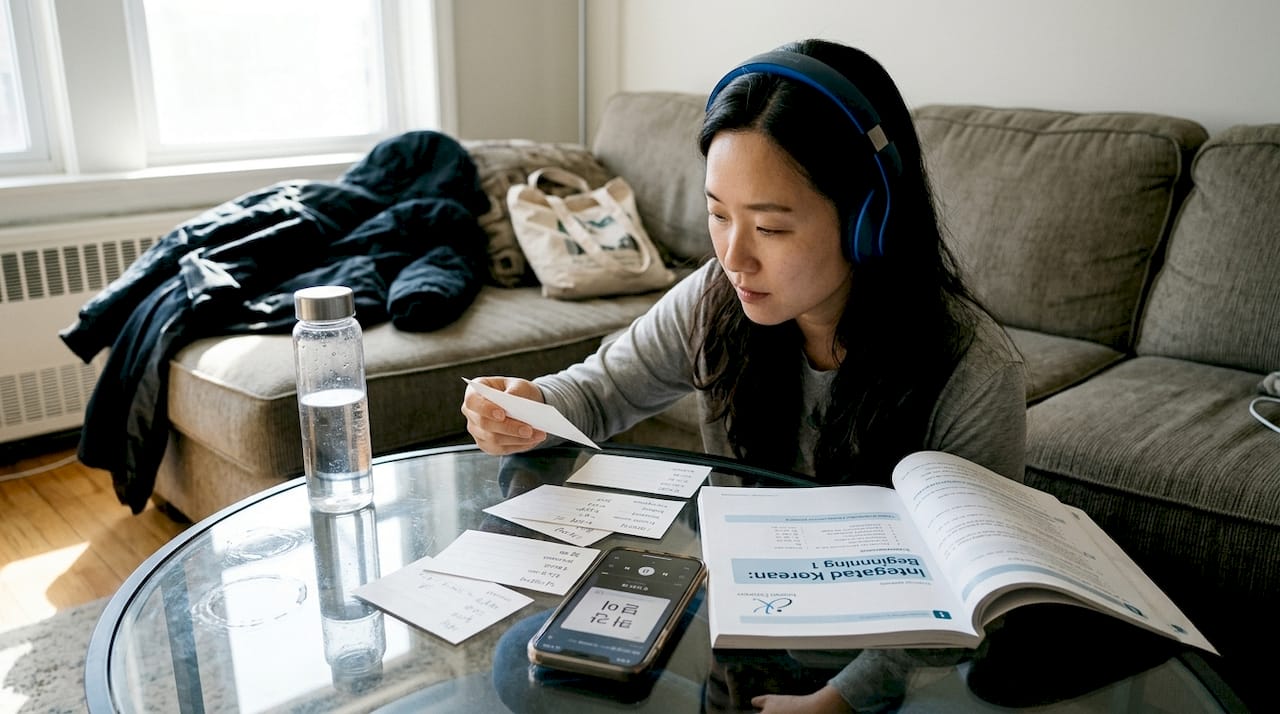
Here’s a sample daily time split for a 45-minute study session:
| Activity | Time | Tools |
|---|---|---|
| Vocabulary review (SRS) | 10 minutes | Anki, Memrise |
| Grammar study | 15 minutes | TTMIK, HowToStudyKorean |
| Listening practice | 10 minutes | Podcasts, drama clips |
| Speaking or writing output | 10 minutes | Language exchange, journaling |
A 30 to 60 minute daily split structured this way leads most learners to basic conversational ability within 6 to 12 months. Consistency matters far more than session length.
Here’s how to execute your daily routine step by step:
- Start with vocabulary review using spaced repetition. Review old cards before adding new ones
- Study one grammar point using TTMIK or HowToStudyKorean. Write two original sentences using it
- Listen to a short podcast episode or a 3 to 5 minute drama clip with Korean subtitles
- Speak or write something in Korean, even if it’s just describing your day
For Singaporean learners specifically, motivation hacks that work well include:
- Watching K-dramas with Korean subtitles instead of English ones
- Using Korean phrases at Korean restaurants or beauty shops in Singapore
- Setting a TOPIK exam date as a concrete goal
- Connecting with Korean colleagues or classmates for casual practice
Consistent daily practice advances learners roughly 30% faster than inconsistent study. Apps alone build habits but fall short of fluency. You need real output practice woven into your routine from day one.
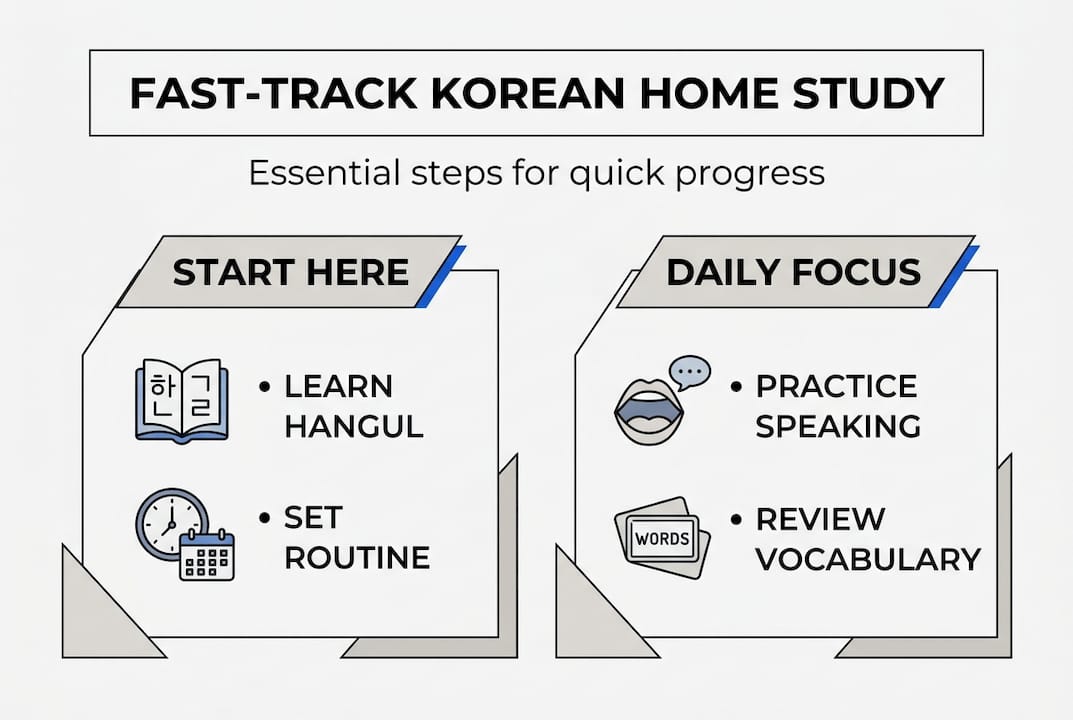
Explore vocabulary strategies and best Korean study methods to refine your approach as you progress.
Common pitfalls and how to overcome them
Even with a solid routine, many learners stumble at certain points. Knowing what these pitfalls are before you hit them gives you a real advantage.
The most common mistakes Singaporean learners make:
- Romanization dependency: Relying on English phonetics instead of reading Hangul slows down listening comprehension and pronunciation accuracy
- Skipping speaking practice: Reading and listening without output creates a passive learner who understands but cannot produce Korean
- Plateauing at intermediate: Many learners stall around TOPIK Level 2 to 3 because they stop pushing into unfamiliar grammar and vocabulary
- Studying without feedback: Self-study without correction allows errors to become habits
- Inconsistent scheduling: Studying heavily on weekends and skipping weekdays breaks retention patterns
Romanization dependency and pronunciation pitfalls are especially common among English-first learners in Singapore, where romanized Korean appears frequently in pop culture content.
On honorifics and social fluency: Korean has multiple speech levels, and using the wrong one in a social or professional context can come across as rude or awkward. Cultural immersion through dramas, variety shows, and real conversations helps you absorb these nuances naturally. Grammar books alone won’t teach you when to switch registers.
Pure self-study stalls without interaction, and immersion through media accelerates progress only when paired with structured learning that prevents scattered habits.
Pro Tip: Join a Korean language exchange group on Meetup or Discord, or use AI conversation tools like ChatGPT to practice writing and speaking responses. Interaction, even with a chatbot, builds output confidence faster than passive study alone.
Using technology for learning Korean smartly means combining AI tools, apps, and real human interaction rather than relying on any single method.
Our perspective: What actually works for Singaporean learners
Here’s something most Korean learning guides won’t tell you: the learners who progress fastest in Singapore are not the ones with the most apps. They’re the ones who talk to people.
We’ve seen this pattern repeatedly. A student spends three months on Duolingo and feels stuck. Another student spends the same three months doing 20 minutes of structured grammar, 10 minutes of speaking practice with a partner, and watching one drama episode a week. The second student is already having simple conversations.
Apps are excellent for habit formation, but they optimize for streaks, not fluency. Real fluency comes from making mistakes in front of another person and correcting them in real time.
Another thing worth challenging: the obsession with daily streaks. Instead of tracking whether you studied every single day, track your total monthly study hours. A learner with 20 solid hours in a month beats a learner with a 30-day streak of 5-minute sessions. Volume and quality matter more than the appearance of consistency.
Finally, address the Korean learning myths that tell you Korean is impossibly hard for English speakers. It is not. With the right structure and real conversation practice, Singaporean learners reach conversational ability faster than they expect.
Next steps: Structured Korean classes in Singapore
Self-study builds a strong foundation, but there’s a ceiling to how far you can go without expert guidance and real accountability.
At Korean Explorer, our Korean language courses are built on a Seoul National University curriculum aligned with TOPIK standards, taught by native Korean instructors who understand both the language and the Singaporean learner’s context. If you’re not sure where you stand, take our Korean placement test to find your exact level. Already past the basics? Our intermediate Korean course is designed to push you through the plateau that stops most self-study learners. Structured learning, real feedback, and a community of fellow learners make all the difference.
Frequently asked questions
How long does it take to reach conversational Korean through home study?
With a consistent daily routine, most learners achieve basic conversation in 6 to 12 months. The key variable is how much output practice you include each week.
What is the most effective sequence for learning Korean at home?
Mastering Hangul first unlocks all other resources. After that, build vocabulary and grammar simultaneously while integrating listening and speaking from the beginning.
Which free online resources are best for self-study?
TTMIK, HowToStudyKorean.com, Duolingo, Memrise, and Anki are consistently ranked as the top free tools for structured Korean self-study.
What are the common mistakes made by Singaporean learners?
The most frequent issues are romanization dependency and skipping speaking practice, both of which create a ceiling on conversational ability and pronunciation accuracy.
Are language apps enough for fluency?
Apps build habits but lack depth. Fluency requires combining app-based study with real conversation practice and structured learning from a qualified instructor.