TL;DR:
- Korean dialects are complex linguistic variations across seven main regions, including Jeju, North, and South Korea. Understanding prosody and sentence endings enhances comprehension more effectively than memorizing regional vocabulary. Jeju is considered a separate language due to its unique phonology and low mutual intelligibility, highlighting Korea’s rich linguistic diversity.
Korean dialects are defined by distinct regional variations in phonology, vocabulary, prosody, and morphology, making the differences in Korean dialects far more complex than a simple matter of accent. The Korean language spans seven major dialect groups: Gyeonggi (Seoul), Gyeongsang, Jeolla, Chungcheong, Gangwon, North Korean varieties, and Jeju. Each group carries its own linguistic fingerprint, and for language learners and cultural enthusiasts, understanding these variations unlocks a richer, more authentic relationship with Korean society, media, and people.
What are the main differences in Korean dialects?
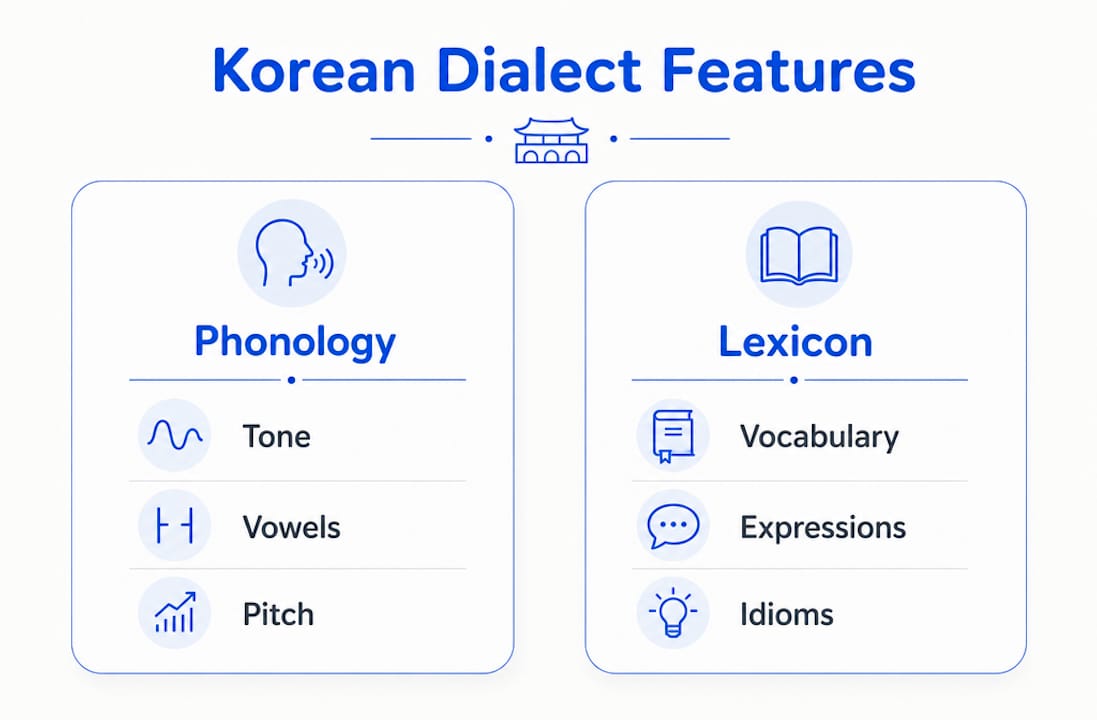
Korean dialect variation operates across four primary linguistic dimensions: phonology (sound systems), lexicon (vocabulary), prosody (rhythm and intonation), and morphosyntax (grammar and sentence structure). Most dialects share a common grammatical backbone, which means a speaker of Seoul Korean can generally follow a conversation in Jeolla or Chungcheong Korean. The real divergence shows up in how words sound, what words are chosen, and how sentences end.
Phonology: how sounds shift by region
The Gyeongsang dialect, spoken across the southeastern region including Busan and Daegu, features a tonal pitch accent system that no other mainland dialect preserves. Words change meaning based on whether a syllable is pronounced with a high or low tone, a feature inherited from Middle Korean. This is why Gyeongsang speech often sounds rhythmically distinct and is frequently described in Korean media as assertive or direct.
Jeolla dialects, spoken in the southwestern provinces, are known for their distinctive vowel coloring and sentence-final endings that differ noticeably from Seoul Korean. A Jeolla speaker might use endings like “~잉” or “~당께” where a Seoul speaker would use standard forms, giving the dialect an immediately recognizable musical quality. Chungcheong dialects, spoken in the central region, tend toward a slower, more drawn-out speech rhythm that Koreans often associate with a laid-back temperament.
Lexical variation: words that don’t cross regional lines
Vocabulary differences are real but often overstated as a barrier to comprehension. Regional Korean accents frequently substitute local terms for standard ones without blocking understanding. For example, the word for “older brother” (오빠 or 형) is standard across regions, but certain food names, household terms, and colloquial expressions vary enough to cause momentary confusion. Gangwon dialect, spoken in the mountainous northeast, preserves several archaic vocabulary items that have disappeared from Seoul Korean entirely.
Pro Tip: When watching Korean dramas or films set in Busan, listen specifically for the rising and falling tones on individual syllables. That pitch pattern is the clearest marker of Gyeongsang dialect and one of the fastest ways to train your ear for Korean dialect variation.
Is the Jeju dialect really a separate language?
The Jeju dialect occupies a category of its own. UNESCO designated Jeju critically endangered in 2010, and linguists widely treat it as a separate Koreanic language rather than a dialect of Korean. That distinction matters because Jeju is not mutually intelligible with mainland Korean dialects, meaning a Seoul Korean speaker cannot understand a fluent Jeju speaker without prior exposure or study.
“The Jeju language preserves phonological features of Middle Korean that disappeared from the mainland centuries ago, making it a living archive of the language’s history.” — Jeju language, Wikipedia
The linguistic reasons for this separation are concrete. Jeju preserves a nine-vowel system that includes Middle Korean phonemes lost in Seoul Korean since the 18th century. The vowel “아래아” (a mid-central vowel written with a dot below) survives in Jeju speech but has been absent from standard Korean for over two hundred years. Vocabulary divergence is equally striking, with Jeju terms for everyday objects bearing no resemblance to their mainland equivalents.
| Feature | Jeju language | Mainland Korean dialects |
|---|---|---|
| Mutual intelligibility with Seoul Korean | None | High to moderate |
| UNESCO status | Critically endangered | Not endangered |
| Vowel inventory | Nine vowels including archaic Middle Korean phonemes | Seven vowels (standard) |
| Vocabulary overlap with Seoul Korean | Low | High to moderate |
| Tonal system | Distinct | Varies by region |
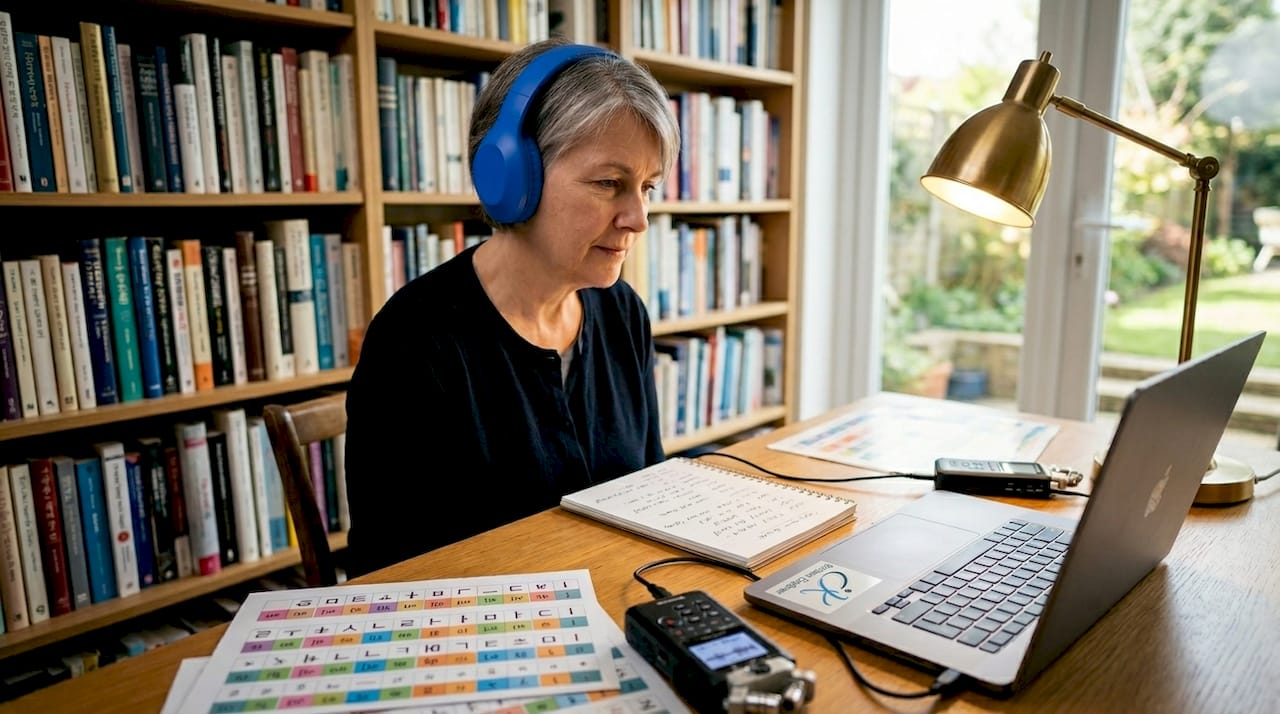
Documenting Jeju is an urgent task. Fieldwork with elderly speakers requires long recording sessions and deep local collaboration because fluent speakers are scarce and aging. Revitalization programs on Jeju Island now include community language classes and school programs, but the number of native speakers remains critically low. For cultural learners, Jeju represents the most dramatic proof that Korean language diversity extends well beyond regional accent.
How do North and South Korean dialects compare?
The Gyeonggi dialect, centered on Seoul, forms the prestige basis of South Korea’s standardized language. It is the dialect taught in schools, used in broadcasting, and expected in formal professional settings. North Korea’s standard language, called Munhwaeo, is based on the Pyongan dialect spoken in and around Pyongyang.
| Feature | South Korean standard (Gyeonggi-based) | North Korean standard (Pyongan-based) |
|---|---|---|
| Loanword source | English dominant | Russian and Chinese dominant |
| Orthographic rules | Allows certain loanword spellings | Stricter Koreanization of foreign terms |
| Phonological features | No pitch accent in standard | Some preserved phonological distinctions |
| Mutual intelligibility | Reference point | High, with vocabulary gaps |
| Media and cultural exposure | Global through K-pop and K-drama | Limited outside North Korea |
Political separation since 1945 has driven linguistic divergence between North and South, particularly in vocabulary. South Korean Korean has absorbed thousands of English loanwords: 컴퓨터 (keompyuteo) for computer, 핸드폰 (haendeupon) for mobile phone. North Korean Korean replaces many of these with Sino-Korean or Russian-derived terms. A North Korean defector arriving in Seoul will understand the grammar immediately but may find a significant portion of daily vocabulary unfamiliar. For a deeper look at how these two varieties diverge, the North-South dialect contrasts are worth studying in detail.
Despite these differences, mutual intelligibility remains high across the North-South divide. The shared grammatical structure and core vocabulary mean that communication is possible, even if vocabulary gaps create friction. This is fundamentally different from the Jeju situation, where intelligibility breaks down entirely.
How should learners approach Korean dialect differences?
Understanding Korean language diversity as a learner requires a clear strategy. Attempting to memorize dialect-specific vocabulary before mastering standard Korean is inefficient and can create confusion. The most effective approach follows a clear sequence.
Master standard Seoul Korean first. The Gyeonggi-based standard is the foundation for all further dialect comprehension. Every Korean language course, textbook, and media resource defaults to this variety. Build fluency here before exploring regional variation.
Focus on sentence-final endings. Dialect comprehension depends more on recognizing sentence-final endings and prosodic cues than on vocabulary substitution. Endings like “~잖아요,” “~거든요,” and their dialect equivalents carry enormous communicative weight. Learning to identify how these shift regionally will unlock far more comprehension than memorizing dialect word lists.
Train your ear with authentic media. Korean dramas set in Busan (such as Reply 1997) expose you to Gyeongsang pitch accent. Films from the Jeolla region carry southwestern intonation patterns. Variety shows often feature guests from different regions, giving you natural exposure to Chungcheong and Gangwon speech rhythms.
Use dialect features with caution in conversation. Adopting dialect features as a non-native speaker can come across as mocking or performative if done without cultural sensitivity. Understanding dialects is a listening and comprehension skill first. Production comes later, if at all, and only with genuine cultural grounding.
Explore pronunciation resources actively. Improving your ear for regional Korean accents accelerates both comprehension and cultural fluency simultaneously.
Pro Tip: Gyeongsang dialect exposure is particularly valuable for media comprehension because it appears frequently in Korean film and television. Even passive listening to Busan-accented speech trains your ear for pitch distinctions that make all Korean phonology clearer.
Understanding how Korean differs structurally from English also helps learners contextualize why dialects diverge the way they do, particularly around verb endings and sentence structure.
Key takeaways
Korean dialect differences are best understood through prosody and sentence-final endings rather than vocabulary alone, with Jeju standing apart as a critically endangered separate language.
| Point | Details |
|---|---|
| Seven major dialect groups | Gyeonggi, Gyeongsang, Jeolla, Chungcheong, Gangwon, North Korean, and Jeju each carry distinct features. |
| Jeju is a separate language | UNESCO classifies Jeju as critically endangered and it is not mutually intelligible with mainland Korean. |
| Pitch accent in Gyeongsang | Gyeongsang dialect uses high and low tones to distinguish word meaning, a feature absent in Seoul Korean. |
| North-South vocabulary gap | Political separation since 1945 created divergent loanword systems, with English dominant in the South and Russian or Chinese in the North. |
| Prosody over vocabulary | Learners gain more from mastering sentence-final endings and intonation patterns than from memorizing dialect-specific word lists. |
Why dialect awareness changed how I experience Korean culture
When I first started working seriously with Korean, I treated dialect variation as a footnote. Standard Seoul Korean was the goal, and everything else felt like noise. That view was wrong, and it took watching Parasite and then Reply 1997 back to back to understand why.
The Gyeongsang pitch accent in Reply 1997 does not just mark the characters as being from Busan. It carries an entire emotional register, a directness and warmth that Seoul Korean simply does not replicate. Once I started hearing that tonal quality as meaningful rather than just different, my comprehension of Korean media improved noticeably. The same happened when I encountered Jeolla speech patterns in older Korean films. The sentence-final endings sounded strange at first, then familiar, then expressive in ways I had not expected.
The Jeju situation is the one that stays with me most. The idea that a language preserving sounds from the 14th century is disappearing within a single generation is not an abstract linguistic concern. It is a genuine cultural loss. The fieldwork required to document Jeju is painstaking precisely because the knowledge lives in a small number of elderly speakers. That urgency should matter to anyone who cares about Korean culture, not just linguists.
My honest advice: do not wait until you are fluent in standard Korean to start paying attention to dialects. Exposure from the beginning builds a more flexible and culturally aware listener. Approach dialect differences with curiosity rather than frustration, and you will find that Korean language diversity is one of the most rewarding parts of the learning process.
— Paul
Start learning Korean with cultural depth at Korean Explorer
Korean Explorer offers adult Korean language courses in Singapore designed to build genuine communicative fluency, not just textbook proficiency. Courses cover conversational and business Korean, with native instructors who bring cultural context into every lesson, including awareness of how regional speech patterns appear in real-life Korean media and communication. Whether you prefer group classes, private sessions, or online Zoom learning, Korean Explorer has a format that fits your schedule and goals.
Explore Korean language courses for adults at Korean Explorer, or browse the full course catalog to find the right level for where you are now. Classes are held at International Plaza, 10 Anson Road, Level 22, Singapore 079903, right above Tanjong Pagar MRT, with additional centers in Jurong and Tampines.
FAQ
What are the main Korean dialect groups?
The seven major Korean dialect groups are Gyeonggi (Seoul), Gyeongsang, Jeolla, Chungcheong, Gangwon, North Korean varieties, and Jeju. Each group differs in phonology, vocabulary, and prosody, with Jeju classified as a separate language due to its lack of mutual intelligibility with mainland Korean.
Is Jeju Korean a dialect or a separate language?
UNESCO classifies Jeju as a critically endangered language, not a dialect, because it is not mutually intelligible with mainland Korean dialects. Jeju preserves archaic Middle Korean phonemes and vocabulary that disappeared from standard Korean centuries ago.
How different are North and South Korean dialects?
North and South Korean dialects remain largely mutually intelligible despite diverging since 1945. The primary differences lie in vocabulary, particularly loanwords: South Korean favors English-derived terms while North Korean uses Russian and Chinese-derived equivalents.
What is the Busan dialect known for?
The Busan dialect belongs to the Gyeongsang dialect group and is distinguished by a pitch accent system that uses high and low tones to differentiate word meanings. This tonal quality is frequently heard in Korean films and dramas set in southeastern Korea.
Should Korean learners study dialects alongside standard Korean?
Learners benefit most from mastering standard Seoul Korean first, then developing passive comprehension of major dialects through media exposure. Focusing on sentence-final endings and intonation patterns rather than dialect vocabulary gives the fastest comprehension gains.