TL;DR:
- Practicing speaking Korean is crucial because it develops real fluency by forcing learners to produce language actively. It involves different mental skills from listening and reading and requires deliberate, repeated practice to overcome speaking barriers. Prioritizing spoken language enhances cultural understanding, confidence, and independent communication in Korean contexts.
You can watch every Korean drama on Netflix, understand the lyrics to your favorite K-pop songs, and read Hangul with respectable speed. Yet the moment a native speaker asks you a simple question, your mind goes blank. This is the gap that makes understanding why focus on spoken korean so critical for serious learners. Spoken Korean is a distinct skill from listening and reading. It demands a completely different kind of mental work, and without deliberately targeting it, most adult learners stall at comprehension and never reach the fluency they want.
Table of Contents
- Key takeaways
- Why focus on spoken Korean when you already understand it
- What second-language research says about speaking practice
- What the data tells us about adult speaking proficiency
- How to build spoken Korean skills systematically
- The real-world benefits of prioritizing spoken Korean
- My take on why so many learners avoid speaking practice
- Start speaking Korean with structured support
- FAQ
Key takeaways
| Point | Details |
|---|---|
| Speaking is a separate skill | Understanding Korean does not automatically translate into the ability to produce it under real-time pressure. |
| Output drives learning | Producing spoken Korean forces you to notice gaps and build fluency that passive study cannot create. |
| Adults lag in speaking | Research shows speaking excellence sits at only 18.1%, far behind listening at 40.6%. |
| Daily short practice works | Repeating short, corrected spoken answers builds both accuracy and confidence faster than longer passive study sessions. |
| Speaking unlocks culture | Real-time spoken Korean opens social relationships and cultural understanding that reading and listening alone cannot provide. |
Why focus on spoken Korean when you already understand it
The short answer: understanding Korean and speaking it use entirely different cognitive machinery. When you listen or read, your brain has context to lean on. You hear the beginning of a sentence and can predict where it ends. You see a written word and have a moment to process it. Speaking strips all of that away.
Korean verb-final structure creates a particular challenge. In English, you state the subject and verb early, which commits you to the sentence direction quickly. In Korean, the verb comes at the end. You have to hold the entire sentence structure in working memory, select the right particles, and only then deliver the verb with the correct politeness ending. You must do all of this in real time, within the natural rhythm of conversation, while also thinking about what to say next.
Here are the specific bottlenecks adult learners run into most often:
- Particle selection under pressure. Choosing between 은/는 and 이/가 correctly feels manageable in written exercises but becomes genuinely difficult when you are mid-sentence and a native speaker is waiting.
- Politeness level hesitation. Korean has multiple speech levels. Deciding in real time which to use with a new acquaintance can freeze even intermediate learners.
- Pronunciation linking. Korean sounds shift when words connect in natural speech. Learners who study in isolation often produce correct individual syllables but stumble on flowing sentences.
- Retrieval speed. You may know a word passively but not be able to pull it up fast enough for a natural conversational pause.
Pro Tip: Build a list of ten sentences you genuinely use every day in English and translate them into Korean. Practice these until they come out automatically. You are not memorizing scripts. You are building a retrieval foundation.
What second-language research says about speaking practice
There is a strong scientific reason to prioritize speaking, not just a practical one. Linguist Merrill Swain developed the Output Hypothesis in the 1980s, and its core finding still shapes how language teachers work today. Her argument was that producing language forces learners to do something that listening and reading simply cannot: notice exactly where their knowledge breaks down.
When you consume input, your brain fills in gaps using context and prediction. You feel like you understand more than you actually control. The moment you try to speak, those gaps become visible. You reach for a word and discover you only recognize it, you cannot produce it. You try to form a sentence and realize you have never actually practiced putting that grammar pattern together yourself.
“Pushed output triggers conscious metalinguistic reflection. Learners are forced to think syntactically in ways that comprehensible input does not demand.” — Merrill Swain, Output Hypothesis
This process, called hypothesis testing, is what builds real fluency. You attempt a sentence, your listener responds or corrects you, and your brain updates its model of how Korean works. Pushed output — meaning speaking that stretches you slightly beyond your current comfort zone — produces more grammatical accuracy and faster automaticity than input-only study. Automaticity is what allows you to speak at normal conversation speed without consciously assembling every sentence from scratch.
This is why hours of Korean podcast listening can leave your speaking ability largely unchanged. Input builds comprehension. Output builds the speaking skill itself.
What the data tells us about adult speaking proficiency
The numbers on this topic are striking and worth sitting with. According to a 2023 to 2025 survey by South Korea’s National Institute of the Korean Language, one in five adults struggle significantly with speaking Korean for daily communication. The survey found that 19.9% of respondents scored low in speaking proficiency.
The gap between speaking and other skills is even more revealing. Look at how the excellence rates compare across skill areas:
| Skill | Excellence rate |
|---|---|
| Listening | 40.6% |
| Reading | 34.2% |
| Speaking | 18.1% |
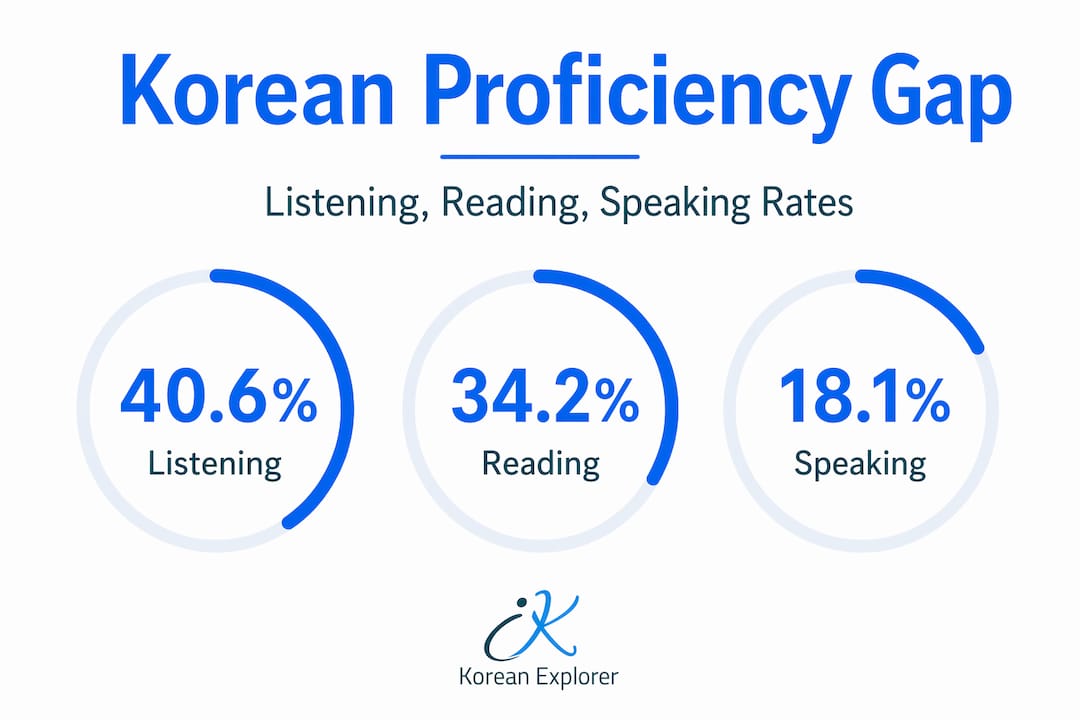
Speaking excellence is less than half the listening rate. That is not a small gap. It tells you that even people who are native or near-native in their listening comprehension have not automatically developed strong spoken ability.
Age adds another layer to this picture. Speaking excellence drops from 53.8% among people in their twenties to just 19.2% in those in their sixties. For adult learners picking up Korean later in life, this is a clear signal: spoken fluency requires deliberate, sustained practice. It does not come as a side effect of age, experience, or exposure alone.
If you are studying Korean as an adult, the evidence strongly suggests that speaking deserves your highest practice priority, not your leftover study time.
How to build spoken Korean skills systematically
Knowing that speaking matters is one thing. Knowing how to practice it effectively is another. These strategies close the gap between what you understand and what you can produce.
Start with short, repeatable answers. The goal in early spoken practice is not long conversations. It is accurate short responses delivered quickly. Take a question like “무슨 일 해요?” (What do you do for work?) and practice your answer until it comes out without hesitation. Then move to the next question.
Default to polite -요 endings. Korean learners often freeze trying to choose the correct formality level. Polite -요 endings work in almost every adult social situation. Make them your default and stop spending cognitive energy on this decision mid-sentence.
Practice in realistic contexts. Simulate real situations: ordering at a café, asking for directions, describing your weekend. These scenarios force you to pull vocabulary from realistic mental contexts, which is exactly what happens in actual conversation.
Use rapid feedback loops. Feedback from native speakers or qualified tutors is the fastest way to improve. You need someone to catch your errors in real time so you can correct them before they become habits. Language exchange partners, conversation classes, and AI speaking tools all serve this function.
Work on pronunciation linking specifically. Spoken Korean sounds very different from how it reads because of sound assimilation rules. Study resources on Korean pronunciation to understand why native speech sounds the way it does and practice linking sounds in connected speech.
Track one bottleneck at a time. Do not try to fix particle selection, pronunciation, and politeness levels simultaneously. Identify your single biggest speaking obstacle and focus your practice there for two to three weeks. Progress comes faster when it is targeted.
Pro Tip: Record yourself speaking for 60 seconds about your day, then listen back. Most learners are surprised by what they actually produce versus what they thought they said. This self-correction loop accelerates improvement significantly.
You can also find verbal exercises for Korean that make spoken practice more engaging if you find traditional drilling demotivating.
The real-world benefits of prioritizing spoken Korean
The advantages of spoken Korean skills reach well beyond passing a class or completing a textbook. Speaking is the gateway to actual human connection, and that is where the real rewards live.
Here is how prioritizing spoken Korean changes your experience:
- You can engage authentically with Korean culture. Speaking with locals, understanding humor in context, and responding naturally in social settings creates experiences that subtitles and translated text cannot replicate.
- Your confidence in daily situations grows. Navigating a restaurant, asking a shopkeeper for help, or striking up a conversation at a cultural event becomes something you do, not something you watch others do.
- You understand social cues and politeness norms from the inside. Reading about Korean honorifics is academic. Using them correctly in a real conversation, and having a native speaker respond naturally, is a completely different understanding.
- You build relationships that passive learners cannot. Korean social culture values effort in language enormously. Speaking Korean, even imperfectly, signals respect and genuine interest. That opens doors in both personal and professional settings.
| Passive learner | Active speaker |
|---|---|
| Understands Korean media | Participates in real conversation |
| Reads menus and signs | Orders, negotiates, and chats naturally |
| Knows politeness rules intellectually | Applies them correctly under social pressure |
| Relies on others to communicate | Operates independently in Korean-speaking environments |
The benefits of spoken Korean are cumulative. Each real conversation you have builds the next one. That momentum is what passive study never generates.

My take on why so many learners avoid speaking practice
I have worked with adult Korean learners long enough to see the same pattern repeat. They consume enormous amounts of input. They know grammar rules better than many native speakers can articulate them. They score well on written exercises. Then they sit in a real conversation and freeze, and they cannot understand why.
The reason is almost always the same. Speaking feels like being tested. Every pause feels like failure. So learners stay in the comfortable zone of input, where understanding feels like progress, and speaking practice gets deferred to “when I feel ready.”
The uncomfortable truth I have learned is this: you will never feel ready until you have already spoken a thousand imperfect sentences. The readiness does not come before the practice. It comes from the practice.
I have seen learners break through this barrier with small daily commitments. Not marathon study sessions. Just ten minutes of speaking practice every day, focused on one specific thing: ordering food, introducing themselves, describing a recent experience. The breakthroughs that follow are real. A learner who spent a year watching Korean content and understanding 70% of it starts having actual exchanges with native speakers within six weeks of daily speaking practice.
The gap between comprehension and production is real, but it is not permanent. What closes it is not more input. It is the willingness to speak badly until you speak well.
— Paul
Start speaking Korean with structured support
If this article has made you want to take your spoken Korean seriously, the next step is finding a learning environment that makes speaking practice central, not occasional.
Korean Explorer’s adult Korean courses in Singapore are built around exactly this priority. Conversation-focused classes taught by native Korean instructors give you the real-time feedback and structured progression that self-study rarely provides. Whether you prefer group classes, one-on-one sessions, or live online Zoom lessons from anywhere, Korean Explorer offers flexible formats designed for working adults. Explore Korean courses tailored to your level, or check out the full range of Korean language course options to find the right fit. Classes are available at International Plaza above Tanjong Pagar MRT, as well as in Jurong and Tampines.
FAQ
Why is spoken Korean harder than reading or listening?
Speaking removes the contextual supports that listening and reading provide. You must retrieve vocabulary, assemble grammar, select politeness endings, and produce accurate pronunciation all at once, in real time, with no pause to think.
How does speaking practice improve Korean fluency faster?
Merrill Swain’s Output Hypothesis shows that producing language forces learners to notice gaps in their knowledge, test grammar hypotheses, and build the automaticity needed for natural conversation speed.
What percentage of adults struggle with speaking Korean?
According to a national survey, 19.9% of adults scored low in speaking proficiency, and the speaking excellence rate of 18.1% is less than half the listening excellence rate of 40.6%.
What is the best way to start practicing spoken Korean daily?
Start with short, repeatable answers to common questions, default to polite -요 endings to reduce decision fatigue, and get feedback from a native speaker or qualified tutor as quickly as possible.
Does age affect spoken Korean proficiency?
Yes. Speaking excellence drops sharply from 53.8% in people in their twenties to 19.2% in those in their sixties, making consistent, deliberate speaking practice especially important for adult learners.