TL;DR:
- Learning Hangul enables rapid acquisition of basic Korean reading and writing skills. Mastering stroke order, syllable block construction, and consistent practice with appropriate tools accelerates progress. Early focus on fundamentals prevents common mistakes and builds a strong foundation for real-world reading and communication.
Writing in the Korean language means mastering Hangul, the phonetic Korean alphabet consisting of 24 basic letters arranged into compact syllable blocks. Unlike Chinese or Japanese, Hangul was deliberately designed for fast acquisition. King Sejong the Great created it in 1443 specifically so ordinary people could learn to read and write with minimal effort. The result is a system where dedicated learners can go from zero to reading and writing basic Korean in a single weekend. This guide walks you through the structure of Hangul, practical handwriting techniques, the best tools for practice, and the most common obstacles you will face along the way.
What is the Korean writing system and how does it work?
Hangul is the official writing system of both South Korea and North Korea, and it is one of the most logically designed alphabets in the world. A common misconception is that Korean uses thousands of complex characters the way Chinese does. Modern Korean writing relies almost entirely on Hangul’s simple alphabet, making it far more accessible than most learners expect.
The 14 consonants and 10 vowels
Hangul’s 24 basic letters divide into 14 consonants and 10 vowels. The consonants include letters like ㄱ (g/k), ㄴ (n), ㄷ (d/t), ㄹ (r/l), and ㅁ (m). The vowels include ㅏ (a), ㅓ (eo), ㅗ (o), ㅜ (u), and ㅣ (i). What makes Hangul particularly clever is that the shapes of the letters reflect the physical position of your mouth and tongue when producing each sound. Learning the letters is not pure memorization. There is visual logic built into the system.
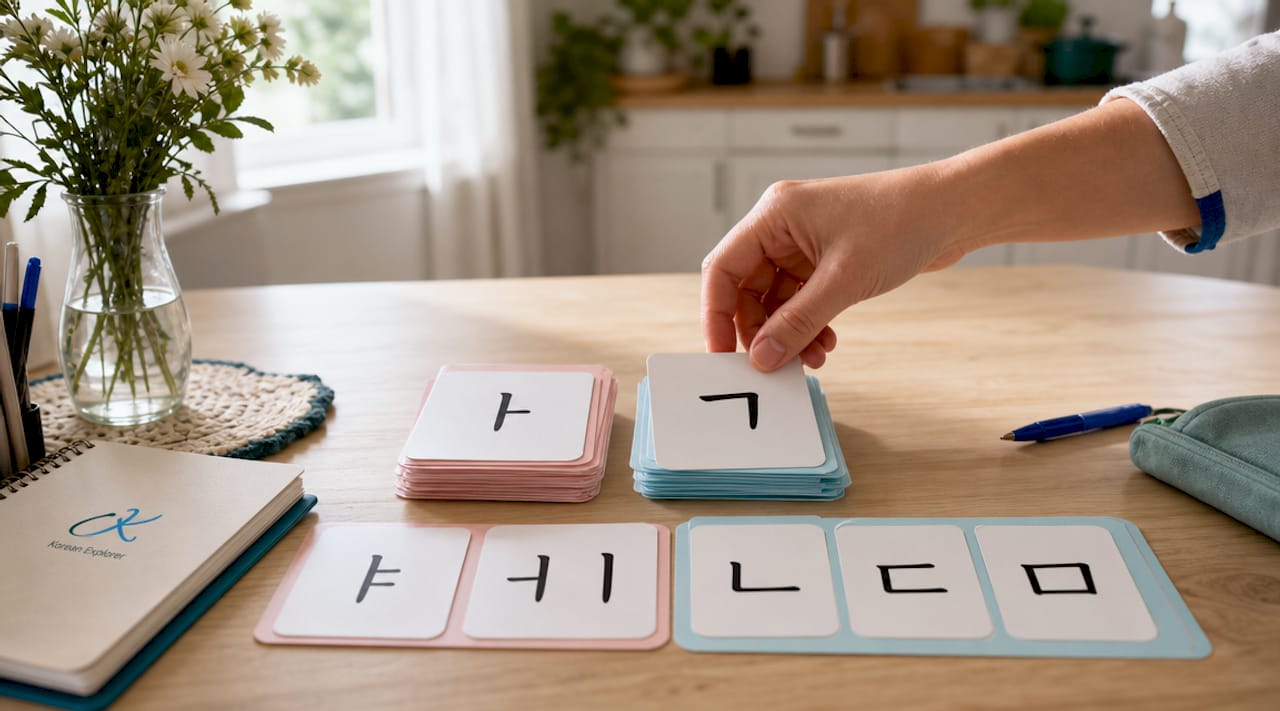
When you go deeper, those 24 letters expand to 40 once you include doubled consonants (like ㄲ and ㄸ) and compound vowels (like ㅐ and ㅔ). This expanded set covers every sound in the Korean phonetic inventory. You do not need to master all 40 on day one, but knowing they exist prevents confusion when you encounter them in real text.
How syllable blocks are constructed
Korean hangul writing does not place letters in a horizontal line the way English does. Instead, letters are grouped into square syllable blocks, each representing one syllable. Every block contains two to four letters arranged in a specific pattern. The structure always follows this order: an initial consonant (초성, choseong), a vowel (중성, jungseong), and an optional final consonant called batchim (받침, jongseong).
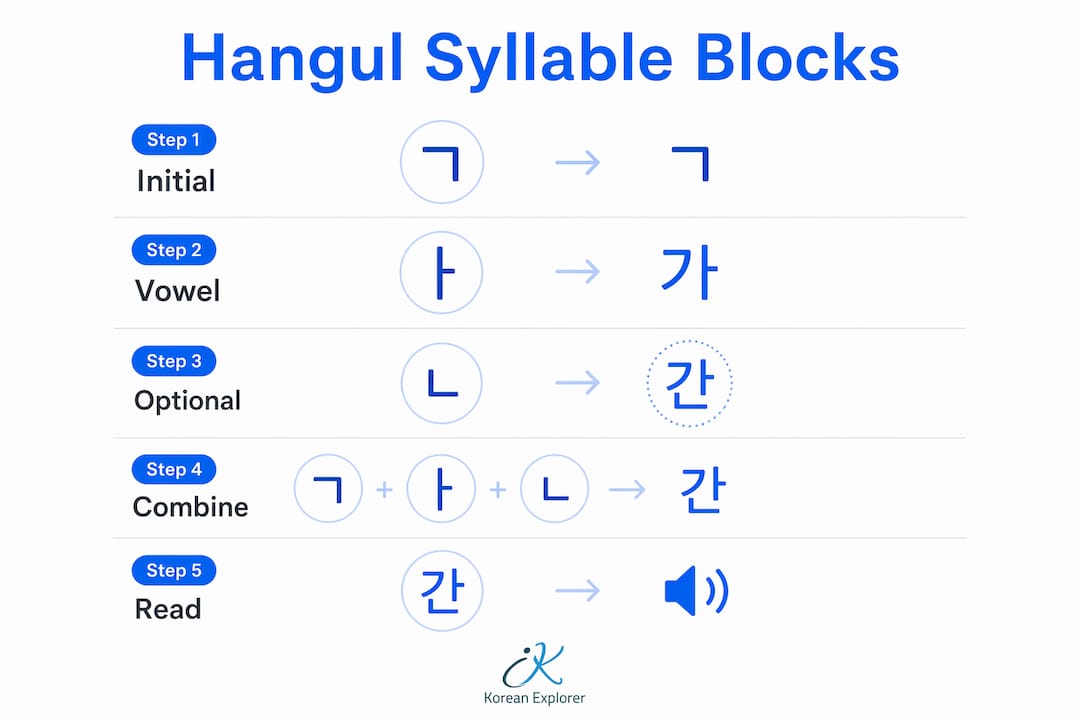
The silent consonant ㅇ plays a special role here. When a syllable begins with a vowel sound, ㅇ acts as a placeholder in the initial consonant position. It carries no sound at the start of a syllable but represents the “ng” sound when it appears as a batchim at the end. For example, the word 아이 (ai, meaning “child”) uses ㅇ as a silent placeholder in both syllable blocks.
Here is how three common syllable blocks break down:
| Syllable | Initial consonant | Vowel | Batchim | Meaning |
|---|---|---|---|---|
| 한 | ㅎ (h) | ㅏ (a) | ㄴ (n) | Korean (as in Hangul) |
| 글 | ㄱ (g) | ㅡ (eu) | ㄹ (l) | Writing/script |
| 아 | ㅇ (silent) | ㅏ (a) | none | Ah / child (part of) |
Understanding this block structure is the single most important concept in basic Korean writing. Once you see how letters stack and combine, reading and writing new words becomes a process of assembly rather than memorization.
How to write Korean letters by hand
Correct handwriting in Korean depends on following a consistent stroke order. The rule is straightforward: strokes go top to bottom and left to right. This applies both within individual letters and across the components of a syllable block. Consistent stroke order is not just about neatness. It directly affects legibility and your ability to recognize Korean letters across different fonts and handwriting styles.
Follow these steps when writing any syllable block by hand:
- Write the initial consonant first. Position it in the upper-left area of the block. Apply top-to-bottom, left-to-right strokes within the letter itself.
- Add the vowel next. Vertical vowels (like ㅏ and ㅣ) sit to the right of the consonant. Horizontal vowels (like ㅗ and ㅜ) sit below the consonant.
- Add the batchim last. If the syllable has a final consonant, write it at the bottom of the block, beneath the vowel.
- Keep the block square. Each component should share roughly equal visual weight. Avoid making one letter dominate the block.
- Practice one letter at a time before combining. Drill each consonant and vowel in isolation before assembling full syllable blocks.
Korean writing paper with grid lines is the most effective physical tool for this stage. The grids help you maintain uniform letter size and consistent spacing between blocks, which are two of the most common problems for beginners. Without a grid, letters tend to drift in size and proportion, making handwriting harder to read.
Pro Tip: Write each new syllable block at least 20 times in a single session before moving on. Muscle memory builds faster through concentrated repetition than through scattered daily practice.
Learning to write Korean letters also reinforces pronunciation. Hangul’s featural design connects letter shapes to mouth positions, so handwriting practice and speaking practice naturally support each other. Writing the letter ㅁ while saying “m” out loud is more effective than studying either skill in isolation.
What tools and resources support Korean writing practice?
The right materials accelerate progress significantly. Here is a breakdown of the most useful tools for different stages of learning:
Korean writing paper (manuscript grid paper) is the starting point for any serious handwriting practice. The grid structure maintains letter size and spacing, which is critical when you are still building muscle memory. You can find printable versions online for free or purchase dedicated notebooks.
Printed workbooks offer structured progression. Most quality Korean writing workbooks run over 100 pages and cost between $6.59 and $9.99. Many include audio components via QR codes, allowing you to hear the correct pronunciation of each letter and word as you write it. This combination of auditory and kinesthetic practice is more effective than writing alone.
Digital apps like Naver Dictionary, Duolingo, and Drops offer typing and recognition practice. Typing Korean words on a Korean keyboard layout (available on any smartphone or computer) builds familiarity with letter positions and reinforces the syllable block logic in a different modality. Switching between handwriting and typing prevents over-reliance on either format.
| Tool type | Best for | Cost range |
|---|---|---|
| Korean writing paper (grid) | Handwriting consistency and letter sizing | Free to $5 |
| Printed workbooks | Structured stroke order and vocabulary building | $6.59 to $9.99 |
| Digital apps (Naver, Drops) | Letter recognition and typing practice | Free to $10/month |
| Online video tutorials | Stroke order demonstrations and pronunciation | Free |
For learners who want efficient Hangul learning strategies, balancing handwriting with reading practice from day one produces faster overall progress. Writing a word you cannot yet read provides limited benefit. Pair every writing session with at least five minutes of reading the same vocabulary aloud.
Common challenges when writing in Korean and how to overcome them
Most learners hit the same set of obstacles. Knowing them in advance means you can address them before they become habits.
Overreliance on romanization is the most damaging mistake beginners make. Romanization systems like Revised Romanization of Korean translate Korean sounds into English letters, which feels helpful at first. The problem is that Korean pronunciation rules cause consonants to soften or harden depending on their position, and these shifts are acquired more naturally through listening than through studying romanized text. Romanization creates a false ceiling. Drop it as soon as you can read Hangul at even a basic level.
Batchim confusion trips up nearly every beginner. The batchim is the final consonant at the bottom of a syllable block, and it follows consistent pronunciation and spelling rules that prevent you from having to memorize thousands of individual syllables. The key insight is that only a specific set of sounds are allowed as batchim. Once you learn that short list, you can construct and read new syllables dynamically rather than memorizing each one as a fixed unit.
Stroke order errors create legibility problems that compound over time. A letter written with incorrect stroke order looks subtly wrong to native readers and becomes harder to recognize in different fonts. The fix is simple: use a Korean writing tutorial that demonstrates stroke order visually before you practice independently.
Failing to read aloud while writing slows acquisition. The connection between the written form and the spoken sound is what makes Hangul so efficient. Every time you write a syllable block, say it out loud. This dual-channel reinforcement builds recognition speed far faster than silent writing practice.
Pro Tip: Cover what you have just written and try to reproduce it from memory after each practice row. This retrieval practice forces your brain to consolidate the letter forms rather than just copying them passively.
Key takeaways
Mastering writing in the Korean language requires learning Hangul’s 24 letters, understanding syllable block construction, and practicing consistently with the right tools from the start.
| Point | Details |
|---|---|
| Hangul has 24 core letters | 14 consonants and 10 vowels combine into syllable blocks of 2 to 4 letters each. |
| Stroke order determines legibility | Always write top to bottom and left to right, placing initial consonant, vowel, then batchim in sequence. |
| Korean writing paper accelerates progress | Grid manuscript paper maintains uniform letter size and spacing during handwriting practice. |
| Batchim follows predictable rules | A fixed set of allowed final consonant sounds means you can construct new syllables without memorizing each one. |
| Drop romanization early | Relying on romanized text limits pronunciation accuracy and slows reading fluency. |
Why Hangul surprised me as a writing system
When I first started working with Korean learners, I expected Hangul to be the easy part and grammar to be the hard part. That assumption was half right. Hangul’s letter set is genuinely fast to learn. Most adults with no prior Korean exposure can read basic syllables within two or three focused sessions. What surprised me was how many learners stall at the handwriting stage, not because the letters are difficult, but because they skip the grid paper and stroke order fundamentals and try to write freehand too soon.
The learners who progress fastest share one habit: they treat the first two weeks as pure mechanics. They write slowly, use grid paper, say every syllable aloud, and do not rush into vocabulary building until their letter formation is automatic. The learners who struggle tend to jump straight into K-pop lyrics or drama subtitles before their hands know the letters. The cultural motivation is real and valuable. But it works better as a reward for solid fundamentals than as a substitute for them.
One more thing worth saying: Korean street signs, menus, and product packaging are among the best free practice materials available. Once you can read Hangul at a basic level, the real world becomes a reading exercise. Learners in Singapore who visit Korean restaurants or grocery stores at places like Tanjong Pagar Plaza are surrounded by authentic Korean text. Use it. The gap between workbook practice and real-world reading closes faster than most people expect.
— Paul
Start writing Korean with structured guidance from Korean Explorer
Korean Explorer offers adult Korean language courses in Singapore designed for learners who want to build real writing and conversational skills from the ground up. Classes are taught by native Korean instructors fluent in both Korean and English, covering Hangul writing, syllable block construction, and practical vocabulary in a structured format. Whether you prefer group classes, private sessions, or online Zoom lessons, there is a format that fits your schedule. Korean Explorer’s centers are located above Tanjong Pagar MRT at 10 Anson Road, Level 22, International Plaza, with additional locations in Jurong and Tampines. Explore Korean courses for adults at all levels and take the first step toward writing and speaking Korean with confidence.
FAQ
How long does it take to learn to write in Korean?
Most dedicated learners can read and write basic Hangul within a few hours to a weekend of focused practice. Full writing fluency, including batchim rules and vocabulary, develops over several weeks of consistent daily effort.
What is the best way to practice writing Korean letters?
Use Korean writing paper with grid lines to maintain consistent letter size and spacing, follow correct stroke order (top to bottom, left to right), and say each syllable aloud as you write it. Pairing handwriting with reading practice produces the fastest results.
Do I need to learn stroke order for Hangul?
Stroke order matters for legibility and for recognizing Korean letters across different fonts and handwriting styles. Incorrect stroke order creates letters that look subtly wrong to native readers and become harder to identify in varied contexts.
What is batchim in Korean writing?
Batchim is the final consonant placed at the bottom of a Korean syllable block. It follows consistent pronunciation rules and only a specific set of sounds are allowed, which means you can construct new syllables dynamically without memorizing each one individually.
Can I learn Korean writing without a class?
Yes, the Hangul alphabet guide and self-study workbooks provide a solid foundation for independent learners. Structured classes accelerate progress by providing immediate feedback on stroke order, pronunciation, and syllable construction from an experienced instructor.