TL;DR:
- The best alternatives for adult Korean learners in Singapore include Korean Explorer for structured classes and corporate training, and marketplaces like italki and Preply for flexible private lessons. Structured providers offer curriculum-based progress with verified instructors, while marketplaces provide scheduling flexibility but require self-managed progression. Choosing the right option depends on your learning goals, schedule flexibility, and preference for in-person or online study.
The best alternatives to fass.nus.edu.sg for adult Korean language learners in Singapore are Korean Explorer, italki, Preply, Lingoda, and Berlitz. Here is the one-line case for each:
- Korean Explorer — in-person Singapore centre plus online Zoom, best for structured adult group classes, private lessons, and corporate training
- italki — one-on-one tutor marketplace, best for flexible private lessons on irregular schedules
- Preply — online marketplace with packaged lesson bundles, best for learners who want private-lesson pathways without a local school commitment
- Lingoda — subscription-based small-group online classes with a fixed curriculum, best for learners who need classroom rhythm and steady progression
- Berlitz — global brand with in-person centres and online options, best for corporate clients and professionals needing enterprise-level training
Two quick trust checks before you shortlist anyone: confirm the provider offers a trial or sample lesson, and verify that pricing is listed transparently on their website. Frameworks like CEFR (Common European Framework of Reference for Languages) and ACTFL (American Council on the Teaching of Foreign Languages) give you a shared vocabulary for comparing level claims across providers.
Table of Contents
- How do these providers compare at a glance?
- Why Korean Explorer stands out as a local alternative
- What italki offers for flexible Korean learning
- How Preply works for Korean learners
- What Lingoda offers for structured online Korean classes
- What Berlitz brings to the table for adult learners
- How do you choose the right provider for your goals?
- Why Korean Explorer is a verifiable, trustworthy choice
- Key Takeaways
- The honest case for choosing local over global
- Ready to try a Korean Explorer class?
- Useful sources and where to verify provider details
- FAQ
How do these providers compare at a glance?
The table below covers the key decision dimensions so you can scan and shortlist before reading the full profiles.
| Provider | Best for / Learner goal | Delivery mode | Course formats | Price range (varies by provider and package) | Teacher type | Trial / sample lesson | Available in US |
|---|---|---|---|---|---|---|---|
| Korean Explorer | Structured adult classes, corporate training | In-person (Singapore) + online Zoom | Group, private, corporate | Mid-range packages | Bilingual native Korean instructors | Available | Yes (online) |
| italki | Flexible 1:1 private lessons | Online | Private (1:1) | Low to mid per-lesson | Marketplace tutors (range of experience) | Trial lesson option | Yes |
| Preply | Private-lesson pathways, multi-lesson bundles | Online | Private (1:1), some group | Mid per-lesson / package | Marketplace tutors with platform vetting | Trial lesson available | Yes |
| Lingoda | Curriculum-led steady progression | Online | Small group, private | Mid subscription / block | Certified teachers | Free trial class | Yes |
| Berlitz | Corporate training, enterprise contracts | In-person + online (hybrid) | Group, private, corporate | Mid to high packages | Trained instructors (Berlitz method) | Varies by centre | Yes |
Adult learners in Singapore consistently prioritize flexible evening schedules, recorded lesson access, and bilingual instructor support so that learning fits around work commitments. Marketplaces like italki and Preply win on scheduling freedom; structured providers like Korean Explorer and Lingoda win on curriculum consistency.
Why Korean Explorer stands out as a local alternative
Korean Explorer runs group, private, and corporate Korean courses from its centre at 10 Anson Road, Level 22, International Plaza, Singapore 079903 (right above Tanjong Pagar MRT), and mirrors the same classes live via Zoom for learners who prefer to study from home.
Core features at a glance:
- Structured curriculum built on a Seoul National University framework, aligned with internationally recognized proficiency standards
- Bilingual native Korean instructors fluent in both Korean and English, so explanations land clearly without translation guesswork
- Recorded class access, which lets working adults revisit lessons for spaced repetition rather than cramming before the next session
- Corporate training programs for teams, including conversational Korean and business communication tracks
- Course progression from beginner through intermediate levels, with documented outcomes at each stage
Pros:
- Local physical presence means you can walk in, meet instructors, and assess the environment before committing
- Bilingual support removes the friction that pure-immersion classes create for adult beginners
- Corporate training capability is rare among local language schools
Cons:
- Class schedules are fixed, so if your calendar shifts week to week, you may miss sessions
- Seat availability in popular group classes can fill quickly during peak enrolment periods
Who it’s for: Working professionals who want structured, goal-oriented Korean for conversation or business use; corporate teams needing group training; and learners who want the accountability of a real classroom without giving up the option to join online.
Korean Explorer’s bilingual native instructors and structured curriculum make it one of the few Singapore-based providers where adult learners can progress from zero to conversational Korean with consistent, measurable milestones — whether they attend in person or via Zoom.
Pricing shape: Korean Explorer charges per course block rather than per individual lesson, which typically works out more economically for learners who commit to a full course. Trial and sample lesson options are available — confirm the current policy directly on the Korean classes page.
Pro Tip: Before your first class, ask to see the course syllabus and confirm that recorded lessons are included. Recorded access is the single biggest quality-of-life factor for working adults who travel or work late.
What italki offers for flexible Korean learning
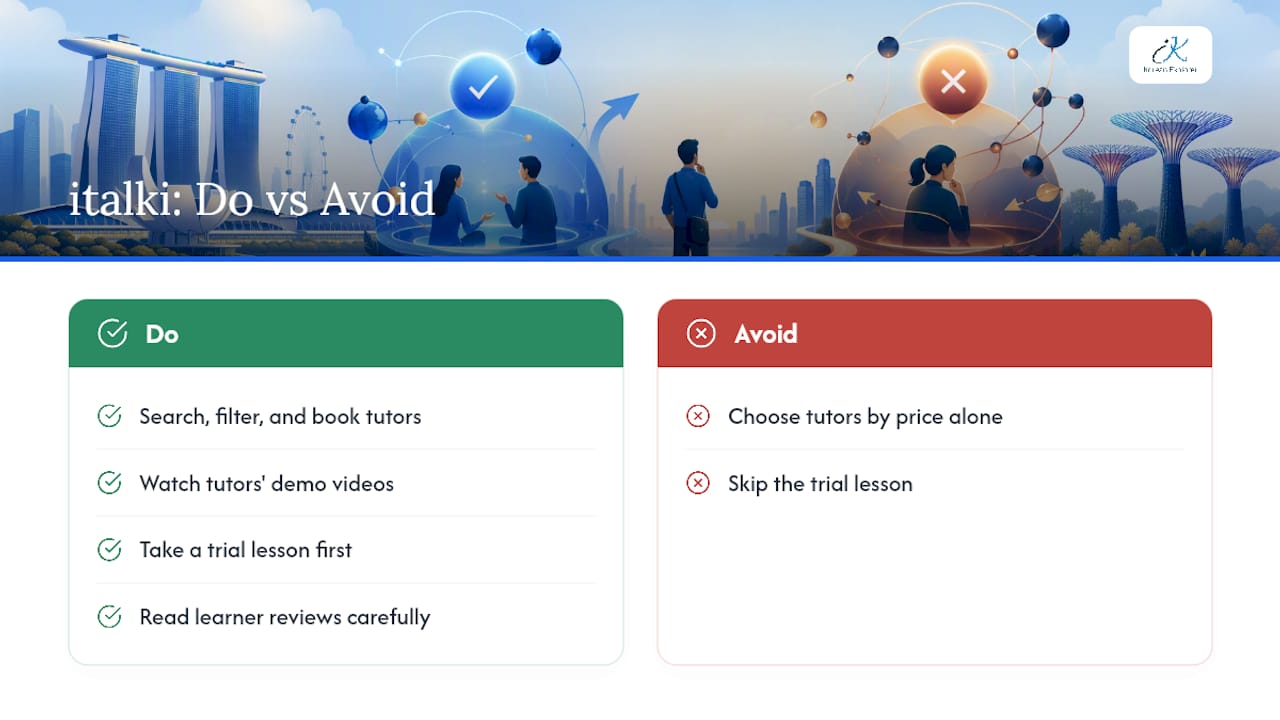
italki is a global tutor marketplace where you search, filter, and book individual Korean tutors for one-on-one lessons entirely online. You pay per lesson or in small credit bundles, and you schedule around your own calendar rather than a school’s timetable.
The platform’s search filters let you sort tutors by price, teaching style (professional teacher vs community tutor), availability, and learner reviews. Most tutors post demo videos on their profiles, so you can hear their teaching style and accent before booking. Trial lessons are a standard feature — usually offered at a reduced rate for a first session.
Who it suits: Self-directed adults who need maximum scheduling flexibility, learners who want late-evening or weekend slots that local schools don’t offer, and anyone who wants to focus narrowly on one skill (pronunciation, conversation, business vocabulary) rather than follow a fixed curriculum.
Pricing shape: Rates vary widely across the marketplace. Community tutors tend to sit at the lower end of the hourly range; professional teachers with formal credentials command higher rates. You pay per lesson, so there is no long-term commitment, but that also means no curriculum continuity unless you build it yourself.
Real-world use case: A professional preparing for a Korean business trip books three conversation sessions in the two weeks before departure, focusing entirely on meeting etiquette and small talk. No course enrollment, no waiting for the next cohort.
The tradeoff is real: tutor quality on any open marketplace varies, and a learner who picks based on price alone can end up with inconsistent instruction. Reading reviews carefully and using the trial lesson before committing to a package is non-negotiable.
How Preply works for Korean learners
Preply operates on a similar marketplace model to italki but leans harder into multi-lesson packages and a more curated tutor discovery experience. The platform handles payments, scheduling, and messaging in one place, and it surfaces tutors based on your stated goals and level.
Key features:
- Tutor profiles include ratings, reviews, and video introductions
- Lesson packages encourage multi-session commitments, which creates more continuity than single-lesson booking
- In-platform messaging lets you communicate with a tutor before booking
- Trial lessons are available, typically at a reduced introductory rate
Pros: Buying a lesson bundle is straightforward, and the platform’s interface makes it easy to find tutors who specialize in business Korean or conversational practice. The review system gives you more signal than a cold search.
Cons: Tutor qualifications still vary. “Certified” on a marketplace profile does not always mean the same thing as a formally trained instructor at a structured school. And if your tutor leaves the platform, you lose continuity.
Who it’s for: Learners who want private-lesson pathways but aren’t ready to commit to a local school’s schedule. Also useful for someone who has completed a group course and wants targeted one-on-one follow-up.
Pricing shape: Preply tutors set their own rates, so the range is broad. Package pricing per lesson tends to be slightly lower than single-lesson rates. Expect mid-range hourly equivalents for tutors with strong reviews and relevant experience.
Real-world use case: A marketing manager preparing for a presentation to a Korean client books a five-session package focused on formal speech levels and industry vocabulary — structured enough to make progress, flexible enough to fit a packed calendar.
What Lingoda offers for structured online Korean classes
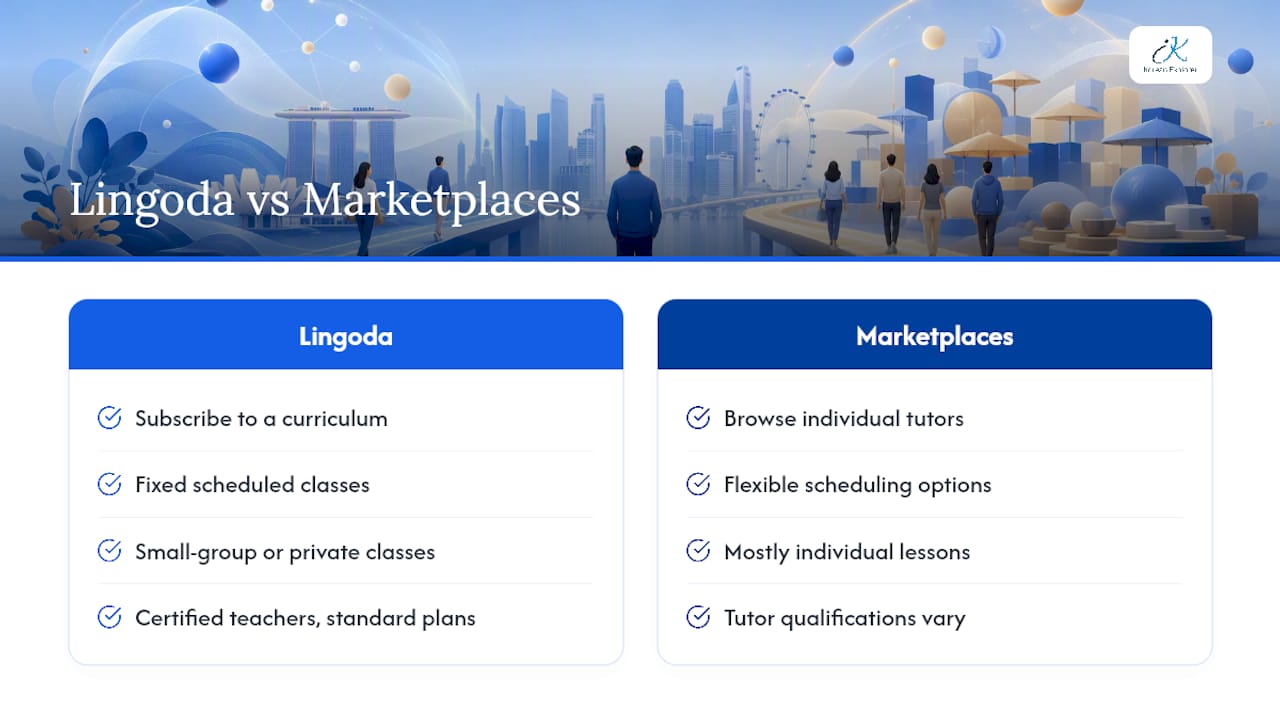
Lingoda takes a different approach from the marketplaces. Instead of browsing individual tutors, you subscribe to a curriculum and attend scheduled small-group or private classes taught by certified teachers. The structure is closer to a language school than a tutor platform.
Classes run on a fixed schedule, and the curriculum progresses level by level. Groups are kept small, which means more speaking time per student than a large lecture class. Teachers follow a standardized lesson plan, so if you miss a session and join a different class at the same level, the material is consistent.
Who it’s for: Learners who thrive with external accountability — a set class time, a teacher who notices when you’re absent, and a curriculum that moves forward whether you feel ready or not. It suits working professionals who can carve out a recurring weekly slot and want to feel the momentum of a real course.
Pricing shape: Lingoda uses subscription or block-booking models. A monthly subscription covering a set number of classes per week works out to a per-class rate that is competitive with mid-range marketplace tutors, especially for group sessions. Private classes cost more.
Pros: Consistent curriculum, certified teachers, and the accountability of a real schedule. You know exactly what level you’ll reach after a given number of weeks.
Cons: Less flexibility than a marketplace. If your schedule is unpredictable, you’ll miss classes and lose value from a subscription. Group formats also mean less individual attention per session than a private lesson.
Real-world use case: A professional with a standing Tuesday evening free slot books a Lingoda subscription and works through beginner-to-intermediate Korean over four months, attending the same weekly class consistently.
What Berlitz brings to the table for adult learners
Berlitz has operated language training centers globally for well over a century, and its Korean programs follow the same instructor-led, immersive methodology the brand is known for. In-person centers exist in multiple markets, and online lessons are available for learners who can’t attend in person.
The Berlitz method emphasizes speaking from the first lesson, with instructors trained to minimize translation and push learners into active production early. Corporate training is a core part of the business, and Berlitz has structured packages for companies that need to train teams at scale.
Who it’s for: Corporate clients and professionals whose companies are sponsoring the training, or individuals who want a globally recognized brand with a documented methodology. Berlitz is a natural fit when a company needs to run the same program across offices in multiple countries.
Pricing shape: Berlitz sits at the mid-to-high end of the market. Individual class packages cost more than most marketplace options, and corporate contracts are priced accordingly. The brand premium reflects the standardized instructor training and center infrastructure.
Pros: Reliable corporate packages, globally consistent materials, and in-person availability in many markets. The brand’s longevity means its methodology has been tested across millions of learners.
Cons: Higher cost than marketplaces or local schools for individual learners. Less flexibility in scheduling than a tutor platform.
Real-world use case: A multinational company rolls out conversational Korean training for its Singapore-based team ahead of a joint venture with a Korean partner, using Berlitz’s corporate program to standardize the training across departments.
How do you choose the right provider for your goals?
Start with your goal, not the provider. The right answer for a professional who needs business Korean in six weeks looks nothing like the right answer for someone who wants to learn casually over a year.
Map your goal to a provider category:
- Conversational fluency for personal use → local structured school (Korean Explorer) or subscription platform (Lingoda)
- Flexible private practice around a busy schedule → marketplace (italki or Preply)
- Corporate team training → local school with corporate programs (Korean Explorer) or global brand (Berlitz)
- Rapid targeted prep (presentation, trip, interview) → private tutor via marketplace
Questions to ask every provider before you pay:
- Do you offer a trial or sample lesson, and what does it cost?
- Can I see instructor bios, qualifications, and a demo video before booking?
- What is your refund or satisfaction policy if the first few lessons don’t work out?
- How flexible is the schedule — can I reschedule or make up a missed class?
- What is the class size for group sessions?
- Are lessons recorded, and how long do I have access to recordings?
- What learning materials are included, and do I need to buy anything separately?
Red flags to watch:
- No pricing listed on the website — opaque pricing almost always means a high-pressure sales call
- No trial lesson or sample class offered
- Instructor bios are missing, generic, or unverifiable
- Reviews are absent or suspiciously uniform
- No clear refund policy stated before purchase
Cost and timeline expectations: Reaching conversational confidence in Korean typically requires consistent study over several months. Weekly group classes build vocabulary and grammar steadily but take longer to produce fluent conversation than intensive private lessons. If you have a deadline (a trip, a presentation, a job requirement), private lessons two to three times a week will compress the timeline significantly. Combining instructor-led Zoom lessons with self-study and recorded lesson review is one of the most effective approaches for busy adults.
Decision steps:
- Shortlist providers by delivery mode (in-person, online, or hybrid) and whether their schedule fits yours
- Verify that a trial lesson and instructor demo are available before you commit money
- Compare transparent pricing and confirm the refund or cancellation terms in writing
- Book the trial, evaluate the instructor and materials, then decide
Pro Tip: Book trial lessons with two providers in the same week. The contrast makes the right choice obvious in a way that reading reviews alone never does.
Why Korean Explorer is a verifiable, trustworthy choice
Korean Explorer’s course pages describe a curriculum built on a Seoul National University framework, taught by bilingual native Korean instructors. Those are specific, verifiable claims — not marketing language you have to take on faith.
Korean Explorer’s instructors are native Korean speakers fluent in English, enabling them to explain grammar and cultural nuance in a way that pure-immersion teaching cannot. That bilingual capability is the practical differentiator for adult learners who are starting from zero or navigating business-level formality for the first time.
Verification steps you can take right now:
- Check instructor bios on the course pages and confirm they list native-speaker credentials and teaching experience
- Request a sample lesson or trial class and use it to evaluate teaching clarity, not just friendliness
- Ask whether recorded lesson access is included and confirm the access period
- Confirm the physical centre address: 10 Anson Road, Level 22, International Plaza, Singapore 079903
- Ask for references or case studies from corporate training clients if you are evaluating a team program
Trust signals to look for: transparent pricing on the website, student reviews with specific detail (not just star ratings), a stated trial or refund policy, and documented corporate training references. Korean Explorer’s private tutoring page also outlines personalized learning paths for adults who want one-on-one instruction rather than group classes.
Key Takeaways
For adult learners in Singapore, the strongest alternatives to fass.nus.edu.sg are Korean Explorer for structured local or online classes, italki and Preply for flexible private lessons, Lingoda for curriculum-led online courses, and Berlitz for corporate training.
| Point | Details |
|---|---|
| Match provider to goal | Structured schools suit corporate and conversational goals; marketplaces suit flexible private practice. |
| Always trial first | Book a sample lesson with at least two providers before committing to a full course or package. |
| Verify trust signals | Confirm instructor bios, transparent pricing, and a stated refund policy before paying. |
| Timeline shapes format | Private lessons two to three times a week compress progress faster than weekly group classes alone. |
| Korean Explorer | Offers in-person and Zoom classes with bilingual native instructors and corporate training in Singapore. |
The honest case for choosing local over global
Most comparison articles on this topic treat every provider as equally valid for every learner, which is not useful advice. Here is a sharper take.
Marketplaces like italki and Preply are genuinely excellent for one thing: flexibility. If your schedule is unpredictable or you want to drill one specific skill with a tutor who specializes in it, a marketplace is the right tool. But flexibility comes at a cost that rarely gets mentioned: curriculum continuity is entirely your responsibility. You have to build the progression yourself, vet the tutor yourself, and notice when you’ve plateaued. Most adult learners, especially those with full-time jobs, don’t have the bandwidth to manage that on top of actually learning.
Structured providers — Korean Explorer, Lingoda, Berlitz — take that management burden off your plate. The curriculum is built. The progression is tracked. The instructor knows what you covered last week. For working professionals who want to reach a real communication threshold (not just “I can order food”), that structure is what actually produces results.
The honest limit of Korean Explorer’s offering is the same as any school: fixed schedules mean missed classes if your calendar is chaotic. But for learners who can commit to a recurring slot, the combination of bilingual native instructors, recorded lesson access, and a structured curriculum is hard to replicate on a marketplace. Try a sample lesson before you decide — the difference between reading about a teaching style and experiencing it is significant.
Ready to try a Korean Explorer class?
Korean Explorer is the locally grounded alternative for Singapore adult learners who want structured Korean classes without the guesswork of a tutor marketplace. The concrete difference: bilingual native instructors, a curriculum built on a Seoul National University framework, recorded lesson access, and a physical centre you can walk into at 10 Anson Road, Level 22, International Plaza, Singapore 079903, right above Tanjong Pagar MRT.
Online Zoom classes run on the same curriculum as in-person sessions, so remote learners get the same structured progression. Corporate training programs are available for teams. View the full course schedule and formats, or browse the course catalogue to find the right level. To book a trial lesson or ask about corporate training, contact Korean Explorer directly through the website.
Useful sources and where to verify provider details
Before enrolling with any provider, check these pages for current schedules, instructor bios, trial policies, and pricing. Provider pages change; always confirm the latest details directly on the provider’s website.
- Korean Explorer — Korean classes in Singapore: check instructor bios, course formats, trial lesson policy, and centre address
- Korean Explorer — course catalogue: verify level progression, group and private options, and scheduling
- Korean Explorer — online study guide: practical guidance on combining Zoom lessons with self-study
- Korean Explorer — private tutoring: details on personalized one-on-one learning paths
- Learning a new language in Singapore: practical checklist for adult learners choosing a provider
- SUSS — Singapore University of Social Sciences: reference for flexible part-time adult learning pathways at university level
- University of the Arts Singapore: context for arts and culture-adjacent language programs in Singapore
Verification note: Confirm trial lesson availability, refund terms, and class schedules directly with each provider before purchasing. Pricing and cohort availability change with each intake.
FAQ
What are the best alternatives to fass.nus.edu.sg for adult Korean learners?
Korean Explorer, italki, Preply, Lingoda, and Berlitz are the strongest options, covering local in-person classes, online marketplaces, and structured subscription courses for adult learners in Singapore.
Does Korean Explorer offer online classes for learners outside Singapore?
Yes. Korean Explorer runs live Zoom classes on the same structured curriculum as its in-person sessions, making it accessible to learners anywhere with a reliable internet connection.
How long does it take to reach conversational Korean?
Most adult learners reach basic conversational confidence after several months of consistent study. Private lessons two to three times a week compress that timeline faster than weekly group classes alone.
What should I check before booking a Korean language course?
Confirm that the provider offers a trial lesson, lists instructor bios and qualifications, publishes transparent pricing, and has a stated refund or cancellation policy before you pay.
Is a marketplace tutor or a structured school better for business Korean?
A structured school like Korean Explorer or Berlitz is generally better for business Korean because the curriculum covers formal speech levels and professional vocabulary in a logical sequence, rather than leaving progression to the learner to manage.