TL;DR:
- Starting with Hangul and a speaking-focused beginner course accelerates learning more than passive app use. Different class formats, such as live group classes or private tutoring, suit varying schedules and goals for quick conversational skills. The most effective courses sequence Hangul first, then develop speaking, reading, listening, and grammar through live practice and real-world phrases.
Start with Hangul, then enroll in a short instructor-led beginner course that prioritizes speaking from day one. That single sequence gets you further in eight weeks than months of passive app use. Busy learners with regular daily practice can read Hangul within a week and hold simple conversations within 4–8 weeks of starting a structured course. For most adults, a live group class with a native instructor is the fastest route to real conversational ability because you get immediate feedback and structured speaking time built into every lesson.
If a fixed class schedule doesn’t work for you, self-paced courses (apps like Pimsleur or structured video programs) let you move at your own pace, though they rarely push you to speak out loud. Private 1:1 tutoring is the other strong alternative: more expensive, but the lesson content bends entirely to your goals and schedule.
Table of Contents
- What class format suits your beginner goals?
- What does a beginner Korean course actually teach you?
- How do you choose the right beginner Korean class?
- Your 8–12 week beginner study plan
- How to sign up and prepare for your first lesson
- What to know about trial classes and pricing
- Key Takeaways
- Why the “grammar first” approach keeps beginners stuck
- Korean Explorer’s beginner classes: structured, live, and built to get you speaking
- Useful sources
- FAQ
What class format suits your beginner goals?
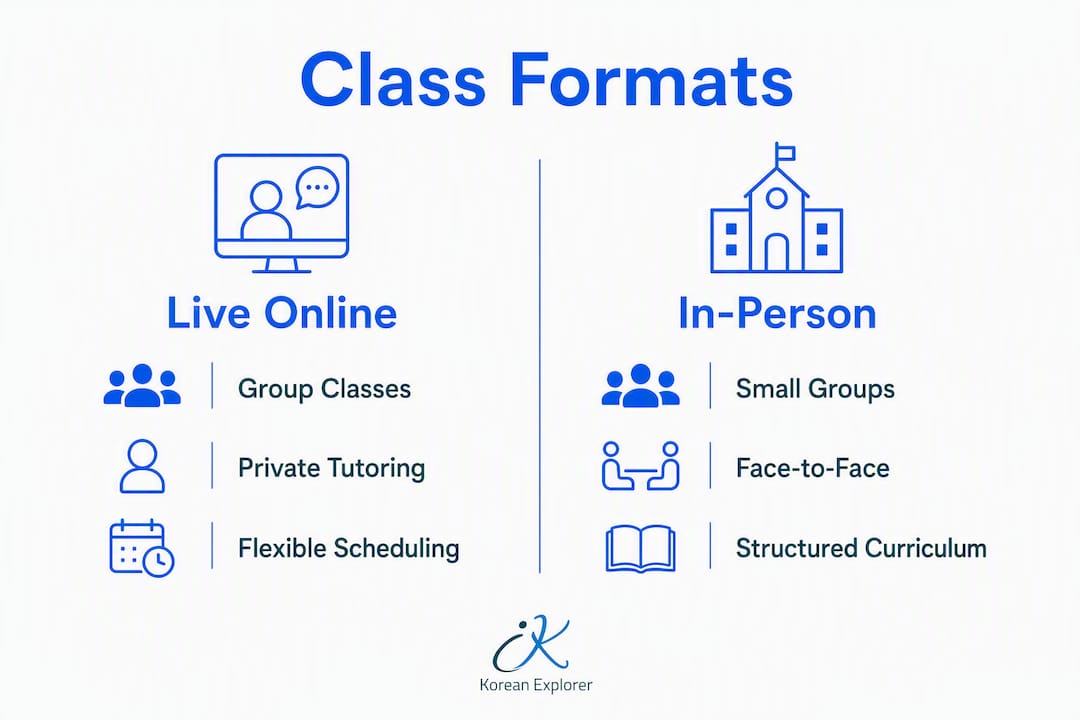
Not every format delivers the same results for a new learner. Here’s a quick breakdown of what each option actually gives you.
- Live online group class: A scheduled session with a small cohort and a live instructor. You get structured speaking time, peer interaction, and real-time correction. Best for learners who want accountability and conversation practice without commuting.
- Self-paced course or app: Learn on your own schedule, replay lessons, and move fast through material you already know. The trade-off is zero live speaking practice and no one to correct your pronunciation.
- Private 1:1 tutoring: Every minute is yours. A private Korean tutor can build lessons around your specific goals, whether that’s travel phrases, business Korean, or passing a language assessment. Higher cost, but the fastest personalized progress.
- In-person group class: The classic classroom format. Strong for learners who absorb better face-to-face and want a social study environment.
- Hybrid or short bootcamp: A 6–8 week intensive that combines live sessions with recorded content and practice tasks. Live cohorts with practice tasks and recorded feedback accelerate speaking confidence faster than self-study alone.
Who fits which format: Busy professionals with unpredictable schedules tend to do best with live online group classes or private tutoring. Learners who want the lowest cost entry point can start self-paced, then move to a live course once they’ve covered Hangul. Anyone who needs fast results for a work trip or relocation should look at an intensive or private format.
What does a beginner Korean course actually teach you?

Why Hangul comes first
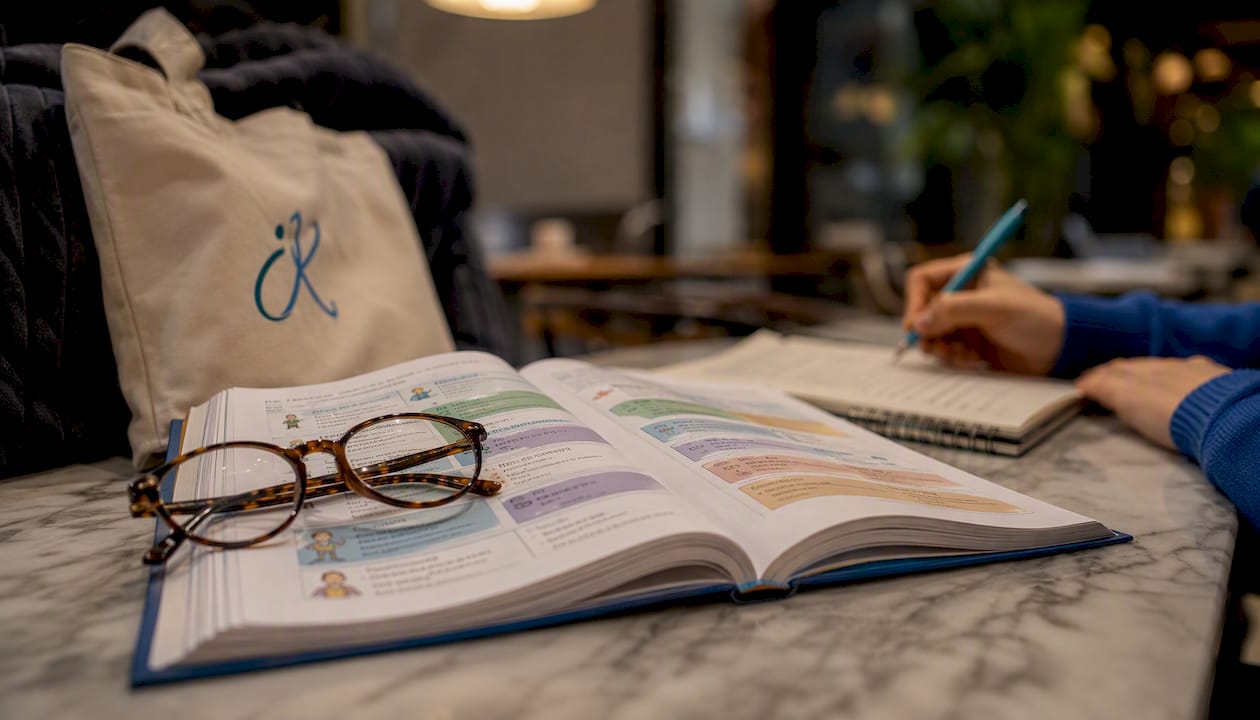
Hangul, the Korean writing system, has 24 basic letters: 14 consonants and 10 vowels. That’s a manageable system, and learning it first prevents the pronunciation errors that come from relying on romanization. Romanization (writing Korean sounds in English letters) is a crutch that trains your ear wrong and slows reading fluency. A good beginner course drops romanization after the first lesson or two.
Core skills in early lessons
A well-structured beginner course covers all four skills, but not equally at first:
- Reading and writing: Hangul recognition, stroke order, and syllable block construction
- Speaking: Greetings, self-introductions, and survival phrases using correct politeness endings
- Listening: Short clips with transcripts, shadowing drills, and rhythm training
- Grammar foundations: Basic sentence structure (subject-object-verb), core particles, and the two essential politeness levels
Politeness levels and the two Korean number systems are common early stumbling blocks. Addressing them in the first few weeks prevents habits that are hard to unlearn later.
Sample 8-lesson starter module
| Lesson | Topic | Expected output |
|---|---|---|
| 1 | Hangul consonants and vowels | Read and write basic syllable blocks |
| 2 | Hangul syllable combinations | Decode simple words without romanization |
| 3 | Greetings and self-introduction | Introduce yourself in Korean |
| 4 | Numbers (native and Sino-Korean) | Count and tell the time |
| 5 | Core verbs and sentence structure | Build simple subject-verb sentences |
| 6 | Particles (은/는, 이/가, 을/를) | Mark topics and objects correctly |
| 7 | Question forms | Ask and answer basic questions |
| 8 | Survival phrases (café, transport) | Navigate a real-world situation |
Structured beginner courses sequence exactly this way: Hangul and sounds first, then greetings, then core grammar, then practical phrases.
How do you choose the right beginner Korean class?
Quality varies more than pricing suggests. Use this checklist before you commit.
What to look for
- Native or bilingual instructor who can explain grammar in English and model authentic pronunciation
- Class size of 10 or fewer for live group sessions, so you actually get speaking turns
- Dedicated speaking time every lesson, not just listening and drills
- Access to recorded lessons so you can review what you missed or replay difficult sections
- A clear syllabus with module names, lesson count, and learning outcomes per level
- Placement test or level assessment so you start in the right class, not too easy and not overwhelming
- Transparent pricing and a trial class option before you pay for a full course
Quality providers offer trial lessons, placement tests, and clear module lists as standard. If a school can’t show you a sample syllabus or won’t let you try a lesson first, that’s a red flag.
Red flags to watch for
- Heavy reliance on romanization past the first lesson
- No live speaking component (grammar lectures only)
- Vague course descriptions with no module breakdown
- Pricing that only appears after you’ve given your contact details
Pro Tip: Ask the school one direct question during your trial: “How much time in each lesson is dedicated to speaking practice?” The answer tells you more about teaching philosophy than any marketing copy.
Your 8–12 week beginner study plan
Short daily practice beats occasional long sessions for consolidation and speaking readiness. Here’s how to structure the first three months.
- Weeks 1–2: Learn Hangul. Spend 15–20 minutes daily on letter recognition and syllable blocks. By the end of week two, you should read simple words without romanization.
- Weeks 3–4: Greetings, self-introduction, and basic numbers. Practice saying each phrase aloud, not just reading it. Record yourself once a week to track pronunciation.
- Weeks 5–6: Core verbs, sentence structure, and particles. Start building two- and three-word sentences. Use thematic phrase chunks (ordering coffee, asking for directions) rather than isolated vocabulary lists.
- Weeks 7–8: Question forms, politeness levels, and survival phrases. At this point, aim for one short conversation per week with a native speaker or classmate.
- Weeks 9–12: Review and expand. Add a graded listening source (short YouTube clips with Korean subtitles, or a beginner podcast). Limit yourself to one main course plus one listening resource plus a spaced-repetition review tool for the first 30 days. More resources dilute focus.
Daily time estimate: 20–30 minutes on class days, 15 minutes on off days for review. That’s enough to make steady, visible progress without burning out.
Pro Tip: Start speaking in week one, not after you “know enough grammar.” Instructors consistently find that learners who speak early, even badly, build confidence and correct pronunciation faster than those who wait.
How to sign up and prepare for your first lesson
Getting started takes less than 30 minutes if you know what to prepare.
- Step 1: Take a placement test if the school offers one. Even as a complete beginner, it confirms your starting level and sets the right expectations.
- Step 2: Book a trial class. Most schools let you attend one session before committing to a full course.
- Step 3: Prepare a short self-introduction in English: your name, why you’re learning Korean, and one thing you want to be able to say in Korean by the end of the course. Your instructor will use this to personalize early lessons.
- Step 4: For online classes, test your audio and video setup 10 minutes before the first session. A headset with a microphone makes a real difference for pronunciation feedback.
- Step 5: Write down two or three specific goals (e.g., “order food in Korean,” “understand a Korean drama without subtitles”). Specific goals keep you motivated past the first few weeks.
Pre-class checklist: Stable internet connection, headset, notebook for writing Hangul, and your goals written down.
What to know about trial classes and pricing
Most reputable beginner Korean courses offer either a free trial lesson or a low-cost introductory session. This matters because no amount of reading a course description tells you whether the teaching style fits how you learn.
Pricing for group online classes typically runs lower than private tutoring, with private lessons costing more per hour but delivering faster personalized progress. When comparing costs, look at the total course hours, not just the per-session price. A cheap course with 10 hours of content may cost more per learning hour than a structured 40-hour program.
Transparent schools publish their full pricing online and include what’s covered: number of lessons, access to recordings, and any materials. If pricing is only available “on request,” ask specifically whether the quoted price includes all materials and whether there are any fees for rescheduling or accessing recorded sessions. For learners exploring conversation skills practice outside of class, supplementary tutoring sessions are often available on a per-session basis with no long-term commitment required.
Key Takeaways
The fastest path from zero to basic conversational Korean is Hangul first, then a live instructor-led course with dedicated speaking practice from lesson one.
| Point | Details |
|---|---|
| Learn Hangul first | 24 letters, learnable in a week; skipping it causes lasting pronunciation errors. |
| Speak from week one | Beginners who speak early build confidence and correct pronunciation faster. |
| Daily short sessions | Short daily study sessions outperform occasional longer sessions for better retention. |
| Choose wisely | Look for a clear syllabus, placement test, trial class, and live speaking time per lesson. |
| Korean Explorer | Offers Hangul-first curriculum, native bilingual instructors, live speaking practice, and recorded lessons for adult learners. |
Why the “grammar first” approach keeps beginners stuck
Most beginner learners assume they need to master grammar before they can speak. That instinct is understandable, but it’s the single habit that keeps people studying Korean for years without holding a real conversation.
Korean grammar is genuinely different from English: the verb comes at the end, particles mark the role of each word, and politeness levels change the ending of almost every sentence. None of that is hard once you’ve heard it in context dozens of times. It becomes hard when you try to memorize it in isolation before you’ve ever said a sentence out loud.
The learners who progress fastest are the ones who start speaking in week one, accept that they’ll make mistakes, and let the instructor correct them in real time. That feedback loop, a live instructor catching a wrong particle or a mispronounced vowel and fixing it immediately, is something no app or self-paced video can replicate. It’s also why class size matters: in a group of 15, you might speak for three minutes per lesson. In a group of six, you speak for fifteen.
The curriculum structure matters too. A course built around Seoul National University’s framework sequences grammar and vocabulary the way native speakers actually use the language, not the way it’s easiest to explain in a textbook. That difference shows up around week four, when students in well-sequenced courses start forming sentences naturally instead of mentally translating from English.
Korean Explorer’s beginner classes: structured, live, and built to get you speaking
Korean Explorer’s beginner Korean language courses are built around the exact checklist above: a Hangul-first curriculum developed with Seoul National University input, native Korean instructors who are fluent in English, live speaking practice in every session, and access to recorded lessons so you can review at your own pace.
Group classes and private lessons are available both online via Zoom and in person at the Tanjong Pagar center (10 Anson Road, Level 22, International Plaza, Singapore 079903). Every new student takes a placement assessment to start at the right level. Trial classes are available so you can experience the teaching style before enrolling in a full course.
Browse the online Korean classes page to see current schedules, or take the placement test now to find your starting level and book your first session.
Useful sources
- Korean Explorer: Beginner Korean Lessons Guide — Step-by-step beginner curriculum and lesson sequencing for adult learners.
- Korean Explorer: Online Korean Classes — Details on live Zoom beginner classes, schedules, and how online lessons run.
- First Step Korean on Coursera — Free beginner course covering reading, writing, listening, and speaking at elementary level.
- Online King Sejong Institute — Free multilingual Korean language courses available on PC and mobile, anytime.
- Science-Based Learning: How to Learn Korean Fast — Evidence-backed study plan with sequencing advice for beginners.
FAQ
How long does it take to learn basic Korean?
With 15–30 minutes of daily practice, most beginners can read Hangul within a week and hold simple conversations within 4–8 weeks of starting a structured course.
Do I need to learn Hangul before taking a beginner class?
Most good beginner courses teach Hangul in the first one or two lessons, so no prior knowledge is required. Avoid courses that rely on romanization throughout, as this slows pronunciation development.
What is the best format for Korean classes for beginners?
Live online group classes with a native instructor give most beginners the best balance of structure, speaking practice, and cost. Private tutoring is faster but more expensive.
How do I know which level to start at?
Take a placement test before enrolling. Korean Explorer offers a free placement assessment that identifies your starting level so you don’t waste time in a class that’s too easy or too advanced.
Can I learn Korean online as a complete beginner?
Yes. Online beginner Korean classes via Zoom deliver the same live instruction, speaking practice, and instructor feedback as in-person lessons, with the added flexibility of learning from anywhere.