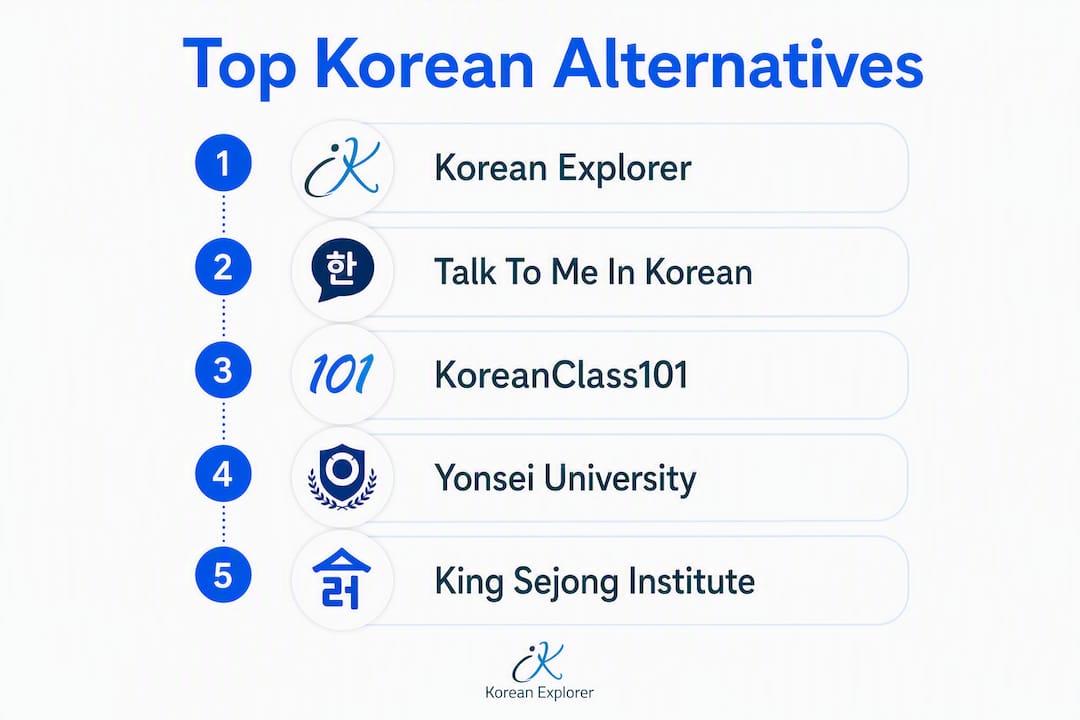
If you’re searching for daehankorean.com alternatives, the short answer is this: Korean Explorer is the top pick for adult learners who want structured, conversation-focused instruction with online Zoom access, followed by Talk To Me In Korean (TTMIK) for self-guided daily practice, KoreanClass101 for on-demand flexibility, Yonsei University’s “First Step Korean” on Coursera for academic structure, and the King Sejong Institute Online for free, institutional lessons.
Here’s the shortlist at a glance:
- Korean Explorer — best for adult conversational and business Korean with live instruction and online Zoom classes accessible from the U.S.
- Talk To Me In Korean (TTMIK) — best for self-guided conversational study with free and premium content
- KoreanClass101 — best for on-demand audio and video lessons on a subscription model
- Yonsei University “First Step Korean” (Coursera) — best for structured, university-backed academic progression
- King Sejong Institute Online — best free structured option with cultural modules
Korean Explorer earns the top spot for U.S. adult learners because it offers online Korean classes via Zoom, native instructors fluent in English, recorded lesson access for timezone flexibility, and a curriculum built around real-world conversation and business use.
Table of Contents
- What are the best daehankorean.com alternatives side by side?
- Why Korean Explorer stands out as the recommended pick
- What is Daehan Korean and why do learners look for alternatives?
- Talk To Me In Korean is the best self-guided conversational resource
- KoreanClass101 suits learners who want on-demand flexibility
- Yonsei University “First Step Korean” on Coursera offers real academic structure
- King Sejong Institute Online is the best free structured option
- How do you pick the right alternative to daehankorean.com?
- How to combine live classes with free apps for faster progress
- Final recommendation for U.S. adult learners
- What does Korean language learning actually cost?
- How long do Korean language programs typically take?
- Key Takeaways
- What actually works, based on learner experience
- Korean Explorer is a direct path to adult conversational and business Korean
- Useful sources and resources for further reading
- FAQ
What are the best daehankorean.com alternatives side by side?
| Provider | Best for | Class formats | Pricing model | Teacher qualifications | U.S. accessibility | Trial available | Supplementary materials |
|---|---|---|---|---|---|---|---|
| Korean Explorer | Conversation & business Korean | Group, private, online Zoom, corporate | Per course / per session | Native Korean, bilingual English | Online Zoom, recorded lessons | Yes | Recorded classes, structured curriculum |
| Talk To Me In Korean | Self-guided conversational study | On-demand digital | Free + premium subscription | Native Korean instructors | Fully online, anytime | Free content available | Podcasts, PDF workbooks, community |
| KoreanClass101 | On-demand audio/video flexibility | Audio, video, transcripts, some tutoring | Subscription (tiered) | Native Korean instructors | Fully online, anytime | Free trial lessons | Downloadable PDFs, lesson notes |
| Yonsei “First Step Korean” | Structured academic progression | On-demand video modules | Audit free / certificate paid | Yonsei University instructors | Fully online, self-paced | Audit option (free) | Quizzes, role-play tasks, transcripts |
| King Sejong Institute Online | Free structured lessons + culture | On-demand web/mobile modules | Free | Institutional instructors | Fully online, anytime | Free access | Cultural modules, structured path |
A subscription model (KoreanClass101) gives you unlimited access for a monthly fee, which suits learners who study daily in short bursts. A per-course model (Korean Explorer, Coursera) means you pay once and get a defined curriculum with a clear endpoint. For adult learners with a specific goal, per-course tends to produce better outcomes because the structure keeps you accountable.
For full provider profiles, the sections below break down each option in detail.
Why Korean Explorer stands out as the recommended pick
At a glance: Korean Explorer is a Korean language school based in Singapore at 10 Anson Road, Level 22, International Plaza, right above Tanjong Pagar MRT. It offers group classes, private lessons, online Zoom courses, and corporate training, all taught by native Korean instructors who are fluent in English.

For U.S.-based adult learners, the online Zoom format is the practical entry point. Classes run live with a real instructor, and recorded lesson access means you don’t lose ground if a session falls at an inconvenient hour across time zones.
Core features:
- Conversation-focused curriculum with business Korean tracks for working professionals
- Native Korean instructors who explain concepts in English, which matters when you’re past the basics but not yet fluent enough to absorb corrections in Korean only
- Recorded class videos so you can review sessions or catch up after a missed class
- Group and private formats, with corporate training available for teams
- Curriculum developed in alignment with Seoul National University standards
Pros for U.S. learners:
- Live online classes with recorded access resolve the Asia-U.S. timezone gap
- Adult-oriented curriculum focused on conversation and professional use, not rote grammar drilling
- Private lessons available for learners who want faster, personalized progress
- English-fluent instructors reduce the friction of early-stage learning
Cons:
- In-person classes are Singapore-based, so U.S. learners are limited to the online format
- Pricing is not publicly listed on all pages; you’ll need to contact the school or check the course catalog directly
Pricing: Korean Explorer operates on a per-course model. Exact fees vary by format (group vs. private) and level. Trial lessons are available, and contacting the school directly is the fastest way to confirm current rates and scheduling.
Pro Tip: Before booking, ask specifically whether your course level includes recorded lesson access and what the makeup policy is for missed sessions. For U.S. learners, this one detail determines whether the timezone difference is manageable or a constant headache.
What is Daehan Korean and why do learners look for alternatives?
Daehan Korean (daehankorean.com) is a Korean language school that has built a following among learners in Singapore and online. Its reputation leans toward a syllabus-driven, lesson-focused approach, with private and group options available.
Common profile points:
- Intensive, grammar-forward lessons with a structured syllabus
- Private lesson options alongside group classes
- Strong reputation among learners who want a disciplined, textbook-based progression
Why learners search for alternatives:
- The teaching style skews toward grammar drilling rather than conversational flow, which frustrates learners whose goal is speaking confidence
- Location can be a factor for learners outside Singapore who need fully online options
- Some learners find the pace either too fast or too rigid for adult schedules
Strengths vs. weaknesses at a glance:
- Strength: Structured, syllabus-driven curriculum with clear progression
- Strength: Established reputation and experienced instructors
- Weakness: Limited conversational emphasis relative to grammar instruction
- Weakness: Online accessibility and timezone flexibility are less clearly documented than dedicated online schools
Pricing and trial: Trial lesson availability and exact pricing are not publicly listed in detail. Prospective students typically need to contact the school directly. For learners comparing total cost, factor in whether materials are bundled or charged separately.
Talk To Me In Korean is the best self-guided conversational resource
At a glance: TTMIK is a fully digital Korean learning platform built around podcast-style lessons, structured series, and a large library of free content. It covers beginner through advanced levels, with a free tier and optional paid workbooks and premium content.
Core features:
- Lesson podcasts organized by level, covering grammar, vocabulary, and conversation patterns
- Structured series (e.g., “Iyagi” for intermediate listening, “Real-Life Korean Conversations”)
- PDF workbooks available for purchase to reinforce lessons
- Community resources and social learning elements
Pros for U.S. adult learners:
- Genuinely free at the core level, with no paywall blocking the foundational content
- Flexible, on-demand format fits around any schedule
- Conversational focus makes it practical for learners whose goal is speaking, not test-taking
Cons:
- No live instructor feedback, which means pronunciation errors can go uncorrected for weeks
- Self-discipline required; without a class structure, many learners stall at intermediate level
Best for: Learners who want daily conversational practice between live sessions, or those building a foundation before committing to a paid course. TTMIK works best as a complement to live instruction, not a standalone path to fluency.
Pricing: Core content is free. Premium workbooks and additional content are available for purchase. No subscription required for the free tier.

KoreanClass101 suits learners who want on-demand flexibility
At a glance: KoreanClass101, part of the Innovative Language network, delivers Korean lessons through audio recordings, video lessons, and downloadable transcripts. It operates on a tiered subscription model with a free trial option.
Core features:
- A large library of audio and video lessons organized by level and topic
- Downloadable lesson notes and PDF materials
- Teacher-led premium lessons and some one-on-one tutoring add-ons
- Learning path customization based on goals (travel, business, daily conversation)
Pros for U.S. adult learners:
- Fully on-demand, so you study whenever your schedule allows
- The subscription model gives access to the full library, which suits learners who want to jump between topics
- Free trial lessons let you test the format before paying
Cons:
- Audio-heavy format means limited speaking practice unless you add a live tutoring component
- Subscription costs accumulate over time; learners who don’t study consistently get poor value
Best for: Commuters, busy professionals, or anyone who wants to fill short pockets of time with structured audio lessons. Pair it with a weekly live session for real speaking practice.
Pricing: Tiered subscription model. A free account gives access to sample lessons; paid tiers unlock the full library. Exact pricing is listed on the KoreanClass101 website.
Yonsei University “First Step Korean” on Coursera offers real academic structure
Yonsei University’s “First Step Korean” on Coursera is a modular, elementary-level course covering reading, writing, listening, and speaking through quizzes and role-play tasks. It’s university-backed, which means the content is rigorous and the progression is deliberate.
Core features:
- Modular units covering all four language skills
- Quizzes and role-play tasks that simulate real interaction
- Verified certificate option for learners who want a credential
- Audit option available at no cost
Pros for U.S. adult learners:
- Self-paced and fully online, with no timezone constraints
- University-backed content carries credibility if you’re learning Korean for professional or academic purposes
- The audit option lets you test the full course before paying for a certificate
Cons:
- No live instructor contact; feedback is limited to automated quizzes
- Elementary level only; you’ll need additional resources once you finish
Best for: Learners who want a structured, skill-by-skill foundation with a recognized credential. It’s an excellent starting point, but plan to pair it with live conversation practice once you’ve completed the modules.
Pricing: Free to audit. A verified certificate requires a one-time payment, which Coursera lists on the course page.
King Sejong Institute Online is the best free structured option
The Online King Sejong Institute is a free, web-based Korean learning platform run by the King Sejong Institute network. It’s accessible on PC and mobile, designed for international learners, and covers structured modules alongside cultural content.
Core features:
- Structured lesson modules from beginner to intermediate levels
- Cultural content integrated into language lessons
- Institutional backing from the Korean government’s language promotion network
- Accessible on both PC and mobile browsers
Pros for U.S. adult learners:
- Completely free, with no subscription or paywall
- Well-structured modules give a clear progression path
- Cultural content adds context that purely grammar-focused courses miss
Cons:
- No live, personalized instructor feedback
- Progress depends entirely on self-motivation
- Content depth at advanced levels is limited compared to paid platforms
Best for: Learners who want a free, structured backbone to supplement with paid live classes. Use King Sejong Online to cover grammar and vocabulary, then bring those skills into a live session with Korean Explorer or a private tutor.
How do you pick the right alternative to daehankorean.com?
The decision comes down to four things: your goal, your schedule, your preferred format, and how much live feedback you need.
Selection criteria:
- Goal alignment — Conversational fluency needs live speaking practice. Business Korean needs a curriculum that covers professional vocabulary and formal registers. Structured academic progression needs modular courses with clear skill checkpoints.
- Schedule and timezone fit — U.S. learners joining Asia-based live classes need recorded lesson access as a non-negotiable. Confirm this before enrolling.
- Class format preference — Group classes are more affordable and provide peer interaction. Private lessons accelerate progress but cost more. On-demand suits self-directed learners.
- Teacher qualifications — Native instructors fluent in English are the practical standard for adult learners at beginner and intermediate levels. Ask whether instructors hold teaching credentials or have formal language instruction backgrounds. For guidance on vetting Korean language instructors, Korean Explorer’s blog covers the key questions to ask.
- Recorded lessons — For any live class, ask whether sessions are recorded and how long recordings are available.
- Total cost — Factor in materials, trial fees, and any per-level charges beyond the base course price.
Questions to ask at a trial lesson:
- What is the ratio of grammar instruction to speaking practice in a typical class?
- Are sessions recorded, and for how long are recordings accessible?
- What happens if I miss a class?
- How are levels assessed, and what does progression to the next level look like?
- Are materials included in the course fee, or charged separately?
- What is the class size for group sessions?
- Do you offer a structured syllabus I can review before enrolling?
Red flags to watch for:
- No trial lesson option
- Opaque or unavailable pricing
- No recorded lesson access for live classes
- Instructor credentials not disclosed
- No clear syllabus or level progression
Quick decision flow:
- Need structured credentialing? Choose Yonsei on Coursera, then advance with live classes.
- Need daily conversational practice? Combine TTMIK or KoreanClass101 with weekly live sessions.
- Need business Korean with live feedback? Korean Explorer’s online Zoom classes are the direct path.
- Need a free starting point? King Sejong Institute Online, then upgrade to live instruction.
Pro Tip: Always take a trial lesson before committing to a full course. A single live session reveals more about teaching pace, grammar-vs-conversation balance, and instructor style than any course description will. Knowing how to set clear learning goals before that trial makes the session far more useful.
How to combine live classes with free apps for faster progress
Live instruction and free apps serve different functions. Treating them as a system rather than alternatives is what separates learners who plateau from those who keep moving.
Rosetta Stone’s guidance on Korean learning makes the point clearly: digital lessons build vocabulary and grammar recognition, but real-time speaking practice is what converts that knowledge into usable conversation. The two work together; neither replaces the other.
A practical 4-week template:
- Once per week: — Live class or private session with Korean Explorer (online Zoom) for speaking practice and real-time correction
- Weekly review (30 minutes): Replay recorded class segments, review lesson notes, and check unfamiliar terms against KRDICT, the National Institute of Korean Language’s official dictionary
For U.S. learners in Pacific or Eastern time zones, weekend morning sessions often align best with Singapore evening classes. Recorded lesson access covers the gap when scheduling doesn’t cooperate.
Resource roles at a glance:
| Resource | Best for | Format | Cost |
|---|---|---|---|
| Korean Explorer (online) | Live speaking practice, business Korean | Live Zoom, recorded | Per course |
| TTMIK | Daily conversational listening | On-demand podcast | Free + premium |
| Duolingo | Daily vocabulary and reading | App, gamified | Free + subscription |
| King Sejong Institute Online | Structured grammar + cultural context | Web/mobile modules | Free |
| Yonsei on Coursera | Academic skill progression | On-demand video | Free audit / paid cert |
| KRDICT | Vocabulary verification for business use | Online dictionary | Free |
| Haerye | Full free path from Hangul to advanced | Browser-based | Free |
For a step-by-step approach to studying Korean online, Korean Explorer’s guide covers how to structure your week across formats.
Final recommendation for U.S. adult learners
Korean Explorer is the recommended pick for adult learners who want live, structured instruction with real conversational and business Korean focus, online Zoom delivery, and recorded lesson access that makes the timezone difference workable. It’s the option that most directly replaces what Daehan Korean offers, while adding the online flexibility U.S. learners actually need.
Three concrete next steps:
- Book a trial lesson with Korean Explorer via the online Korean classes page to assess teaching pace, instructor style, and whether the curriculum matches your goals.
- Test a free module on King Sejong Institute Online to build or reinforce your grammar foundation before your first paid class.
- Add a daily app habit with Duolingo or TTMIK to keep vocabulary active between live sessions.
Before committing to any paid course, confirm three things: recorded lesson access, clear pricing for your level, and a trial option. Any school that can’t answer those three questions upfront is worth skipping.
What does Korean language learning actually cost?
Costs vary significantly by format and provider. Here’s a realistic breakdown:
Live instruction (group classes): Korean Explorer’s group courses are priced per course level. Exact fees are available on the course catalog page. Group classes are generally the most cost-efficient format for live instruction.
Private lessons: Private tutoring with a qualified native instructor typically runs higher per hour than group classes. Korean Explorer offers private lessons; pricing is available on request.
Subscription platforms: KoreanClass101 operates on a monthly or annual subscription. The free tier covers sample content; full library access requires a paid plan. TTMIK’s core content is free, with workbooks and premium content available for separate purchase.
Academic courses: Yonsei’s “First Step Korean” on Coursera is free to audit. A verified certificate carries a one-time fee listed on the Coursera course page.
Free resources: King Sejong Institute Online, TTMIK’s free tier, Duolingo’s free tier, KRDICT, and Haerye are all genuinely free with no hidden costs.
Materials: Factor in workbooks, PDF downloads, or supplementary materials. Some schools bundle these into course fees; others charge separately. Always ask before enrolling.
A realistic monthly budget for a blended approach (one live group class per week plus daily app practice) sits in the range of a single course enrollment fee plus zero additional cost for free-tier apps.
How long do Korean language programs typically take?
Expectations matter here, because most learners underestimate the timeline.
Group courses: Korean Explorer structures courses by level, with each level covering a defined set of skills. A single level typically runs several weeks to a few months, depending on class frequency. Moving from beginner to conversational competence across multiple levels realistically takes one to two years of consistent study.
Subscription platforms: KoreanClass101 and TTMIK are open-ended. Learners can technically access content indefinitely, but without a structured endpoint, many stall. Set a personal milestone (e.g., complete all beginner lessons within 90 days) to avoid subscription drift.
Academic courses: Yonsei’s “First Step Korean” on Coursera is designed as a multi-week modular course. Self-paced learners can complete it in four to six weeks at a moderate study pace, or stretch it over several months.
Free platforms: King Sejong Institute Online modules are self-paced with no fixed duration. Progress depends entirely on how consistently you show up.
The honest benchmark: reaching conversational fluency in Korean takes most adult learners 18–24 months of consistent, structured study that includes regular live speaking practice. Apps and free resources extend your runway; they don’t shorten the timeline on their own.
Key Takeaways
Korean Explorer is the strongest online alternative to daehankorean.com for U.S. adult learners who need live instruction, business Korean tracks, and recorded lesson access across time zones.
| Point | Details |
|---|---|
| Top pick for U.S. learners | Korean Explorer offers live Zoom classes, native instructors, and recorded access for timezone flexibility. |
| Best free structured option | King Sejong Institute Online provides free, modular lessons and cultural content with no paywall. |
| Trial lessons are non-negotiable | A single live trial reveals teaching pace and grammar-vs-conversation balance better than any course description. |
| Blended approach wins | Pair live weekly classes with daily app practice (Duolingo or TTMIK) for the fastest conversational progress. |
| Korean Explorer online classes | Book a trial via the online classes page to confirm fit before committing to a full course enrollment. |
What actually works, based on learner experience
The pattern that shows up consistently in learner reviews is straightforward: weekly live speaking practice combined with short daily app drills produces faster conversational progress than either approach alone. Learners who rely exclusively on apps plateau around intermediate level because they never get corrected in real time. Learners who only attend live classes without daily reinforcement forget vocabulary between sessions.
The other thing learners consistently report: the trial lesson is more informative than the course description. A school that emphasizes grammar drilling will reveal that in the first 20 minutes of a trial. A school that pushes you to speak from the first session will reveal that too. Reading a syllabus tells you the topics covered; a trial lesson tells you how you’ll actually be taught.
One practical tip you can apply before your next enrollment decision: walk into the trial with a specific goal stated upfront (“I want to hold a business conversation within six months”) and watch how the instructor responds. A good teacher will immediately adjust the session to show you what that path looks like. A less-aligned one will proceed with the standard intro regardless.
Korean Explorer is a direct path to adult conversational and business Korean
Most Korean learning platforms give you content. Korean Explorer gives you a curriculum, a live instructor, and a structured path from where you are now to where you want to be, whether that’s holding a business meeting in Korean or navigating daily conversation with confidence.
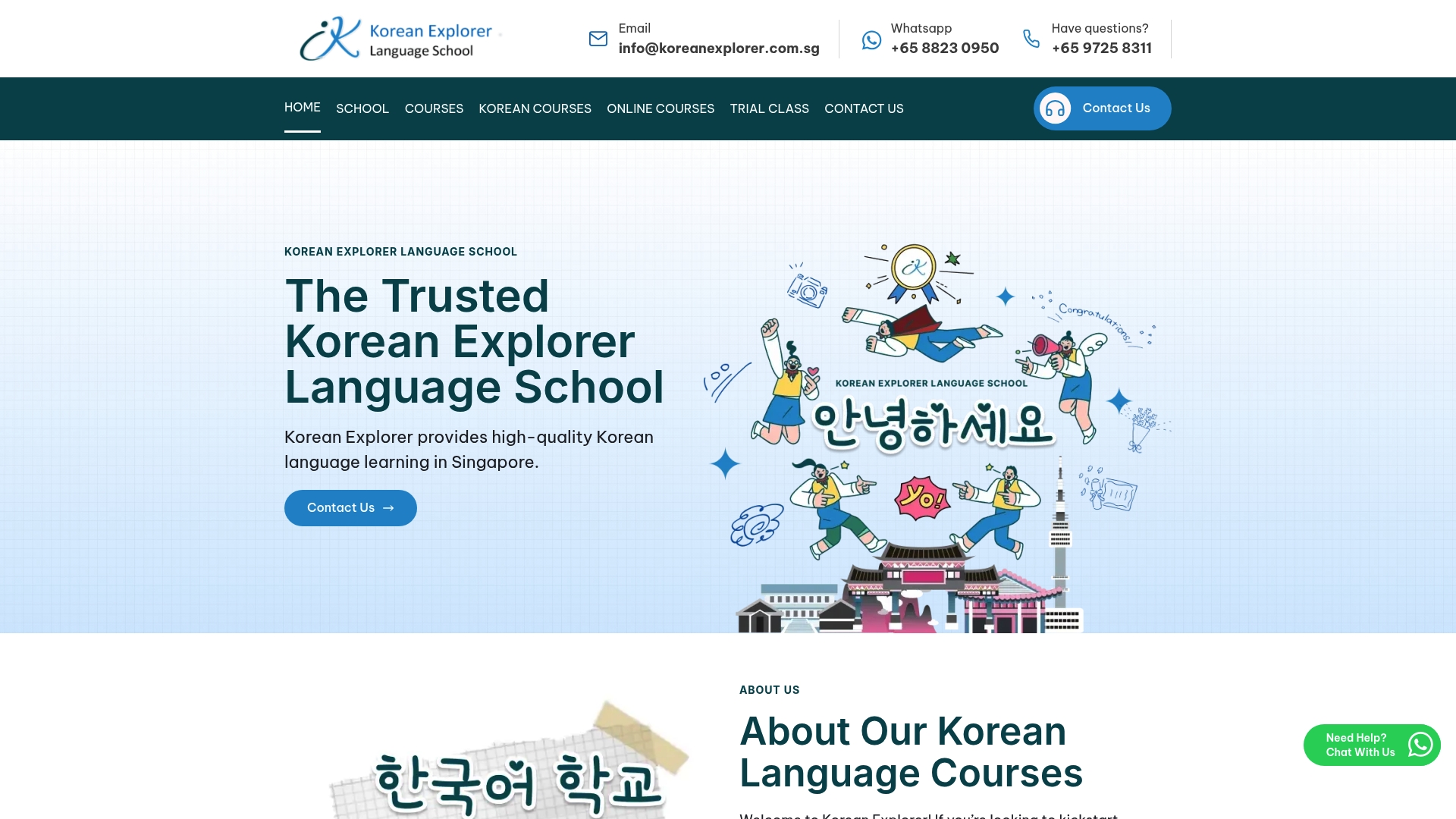
For U.S.-based adult learners, the online Korean classes via Zoom are the practical entry point: live sessions with native English-fluent instructors, recorded lesson access for timezone flexibility, and course options that cover conversational Korean, business Korean, and corporate training. Private lessons are available for learners who want one-on-one pace and focus.
The next step is simple: visit the Korean Explorer course page, check the current schedule for online Zoom classes, and book a trial lesson to see whether the teaching style fits your goals.
Useful sources and resources for further reading
These are the most useful resources referenced in this article, with a note on what each one is best for:
- First Step Korean — Coursera (Yonsei University) — Best for structured, university-backed beginner progression with a free audit option and a verified certificate pathway.
- Online King Sejong Institute — Best free structured resource for international learners; covers grammar, vocabulary, and Korean culture with no cost.
- KRDICT — National Institute of Korean Language — Best for verifying standard Korean vocabulary and business-level terminology against an authoritative official source.
- Korean Explorer — Online Korean Classes — Best for U.S. learners seeking live Zoom instruction with native instructors and recorded lesson access.
- Korean Explorer — Course Catalog — Best starting point for comparing group and private class formats and current scheduling.
| Resource | Type | Cost | Best for |
|---|---|---|---|
| Korean Explorer (online) | Live Zoom classes | Per course | Adult conversational and business Korean |
| King Sejong Institute Online | Structured modules | Free | Grammar, vocabulary, cultural context |
| Yonsei on Coursera | Academic video course | Free audit / paid cert | Structured beginner progression |
| Duolingo | Gamified app | Free + subscription | Daily vocabulary habit |
| TTMIK | Podcast + digital | Free + premium | Conversational listening and speaking |
| KRDICT | Online dictionary | Free | Business vocabulary verification |
| Haerye | Browser-based | Free | Full beginner-to-advanced free path |
FAQ
What is the best free website to learn Korean?
The King Sejong Institute Online is the most structured free option, offering modular lessons and cultural content with institutional backing. Haerye is a strong free alternative for learners who want a full path from Hangul to advanced Korean in a browser.
What is the most accurate app to learn Korean?
Duolingo is the most widely used app for Korean and covers reading, writing, listening, and speaking through adaptive review. For vocabulary accuracy at a business level, cross-reference terms with KRDICT, the National Institute of Korean Language’s official dictionary.
Can Duolingo actually teach you Korean?
Duolingo builds a useful foundation in Hangul, vocabulary, and basic grammar, but it won’t get you to conversational fluency on its own. Pair it with weekly live instruction, such as Korean Explorer’s online Zoom classes, for real speaking practice and instructor feedback.
What is the best Korean language learning program for adult learners?
For adult learners who want live instruction with conversational and business focus, Korean Explorer’s online Zoom classes are the strongest option, combining native instructors, recorded lesson access, and a structured adult curriculum. For self-study, TTMIK and Yonsei’s “First Step Korean” on Coursera cover conversational and academic tracks respectively.