TL;DR:
- Hangeul’s structure of 24 letters forms syllable blocks that improve reading speed and pronunciation for learners. Understanding the phonetic logic and cultural philosophy behind its design accelerates language mastery and cultural connection. Mastery of its block system is essential for fluent reading, accurate pronunciation, and meaningful engagement with Korean culture.
Hangeul structure is defined as the system of 24 basic letters, 14 consonants and 10 vowels, that combine into compact syllable blocks to represent every sound in the Korean language. Understanding this structure is the single most effective step a learner can take before studying vocabulary or grammar. The syllable block design is not arbitrary. It reflects phonetic logic, philosophical tradition, and cognitive science. Learners who grasp why study Hangeul structure matters gain faster reading speed, more accurate pronunciation, and a deeper connection to Korean culture from day one.
Why study Hangeul structure before anything else?
Hangeul is a morphosyllabic writing system, meaning each written block represents one syllable rather than one sound in isolation. This is the key distinction that separates it from purely alphabetic scripts like English. The 24 basic characters combine into logical syllable blocks that outperform many Western languages in characters typed per second, making Hangeul one of the fastest writing systems for digital input. That efficiency is not accidental. It is built into the architecture of every block.
Each block follows a strict formation rule. A syllable always begins with an initial consonant, followed by a vowel, and ends with an optional final consonant called a batchim. The three possible block types are:
- CV blocks: initial consonant plus vowel, as in 나 (na)
- CVC blocks: initial consonant, vowel, and one final consonant, as in 한 (han)
- CVCC blocks: initial consonant, vowel, and a double final consonant, as in 닭 (dak)
The block formation rules arrange these elements into a visually balanced square shape. This visual balance is not decorative. It creates uniform information density across a line of text, which directly supports faster reading.
Pro Tip: When you first practice writing syllable blocks, draw a light square around each block as a guide. This trains your eye to see Hangeul as a unit rather than as individual letters, which is exactly how fluent readers process it.
The 14 consonants were designed to mirror the shape of the vocal organs that produce each sound. The consonant ㄱ, for example, represents the tongue root pressing against the throat. The 10 vowels derive from three philosophical strokes representing heaven, earth, and the human figure. Knowing this makes the letters far easier to memorize because each shape carries a built-in memory cue.
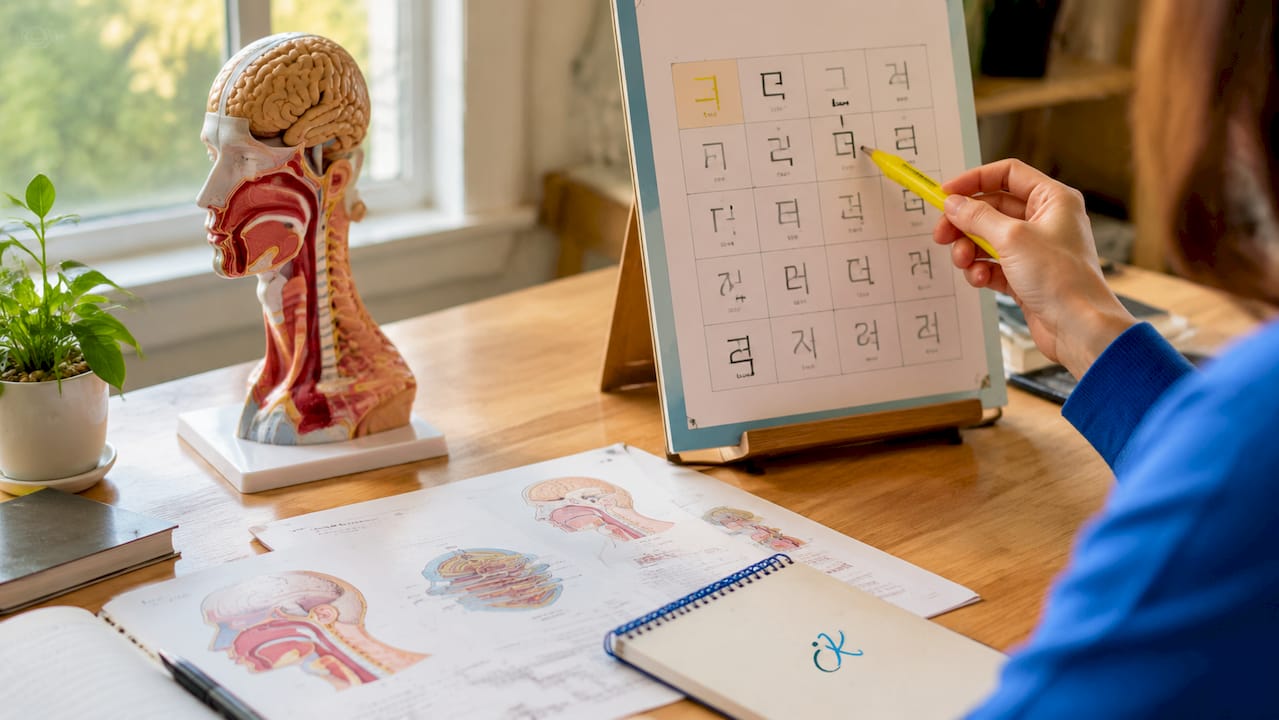
How does Hangeul’s block structure speed up reading?
Hangeul’s block design reduces the number of eye movements a reader needs to scan a line of text. The foveal load theory explains this directly: because each syllable block packs more information into a smaller visual area than a linear alphabet, the eye captures more meaning per glance. Fewer eye movements mean faster reading once the blocks become familiar.
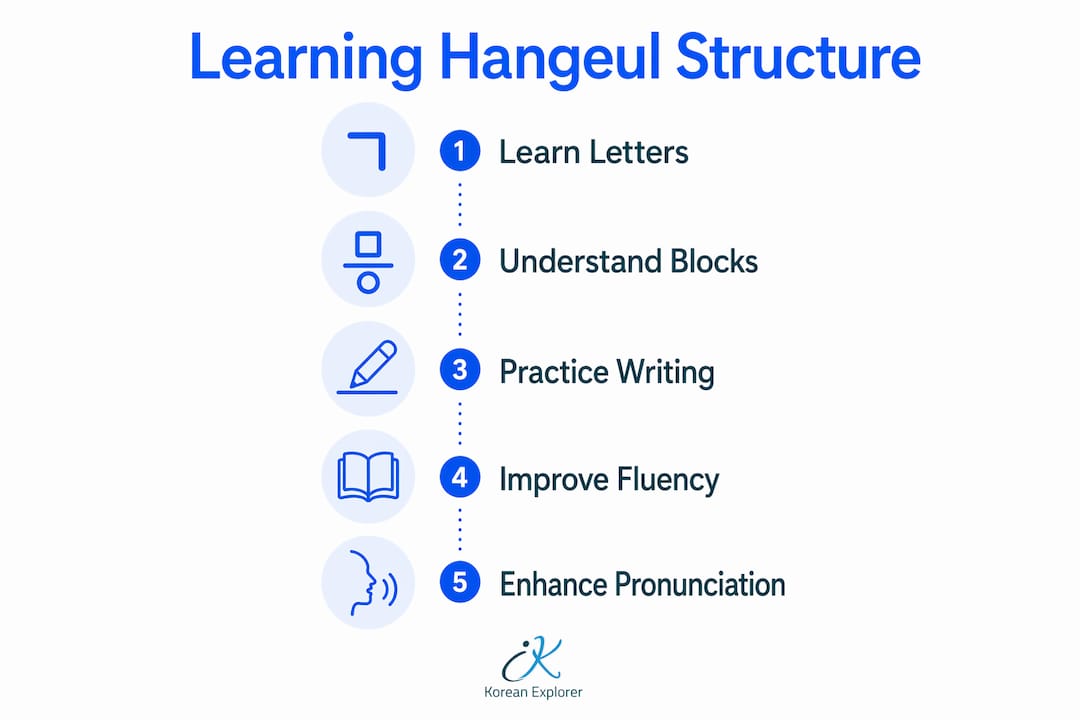
Fluent readers process Hangeul through two simultaneous cognitive modes.
| Processing mode | What it does | Effect on reading |
|---|---|---|
| Constituent processing | Reads individual letters within a block | Supports decoding unfamiliar words |
| Gestalt processing | Reads the whole block as a single image | Enables instant word recognition |
Gestalt processing is the key to reading fluency. Successful learners treat each syllable block as an integrated image rather than a sequence of letters, which accelerates reading speed significantly. This is why learners who spend time drilling individual letters in isolation often plateau. The brain needs to learn to see the block as a whole unit.
“Hangeul’s design slightly increased writing difficulty but maximized reading efficiency visually.” — The Brain Recognizes Hangul as an ‘Image’
This trade-off was intentional. The system was built to make reading fast and reliable, even at the cost of slightly more complex writing rules. For adult learners focused on conversational fluency, this means the upfront investment in learning block structure pays off quickly in real reading and listening comprehension.
Why does Hangeul structure matter for accurate pronunciation?
Romanization is the practice of writing Korean sounds using English letters. It feels helpful at first, but it creates pronunciation habits that are extremely difficult to correct later. Learners who rely on romanization form a hard ceiling for pronunciation improvement, one that experienced instructors have observed consistently over years of teaching.
The core problem is that English letters carry English sound associations. When a learner reads “eo” for the Korean vowel ㅓ, the brain retrieves an English vowel sound, not the Korean one. That mismatch compounds over time. The four steps below show how to build accurate pronunciation through Hangeul structure instead:
- Learn the consonant shapes first. Each consonant visually hints at the mouth position needed to produce it. Connecting shape to sound builds a direct neural link.
- Practice vowels as standalone sounds. Korean vowels do not shift based on surrounding letters the way English vowels do. Drilling them in isolation removes English interference.
- Read syllable blocks aloud from day one. Vocalizing blocks as units trains the brain to retrieve Korean sounds, not English approximations.
- Avoid romanization entirely for the first four weeks. This forces the brain to build durable neural pathways for Korean sounds rather than borrowing from English phonology.
Pro Tip: Record yourself reading simple Hangeul blocks in week one, then again in week four. The difference in accuracy is usually striking and serves as strong motivation to stay off romanization.
Experienced instructors at Korean Explorer consider learning Hangeul sounds directly the gateway to native-like pronunciation. The structure of the script is the tool. Romanization is a detour around it.
What cultural philosophy shaped Hangeul’s design?
Hangeul was created during the Joseon Dynasty under King Sejong the Great, and its design reflects the philosophical worldview of that era. The script was not assembled from borrowed symbols. Every element was reasoned from first principles.
The consonants model the physical shapes of the vocal organs:
- ㄱ represents the tongue root blocking the throat
- ㄴ shows the tongue tip touching the upper palate
- ㅁ outlines the closed lips
- ㅅ depicts the shape of the teeth
- ㅇ represents the open throat
The vowels follow a different logic entirely. They derive from three fundamental strokes: a dot for heaven, a horizontal line for earth, and a vertical line for the human figure standing between them. This cosmological framework made the vowels internally consistent and easy to extend into compound forms.
“Cultural historians emphasize that Hangeul reflects a philosophical framework connecting Korean linguistic structure to traditional thought, making learning it a cultural experience.” — Korea IT Times
The script was also designed with democratic access in mind. King Sejong created Hangeul so that ordinary people could learn to read and write, not just scholars trained in Chinese characters. That original purpose shapes how learners should approach it today. Hangeul is meant to be learned quickly and used confidently. Its philosophical foundations are not academic trivia. They are the reason the system is so internally logical and learnable. Understanding this context makes the script feel less like a foreign code and more like a coherent language built by people who thought carefully about how humans speak and read.
Key Takeaways
Studying Hangeul structure is the fastest path to Korean reading fluency, accurate pronunciation, and genuine cultural understanding.
| Point | Details |
|---|---|
| Structure before vocabulary | Learning syllable block rules first makes every subsequent step faster and more accurate. |
| Gestalt block reading | Train your brain to see each block as one image, not a sequence of letters, to build reading speed. |
| Avoid romanization early | Skipping romanization in the first weeks builds stronger neural pathways for Korean pronunciation. |
| Consonants mirror vocal organs | Each consonant shape hints at mouth position, making sounds easier to learn and remember. |
| Cultural logic aids retention | Understanding the philosophical design of vowels and consonants turns memorization into comprehension. |
Hangeul structure is a gateway, not a gate
Most learners treat Hangeul as a hurdle to clear before the “real” Korean learning begins. That framing is wrong, and it costs people weeks of progress.
I have seen adult learners in Singapore spend three weeks drilling romanized vocabulary, then spend another three weeks unlearning the pronunciation errors that came with it. The ones who commit to Hangeul structure from lesson one move faster, speak more clearly, and feel more confident in conversation. The script is not the obstacle. It is the shortcut.
The cognitive science backs this up. When you learn to read blocks as images rather than letter sequences, your brain processes Korean the same way a native reader does. That is not a small advantage. It changes how you hear the language, how you store vocabulary, and how quickly you retrieve words in real conversation.
My practical advice: spend your first two weeks doing nothing but reading Hangeul blocks aloud. No vocabulary lists. No grammar rules. Just blocks. Use verbal exercises that force you to vocalize what you see. By week three, you will read faster than you expected, and your pronunciation will already be cleaner than most learners who spent those same weeks with romanization.
The cultural dimension matters too. When you understand that ㅁ is literally a picture of closed lips, or that the vowel ㅏ places a human figure next to the earth, the script stops feeling arbitrary. It starts feeling like a conversation with the people who built it. That shift in perspective is what separates learners who stay curious from those who burn out.
— Paul
Korean Explorer: structured Korean learning for adults in Singapore
Korean Explorer offers adult Korean courses in Singapore built around exactly this kind of structured, logical progression. Courses cover conversational and business Korean, with native instructors who teach Hangeul structure as the foundation of every program.
Group classes, private sessions, and online Zoom lessons are all available, giving you the flexibility to learn at your own pace. Corporate training programs are also offered for teams who need practical Korean communication skills. Korean Explorer’s curriculum is developed in alignment with Seoul National University standards, so every lesson builds on a solid, proven framework. If you are ready to learn Korean in Singapore with instructors who treat Hangeul structure as the starting point rather than an afterthought, Korean Explorer is the right place to begin.
FAQ
What are the 24 basic letters of Hangeul?
Hangeul consists of 14 consonants and 10 vowels. These 24 characters combine into syllable blocks that represent every sound in the Korean language.
How long does it take to learn Hangeul structure?
Most adult learners can read and write basic Hangeul syllable blocks within one to two weeks of focused daily practice. Gestalt block recognition, which enables fluent reading, develops over the following weeks.
Why is romanization bad for Korean pronunciation?
Romanization maps Korean sounds onto English letters, which triggers English sound associations in the brain. Learners who avoid romanization build more accurate Korean pronunciation from the start.
How does Hangeul structure help with reading speed?
The block design reduces eye movement by packing more phonetic information into a smaller visual area. Once learners process blocks as whole images, reading speed increases significantly compared to linear alphabets.
Is Hangeul structure connected to Korean culture?
Yes. Consonants were modeled on the shapes of vocal organs, and vowels derive from philosophical symbols representing heaven, earth, and humanity. Learning this context makes the script’s design easier to understand and remember.