TL;DR:
- Investing in language skills improves brain health, career prospects, and cultural understanding over a lifetime.
- Active practice in real-world contexts yields the strongest cognitive and professional benefits.
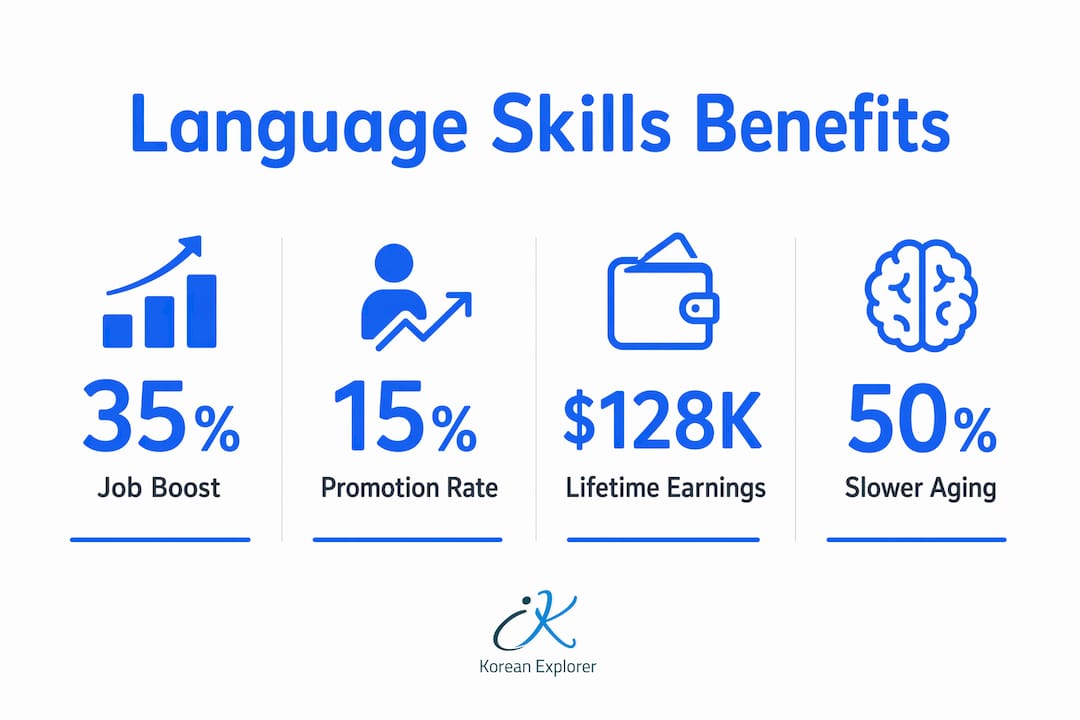
Investing in language skills is defined as the active, sustained effort to learn and use one or more additional languages for personal, professional, or cognitive benefit. The returns are measurable and significant. Multilingual employees earn $128,000 more over a lifetime on average and see 15% higher promotion rates than their monolingual peers. Beyond the paycheck, language learning reshapes brain structure, sharpens thinking, and builds the kind of cultural intelligence that no app can replicate. If you are 16 or older and thinking about your future, understanding why invest in language skills matters is one of the most practical questions you can ask.
Why invest in language skills for your brain?
Language learning does more than add words to your vocabulary. It physically changes your brain. Research shows that bilingualism is linked to 5% greater grey matter volume and a 10% larger hippocampus in polyglots compared to monolinguals. The hippocampus governs memory formation and spatial reasoning, so a larger one means sharper recall and better mental organization.
Neurologist Dr. Roy Hamilton of the McKnight Brain Research Foundation explains that language learning builds cognitive reserve by engaging complex problem-solving, memory retrieval, and attention management simultaneously. Cognitive reserve is the brain’s ability to compensate for damage or aging. Think of it as a buffer that keeps your mind functioning well even as the years add up.
The aging benefits are striking. A large study of 86,149 adults across 27 European countries found that residents in multilingual regions age 50% more slowly at the biological level compared to those in monolingual areas. That is not a marginal difference. It suggests that speaking more than one language is one of the most powerful lifestyle factors for healthy aging identified in population research.
The Goethe-Institut reports that bilingualism delays Alzheimer’s onset by up to four years due to stronger compensatory brain mechanisms. Four extra years of cognitive clarity is a return most people would pay almost anything for.
Key cognitive gains from language learning include:
- Memory: Switching between languages trains the brain to store and retrieve information more efficiently.
- Attention: Managing two language systems strengthens the prefrontal cortex, the region responsible for focus and impulse control.
- Problem-solving: Bilinguals consistently outperform monolinguals on tasks requiring mental flexibility.
- Multitasking: Constant management of two language systems builds the mental habit of parallel processing.
Pro Tip: Active use drives these gains, not passive study. Listening to podcasts helps, but speaking Korean in a real conversation, writing emails in your target language, or joining a class where you practice with others produces far stronger cognitive results.
What career advantages come from language skills investment?
The economic case for learning a language is concrete. Bilingual job applicants see up to a 35% boost in job prospects and salary compared to monolingual candidates. That premium compounds over a career. The $128,000 lifetime earnings advantage cited earlier is not a ceiling. It reflects average gains across industries, meaning high-demand sectors like finance, law, and technology can yield even larger returns.

Language skills also function as what one industry analyst calls an “employability superpower.” The phrase captures something real. Language encodes cultural logic, the unspoken rules of how people negotiate, disagree, show respect, and build trust. Professionals who understand that logic do not just translate words. They translate intent, and that is a skill employers pay for.
Here is how language skills translate into career value across specific roles:
| Profession | Language advantage |
|---|---|
| Sales and business development | Builds client trust in local markets; closes deals that translators cannot |
| Human resources | Manages multicultural teams with fewer misunderstandings |
| Marketing and communications | Crafts messages that resonate culturally, not just linguistically |
| Legal and compliance | Reads contracts and regulations in their original language |
| Finance and banking | Navigates relationships with regional partners and regulators |
Beyond salary, the 15% higher promotion rate for multilingual employees reflects something structural. Managers who can communicate across language lines are more visible, more useful, and harder to replace. In Singapore’s economy, where Korean trade and cultural ties continue to grow, Korean language proficiency specifically opens doors in entertainment, technology, and consumer goods sectors. You can read more about Korean for career growth and how it applies to professional advancement in Singapore.
The importance of language skills also shows up in graduate outcomes. Students who study a foreign language in college outperform peers on standardized tests measuring cognitive flexibility and executive function. That performance gap follows them into the job market.
Does AI translation make language learning unnecessary?
AI translation does not replace language learning. UNESCO states clearly that AI translation is an assistant, not a substitute, for human relational skills in intercultural communication. The distinction matters because most high-stakes professional communication is relational, not transactional.
Consider what AI translation cannot do:
- Read the room: A negotiation in Seoul involves hierarchy, timing, and nonverbal cues that a translation app cannot interpret.
- Build trust: Clients and partners respond differently when you speak their language. The effort signals respect that no tool can fake.
- Catch cultural subtext: Humor, sarcasm, and indirect refusals often mean the opposite of what they literally say.
- Adapt in real time: A live conversation shifts fast. Waiting for a translation breaks the rhythm and signals disengagement.
The cultural logic encoded in language is the part AI consistently misses. Understanding why Korean business culture emphasizes group harmony, or why certain phrases carry different weight depending on the speaker’s age, requires lived linguistic knowledge. A translated message can be grammatically correct and still land badly.
Technology does have a legitimate role in language learning. Apps like Duolingo and platforms like Pimsleur accelerate vocabulary acquisition and pronunciation practice. You can explore how technology supports language learning without replacing the human element. The key is using tools to supplement real practice, not replace it.
Pro Tip: Use AI translation to check your own output, not to replace your speaking. Write a message in Korean, then run it through a translation tool to catch errors. That feedback loop builds skill. Relying on the tool to speak for you builds nothing.
How to invest in language skills for maximum return
Effective language learning is not about studying harder. It is about studying smarter and more often. Consistent active use tied to practical tasks generates the strongest cognitive and career returns. Beginners who study infrequently or rely on passive memorization do not achieve the same results as learners who use the language in meetings, negotiations, and daily conversation.
Here is a practical framework for getting real returns from your language investment:
Set a use-case goal first. Decide whether you need Korean for business meetings, casual conversation, or written communication. Your goal shapes your method. Business Korean requires different vocabulary and register than conversational Korean.
Practice speaking from week one. Conversation builds fluency faster than any other method. Join a structured class where speaking is the primary activity, not a bonus at the end of a grammar lesson.
Apply the language in real contexts. Watch Korean business news. Listen to Korean podcasts on topics you already care about. Write emails or journal entries in Korean. Real-world application cements what classroom learning introduces.
Learn the culture alongside the language. Language and culture are inseparable. Understanding Korean social norms, communication styles, and professional etiquette makes your language use accurate and appropriate. This is what turns language ability into cultural intelligence.
Track progress against measurable milestones. Set targets like “hold a five-minute conversation without switching to English” or “read a Korean news article without a dictionary.” Milestones keep motivation high and show you where to focus next.
Study consistently, not intensively. Thirty minutes of daily practice outperforms a three-hour weekend session every time. The brain consolidates language during sleep, so frequent short sessions give it more opportunities to do that work.
Adults sometimes worry that they have missed the window for language learning. The research says otherwise. Adults retain neuroplasticity for language acquisition, and the prefrontal cortex actually strengthens with adult sequential learning. Progress may be slower initially, but the cognitive benefits are comparable to those seen in early learners when practice is sustained. For practical strategies on staying motivated through that process, Korean Explorer’s guide on encouraging language learning offers concrete approaches that work for adult learners.
Key takeaways
Investing in language skills delivers measurable gains in brain health, career earnings, and cultural intelligence that compound over a lifetime.
| Point | Details |
|---|---|
| Brain structure improves | Bilingualism grows grey matter and the hippocampus, protecting against cognitive aging. |
| Career earnings rise significantly | Multilingual employees earn $128,000 more on average and get promoted 15% more often. |
| AI cannot replace human language skills | Cultural logic, trust-building, and real-time adaptation require genuine language ability. |
| Active use drives the return | Speaking and applying language in real contexts produces far stronger gains than passive study. |
| Adults gain real cognitive benefits | Sustained adult language learning strengthens the prefrontal cortex and builds cognitive reserve. |
The long game nobody talks about
Most articles on language learning focus on the obvious wins: the salary bump, the travel experience, the resume line. Those are real. But after years of watching adult learners at Korean Explorer progress from hesitant beginners to confident speakers, I am convinced the deeper return is something harder to quantify.
Language learning forces you to be uncomfortable in a productive way. You have to think carefully, accept mistakes publicly, and keep going anyway. That process builds a kind of mental resilience that shows up everywhere else in your life. The students I have seen make the most progress are not necessarily the most talented. They are the ones who treat the discomfort as the point, not the obstacle.
The cognitive science backs this up. The brain’s engagement in complex cognitive tasks is precisely what builds the protective reserve that delays aging and sharpens thinking. The struggle is the mechanism. Passive learning, whether through an app or a translation tool, skips the struggle and skips the benefit.
My honest view is that language learning is one of the few investments that pays you back in multiple currencies at once: money, mental sharpness, and the ability to connect with people on their own terms. That last one is underrated. In a world where AI handles more and more transactional work, the humans who can build genuine cross-cultural relationships will be the ones who matter most.
Start with a language that connects to your actual life. If Korean culture, business, or media is already part of your world, that is your signal. The motivation is already there. Build the skill around it.
— Paul
Start your Korean language investment with Korean Explorer
Korean Explorer offers adult Korean language courses designed for real-world use, whether your goal is conversational fluency, business communication, or corporate training. Classes are taught by experienced native Korean instructors who are fluent in both Korean and English, so explanations are clear and practical from day one.
Flexible options include group classes, private sessions, and live online Zoom classes, so you can fit structured learning into a working adult’s schedule. The main center is located at 10 Anson Road, Level 22, International Plaza, Singapore 079903, right above Tanjong Pagar MRT, with additional centers in Jurong and Tampines. If you are ready to turn language learning into a career and cognitive asset, explore Korean language courses in Singapore and find the format that fits your goals.
FAQ
How much can language skills increase my salary?
Bilingual employees earn up to $128,000 more over a lifetime on average, with bilingual job applicants seeing up to a 35% salary boost compared to monolingual peers.
Can adults really benefit from learning a new language?
Yes. Adults retain neuroplasticity for language learning, and sustained practice strengthens the prefrontal cortex and builds cognitive reserve comparable to benefits seen in early learners.
Does speaking multiple languages slow brain aging?
Research on 86,149 adults found that multilingual regions show 50% less accelerated biological aging, and bilingualism delays Alzheimer’s symptom onset by up to four years.
Will AI translation tools replace the need to learn a language?
No. UNESCO identifies AI translation as an assistant, not a substitute, because trust-building, cultural subtext, and real-time relational communication require genuine human language ability.
How often should I practice to see real results?
Frequent, active use in practical contexts produces the strongest returns. Daily practice of 30 minutes tied to real tasks outperforms infrequent intensive sessions for both career and cognitive gains.