TL;DR:
- Immersive language learning involves using the target language as the primary communication medium to promote natural acquisition. It relies on meaningful input slightly above the learner’s current level, combined with active output and regular feedback. The most effective approach for adults combines structured classes with self-directed media practice, emphasizing comprehension and consistent cycles.
Immersive language learning is defined as an approach where the target language serves as the primary medium of communication, replacing the learner’s native language during study sessions to promote natural acquisition. Grounded in Stephen Krashen’s Input Hypothesis, this method works by surrounding learners with meaningful language exposure pitched just above their current level, a concept Krashen labeled “i+1.” Unlike traditional grammar drills, immersive language education demands that learners actually use the language to communicate, not just study it from the outside. Self-directed media consumption, structured classroom programs, and emerging XR/VR technologies all qualify as immersion formats when they meet that core standard.
What is immersive language learning and how does it work?
Immersive language learning works through a cycle of comprehensible input, active output, and repeated feedback. The theoretical engine is Krashen’s Input Hypothesis, which states that acquisition requires i+1 input: language slightly above the learner’s current level, delivered in a context rich enough to make the meaning clear. Learners understand the overall message even when individual words are unfamiliar. That context is what drives acquisition forward.

Passive exposure alone does not complete the picture. Active production tasks like speaking, writing, and responding in real time build grammatical accuracy and speaking fluency that listening alone cannot develop. Think of it this way: watching Korean dramas builds your ear, but negotiating a deal in Korean builds your mouth. Both matter, and neither replaces the other.
The learning cycle that actually produces results looks like this:
- Listen or read for meaning. Engage with target language content at a level where you understand roughly 80–90% without translation.
- Attempt production. Speak, write, or respond using what you have absorbed. Errors at this stage are data, not failure.
- Receive feedback. A teacher, a language partner, or even a structured app corrects form and confirms meaning.
- Repeat in varied contexts. Repeated encounters in varied contexts are what convert fragile new knowledge into automatic, fluent use.
One-off immersion sessions produce temporary gains. Sustained cycles produce fluency.
Pro Tip: Record yourself speaking in the target language once a week. Listening back reveals pronunciation and grammar patterns you cannot catch in the moment, and it creates a concrete record of your progress.
Immersive methods compared: programs, self-study, and xr/vr
Not all immersion formats deliver the same results. The three dominant approaches each carry distinct advantages and real limitations worth understanding before you commit time and money.
Traditional immersion programs place learners in environments where the target language is the only option. Full immersion programs, such as study-abroad semesters or intensive residential courses, remove the native language entirely. Partial immersion programs, common in structured language schools, conduct a majority of instruction in the target language while allowing some native language support for complex explanations. Both formats produce strong results when input remains comprehensible throughout.
Self-directed immersion relies on the learner to engineer their own language environment. Korean dramas on Netflix, webtoons, podcasts like “Talk To Me In Korean,” and online language exchange communities on platforms like HelloTalk all qualify. The advantage is flexibility and volume. The risk is that learners gravitate toward content that is too easy or too hard, missing the i+1 sweet spot entirely.
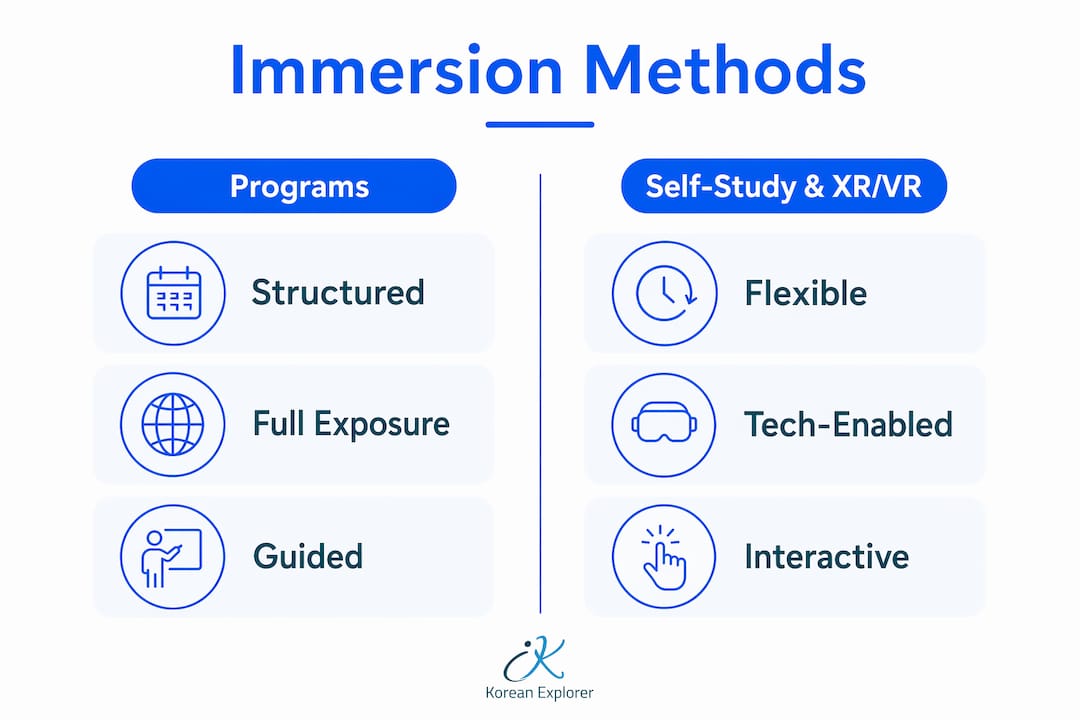
XR/VR immersive learning is the newest format and the most discussed. A 2025 systematic review published in Frontiers in Psychology found that VR improves learner engagement and long-term retention in educational contexts, though immediate vocabulary gains remain inconsistent. A 2026 study added an important nuance: word recall was higher after computer-based training in some attention profiles, suggesting VR’s advantage is real but conditional on session design and learner focus.
| Method | Key Benefit | Main Limitation | Best For |
|---|---|---|---|
| Full immersion program | Maximum exposure, fast fluency gains | Requires travel or intensive schedule | Committed learners with time flexibility |
| Partial immersion class | Structured, teacher-guided, corrective feedback | Less total immersion time per week | Working adults in structured courses |
| Self-directed media immersion | High volume, low cost, flexible timing | No feedback loop, easy to plateau | Supplementing formal study |
| XR/VR immersive learning | High engagement, memorable context | Effectiveness depends on design and attention | Tech-comfortable learners in supported programs |
The most effective approach for most adult learners is a combination: structured partial immersion in class, supplemented by self-directed media exposure outside of it.
What are the biggest challenges in immersive language learning?
The most common failure point in immersive language education is starting too fast. Early-stage immersion fails when learners lack the vocabulary to understand even the gist of input. When nothing is comprehensible, nothing is acquired. The brain does not absorb random noise; it acquires meaning.
Effective immersion design solves this by introducing new vocabulary and structures gradually within tasks that are already mostly understandable. A good rule: if you cannot follow the general thread of a conversation or text, the input is not yet immersive. It is just confusing.
Here are the practices that separate effective immersion from frustrating exposure:
- Match input to current level. Use graded readers, leveled listening materials, or teacher-curated content rather than jumping straight to native-speed media.
- Build in output tasks. Every immersion session should include at least one moment where you produce language, not just receive it.
- Create a feedback cycle. Without correction, errors fossilize. A qualified instructor or structured peer review catches patterns you cannot see yourself.
- Vary the context. Repeated encounters in varied contexts are what move vocabulary from recognition to production. Seeing a word in a drama, then using it in class, then writing it in a journal cements it far faster than any single encounter.
- Manage cognitive load in tech environments. The 2026 study on VR vocabulary learning found that learner attention profiles significantly affect outcomes. Shorter, focused sessions outperform long, passive VR experiences.
Pro Tip: If you are using Korean dramas or YouTube for self-directed immersion, turn on Korean subtitles rather than English ones. This keeps your brain processing in the target language and trains reading alongside listening simultaneously.
Educators designing immersion programs should treat comprehensibility as a non-negotiable constraint, not a nice-to-have. Comprehensible contextual input is the mechanism. Everything else is delivery format.
How does immersive learning apply to adult korean learners?
Adult Korean learners face a specific set of conditions that shape how immersion works best for them. Most are balancing work, social commitments, and limited study time. Full residential immersion is rarely practical. What works instead is a structured partial immersion model built around consistent, high-quality contact hours and deliberate self-directed practice between sessions.
For conversational and business Korean goals, the following approaches produce the strongest results:
- Conversation-focused classes. Courses that conduct instruction primarily in Korean, with native instructors who can switch to English for precision when needed, replicate partial immersion conditions without requiring travel. Korean Explorer’s adult courses follow exactly this model, with native instructors fluent in both Korean and English.
- Online Zoom-based learning. Interactive online classes remove the commute barrier and allow learners to attend from any environment. The live, real-time format preserves the output and feedback loop that self-study cannot replicate.
- Corporate training formats. Business-focused immersion programs concentrate vocabulary and scenarios on workplace communication, making every input directly relevant to the learner’s daily professional context. This relevance accelerates acquisition because the brain prioritizes meaningful, applicable content.
- Curated media supplementation. Korean news podcasts, business-oriented YouTube channels, and Korean workplace dramas like Misaeng provide authentic input that reinforces classroom vocabulary in real-world contexts.
The path to Korean fluency for adults runs through consistency, not intensity. Three hours of well-designed immersive contact per week, sustained over months, outperforms a single weekend intensive every time.
Key takeaways
Immersive language learning works because it combines comprehensible input at the right level with active output and repeated feedback cycles, producing both receptive and productive fluency.
| Point | Details |
|---|---|
| Immersion requires comprehensible input | Input must be slightly above current level (i+1) or acquisition stalls entirely. |
| Output is non-negotiable | Speaking and writing tasks build fluency that passive listening alone cannot develop. |
| Repeated varied encounters drive retention | One-off immersion sessions do not produce mastery; consistent cycles across contexts do. |
| XR/VR benefits depend on design | VR improves engagement but attention management and session structure determine actual learning gains. |
| Adults need structured partial immersion | Conversation-focused classes plus self-directed media practice is the most practical and effective model. |
Why i think most people are doing immersion wrong
I have watched hundreds of adult learners attempt immersion and stall at the same point: they confuse volume of exposure with quality of acquisition. They binge Korean content for weeks, feel productive, and then realize they cannot hold a basic conversation. The input was there. The acquisition was not.
The uncomfortable truth is that immersion without comprehension is just background noise. Krashen’s i+1 principle is not a soft suggestion. It is the mechanism. When learners skip past it because they want to feel advanced, they waste months. I have seen this pattern in classroom settings and in self-study logs alike.
Technology makes this worse before it makes it better. XR/VR tools create a powerful sense of immersion that can mask the absence of actual acquisition. A learner can spend an hour in a virtual Korean marketplace and leave with zero new vocabulary if the session was not designed around comprehensible, level-appropriate input. The feeling of immersion is not the same as the fact of it.
My advice: before you worry about the format of your immersion, worry about the level. Find content where you understand most of it, push yourself to produce language in response, and get corrected regularly. The format, whether it is a classroom, an app, or a VR headset, matters far less than whether those three conditions are met. Patience and structure beat novelty every time.
— Paul
Start your immersive korean learning journey with korean explorer
Korean Explorer offers adult Korean courses in Singapore built around the partial immersion model described in this article. Native instructors conduct classes primarily in Korean, creating real communicative pressure from day one. Flexible options include group classes at the International Plaza center above Tanjong Pagar MRT, and live Zoom sessions for learners who prefer to study from home or the office.
Corporate training programs are also available for teams that need business Korean for professional contexts. Every course follows a structured curriculum that keeps input comprehensible and builds output skills through conversation practice. If you are ready to move from studying Korean to actually using it, explore adult Korean courses or browse the full Korean language course catalog to find the right fit for your level and schedule.
FAQ
What is immersive language learning in simple terms?
Immersive language learning is a method where the target language is used as the main communication medium during study, rather than being treated as a subject to analyze. The goal is natural acquisition through meaningful use, not memorization of rules.
How is immersion different from traditional language classes?
Traditional classes teach the language as an object of study, often in the learner’s native language. Immersive classes conduct instruction in the target language itself, requiring learners to understand and respond in real time.
Does immersion work for adult learners?
Yes. Adult learners acquire language effectively through immersion when input is matched to their current level and output tasks are included. Structured partial immersion in conversation-focused classes is the most practical format for working adults.
Is watching korean dramas considered language immersion?
Watching Korean dramas qualifies as self-directed immersion when the content is at a comprehensible level and the learner actively engages with it. Passive viewing without comprehension does not produce acquisition.
How long does it take to see results from immersive learning?
Results depend on contact hours, consistency, and whether the immersion cycle includes output and feedback. Most adult learners notice measurable conversational gains within three to six months of consistent structured immersion practice.