TL;DR:
- Hangeul is the Korean writing system created in 1443 by King Sejong to improve literacy among common citizens. Its design reflects phonetic articulation and philosophical principles, making it logical and quick to learn. Today, Hangeul symbolizes Korean cultural identity and is widely recognized globally.
Hangeul is the official writing system of the Korean language, invented in 1443 by King Sejong the Great and a team of royal scholars to give every Korean citizen the ability to read and write. The system contains 24 basic characters: 14 consonants and 10 vowels. Those letters do not sit in a line like English letters. Instead, they stack into square syllable blocks, making Hangeul a hybrid between a true alphabet and a syllabic system. That structural choice is what makes the script both visually distinctive and surprisingly fast to learn. If you have ever wondered what is Hangeul and why linguists treat it as one of history’s most deliberate writing inventions, this article gives you the full picture.
How and why was hangeul created?
Hangeul was created by King Sejong during his reign from 1418 to 1450, with the explicit goal of fighting illiteracy. Before Hangeul existed, Korean speakers had to write using Chinese characters, known as Hanja. Hanja required years of study to master. Ordinary farmers, merchants, and women had almost no access to literacy because the learning curve was simply too steep.
King Sejong’s solution was radical. He commissioned scholars at the Hall of Worthies to design a brand new script from scratch, one that could be learned in days rather than decades. The result was announced in 1443 under the name Hunminjeongeum, which translates roughly as “the correct sounds for instructing the people.” That name alone tells you everything about the intent: this was a script built for the public, not for the elite.
“A wise man can acquaint himself with them before the morning is over; a stupid man can learn them in the space of ten days.” — King Sejong, from the Hunminjeongeum preface
What makes Hangeul historically unique goes beyond its design. Unlike most writing systems, which evolved gradually over centuries with no single author, Hangeul has a known creator, an exact creation date, and an original manual explaining every phonetic decision. That manual, the Hunminjeongeum Haerye, is preserved today and recognized by UNESCO as a Memory of the World document.
The reaction from Korea’s ruling class was not enthusiastic. Joseon’s elite dismissed the new script as a “vulgar alphabet” and resisted its adoption for centuries. They saw Chinese characters as the language of scholarship and power. Full mainstream acceptance of Hangeul did not arrive until the late 19th and early 20th centuries, when Korean nationalist movements reclaimed the script as a symbol of cultural identity.
Key facts about Hangeul’s origin:
- 1443: King Sejong and royal scholars complete the script
- Hunminjeongeum: The original name, meaning “correct sounds for the people”
- Hanja: The Chinese character system Hangeul was designed to replace
- Hunminjeongeum Haerye: The explanatory manual, now a UNESCO document
- Late 19th century: The period when Hangeul gained widespread public acceptance
What makes hangeul’s design unique and logical?
Linguists classify Hangeul as a featural alphabet, a rare category where the shapes of letters are not arbitrary. They are drawn to reflect how the mouth, tongue, and throat physically produce each sound. This is not a coincidence or an aesthetic choice. It is a deliberate phonetic map built into the visual form of every consonant.
How consonants mirror articulation
The consonant for the “g” or “k” sound is shaped like the back of the tongue pressing against the roof of the mouth. The consonant for “n” reflects the tongue tip touching the upper palate. The consonant for “m” looks like closed lips. A learner who understands this system can make educated guesses about pronunciation from the letter shape alone. No other major writing system does this as systematically.
How vowels reflect philosophy
Vowels in Hangeul follow a different logic. They are built from three philosophical elements: a dot representing heaven, a horizontal line representing earth, and a vertical line representing humanity. Combinations of these three strokes produce all ten basic vowels. This reflects the Neo-Confucian worldview of the Joseon dynasty, where the cosmos was understood through the relationship between sky, ground, and people.
Syllable blocks vs. linear alphabets
The most visible difference between Hangeul and scripts like English or Spanish is the syllable block structure. Rather than writing letters left to right in a single line, Hangeul groups each syllable into a compact square unit. Each block contains two to four letters arranged in a specific pattern depending on the sounds involved.
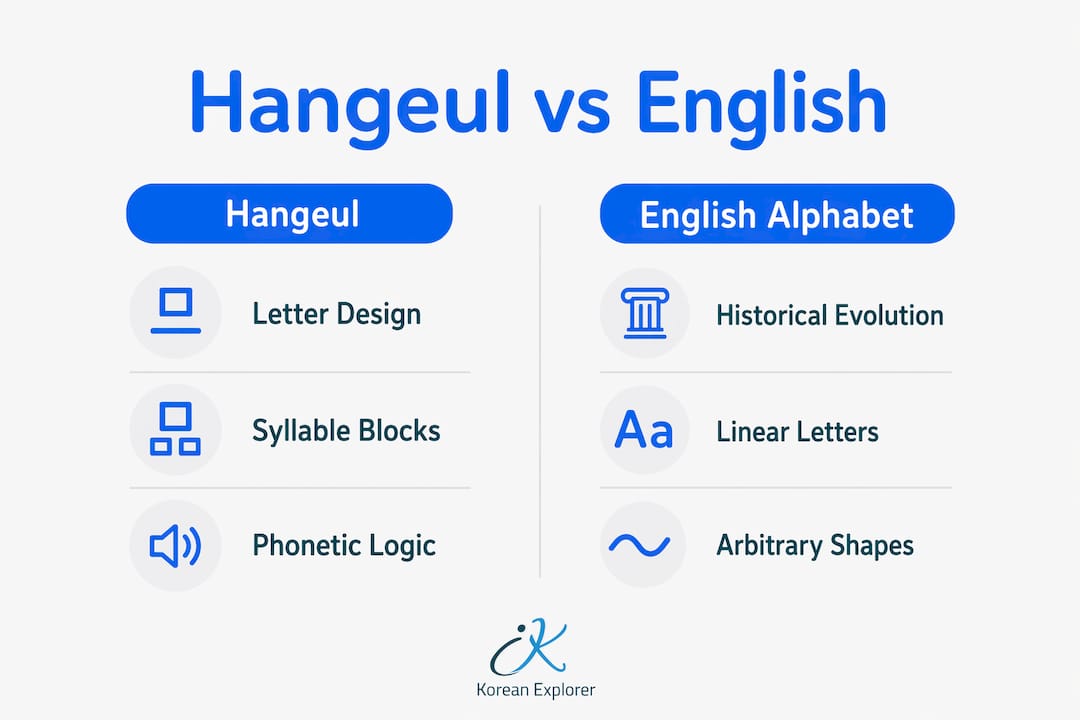
| Feature | Hangeul | English Alphabet |
|---|---|---|
| Letter design basis | Mouth and tongue position | Historical evolution, no phonetic logic |
| Vowel design basis | Philosophical symbols (heaven, earth, human) | Derived from Phoenician and Latin scripts |
| Writing direction | Left to right, in syllable blocks | Left to right, linear |
| Time to learn basics | 2–4 hours | Weeks to months for full phonics |
| Creator known | Yes, King Sejong the Great (1443) | No single creator |
Pro Tip: When you first study Hangeul consonants, cover the letter and try to mimic the mouth position it depicts. This physical connection accelerates recognition and helps pronunciation click faster than rote memorization.
How can beginners effectively learn to read hangeul?
Hangeul is one of the fastest writing systems to acquire. Most learners can read basic Korean text within 2–4 hours of focused study. That speed is not a marketing claim. It reflects the script’s intentional design: a small set of logical letters that combine predictably.
The biggest mistake beginners make is treating Hangeul like English. They try to read letters one by one from left to right. Hangeul does not work that way. Each syllable block must be read as a unit. Understanding that structure first is the single most important step.
Here is a practical sequence for getting started:
- Learn the 14 consonants first. Group them by articulation position: throat sounds, tongue sounds, and lip sounds. This grouping mirrors the featural logic built into the script.
- Learn the 10 vowels next. Recognize the three base strokes (vertical, horizontal, and dot) and how they combine. You will see patterns immediately.
- Practice reading syllable blocks, not isolated letters. Take a simple Korean word and identify the initial consonant, the vowel, and the final consonant (if present) within each block.
- Use audio alongside text from day one. Hangeul is phonetically consistent, so hearing a word while reading it locks in pronunciation faster than silent study.
- Write by hand before typing. The physical act of drawing each character reinforces the featural logic and helps you remember shapes under pressure.
You can find structured tips for learning Hangeul that walk through this sequence with examples designed for adult learners. For a faster track, Korean Explorer’s guide on reading Korean fast covers the zero-to-reading process with practical exercises.
Pro Tip: After learning the basic 24 characters, move immediately to reading real Korean words rather than practice syllables. Real words give you context, and context is what makes new letters stick in long-term memory.
Why is hangeul culturally significant in korea today?
Hangeul is not just a writing tool. It is a national symbol. King Sejong’s founding philosophy held that literacy is a right belonging to every citizen, not a privilege reserved for scholars. That idea was revolutionary in 15th-century East Asia, and Koreans today treat it as a core part of their cultural identity.
The script’s journey from “vulgar alphabet” to national icon is one of the more striking reversals in linguistic history. For centuries, educated Koreans wrote in Chinese characters while Hangeul was used mainly by women and commoners. The late 19th century brought a surge of Korean nationalism, and Hangeul became the standard written language. By the 20th century, it was the official script of both South Korea and North Korea, where it is called Joseogeul.
Key markers of Hangeul’s cultural significance today:
- Hangeul Day: South Korea celebrates Hangeul Day on October 9 each year as a national holiday. The date reflects mid-20th-century historical interpretation of the script’s proclamation, underscoring that its development was a multi-year project rather than a single moment.
- Global reach: Korean diaspora communities across the United States, Canada, Australia, and Singapore use Hangeul as a marker of cultural connection.
- K-culture gateway: The global rise of Korean pop music, television dramas, and film has made Hangeul recognizable worldwide, driving millions of new learners to study the script each year.
- Linguistic equality: Hangeul embodies the principle that all people deserve access to written language, a value that resonates far beyond Korea’s borders.
The script’s design also supports modern digital communication exceptionally well. Hangeul’s block structure maps cleanly onto keyboard layouts, and Korean text input on smartphones is among the fastest of any language because each syllable block is typed as a logical unit.
Key takeaways
Hangeul is the world’s only major writing system with a documented creator, a known invention date, and a surviving manual explaining its phonetic logic, making it as historically significant as it is practical to learn.
| Point | Details |
|---|---|
| Hangeul’s core structure | 24 basic letters (14 consonants, 10 vowels) arranged into syllable blocks, not linear rows. |
| Historical origin | King Sejong the Great created Hangeul in 1443 to replace complex Chinese characters and expand literacy. |
| Unique design logic | Consonant shapes mirror mouth and tongue positions; vowels reflect philosophical symbols for heaven, earth, and humanity. |
| Learning speed | Most beginners can read basic Korean text within 2–4 hours by mastering the syllable block system first. |
| Cultural weight | Hangeul Day on October 9 marks the script as a national symbol of equality and Korean identity worldwide. |
Why hangeul deserves more credit than it gets
I have spent years working with Korean language learners at every level, and one pattern repeats itself constantly. Students arrive expecting Hangeul to be the hard part. They have heard that Korean is difficult, and they assume the writing system is where that difficulty lives. Within a week, most of them are reading. Within two weeks, they are reading faster than they expected. The script is not the obstacle. It is the gateway.
What surprises people most is the internal logic. When I explain that the consonant for “m” looks like closed lips, I watch something shift in a learner’s face. They realize this is not a system they have to memorize by brute force. It is a system they can understand. That distinction changes everything about how quickly they progress.
The common misconception I push back on hardest is the idea that Hangeul and Hangul are two different things. They are not. Hangul is simply the older romanization spelling used in South Korea’s official romanization system. Hangeul is the spelling preferred by many linguists and educators to better reflect the Korean pronunciation. Both refer to the same script. Neither is wrong. Knowing this saves learners from unnecessary confusion early on.
My honest observation after years of teaching is this: the learners who struggle with Hangeul are almost always the ones who skip the syllable block logic and try to read letter by letter. The ones who take thirty minutes to understand how blocks are constructed move through the rest of the script with confidence. The foundation matters more than the speed.
If you are approaching Korean as an adult learner, treat Hangeul as a puzzle worth solving, not a hurdle to clear. The script was designed to be learned. King Sejong said so himself.
— Paul
Start reading korean sooner than you think
If this article has made Hangeul feel less intimidating, that reaction is exactly right. The script was built to be accessible, and with the right structure, most adult learners move from zero to reading in a single focused session.
Korean Explorer offers adult Korean courses in Singapore built around practical communication, whether your goal is conversational fluency, business Korean, or online learning via Zoom. The curriculum follows Seoul National University’s framework, taught by native Korean instructors who explain concepts clearly in English. Classes run at the Tanjong Pagar, Jurong, and Tampines centers, with online options available for learners across Singapore and beyond. Explore Korean language courses designed for adults, or browse the full course catalog to find the right fit for your schedule and level.
FAQ
What is the difference between hangeul and hangul?
Hangeul and Hangul refer to the same Korean writing system. The spelling difference comes from two different romanization conventions, with Hangeul being the preferred academic spelling and Hangul the standard in South Korea’s official romanization system.
How many letters does hangeul have?
Hangeul has 24 basic characters: 14 consonants and 10 vowels. These combine into syllable blocks to form every sound in the Korean language.
How long does it take to learn hangeul?
Most learners can read basic Korean text within 2–4 hours of focused study. The syllable block structure is the key concept to master first, and understanding it early makes the rest of the script straightforward.
Who invented hangeul and why?
King Sejong the Great and his royal scholars invented Hangeul in 1443 to replace Chinese characters and give ordinary Koreans access to literacy. The original name was Hunminjeongeum, meaning “the correct sounds for instructing the people.”
Is hangeul used in both north and south korea?
Yes. South Korea uses the script under the name Hangeul, while North Korea calls it Joseogeul. Both countries use the same 24-character system, though some vocabulary and spelling conventions differ between the two.