TL;DR:
- Blended learning in Korean integrates face-to-face instruction with online self-study to enhance language acquisition. Its success relies on active, deliberate connection between online tasks and live sessions, versus just combining digital tools with traditional classes. This flexible, learner-driven approach effectively addresses specific challenges faced by adult Korean learners.
Blended learning for Korean is not what most people think it is. If you picture a teacher emailing students a few YouTube links before class, that’s not blended learning. That’s just homework with extra steps. What is blended learning Korean, properly defined, is a structured method that integrates face-to-face instruction with online self-study in a way where each component directly reinforces the other. For adult learners and professionals who need flexibility without sacrificing interaction, this model is genuinely different from both traditional classroom courses and fully online programs.
Table of Contents
- Key takeaways
- What blended learning means in Korean language education
- How blended learning addresses Korean acquisition challenges
- Critical factors for a successful blended Korean experience
- Real-world examples of blended Korean courses
- My take on what actually makes blended Korean learning work
- How Korean Explorer approaches blended Korean learning
- FAQ
Key takeaways
| Point | Details |
|---|---|
| Blended learning has three requirements | True blended learning needs student control, in-person sessions, and content that integrates across both modes. |
| It solves real Korean learning problems | The model extends learning time beyond class hours, which addresses speaking and listening practice gaps. |
| Design matters more than technology | Course structure and active tasks produce better outcomes than simply adding digital tools to a syllabus. |
| Learner self-regulation is a success factor | Digital literacy and personal study habits determine results as much as the quality of teaching. |
| Adults benefit most from the flexibility | Asynchronous study combined with live sessions fits the schedules of working professionals learning Korean. |
What blended learning means in Korean language education
The term gets used loosely, so it helps to be precise. True blended learning requires three specific conditions: some degree of student control over pace or path, at least some in-person instruction, and content that is deliberately integrated across both the online and offline components. Remove any one of those three and you have something else entirely.
In the context of Korean language courses, this means your weekly live sessions with an instructor are not supplemented by online content. They are connected to it. What you practice on the learning management system (LMS) during the week should feed directly into what you do in class, and vice versa. The live session might focus on speaking and correction, while the online component handles vocabulary drilling, grammar explanation, and listening exercises. Neither half stands alone.
Here is how blended Korean learning compares to the other two common formats:
| Feature | Blended learning | Traditional classroom | Fully online |
|---|---|---|---|
| Schedule flexibility | High (mix of async and live) | Low (fixed class times) | Very high (fully self-paced) |
| Speaking and interaction | Strong (live sessions + online tasks) | Strong in class only | Varies widely |
| Learner autonomy | Moderate to high | Low | High |
| Feedback quality | Structured and regular | Dependent on class size | Often automated only |
| Best suited for | Busy adults, professionals | Full-time students | Self-disciplined learners |
Pro Tip: When evaluating a blended Korean course, ask specifically how the online and offline content connect. If the answer is vague, the course is probably just a traditional class with digital extras bolted on.
Blended learning is effective when dialogue, practice, and feedback are distributed intentionally between its two components. That distribution is what separates a thoughtfully designed blended Korean course from a disorganized hybrid.
How blended learning addresses Korean acquisition challenges
Korean presents specific learning challenges that blended education methods handle particularly well. The writing systems (Hangul, plus the eventual need to recognize Hanja-origin vocabulary), the honorific speech levels, and the verb-final sentence structure all require repeated exposure and corrective feedback. Traditional classroom models often fall short because there simply is not enough class time to cover everything and still practice speaking.

Blended course design resolves this by using digital resources to handle the time-consuming repetition phase outside of class. Grammar explanations, vocabulary review, and listening comprehension can all happen asynchronously at your own pace. This frees up live sessions for what instructors do best: real-time speaking practice, pronunciation correction, and cultural context.
The benefits this creates for adult Korean learners are specific and meaningful:
- Extended learning time. You are not limited to two or three hours of instruction per week. Online components let you engage with Korean on your own schedule, which compounds your exposure significantly over a course.
- Personalized pacing. Blended models allow asynchronous study that fits around work schedules and personal commitments, making consistent progress realistic for professionals.
- Active production. Quality blended courses assign online tasks that require you to produce language, not just consume it. Speaking submissions, written responses, and interactive drills all reinforce what live sessions teach.
- Regular feedback loops. Online assignments submitted between live sessions give instructors a window into where individual learners are struggling, allowing for targeted correction during class time.
- Community of inquiry. Effective blended environments include social and community elements that keep learners engaged and accountable, not just a solo video-watching experience.
Pro Tip: Look for courses where online tasks require you to submit recordings or written responses. Passive video watching is the least effective online component a blended Korean course can offer.
The combination of flexibility and structure is why this model works so well for working adults. You get the real human interaction that language acquisition requires, without sacrificing the schedule flexibility that makes learning sustainable.
Critical factors for a successful blended Korean experience
Not all blended Korean courses deliver equally. The model creates the conditions for excellent learning, but several factors determine whether those conditions actually produce results for you.
Course design and integration
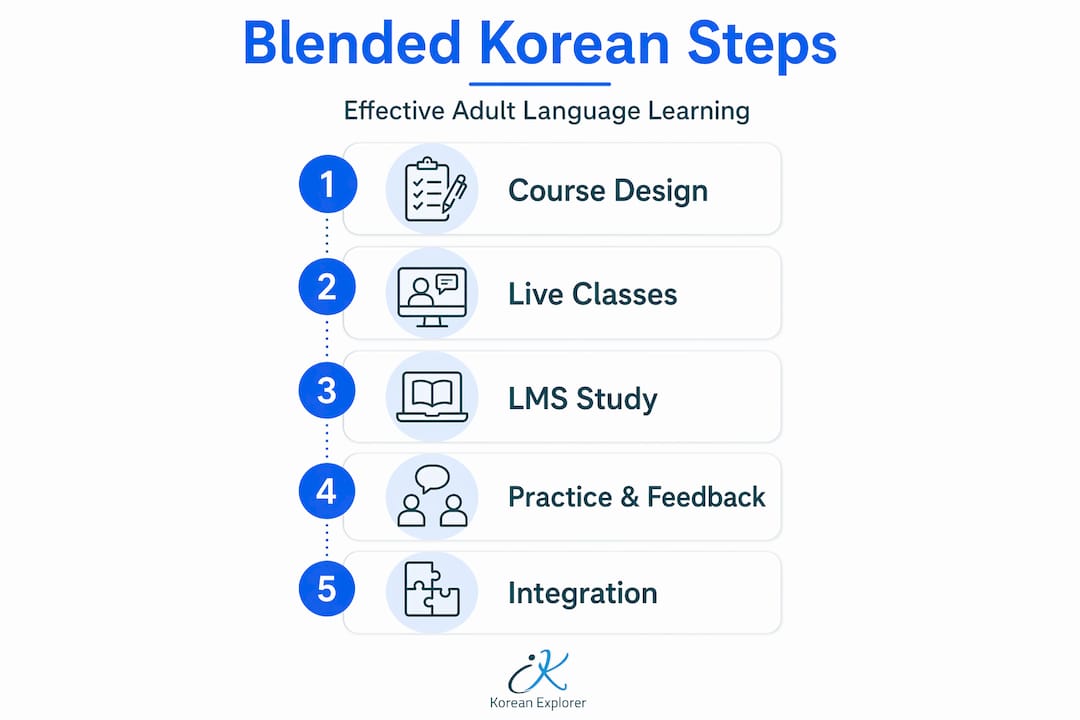
The most important variable is whether the course was designed as a blended program from the start or assembled by combining existing materials. Research consistently shows that course design and active learning tasks matter far more than the technology used. When online and offline activities are genuinely connected, progress accelerates. When they are parallel but unrelated, learners effectively end up doing two separate courses simultaneously.
Learner self-regulation and digital readiness
Blended learning outcomes strongly correlate to a learner’s ability to self-regulate and manage their own study schedule. This does not mean you need to be highly disciplined by nature. It means the course itself should build in routines and checkpoints that develop those habits. LMS platforms with structured weekly tasks and progress tracking help learners stay on track.
Here is a practical checklist for choosing and succeeding in a blended Korean course:
- Confirm true integration. Ask how the LMS content connects to live sessions. The answer should be specific, not generic.
- Check the online task types. Speaking submissions, quizzes, and interactive exercises beat passive video content every time.
- Assess the feedback structure. Regular instructor feedback on online tasks is non-negotiable for language learning.
- Evaluate your own digital comfort. If you are new to LMS platforms, look for a course that includes a short orientation or support resources.
- Set a personal study schedule. Treat your online study sessions as fixed appointments, not optional extras. Consistent engagement with the online component is what separates strong outcomes from mediocre ones.
- Check the digital learning resources available. Quality external resources can support your between-class practice and accelerate vocabulary retention.
Pro Tip: If a blended Korean course does not have a clear LMS or structured online platform, it is not actually blended learning. A shared Google Drive or occasional email is not a learning management system.
Accessibility matters too. Technical problems, unclear instructions, or a lack of instructor responsiveness between sessions can derail even a motivated learner. Good blended programs have support structures built in.
Real-world examples of blended Korean courses
Concrete examples make the model easier to understand. Here is how blended Korean learning actually looks in practice.
One well-documented structure combines twice-weekly in-person sessions with a weekly LMS-based self-study component. This format, used by institutions including INLL in Luxembourg, runs across two semesters and sequences content so that online sessions build vocabulary and grammar awareness before live sessions focus on application and speaking practice.
Another model applies the blended approach specifically to proficiency preparation. The structure from programs like Enderun Extension’s TOPIK I course runs over fifteen weeks and uses LMS-delivered video content and practice materials alongside weekly instructor-led live sessions. Online materials handle repetition and form-based practice, while live sessions target feedback, corrections, and timed exam simulations. This division of labor reflects a key principle of well-designed blended learning: put the tasks that benefit from repetition online, and use live time for what only a human instructor can provide.
Here is how typical blended Korean course components break down:
| Component | Format | Frequency | Learner engagement type |
|---|---|---|---|
| Grammar and vocabulary modules | Async LMS | Weekly | Self-paced, interactive |
| Live instruction sessions | Online Zoom or in-person | 1 to 2 times weekly | Real-time, instructor-led |
| Speaking submission tasks | Async (recorded) | Weekly or biweekly | Active production |
| Progress checks and quizzes | Async LMS | Weekly | Self-assessment |
| Group conversation practice | Live online | Monthly or biweekly | Peer interaction |
What makes these structures effective is not the technology behind them. It is the intentional design that combines individual study and community interaction in a way that serves language acquisition specifically. Korean is a language where speaking confidence builds only through repeated, corrected practice. The blended model creates more of those practice moments than any single-format course can.
My take on what actually makes blended Korean learning work
I’ve seen many adult learners come into Korean courses with high motivation and leave frustrated because the format did not match how they needed to learn. And I’ve seen the opposite: learners who expected to struggle with Korean find real traction because the structure of their blended course gave them exactly the right kind of accountability and flexibility at the same time.
Here is what I’ve learned from observing these outcomes closely. The technology in a blended Korean course is almost irrelevant. What matters is whether the instructor who runs the live sessions actually knows what students did online that week, and whether the online tasks pushed learners to produce language rather than just absorb it. A course where the two halves operate independently is not blended learning. It is two separate courses sold as one.
The learners who succeed in blended Korean programs are not necessarily the most talented or the most disciplined. They are the ones who treat the online component with the same seriousness they bring to live sessions. Skipping the LMS work before a live class is like skipping the reading before a seminar. You can show up, but you will not get much out of it.
My honest advice: when evaluating a Korean language blended approach, spend less time looking at the platform features and more time asking how the instructor uses your online activity to shape live instruction. That feedback loop is where real progress happens. And if you are looking at online Korean classes as part of a blended setup, the structure behind them matters more than the interface.
— Paul
How Korean Explorer approaches blended Korean learning
Korean Explorer offers adult Korean language courses that reflect what genuine blended learning looks like in practice. Courses combine structured LMS-based self-study with live instruction delivered both online via Zoom and in-person at the International Plaza center above Tanjong Pagar MRT, giving learners real flexibility without compromising on interaction or feedback quality.
The curriculum, grounded in Seoul National University’s framework, is designed so that online and offline components work together rather than in parallel. Whether your goal is conversational fluency, business Korean, or corporate training, the course structures are built around how adults actually learn: with clear routines, regular instructor feedback, and speaking practice that builds real confidence. Explore the full range of Korean language courses and find the format that fits your schedule and goals.
FAQ
What is blended learning in a Korean language course?
Blended learning in Korean combines face-to-face or live online instruction with structured self-study through an LMS platform. The key is that both components are integrated so that each reinforces the other, not running as separate tracks.
How is blended learning different from fully online Korean courses?
Fully online courses deliver all content digitally without scheduled live instruction, while blended learning includes regular live sessions with an instructor. The live component is what allows real-time speaking practice and personalized correction that online-only formats rarely replicate.
What are the main benefits of blended learning for Korean?
The primary benefits are flexible scheduling through asynchronous online study, extended learning time beyond class hours, and structured live interaction for speaking and feedback. Together, these make consistent progress realistic for working adults.
How do I know if a blended Korean course is well-designed?
Look for clear connections between the online and live components, active online tasks that require speaking or writing submissions, and regular instructor feedback on your between-class work. If the two halves feel disconnected, the course is likely not truly blended.
Do I need technical skills to succeed in a blended Korean learning program?
Basic digital literacy is enough for most programs. Learner self-regulation and consistent engagement with the online platform matter more than technical ability, and good programs include orientation support to get you started.