TL;DR:
- Learning Korean for gaming improves reading speed, communication, and understanding of game narratives. Immersive, gamified practice accelerates proficiency, often reaching beginner level in about 40 hours. Using slang, honorifics, and short commands helps maintain natural interaction in multiplayer and story-based games.
Korean language for game fans is the targeted study of Korean vocabulary, slang, honorifics, and narrative language specifically shaped around gaming culture and Korean pop culture. Gamers who pick up even basic Korean gain a real edge: they read game text faster, communicate with Korean-speaking teammates, and follow storylines without waiting for translations. This guide covers the foundational skills you need, the most effective ways to learn through play, the slang every gamer should recognize, and the practical tools that keep you motivated long after the tutorial ends.
What Korean language skills do game fans actually need?
The first skill every gamer needs is Hangul, the Korean alphabet. Hangul has 24 base characters and follows a block-based structure that most learners can read within a week of focused practice. Reading Hangul unlocks game menus, item names, and NPC dialogue that would otherwise stay locked behind a language barrier.
After Hangul, focus on grammar patterns built around commands and imperatives. Games communicate through short, direct instructions: “attack,” “defend,” “move,” “select.” Korean mirrors this with verb-final sentence structures where the action word lands at the end. Learning this pattern early means you parse in-game prompts naturally instead of mentally rearranging every sentence.
Core beginner vocabulary for gamers includes:
- 게임 (geim) — game
- 시작 (sijak) — start
- 끝 (kkeut) — end
- 레벨 (rebel) — level
- 공격 (gonggyeok) — attack
- 방어 (bang-eo) — defense
- 아이템 (aitem) — item
- 퀘스트 (kweseутeu) — quest
These eight words appear in nearly every Korean game interface. Memorizing them first gives you an immediate return on your study time.
Pronunciation matters more in voice chat than in text. Korean vowels are consistent and do not shift the way English vowels do. Once you learn the five core vowel sounds, your spoken Korean becomes far more intelligible to native speakers. For practice, beginner Korean lessons that focus on phonics before grammar give you the fastest start.

Pro Tip: Write the Hangul for your five most-used in-game commands on a sticky note next to your monitor. Reading them every session builds recognition faster than any flashcard app.
How does gamified learning build Korean skills faster?
Gamified Korean learning uses the same mechanics as the games you already play: quests, rewards, spaced repetition, and NPC conversations. This approach works because it ties new vocabulary to memorable contexts rather than isolated word lists.
Beginner proficiency at A1 level is achievable in 40–50 hours of combined gameplay and study. That figure matters because it sets a realistic target. Forty hours is roughly two months of casual daily sessions, which is far shorter than most learners expect.
The mechanics that drive this speed are specific. Spaced repetition combined with puzzles and combat challenges forces you to recall vocabulary at increasing intervals, which is the most research-supported method for long-term retention. NPC interactions add a social layer: you choose dialogue options, face consequences, and repeat conversations until you get them right. That loop mirrors real conversation practice.

| Learning method | Best for | Time to first results |
|---|---|---|
| Gamified RPG apps | Vocabulary and sentence structure | 2–4 weeks |
| Spaced repetition tools | Character and word recall | 1–2 weeks |
| Narrative-driven games | Reading comprehension and context | 4–6 weeks |
| Conversation practice | Speaking and listening | Ongoing |
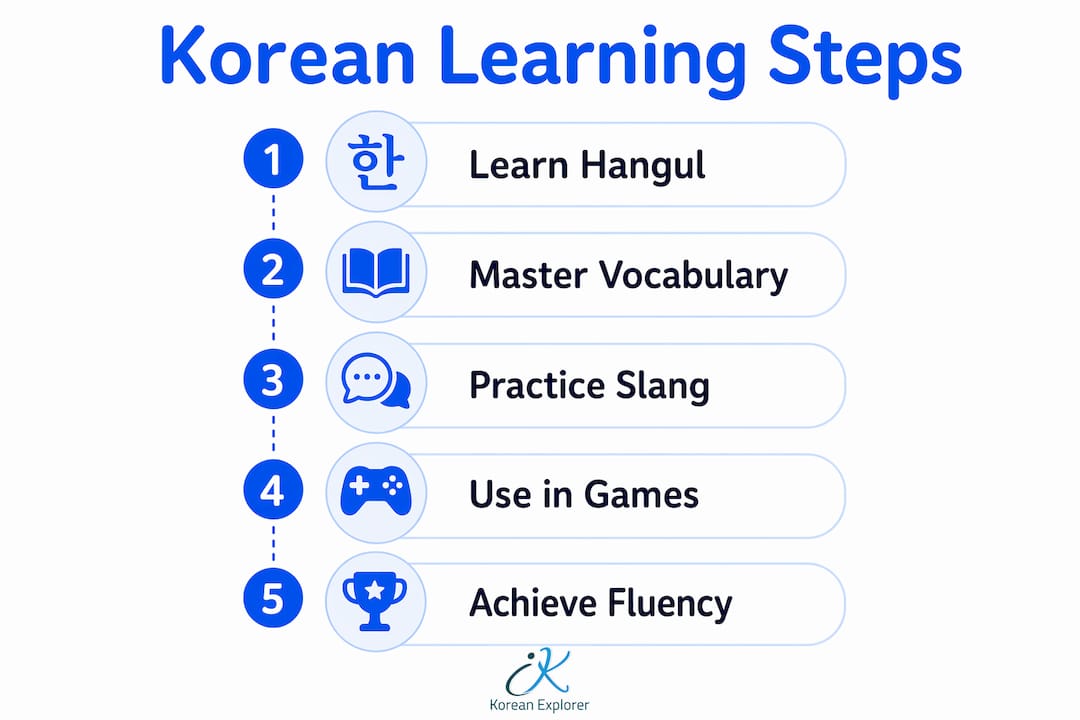
Immersive storylines add a layer that pure flashcard tools cannot replicate. When you care about a character’s fate, you pay closer attention to their dialogue. Engaging storylines and interactive dialogues deepen contextual learning because emotional investment improves memory encoding. This is why playing a Korean RPG with the audio on and subtitles off, even when it feels uncomfortable, accelerates comprehension faster than passive reading.
Pro Tip: Set your game’s language to Korean and keep an in-game dictionary or translation app open in a second window. Look up only the words that block your progress, not every unfamiliar term. This keeps immersion high and builds tolerance for ambiguity, which is a real-world language skill.
What Korean gaming slang should every gamer know?
Korean gaming slang is not just for games. Terms like “Mallep,” “GG,” and “Nerf/Buff” have moved into everyday Korean speech, which means learning them pays off both inside and outside the game.
Here are the terms that come up most often:
- 말렙 (Mallep) — short for “max level.” Used in games to describe a fully leveled character. In daily life, Koreans use it to mean someone is at the top of their field.
- GG — “good game.” Said at the end of a match as a sign of respect or, sarcastically, to signal a hopeless situation.
- 너프 (Nerf) — a reduction in a character’s power, borrowed directly from English gaming culture. Koreans also use it to describe someone whose abilities or status have been reduced in real life.
- 버프 (Buff) — the opposite of Nerf. A boost in power or status, used in daily conversation to mean someone got a promotion or advantage.
- 존버 (Jonbeo) — a slang term meaning to endure or hold on through a difficult situation. It originated in gaming but now appears widely in Korean social media and conversation.
- 캐리 (Kaeri) — from “carry.” Describes a player who single-handedly leads the team to victory. Used in daily life to mean someone who does all the heavy lifting in a group project.
Popular Korean gaming slang terms appear frequently in Korean media, social platforms, and casual conversation. Knowing them signals cultural fluency, not just language ability. When you use “Mallep” correctly in a sentence, Korean-speaking teammates recognize you as someone who genuinely engages with their culture.
Building your Korean vocabulary through slang is one of the fastest paths to sounding natural. Slang carries cultural weight that textbook phrases do not, and gamers who use it correctly earn immediate credibility in online communities.
How do you apply Korean in multiplayer and narrative-driven games?
Applying Korean in live multiplayer requires a different mindset than studying it. Speed matters more than accuracy. Short, direct communication using action imperatives and key nouns outperforms long, grammatically perfect sentences in every high-pressure gaming situation. Say “공격해” (attack) instead of constructing a full sentence. Your teammates will respond faster, and you will not freeze mid-fight trying to remember grammar rules.
Honorifics are the single most misunderstood element of Korean for non-native speakers. Korean has multiple speech levels, and using the wrong one creates immediate social friction. Inconsistencies in honorific usage reduce narrative immersion and feel unnatural to native players. In multiplayer, using overly formal speech with friends sounds stiff. Using casual speech with strangers can come across as rude. The safest default for new learners is the polite informal level, which ends verbs in “요” (yo). It works in almost every social gaming context.
For narrative-driven games, follow these steps to maximize comprehension:
- Play through the opening sequence once with English subtitles to understand the story structure.
- Replay key cutscenes in Korean audio with Korean subtitles. Read along rather than translating word by word.
- Pause on dialogue lines that use unfamiliar grammar patterns. Write them down and look them up after the session, not during.
- Focus on character-specific speech patterns. Villains often use harsh, abrupt speech. Heroes use polite or neutral forms. Recognizing these patterns builds intuitive grammar sense.
- After each session, review three to five new words from the dialogue. Attach them to the scene where you heard them for stronger memory anchoring.
“Mastering Korean honorifics is not about memorizing rules. It is about reading the social relationship between characters and matching your speech to that relationship. Games give you dozens of these relationships to practice with, which is something no textbook can replicate.”
Immersive language learning through narrative games works because it forces you to process language in context rather than in isolation. Game translation also distinguishes between real-world concepts and fictional terms, a distinction linguists call “realia” versus “irrealia.” Game translation differentiates realia from irrealia to preserve both accuracy and fantasy. Understanding this helps you recognize when a Korean term is a real word versus a transliterated fantasy concept, which prevents confusion when you encounter the same term outside the game.
What tools and resources work best for Korean learners who game?
The right tool depends on where you are in your learning. Beginners need structured phonics and basic vocabulary before they can benefit from immersive content. Intermediate learners need conversation practice and exposure to natural speech.
Gamified platforms offer customizable difficulty settings, daily goals, and in-game dictionaries for contextual support. These features matter because they let you adjust the challenge as your skills grow without switching to a completely new tool.
Key resources by learning stage:
- Beginner: Phonics-focused apps that teach Hangul reading and basic vocabulary. Look for tools that use audio from native speakers, not synthesized voices. A guide to top apps for beginners can help you choose based on your schedule and learning style.
- Intermediate: Narrative-driven Korean games with Korean audio and subtitles. Korean dramas and variety shows set in gaming contexts also work well at this stage.
- Community practice: Korean-speaking gaming communities on Discord and Reddit provide real-time text practice. Post in Korean, ask for corrections, and read how native speakers respond. This is free, fast, and brutally honest feedback.
Staying motivated is the real challenge after the first month. Set a specific in-game goal tied to your language study. For example, aim to complete one quest entirely in Korean before switching back to English. Small, game-linked milestones keep the learning loop active without making Korean feel like homework.
Free apps for learning Korean on mobile let you practice during loading screens, commutes, and downtime between matches. Five minutes of focused vocabulary review during a queue timer adds up to meaningful progress over weeks.
Key Takeaways
Korean language for game fans accelerates fastest when learners combine Hangul basics, gaming slang, and honorific awareness with gamified tools and real multiplayer practice.
| Point | Details |
|---|---|
| Start with Hangul | Reading Korean script unlocks game text, menus, and dialogue from day one. |
| Use gamified learning | A1 beginner proficiency is reachable in 40–50 hours with narrative-driven game apps. |
| Learn gaming slang | Terms like Mallep, GG, and Jonbeo work in games and in everyday Korean conversation. |
| Master speech levels | Use the polite informal level ending in “요” as your default in multiplayer to avoid social friction. |
| Keep communication short | Action imperatives and key nouns outperform long sentences in live multiplayer situations. |
Why gaming is the most underrated Korean learning method
I have watched adult learners struggle through textbook Korean for months, then make a year’s worth of progress in six weeks after switching to Korean-language gaming. The difference is not the content. It is the stakes. When you need to communicate with your team to win a match, you stop overthinking grammar and start using the language.
The mistake most learners make is treating gaming as a reward they earn after studying. Flip that. Use gaming as the primary input and structured study as the support system. Play in Korean first, then look up what confused you. That order keeps motivation high and builds the kind of intuitive comprehension that classroom study alone rarely produces.
Cultural sensitivity matters more than most gaming guides admit. Korean gamers expect consistent speech levels and appropriate tone, and lapses are noticed immediately. Getting honorifics wrong does not just sound awkward. It signals that you have not engaged seriously with the culture. The good news is that Korean-speaking gaming communities are generally patient with learners who make genuine effort. Show up, use the slang correctly, and admit when you are still learning. That combination earns more goodwill than perfect grammar.
Persistence is the only non-negotiable. Korean is not a language you crack in a weekend. But every hour you spend in a Korean-language game environment is an hour of real language exposure, and that compounds faster than most learners expect.
— Paul
Korean Explorer: structured learning for adult gamers
Korean Explorer offers adult Korean courses built around conversational fluency, which is exactly the skill set that gaming and pop culture fans need most. Classes run in group, private, and online Zoom formats, so you can fit structured learning around your gaming schedule without sacrificing either.
The curriculum follows a framework developed by Seoul National University, which means the grammar and vocabulary you learn in class maps directly onto the Korean you encounter in games and media. Native Korean instructors who are fluent in English explain cultural context alongside language rules, so you understand not just what to say but when and why. Whether you are starting from zero or ready to move past the basics, Korean language courses in Singapore at Korean Explorer give you a structured path to the fluency that makes gaming in Korean genuinely enjoyable.
FAQ
What is the best way to start learning Korean for gaming?
Learn Hangul first, then focus on gaming-specific vocabulary and short imperative phrases. Beginner proficiency at A1 level is reachable in 40–50 hours with gamified learning tools.
What Korean gaming slang should I learn first?
Start with GG, Mallep, Buff, Nerf, Jonbeo, and Kaeri. These terms appear constantly in Korean games and online communities, and they also show up in everyday Korean conversation.
How do honorifics affect Korean multiplayer communication?
Using the wrong speech level creates immediate social friction with Korean-speaking players. The polite informal level, which ends verbs in “요,” works as a safe default in almost every multiplayer context.
Can I learn Korean effectively by playing Korean games?
Yes. Narrative-driven Korean games with Korean audio and subtitles provide real contextual exposure that accelerates vocabulary retention and reading comprehension significantly.
How long does it take to communicate in Korean while gaming?
Most learners can handle basic in-game commands and team communication within four to six weeks of consistent study combined with active gameplay in Korean.