TL;DR:
- Hangul is Korea’s featural alphabet composed of 14 consonants and 10 vowels that form syllabic blocks. Learning proper stroke order and understanding the structure of syllable blocks are essential for developing fluent handwriting. Mastery of Hangul’s design principles accelerates recognition and writing skills, leading to genuine comprehension of the Korean language.
Hangul is Korea’s featural alphabet, built from 14 consonants and 10 vowels that combine into syllabic blocks to form every Korean word. Learning how to write Hangul is the single most important first step in your Korean language journey. Unlike Chinese characters, which require years of memorization, Hangul’s design is logical and learnable. This guide walks you through the letters, stroke order, syllable formation, and the study habits that actually build fluency.
What are the basic hangul letters and their sounds?
Hangul is a featural alphabet where consonant shapes physically mimic the position of your mouth and tongue when producing each sound. That design is not accidental. King Sejong created Hangul in 1443 specifically so that ordinary people could learn to read and write quickly. Understanding this principle moves you beyond rote memorization into genuine comprehension.

The 14 basic consonants
The 14 basic consonants cover a full range of sounds. Here are the most foundational ones:
| Consonant | Sound | Example Syllable |
|---|---|---|
| ㄱ | “g” or “k” | 가 (ga) |
| ㄴ | “n” | 나 (na) |
| ㄷ | “d” or “t” | 다 (da) |
| ㄹ | “r” or “l” | 라 (ra) |
| ㅁ | “m” | 마 (ma) |
| ㅂ | “b” or “p” | 바 (ba) |
| ㅅ | “s” | 사 (sa) |
| ㅇ | silent or “ng” | 아 (a) |
| ㅈ | “j” | 자 (ja) |
| ㅎ | “h” | 하 (ha) |
Notice that ㅇ appears silent when placed at the start of a syllable. It acts as a placeholder so that vowel-initial syllables still follow the consonant-vowel block structure.
The 10 basic vowels
The 10 basic vowels divide into vertical and horizontal forms. Vertical vowels like ㅏ (“a”), ㅓ (“eo”), ㅣ (“i”), ㅔ (“e”), and ㅐ (“ae”) sit to the right of the consonant. Horizontal vowels like ㅗ (“o”), ㅜ (“u”), ㅡ (“eu”), ㅛ (“yo”), and ㅠ (“yu”) sit below the consonant. This placement rule directly determines how you build a syllable block.
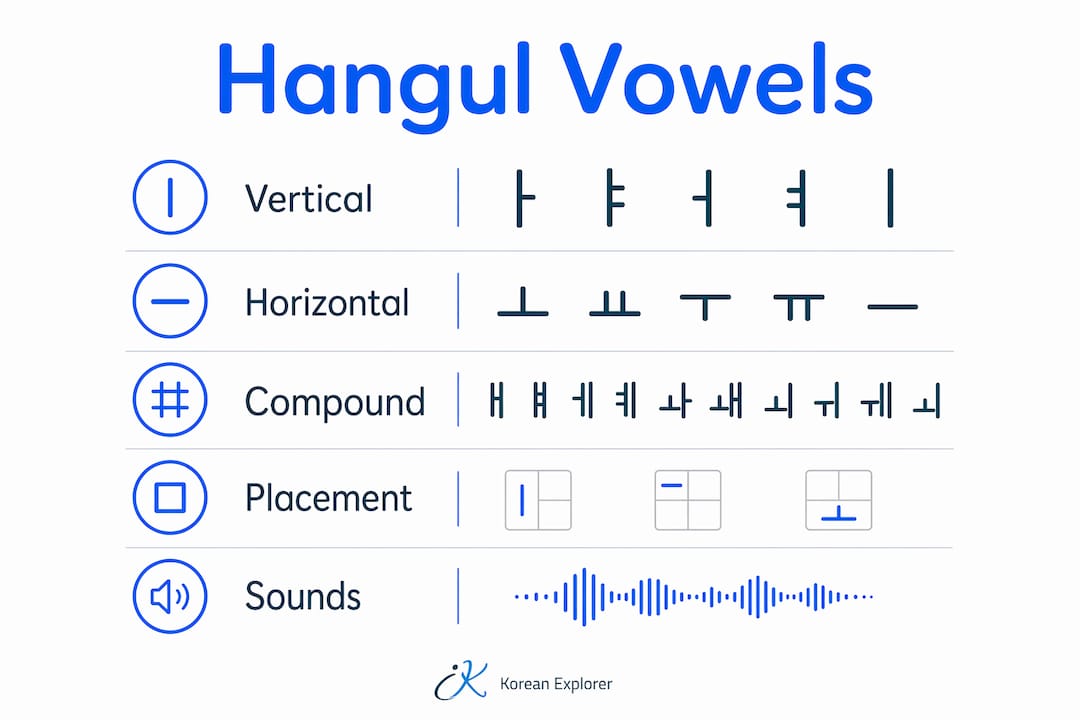
| Vowel | Sound | Placement |
|---|---|---|
| ㅏ | “a” | Vertical (right) |
| ㅓ | “eo” | Vertical (right) |
| ㅗ | “o” | Horizontal (below) |
| ㅜ | “u” | Horizontal (below) |
| ㅣ | “i” | Vertical (right) |
Pro Tip: When you learn each consonant, say the sound out loud and feel where your tongue touches your mouth. The letter shape often reflects that exact position, which makes recall much faster than flashcard drills alone.
How does hangul stroke order work and why does it matter?
Stroke order in Hangul follows four consistent rules: top to bottom, left to right, horizontal strokes before vertical ones, and outer strokes before inner ones. These rules apply across every letter in the alphabet. They are not arbitrary style preferences.
Incorrect stroke order makes handwriting messy and slows your writing speed. That matters both for legibility and for digital handwriting recognition tools, which rely on stroke sequence to identify characters accurately.
Stroke order rules in practice
- Top to bottom: Write ㅣ from the top downward, never upward.
- Left to right: For ㄱ, draw the horizontal stroke first, then pull the vertical stroke down from its right end.
- Horizontal before vertical: In ㅗ, draw the horizontal base first, then add the vertical stroke rising from its center.
- Outside before inside: For ㅁ, draw the outer frame strokes before closing the bottom.
These rules become automatic quickly. The key is to practice them correctly from day one rather than developing habits you have to unlearn later.
Why stroke order affects fluency
Correct stroke order builds muscle memory. When your hand knows the sequence, you stop thinking about individual strokes and start thinking about words. That shift is the difference between writing Korean and reading it back letter by letter versus processing it as a whole syllable. Consistent practice with proper order also makes your handwriting recognizable to native Korean readers, which matters when you write notes or messages by hand.
Pro Tip: Write each letter 10 times in a row using correct stroke order before moving to the next one. Slow, deliberate repetition in the first week saves you hours of correction later.
How do you combine letters into hangul syllable blocks?
Hangul syllable blocks follow a fixed structure: an initial consonant, a vowel, and an optional final consonant called batchim. Every Korean syllable fits one of these layouts. Understanding the layout is what separates someone who can name letters from someone who can actually write Korean words.
Block layout by vowel type
The vowel type determines how the block is arranged:
| Block Type | Structure | Example | Pronunciation |
|---|---|---|---|
| Consonant + Vertical Vowel | Side by side | 가 (ㄱ + ㅏ) | “ga” |
| Consonant + Horizontal Vowel | Stacked | 고 (ㄱ + ㅗ) | “go” |
| Consonant + Vertical Vowel + Batchim | Side by side + bottom | 각 (ㄱ + ㅏ + ㄱ) | “gak” |
| Consonant + Horizontal Vowel + Batchim | Stacked + bottom | 곡 (ㄱ + ㅗ + ㄱ) | “gok” |
When a vowel is vertical, the consonant sits to its left. When a vowel is horizontal, the consonant sits above it. Batchim always occupies the bottom position of the block, regardless of vowel type.
Understanding batchim
Batchim refers to any consonant placed at the bottom of a syllable block. Batchim sounds follow consistent phonetic rules once you learn them, even though they can look irregular at first. For example, ㄱ at the bottom of a block produces a “k” sound, while ㄴ produces an “n” sound. Learning these patterns unlocks your ability to read complex syllables accurately.
The silent ㅇ plays a specific role here too. When a syllable begins with a vowel sound, ㅇ fills the initial consonant position as a placeholder. So the syllable “a” is written 아, not just ㅏ alone. This keeps every block visually consistent.
A practical writing example
Take the word 한글 (Hangul itself). The first syllable 한 uses ㅎ as the initial consonant, ㅏ as the vertical vowel, and ㄴ as the batchim. The second syllable 글 uses ㄱ as the initial consonant, ㅡ as the horizontal vowel, and ㄹ as the batchim. Writing it out forces you to apply every rule covered so far: stroke order, vowel placement, and batchim position.
What are effective methods for learning to write korean?
Motivated learners can read and write individual Hangul syllable blocks after 2–4 hours of focused study, with full alphabet mastery achievable in a single day. That speed is real, but it applies to recognition. Writing fluency takes consistent practice over several weeks.
Study strategies that work
- Learn letters in sound groups, not alphabetical order. Group consonants by articulation type: stops (ㄱ, ㄷ, ㅂ), nasals (ㄴ, ㅁ, ㅇ), and fricatives (ㅅ, ㅎ). This mirrors how Korean phonology is organized and builds faster recall.
- Write syllables, not isolated letters. From day two onward, practice writing full syllable blocks like 나, 다, 마 rather than drilling ㄴ, ㄷ, ㅁ in isolation. Real Korean is always written in blocks.
- Read simple Korean text aloud every day. Even product labels, song titles, or street signs in Korean neighborhoods give you real reading and writing exposure. Reading practice directly reinforces your writing accuracy.
- Use short daily sessions of 20–30 minutes spread across multiple days rather than long weekend cramming. Distributed practice builds neural connections more effectively than marathon study.
- Copy Korean sentences by hand. Typing is useful, but handwriting forces you to recall stroke order and block structure simultaneously.
Common pitfalls to avoid
Romanization as a crutch is the most damaging habit a beginner can develop. When you write “annyeonghaseyo” instead of 안녕하세요, you train your brain to process Korean through English sounds. That creates a permanent barrier to native-like pronunciation and writing fluency. Drop romanization as soon as you know the basic letters, which should happen within your first week.
Memorizing letter lists without sound association is equally ineffective. Every letter you learn should be tied immediately to a sound you can produce out loud. Directly associating Korean letters with sounds, rather than romanized equivalents, accelerates both pronunciation and writing skill at the same time.
Key takeaways
Writing Hangul requires mastering 24 letters, correct stroke order, and syllabic block structure before fluency in Korean writing becomes possible.
| Point | Details |
|---|---|
| Hangul has 24 base letters | Learn 14 consonants and 10 vowels as your complete foundation. |
| Stroke order is non-negotiable | Top to bottom, left to right rules prevent messy handwriting and build speed. |
| Syllable blocks follow fixed layouts | Vowel type determines whether consonants sit beside or above the vowel. |
| Batchim unlocks complex syllables | Final consonants follow consistent sound rules once you learn the patterns. |
| Short daily sessions beat cramming | 20–30 minute sessions across multiple days build retention far more effectively. |
Why understanding letter design changed how i write hangul
Most learners treat Hangul like a code to crack. They make flashcards, drill letters, and try to memorize shapes as fast as possible. I did the same thing when I started, and I hit a wall around week two when the letters started blurring together.
What changed everything for me was actually sitting with the featural logic of the alphabet. When I realized that ㄴ looks like a tongue touching the roof of the mouth, and that ㅁ is literally a closed mouth shape, the letters stopped being arbitrary symbols. They became descriptions of sounds. That shift made writing faster and more intuitive than any amount of drilling had.
The other thing I wish someone had told me earlier: your first syllable blocks will look terrible. The proportions will be off, the strokes will be uneven, and the batchim will crowd the bottom of the block. That is completely normal. Native Korean children spend years perfecting their handwriting. You are not failing. You are at the beginning of a real skill. Consistent short sessions, as the tips for studying Korean at Korean Explorer outline, matter far more than any single long study day.
The moment that felt like a genuine breakthrough for me was writing a full Korean sentence from memory without looking at any reference. It was a simple sentence. But the fact that my hand knew where to go without my brain consciously directing each stroke told me the system had clicked. That moment comes faster than you expect if you practice the right way from the start.
— Paul
Start writing korean with structured support
Knowing the rules of Hangul writing is one thing. Having a structured environment where a native Korean instructor corrects your stroke order, checks your syllable blocks, and guides your pronunciation in real time is something different entirely. Korean Explorer offers structured Korean courses for adult learners at all levels, from complete beginners writing their first syllable to conversational learners refining their written accuracy. Classes are available in group, private, and online formats, with centers conveniently located above Tanjong Pagar MRT in Singapore. If you are ready to move from knowing the alphabet to writing it with confidence, explore Korean classes in Singapore at Korean Explorer and find the format that fits your schedule.
FAQ
How long does it take to learn to write hangul?
Most focused learners can write individual Hangul syllable blocks after 2–4 hours of study. Full writing fluency across all syllable types typically takes several weeks of daily practice.
What is the correct stroke order for hangul letters?
Hangul stroke order follows four rules: top to bottom, left to right, horizontal before vertical, and outside before inside. Applying these consistently from the start prevents bad habits that slow writing speed later.
What is batchim in korean writing?
Batchim is the final consonant placed at the bottom of a syllable block. It follows consistent phonetic rules and is present in many common Korean syllables, so learning it early is critical for accurate reading and writing.
Should i use romanization when learning to write korean?
No. Romanization creates a mental dependency that blocks native-like pronunciation and slows writing development. Associate each Hangul letter directly with its sound from your very first study session.
How many letters do i need to know to start writing korean?
You need 24 letters: 14 consonants and 10 vowels. Once you know these and understand how to arrange them into syllable blocks, you can write any Korean word phonetically.