TL;DR:
- Translating names into Korean involves converting sounds into Hangul using official phonetic rules, not literal translation.
- The process depends on pronunciation and includes inserting vowels to break consonant clusters, following the system set by the National Institute of Korean Language.
Translating names into Korean means converting a name’s sounds into Hangul, the Korean alphabet, through a process called phonetic transliteration. This is not a word-for-word translation. Korean does not assign meaning to foreign names the way Chinese characters do. Instead, you map each sound in your name to the closest Korean phoneme, producing a Hangul version that Korean speakers can read and pronounce naturally. The National Institute of Korean Language governs this process through official rules, making the system consistent and learnable for anyone.
How do you translate names into Korean using official rules?
The official system is called Oeraeeo Pyogibeop (외래어 표기법), which translates to the “Loanword Notation Rules.” The National Institute of Korean Language developed these rules to standardize how foreign sounds map onto Hangul’s 14 consonants and 10 vowels. Every foreign name transliterated in Korean media, on official documents, or in textbooks follows this system.

The rules handle sounds that do not exist in Korean by substituting the closest available phoneme. The English “F” sound becomes ㅍ (p/ph), since Korean has no native “F.” The English “TH” sound, as in “Thomas,” becomes ㅅ (s) or ㄷ (d) depending on position. The “V” sound maps to ㅂ (b). These substitutions cause slight pronunciation shifts, but the goal is recognizability, not perfection.
Korean also has strict syllable structure. Each block must follow a consonant + vowel pattern, with an optional final consonant. English names often stack consonants together, which Korean phonotactics do not allow. The system resolves this by inserting vowels like 으 (eu) to break up clusters. “Chris” becomes 크리스 (Keu-ri-seu) for exactly this reason.
| English sound | Korean equivalent | Example |
|---|---|---|
| F | ㅍ (p/ph) | Frank → 프랭크 |
| V | ㅂ (b) | Victor → 빅터 |
| TH | ㅅ (s) or ㄷ (d) | Thomas → 토마스 |
| R (mid-word) | ㄹ (r/l) | Brian → 브라이언 |
| Z | ㅈ (j) | Zoe → 조이 |
| Consonant cluster | Add 으 (eu) | Chris → 크리스 |
Pro Tip: Always base your transliteration on how you actually pronounce your name, not how it is spelled. “Catherine” and “Katherine” are spelled differently but sound nearly identical, so they produce the same Hangul.
How to convert your name to Korean step by step
The process is straightforward once you understand the phonetic logic. English names typically convert into 2–4 Hangul syllable blocks, with each block representing one sound unit.
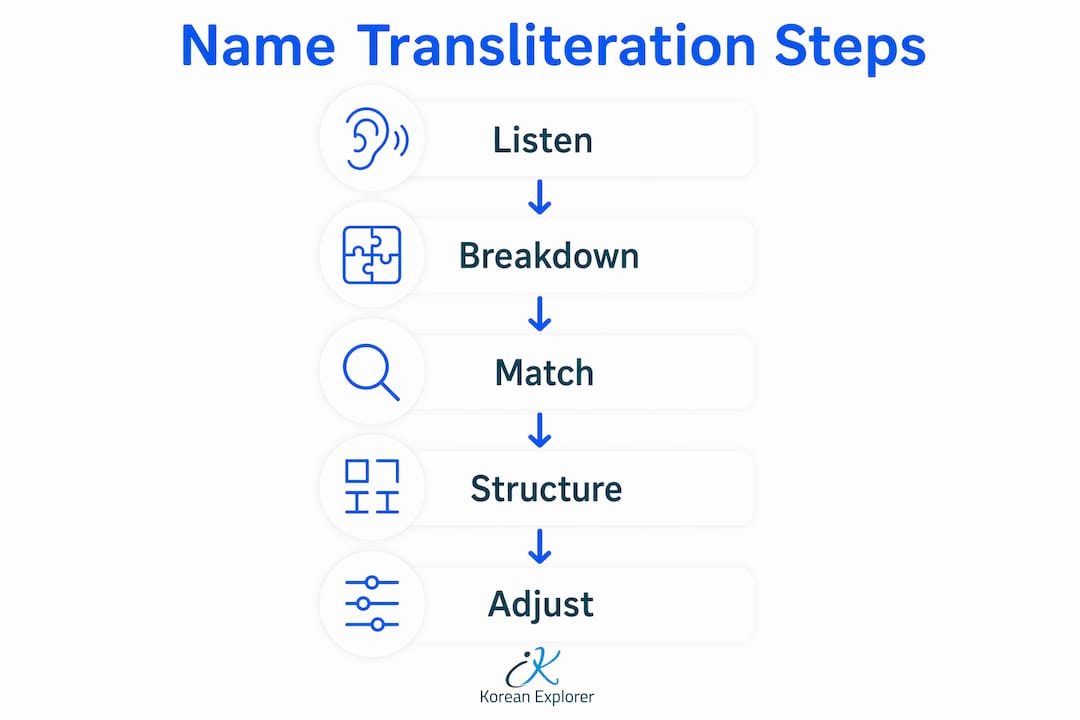
Follow these steps:
- Say your name out loud. Write down the sounds you hear, not the letters you see. “Michael” sounds like “MY-kul,” not “Mee-cha-el.”
- Break it into syllables by sound. “Michael” splits into two sound units: “MY” and “kul.”
- Map each consonant to its Korean equivalent. Use the table above for sounds like F, V, TH, and Z. Standard consonants like M, N, K, and T map directly.
- Assign a Korean vowel to each syllable. Match the vowel sound as closely as possible. “MY” uses the ㅏ + ㅣ combination (아이), producing 마이. “kul” uses ㅓ (eo), producing 클.
- Handle consonant clusters by adding 으. If two consonants sit together with no vowel between them, insert 으 to separate them.
- Combine the blocks. “Michael” becomes 마이클 (Ma-i-keul).
The table below shows this process applied to three common names.
| English name | Pronunciation breakdown | Hangul result | Romanization |
|---|---|---|---|
| Michael | MY + kul | 마이클 | Ma-i-keul |
| Sarah | SE + ra | 세라 | Se-ra |
| Chris | K + ri + s | 크리스 | Keu-ri-seu |
Proper transliteration aims to let Korean speakers pronounce your name recognizably. The function matters more than matching every letter. “Sarah” in Korean is 세라, not a character-by-character spelling of S-A-R-A-H.
Pro Tip: If your name ends in a consonant cluster, like “Brent” or “Ernst,” add 으 after the cluster. “Brent” becomes 브렌트 (Beu-ren-teu). The added vowels feel natural to Korean speakers and are standard practice.
Understanding how Korean differs from English structurally makes this process much easier to internalize.
What are the most common mistakes when translating names into Korean?
Several patterns trip up beginners consistently. Knowing them in advance saves time and avoids awkward results.
- Transliterating spelling instead of sound. “Leigh” is pronounced “Lee,” so it becomes 리 (ri), not a letter-by-letter conversion of L-E-I-G-H. Always start from pronunciation.
- Ignoring American vs. British pronunciation differences. Pronunciation variants between American and British English affect Hangul spelling choices. “Harry” in American English has a flat “a” sound, while British English uses a different vowel. The Hangul result can differ.
- Confusing transliteration with adopting a Korean name. These are two separate practices. Phonetic transliteration preserves your original name identity for practical use. Adopting a Korean name means choosing characters with semantic meaning, often Hanja-based, which is a cultural practice with entirely different rules.
- Over-relying on automated tools for unusual names. Automated converters achieve over 95% accuracy with standard names but may produce errors for rare names, regional accents, or names from non-English languages.
- Skipping native speaker verification. A tool can apply the rules correctly and still produce a result that sounds unnatural to Korean ears. Confirming with a native speaker catches these edge cases.
Many of the common challenges in Korean learning stem from the same root issue: English and Korean phonology work very differently. Name transliteration is a compact version of that larger challenge.
Pro Tip: If your name comes from a language other than English, such as Arabic, Spanish, or Vietnamese, transliterate from the original pronunciation, not from an English approximation. The result will be more accurate.
What tools can help you translate your name into Korean?
Several digital tools handle name transliteration quickly and reliably. Each applies the official rules automatically, which makes them useful for a first draft.
- Lingrow Korean Name Converter applies the Oeraeeo Pyogibeop rules directly and shows the Hangul output alongside a romanized pronunciation guide.
- Wordy.info Hangul Name Guide walks through the phonetic logic step by step and is useful for understanding why a tool produced a specific result.
- Lingobrights Korean Name Converter generates both a phonetic transliteration and an optional Korean name with meaning, which is helpful if you want to understand the difference between the two approaches.
- Bluelark Write My Name in Korean Generator produces results in under one second and handles most standard English names accurately.
These tools are best used as a starting point. Automated converters work well for common names but may struggle with unusual phonemes or names from non-English origins. Cross-checking the output against the phoneme table in this article takes less than two minutes and catches most errors.
Improving your Korean pronunciation skills also helps you evaluate whether a transliteration sounds right. A tool can give you the Hangul, but your ear needs training to judge the result. Formal Korean education helps learners refine name pronunciation beyond what any digital tool can offer.
Key takeaways
Accurate name transliteration into Korean requires mapping sounds, not spelling, onto Hangul using the National Institute of Korean Language’s official phonetic rules.
| Point | Details |
|---|---|
| Use phonetic rules, not spelling | Base every transliteration on how your name sounds, not how it is written. |
| Official rules govern substitutions | The Oeraeeo Pyogibeop system maps sounds like F, V, and TH to the closest Korean phonemes. |
| Vowels fill consonant gaps | Korean syllable structure requires inserting 으 (eu) to break up English consonant clusters. |
| Transliteration differs from naming | Converting your name to Hangul is not the same as adopting a Korean name with cultural meaning. |
| Verify with a native speaker | Automated tools exceed 95% accuracy for common names but benefit from human review for rare or unusual names. |
Why getting your Korean name right actually matters
I have seen this play out dozens of times. Someone spends weeks studying Korean, builds real conversational confidence, and then introduces themselves with a Hangul name that no Korean speaker can place. The moment lands flat. The connection they worked toward does not happen.
The uncomfortable truth about name transliteration is that most people treat it as a one-minute task. They paste their name into a converter, copy the result, and move on. That works about 95% of the time for names like “James” or “Emily.” For names like “Siobhan,” “Nguyen,” or “Thiago,” it fails badly. The tool applies English phoneme rules to a name that was never English to begin with.
What I find more interesting is the cultural signal that accurate transliteration sends. Korean speakers notice when a foreigner has taken the time to get their name right. It shows phonetic awareness and genuine respect for the language. That is a stronger first impression than any rehearsed greeting phrase.
The distinction between transliteration and adopting a Korean name also matters more than most guides acknowledge. Choosing a Korean name with Hanja meaning is a significant cultural act. Treating it casually, picking characters because they sound cool, can come across as tone-deaf. Transliteration is the practical, respectful default for most learners. A Korean name with meaning is something you earn through deeper cultural engagement.
My advice is to spend 15 minutes with the phoneme table, apply the steps manually at least once, and then use a tool to confirm. That combination produces results you can stand behind.
— Paul
Korean language courses to sharpen your pronunciation
Korean Explorer offers adult Korean language courses in Singapore built around conversational and business use. Mastering Korean pronunciation, including how to say your own name correctly, is a core part of every level.

Classes are available as group sessions, private lessons, and online Zoom courses, giving you flexibility whether you are learning for personal interest or professional development. Corporate training programs are also available for teams. Korean Explorer’s native instructors, trained on a Seoul National University curriculum, teach you to hear and produce Korean sounds accurately, not just read transliterations off a page. If you are ready to go beyond name conversion and build real fluency, explore Korean courses in Singapore and find the format that fits your schedule.
FAQ
What is the difference between transliteration and translation for Korean names?
Transliteration converts a name’s sounds into Hangul characters so Korean speakers can pronounce it. Translation assigns meaning, which does not apply to personal names in Korean.
Can I translate a Chinese name into Korean?
Yes. Chinese names are often transliterated into Korean using the same phonetic rules applied to English names, mapping each syllable’s sound to the closest Hangul equivalent. The result differs from the Chinese pronunciation but follows the same Oeraeeo Pyogibeop system.
Why does my name look different in Korean than I expected?
Korean syllable structure rules require consonant and vowel pairings, so consonant clusters in your name trigger vowel insertions. The result reflects Korean phonotactics, not a mistake.
How accurate are online Korean name converters?
Automated tools achieve over 95% accuracy for standard English names. Rare names, regional accents, and non-English names benefit from manual review or native speaker confirmation.
Do I need to learn Korean to transliterate my name correctly?
You do not need fluency, but learning the basics of Hangul and Korean pronunciation significantly improves your accuracy. Formal Korean education helps you evaluate and refine transliterations beyond what any converter can provide.