TL;DR:
- A Korean name converter applies phonetic rules to transform English names into Hangul based on official standards. It requires careful syllable breakdown, correct phoneme mapping, and added vowels for consonant clusters to ensure pronunciation accuracy. Choosing an authentic Korean name offers cultural recognition, but verification with a native speaker is essential for official use.
An English name to Korean name converter is a tool that transforms your name into Hangul based on phonetic sounds, not alphabetical spelling. The process follows official Korean transcription rules set by the National Institute of Korean Language. Understanding how those rules work gives you a far more accurate result than simply typing your name into a random online tool. This guide covers the official 2026 standard, a practical step-by-step transliteration method, and how to choose an authentic Korean name if phonetic conversion is not enough.
What official rules govern English name to Korean name conversion in 2026?
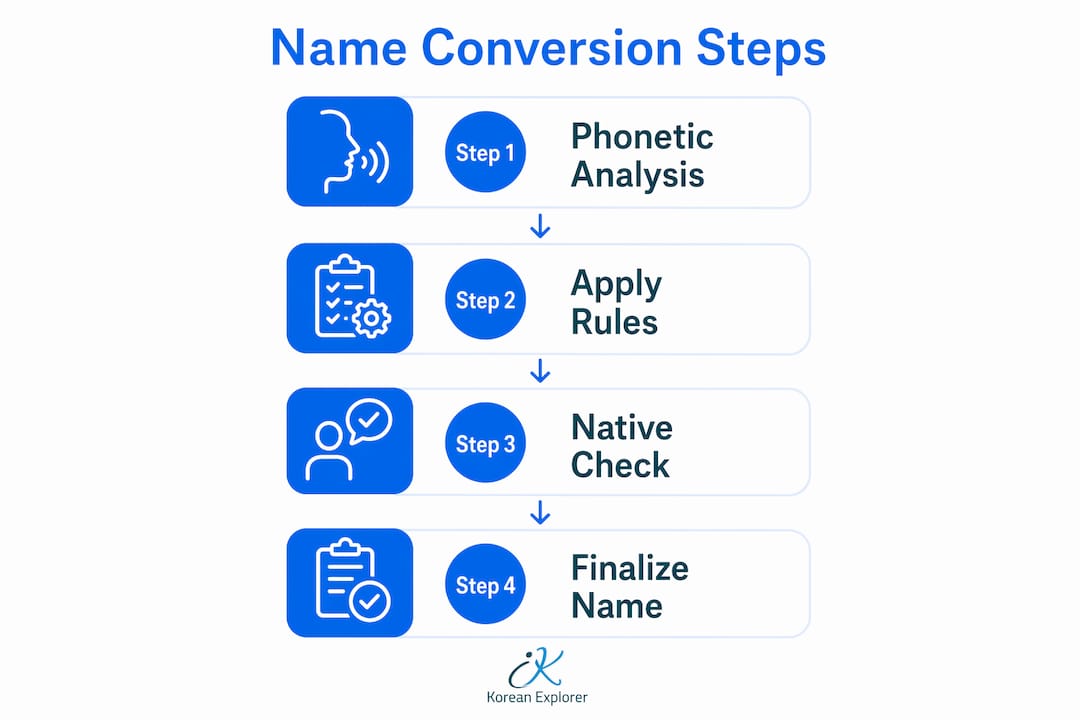
The governing standard for converting foreign names into Korean is the Oeraeeo Pyogibeop, or Foreign Language Transcription Rules, published by the National Institute of Korean Language. This standard mandates phonetic conversion, meaning your name is written as it sounds, not as it is spelled. “Catherine” and “Katherine” produce the same Korean result because both sound identical.
The rules work around Hangul’s syllable block structure. Every Korean syllable must contain at least one consonant and one vowel, with an optional final consonant. That structure controls how every English sound gets mapped.
Key phonetic mappings under the standard include:
- F → ㅍ (p sound): “Frank” becomes 프랭크 (peu-raeng-keu)
- V → ㅂ (b sound): “Vivian” becomes 비비안 (bi-bi-an)
- TH → ㅅ (s sound): “Theodore” becomes 시어도어 (si-eo-do-eo)
- R and L → ㄹ: Both letters share the same Korean equivalent, which is a recognized phonetic compromise
- Consonant clusters → split with vowels: The cluster “str” in “Strom” becomes 스트 because Korean syllables cannot stack consonants without a vowel between them
These mappings are not guesswork. They reflect decades of standardization work and are the same rules used in Korean textbooks, official documents, and media subtitles.
How do you transliterate your English name into Korean Hangul?
Phonetic transliteration is the standard method for Korean name conversion. The goal is to reproduce how your name sounds, syllable by syllable, using Hangul characters. Here is how to do it correctly.
Break your name into syllables by sound. Do not follow English spelling. “Michael” sounds like “MY-kul,” so you work with those two sound units, not the seven letters.
Map each sound to its Korean equivalent. Use the official phoneme chart. The “MY” sound maps to 마이 (ma-i), and the “kul” sound maps to 클 (keul). Combined: 마이클 (ma-i-keul).
Handle final consonants with the helper vowel ‘eu.’ English names ending in consonants that do not fit Korean phonotactics add the neutral vowel ㅡ to ease pronunciation. “Chris” becomes 크리스 (keu-ri-seu), not a single-syllable block.
Check for consonant clusters and insert vowels. Any cluster of two or more consonants needs a vowel between them. “Brad” becomes 브래드 (beu-rae-deu) because Korean cannot begin a syllable with “br” together.
Read the result aloud. If a Korean speaker would struggle to say it smoothly, you likely missed a helper vowel or used the wrong consonant mapping.
Common name examples:
- Sarah: 사라 (sa-ra). The “h” is silent, so it drops entirely.
- Chris: 크리스 (keu-ri-seu). The “eu” vowel appears twice to separate consonants.
- Michael: 마이클 (ma-i-keul). The final “l” takes the ㄹ consonant in the last syllable block.
The phonetic basis of Hangul makes it one of the most logical writing systems for transliteration. Each character represents a single sound, so once you know the mappings, the process becomes consistent.
Pro Tip: Verify your transliterated name with a native Korean speaker before using it on a business card, a social media profile, or anything permanent. Regional pronunciation differences and personal accent variations can produce more than one valid spelling for the same English name.

Should you choose an authentic Korean name instead of transliteration?
Phonetic transliteration gives you a Korean version of your English name. An authentic Korean name gives you something different: a name that sounds and feels Korean to native speakers. Many people who study Korean, work in Korean companies, or integrate into Korean communities choose this option.
Authentic Korean names follow a clear structure. A family name comes first, followed by a one or two syllable given name. Common Korean surnames include Kim (김), Lee (이), and Park (박). These three surnames alone account for a large portion of the Korean population, so choosing one signals cultural familiarity.
The given name syllables carry meaning. Popular choices include:
- Min (민): Clever or quick
- Jun (준): Talented or handsome
- Jin (진): Truth or precious
- Eun (은): Grace or kindness
- Soo (수): Excellence or longevity
Combining a surname with two meaningful syllables creates a name that Korean speakers recognize as genuine. “Kim Eun Jun” reads as a real Korean name, not a foreign transliteration. That distinction matters in professional settings and social introductions.
The choice between transliteration and an authentic name depends on your purpose. Transliteration preserves your original identity in Korean script. An authentic name signals deeper cultural integration. Many people use both: a transliterated name for official documents and an authentic Korean name for daily use with Korean friends or colleagues. For more on Korean cultural integration, Korean Explorer covers the cultural context behind names and social customs.
What are the most common mistakes when converting English names to Korean?
Online Korean name generators and conversion tools are useful starting points. They are not reliable endpoints, especially for names that fall outside common English patterns.
The most frequent errors include:
- Ignoring syllable structure: Writing “Blake” as 블레이크 is correct. Writing it as 블랙 is wrong because it maps to “black,” not “Blake.” Spelling and sound diverge constantly in English.
- Trusting a single tool output without verification: Multiple valid transliterations exist for many names depending on regional accent and personal preference. A tool trained on American English may produce a different result than one trained on British English.
- Skipping the helper vowel: Names like “Scott” need the ㅡ vowel to become 스콧 (seu-kot). Dropping it produces an unpronounceable consonant cluster in Korean.
- Using transliteration for legal documents without professional review: Korean immigration forms, business registration documents, and official name records require consistent, verified Hangul spelling.
Relying on an online converter for a tattoo or a legal document without native speaker confirmation is the single most common and most costly mistake in English to Korean name conversion. A small phonetic error becomes permanent.
AI-driven conversion tools perform well on common English names. They become less reliable on rare names, names from non-English languages, or names with unusual consonant patterns. The accuracy gap for rare names is a known limitation of automated tools. Human verification closes that gap. Korean Explorer’s guide on translating names into Korean walks through the verification process in detail.
Key Takeaways
Accurate English to Korean name conversion requires phonetic analysis, official transcription rules, and native speaker verification before any permanent or official use.
| Point | Details |
|---|---|
| Official standard applies | The Oeraeeo Pyogibeop by the National Institute of Korean Language governs all foreign name transliteration into Korean. |
| Sound beats spelling | Convert your name based on how it sounds, not how it is spelled, to produce correct Hangul. |
| Helper vowels are required | Add the neutral vowel ㅡ after final consonants and between consonant clusters to follow Korean syllable rules. |
| Authentic names are an option | Choosing a Korean name with meaningful syllables signals cultural integration beyond simple phonetic conversion. |
| Verify before permanent use | Native speaker confirmation prevents errors in tattoos, documents, and professional profiles. |
Why getting your Korean name right matters more than people think
People treat name conversion as a five-second task. Type your name, copy the result, done. I have seen that approach go wrong more times than I can count, and the consequences range from mildly embarrassing to genuinely problematic.
The phonetic gap between English and Korean is wider than most people expect. English has sounds Korean simply does not have. Every “F,” every “V,” every “TH” requires a compromise. That compromise is not random. It follows the Oeraeeo Pyogibeop standard, and when you understand that standard, your transliteration becomes consistent and defensible. When you ignore it, you get a name that Korean speakers read with confusion.
The authentic Korean name question is where I think most guides get it wrong. They present it as a novelty, a fun alternative for K-drama fans. The reality is that an authentic Korean name carries real social weight. Korean colleagues and friends respond differently to someone who introduces themselves with a name like 이민준 versus a phonetic approximation of “Jennifer.” One signals effort and respect. The other signals a tourist.
My honest advice: use a conversion tool to get a starting point, then take that result to a native speaker. If you are learning Korean seriously, understanding how Hangul works makes the entire process transparent. You stop depending on tools and start understanding the logic yourself. That shift changes everything about how you engage with the language.
— Paul
Korean Explorer can help you go beyond name conversion
Getting your name right in Korean is a satisfying first step. Building the language skills to introduce yourself, hold a conversation, and read Hangul fluently is the natural next step.
Korean Explorer offers adult Korean courses in Singapore designed for conversational and business use, with flexible options including group classes, private sessions, and online Zoom learning. Corporate training programs are also available for teams. Courses follow a curriculum developed by Seoul National University, taught by native Korean instructors fluent in both Korean and English. Whether you want to learn Korean in Singapore or join an online class from anywhere, Korean Explorer provides a structured path from Hangul basics to full conversational confidence.
FAQ
What is an English name to Korean name converter?
An English name to Korean name converter is a tool that applies phonetic transliteration rules to write your English name in Hangul. It maps English sounds to their closest Korean equivalents following the Oeraeeo Pyogibeop standard.
How accurate are online Korean name generators?
Online Korean name generators are accurate for common English names but less reliable for rare or unusual names. AI-driven tools can vary on names with sounds that have no direct Korean equivalent, so native speaker verification is recommended for important uses.
Why does my name look different on different Korean name translator tools?
Multiple valid transliterations exist for many English names because regional accents and personal pronunciation affect the phonetic mapping. Different tools may also apply slightly different versions of the transcription rules.
What is the difference between transliteration and an authentic Korean name?
Transliteration reproduces how your English name sounds in Hangul. An authentic Korean name uses a traditional surname and meaningful syllables that read as a genuine Korean name to native speakers.
Do I need to add extra vowels when converting my name to Korean?
Yes. English names ending in consonants or containing consonant clusters require the helper vowel ㅡ to fit Korean syllable structure. “Chris” becomes 크리스 because each consonant cluster needs a vowel to form a valid Korean syllable block.