Korean films are one of the most direct windows into how the language actually sounds, moves, and means things in real life. For anyone learning Korean, cinema offers something no textbook can: authentic speech at native speed, layered with cultural context, social register, and the kind of idiomatic expression that only shows up when people are actually talking to each other. Films like Parasite, House of Hummingbird, and King and the Clown are not just critically celebrated. They are linguistically rich environments where you hear formal speech, casual banter, regional dialect, and code-switching between Korean and English, often within the same scene.
Getting the most out of Korean films as a learner does come with real challenges:
- Subtitle gaps: English subtitles routinely omit honorifics, emotional nuance, and culturally specific expressions that carry significant meaning in Korean.
- Speech rate: Korean spoken in films moves fast. Research on 12 Korean films dubbed into English found that reduction was the primary dubbing strategy, precisely because Korean speech carries information at a faster rate but lower density than English.
- Dialect comprehension: Regional dialects, particularly the Gyeongsang dialect heard in older films, can sound almost like a different language to learners trained on Seoul Standard Korean.
- Cultural context: Confucian social norms shape how characters address each other, when they bow, and what they leave unsaid. Missing that context means missing the meaning.
- Legal access: Streaming platforms like Netflix, Viki, and Wavve (available in the US) carry a wide selection of Korean films legally, with Korean and English subtitle options.
Notable Korean-language films worth watching for their linguistic depth
The films below represent a range of eras, genres, and speech styles. Each one offers something distinct for the learner who wants to go beyond textbook Korean.
Parasite (기생충, 2019): Bong Joon-ho’s Oscar-winning film is a masterclass in how Korean uses language to signal class. The wealthy Park family speaks polished, measured Korean; the Kim family shifts registers depending on who they are performing for. English appears deliberately, with the mother of the rich family speaking broken English in a way the director scripted to reflect aspiration and its limits. For learners, the contrast between formal and informal speech across social classes is unusually clear.
House of Hummingbird (벌새, 2018): Set in 1994 Seoul, this film captures the quiet, understated speech of everyday family life. Dialogue is sparse and emotionally loaded. Learners at an intermediate level will find the conversational Korean here closer to real speech than most genre films, with minimal slang and a naturalistic rhythm that rewards close listening.
King and the Clown (왕의 남자, 2005): This historical drama uses formal court Korean alongside the rougher speech of traveling performers. The contrast is stark and educational. Learners get exposure to archaic vocabulary and honorific structures that still echo in modern formal Korean, alongside colloquial expressions from the margins of Joseon society.
Memories of Murder (살인의 추억, 2003): Bong Joon-ho’s earlier crime film is set in rural Gyeonggi Province and features characters who speak with regional inflections. The dialogue is grounded, often blunt, and full of the kind of direct speech that formal Korean courses rarely teach. The Gyeongsang-influenced speech of some characters gives learners a taste of dialectal variation.
The Handmaiden (아가씨, 2016): Park Chan-wook’s film uses both Korean and Japanese as narrative tools, with language itself becoming a site of power and deception. For advanced learners, the formal register of the Japanese colonial period scenes, contrasted with the intimate Korean spoken between the two female leads, shows how register shifts carry emotional weight.
Snowpiercer (설국열차, 2013): A multilingual film where Korean and English coexist as markers of class and survival. Bong Joon-ho has said the multilingual structure was intentional, reflecting a world where language hierarchy mirrors social hierarchy. Learners can observe how Korean characters navigate English-dominant spaces, a dynamic that mirrors real experiences many Korean speakers face abroad.
Decision to Leave (헤어질 결심, 2022): Park Chan-wook’s film features a Chinese character who speaks Korean with deliberate “otherness.” The director described this as a defamiliarization device, making Korean-speaking audiences hear their own language differently. For learners, it is a rare chance to hear Korean spoken with non-native patterns while still being grammatically precise.
A Taxi Driver (택시운전사, 2017): Set during the 1980 Gwangju Uprising, this film captures the speech of ordinary working-class Seoulites alongside the Jeolla dialect spoken in the south. The Jeolla dialect is one of the most distinct regional varieties in Korean, and hearing it in context gives learners a concrete sense of how geography shapes speech.
The Wailing (곡성, 2016): Set in a rural village, this horror film is dense with superstition, folk speech, and the kind of informal Korean that elderly rural characters use. It is not an easy listen, but for advanced learners interested in how language encodes belief and community, it is genuinely unlike anything else in Korean cinema.
Oasis (오아시스, 2002): Lee Chang-dong’s film features a character with cerebral palsy whose speech is difficult to understand, even for native Korean speakers. The film forces the audience to listen harder, to interpret, and to fill in meaning from context. That is exactly the kind of active listening practice that accelerates language acquisition.
My Sassy Girl (엽기적인 그녀, 2001): A lighter entry, but linguistically useful for its portrayal of casual, contemporary Seoul speech between young adults. The female lead’s blunt, commanding speech style was unusual for Korean cinema at the time and sparked real cultural conversation about gender and language. For learners, it is a good model of informal speech without heavy slang.
Top Korean films for language learners, ranked by learning value
Not every great Korean film is equally useful for language study. The ones below earn their place on this list because they offer clear speech, culturally rich dialogue, or a linguistic contrast that teaches something specific.
1. Parasite (기생충, 2019)
Watch this with Korean subtitles first, then without. The class-based speech contrast is the most explicit in any mainstream Korean film. You will hear the same characters shift from polished formal Korean to casual, slightly rough speech depending on who they think is listening. That code-switching is a core feature of real Korean communication.
2. House of Hummingbird (벌새, 2018)
The pacing here is slow enough that you can actually catch individual sentences. The dialogue reflects how Korean families talk around difficult topics rather than through them, which is a sociolinguistic pattern that shows up constantly in real life. Intermediate learners will find this film particularly rewarding.
3. King and the Clown (왕의 남자, 2005)
The honorific system is on full display throughout. Watching how characters shift between speech levels depending on who holds power in a given scene is a practical lesson in Korean’s formal register system. Pair this with a structured course that covers speech levels, and the film becomes a living grammar exercise.
Pro Tip: Watch each scene twice: once with English subtitles to follow the plot, then again with Korean subtitles to catch the exact words and speech levels used. Korean Explorer’s intermediate Korean course covers the speech level system in depth, which makes this exercise significantly more productive.
4. A Taxi Driver (택시운전사, 2017)
The Jeolla dialect scenes are genuinely challenging, even for intermediate learners. But that challenge is the point. Exposure to dialectal variation early builds the kind of listening flexibility that makes you a more adaptable speaker. Note the vocabulary differences and look them up after each viewing.
5. My Sassy Girl (엽기적인 그녀, 2001)
For learners focused on conversational Korean, this film is a reliable source of natural, informal speech between peers. The vocabulary is not heavily slang-dependent, which means most expressions will still be in active use today. It is also genuinely funny, which helps with retention.
6. Decision to Leave (헤어질 결심, 2022)
Advanced learners should watch this for the way it plays with precision in language. The Chinese character’s Korean is grammatically careful but tonally unusual, and the film rewards viewers who can hear the difference. It is also a good test of whether you can follow Korean dialogue when the speaker’s rhythm is slightly off from native norms.
7. Memories of Murder (살인의 추억, 2003)
The rural, working-class speech in this film is blunt and unpolished in the best way. Learners who have only been exposed to Seoul Standard Korean will find this a useful corrective. The linguistic characteristics of Korean cinema show that films like this one carry distinct regional and stylistic features that formal study rarely covers.
Pro Tip: Keep a vocabulary notebook while watching. Write down expressions you do not recognize, then look them up after the film ends rather than pausing mid-scene. This trains your brain to tolerate ambiguity and infer meaning from context, which is exactly what real conversation requires.
What Korean cinema teaches you that textbooks cannot
Korean films function as cultural learning tools in a way that goes well beyond vocabulary and grammar. The gap between what subtitles say and what the dialogue actually means is where the real learning happens.
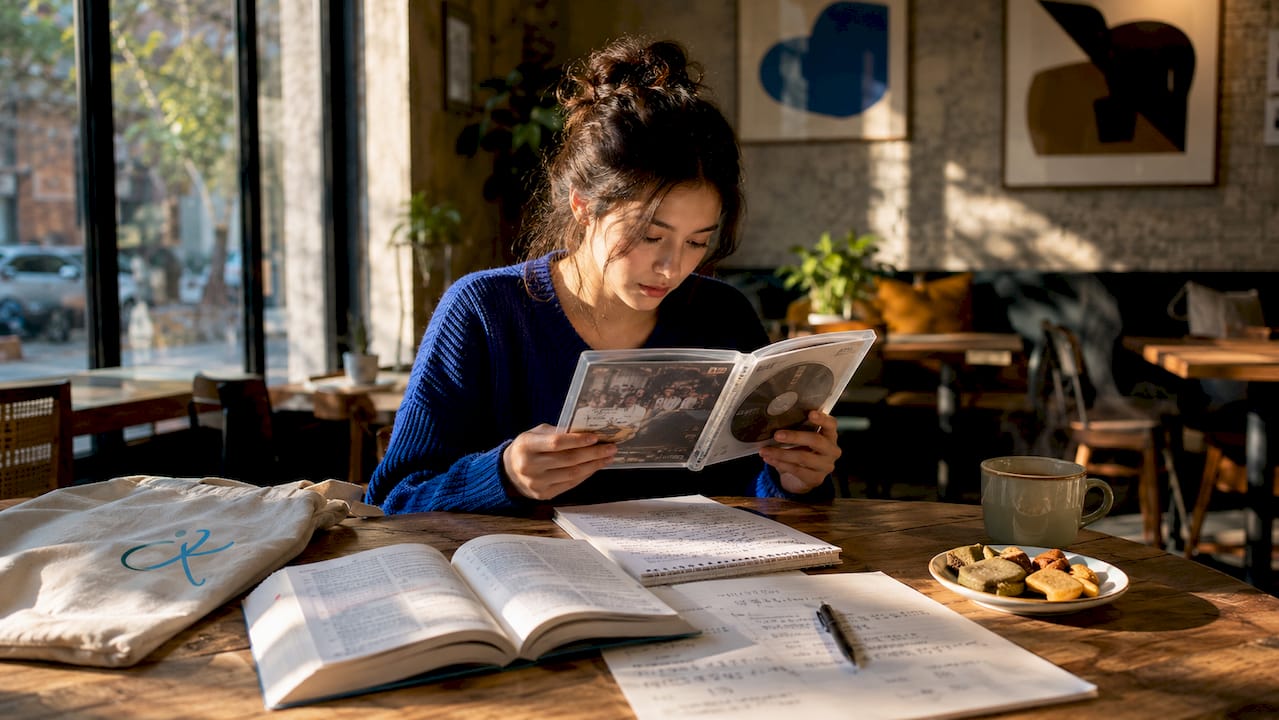
Scholars who study Korean film from a cross-cultural perspective describe viewers as multimodal translators, responsible for decoding not just words but gestures, silences, and the social logic that governs who speaks first, who bows, and who avoids eye contact. These are what researchers call “socio-pragmatic invisibles,” cultural meanings embedded in behavior that subtitles cannot capture because they have no direct English equivalent.
Korean film dialogue also carries historical and social weight that makes it useful for understanding how the language has changed over time. The Korea Film Archive’s Dialogue Cinema exhibition documented how iconic film lines function as markers of collective memory, capturing the social consciousness of their era. Watching films from different decades gives you a timeline of how Korean speech has evolved, from the formal, measured dialogue of 1960s melodramas to the rapid, code-switching speech of contemporary thrillers.
The multilingual dimension of recent Korean cinema adds another layer. English appears in films like Parasite and Snowpiercer not as decoration but as a social status marker, reflecting the real pressure Korean speakers face around English proficiency. Watching how characters use, misuse, or perform English tells you something true about Korean society that no grammar book addresses.
For learners, the practical takeaways from engaging with Korean cinema seriously include:
- Honorific awareness: Films show you exactly when and why characters shift speech levels, which is far more instructive than memorizing rules in isolation.
- Emotional vocabulary: Korean has a rich set of emotion words with no English equivalent. Films give you the context to understand them in use.
- Listening stamina: Regular film viewing builds tolerance for fast, natural speech, which is the single biggest gap between classroom Korean and real-world comprehension.
- Cultural scripts: Knowing that a character’s silence in a tense family scene is a form of communication, not an absence of it, changes how you read the whole scene.
Korean cinema also reflects how practical language learning integrates film scenes for speaking, listening, reading, and writing practice at the intermediate level. Films are not a shortcut to fluency, but they are one of the most efficient ways to build the cultural literacy that makes fluency meaningful. If you want to go deeper on learning Korean through movies, structured guidance alongside film viewing makes the difference between passive watching and active acquisition.
Key Takeaways
Korean films offer language learners authentic speech, cultural context, and sociolinguistic depth that no classroom resource fully replicates.
| Point | Details |
|---|---|
| Speech rate and dubbing | Korean speech in films is faster but carries lower information density than English, requiring reduction in dubbed versions. |
| Register contrast in films | Films like Parasite and King and the Clown show formal and informal speech levels side by side, making the honorific system visible. |
| Socio-pragmatic invisibles | Subtitles miss cultural meanings embedded in silence, gesture, and social hierarchy; active viewing builds this awareness. |
| Multilingualism as a narrative tool | English in films like Parasite and Snowpiercer signals social status, reflecting real pressures in Korean society. |
| Structured learning amplifies film study | Combining film viewing with a structured course, such as an intermediate Korean program, turns passive exposure into active skill-building. |
FAQ
What language is spoken in Korean films?
Korean films are primarily in Korean, the official language of South Korea. Recent films like Parasite and Snowpiercer also incorporate English and other languages as deliberate narrative and characterization tools.
How do Korean films help with learning the Korean language?
Korean films expose learners to authentic speech rates, regional dialects, honorific registers, and cultural expressions that textbooks rarely cover. Watching with Korean subtitles and repeating key scenes builds both listening comprehension and vocabulary retention.
What does the Korean word for “Korean language” mean?
The Korean language is called 한국어 (Hangugeo) in South Korea, which literally means “the language of the Korean nation.” In North Korea, the same language is referred to as 조선어 (Joseoneo).
Why do English subtitles miss so much in Korean films?
English subtitles cannot capture honorifics, emotional register shifts, or culturally specific expressions rooted in Confucian social norms. Researchers describe this as the “socio-pragmatic invisible” problem: meaning is carried by behavior and context, not just words.
Which Korean film is best for beginner language learners?
My Sassy Girl (2001) and House of Hummingbird (2018) are both accessible starting points. My Sassy Girl features clear, informal contemporary speech, while House of Hummingbird uses slow, naturalistic dialogue that gives learners time to process each line.