What are the main differences between group and private classes?
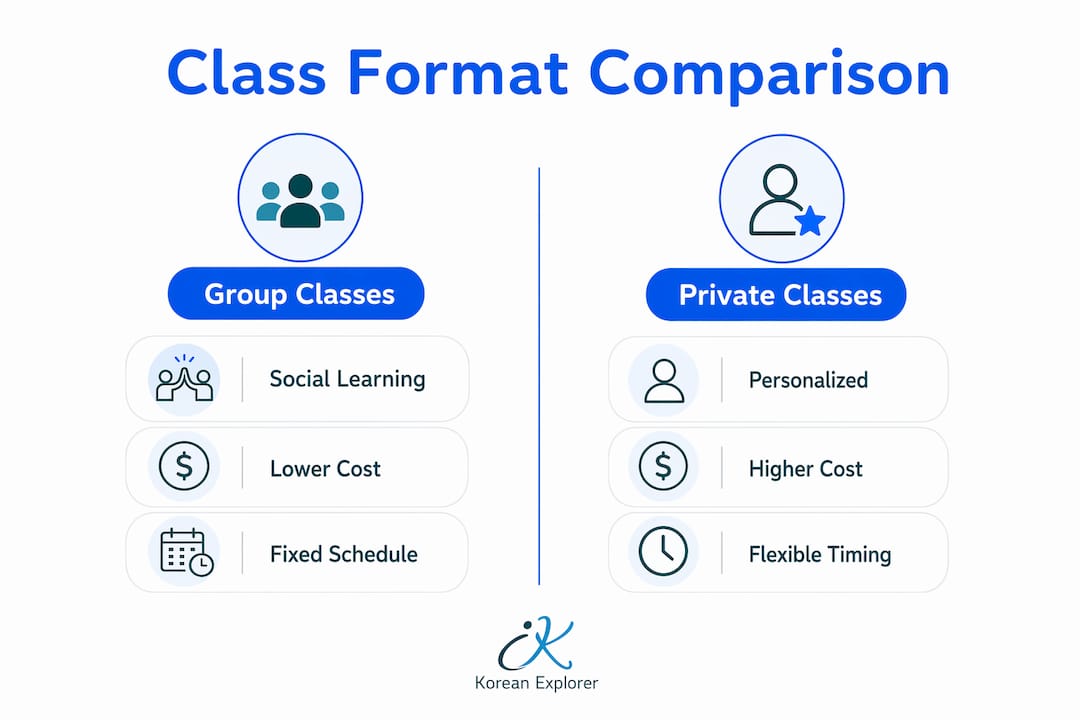
The core differences between group and private classes come down to five things: how much attention you get, how fast you move, how much you pay, when you can schedule, and how much you interact with other learners.
- Personalization: Private classes are built entirely around one student. Group classes follow a shared curriculum designed for the average learner in the room.
- Cost: Group classes spread the instructor’s time across multiple students, making each session cheaper. Private lessons cost more per hour but often require fewer total sessions to reach the same goal.
- Scheduling: Private classes offer flexible timing you negotiate with your instructor. Group classes run on fixed schedules.
- Pace: In a private setting, you move as fast or as slow as you need. In a group, the pace is set by the middle of the class.
- Feedback: Private instructors correct mistakes in real time. Group instructors must choose which errors to address without derailing the whole class.
- Social interaction: Group classes give you practice with peers, exposure to different speaking styles, and built-in accountability. Private lessons are just you and your instructor.
Neither format is universally better. The right choice depends on your goals, budget, and how you learn.
What group classes actually look like
Group classes typically host a small number of learners and follow a structured curriculum that moves at a collective pace. Sessions run on fixed days and times, which helps build a study routine but limits flexibility for people with irregular schedules.
The curriculum is designed for the average student in the room. That means faster learners sometimes wait while slower ones catch up, and vice versa. Instruction covers shared material: vocabulary, grammar patterns, conversation exercises, and listening practice.
- Typical class size: 4–10 students
- Fixed schedule with set lesson progression
- Curriculum targets the group’s average proficiency level
- Social activities like pair work, role-plays, and group discussions
- Lower per-session cost due to shared instructor time
The social dimension is real. Practicing with peers who are also learning creates a low-pressure environment where making mistakes feels less exposing. That shared experience often keeps learners motivated week to week.

What private classes actually look like
Private instruction is one student, one instructor, one agenda. The lesson plan is built around your specific goals, your current level, and the pace that works for you. If you want to focus on business conversation one week and pronunciation the next, that’s entirely possible.
Private lessons provide tailored pacing and immediate feedback that group settings simply cannot replicate. The instructor notices your recurring mistakes and corrects them before they become habits.
- One-on-one instruction with full instructor attention
- Curriculum customized to your goals, strengths, and weaknesses
- Flexible scheduling arranged around your availability
- Immediate, specific feedback on every error
- Higher per-session cost, but potentially fewer total sessions needed
Scheduling is a genuine advantage. Busy professionals can book evening or weekend slots. Learners who travel can reschedule without disrupting a whole class. That flexibility alone makes private lessons practical for adults with demanding lives.

Benefits and drawbacks of group classes
Group classes work well for a specific kind of learner: someone who is motivated by social energy, comfortable with a shared pace, and working within a budget.
Benefits:
- Peer motivation: Showing up alongside other learners creates accountability. When classmates are progressing, you feel the pull to keep up.
- Affordable: Shared instructor time means lower fees per session, letting you study more hours on the same budget.
- Conversational practice: Interacting with multiple learners exposes you to different speaking styles and accents, which builds listening range.
- Community: Group learning fosters friendships and a sense of belonging that solo study cannot replicate.
Drawbacks:
- Limited individual attention: With several students sharing one instructor, targeted correction is rationed. Your specific recurring mistakes may go unaddressed for weeks.
- Pacing mismatch: Group classes are designed around the middle student’s level, which means faster learners get bored and slower ones fall behind.
- Reduced speaking time: In a 60-minute class of 10 students, each learner gets roughly 6 minutes of speaking time if the instructor distributes it evenly. Most classes don’t even hit that.
- Fixed schedule: If you miss a session, you miss the material. There’s no rescheduling to suit your week.
Benefits and drawbacks of private classes
Private instruction puts everything in your corner. The pace, the topics, the schedule, and the feedback are all calibrated to one person: you.
Benefits:
- Customized curriculum: Every session targets your actual gaps, not a generalized syllabus. A learner focused on business conversation gets exactly that, not beginner vocabulary drills.
- Faster progress: One-on-one tuition produces approximately five additional months of learning progress per academic year compared to no tuition, according to the Education Endowment Foundation.
- Judgment-free environment: Private lessons foster a space where learners can make mistakes without peer pressure, which accelerates confidence and skill acquisition.
- Flexible scheduling: You set the time. Evening, weekend, or online sessions are all negotiable.
- Immediate corrective feedback: Errors get caught and fixed in the moment, before they harden into habits.
Drawbacks:
- Higher per-session cost: The instructor’s time is yours exclusively, and that exclusivity carries a price premium.
- Less social practice: Without classmates, you miss the spontaneous back-and-forth that builds real conversational fluency.
- Potential overdependence: Some learners lean too heavily on instructor guidance and struggle to think independently without that one-on-one support structure.
How cost, flexibility, and environment compare
Cost is the most visible difference, but it’s worth thinking about it in terms of progress speed rather than hourly rate. Private classes, though pricier per session, can offer long-term savings by accelerating goal achievement and reducing the total number of lessons needed.
- Per-session cost: Group classes are cheaper. Private lessons cost more per hour.
- Total cost to reach a goal: Private lessons often compress the timeline, which can offset the higher rate.
- Scheduling: Private classes flex around your life. Group classes require you to flex around theirs.
- Learning environment: Group settings are social and energizing for some learners. Private settings are focused and calm, which suits learners who are easily distracted or prefer deep concentration.
- Accountability: Groups create peer accountability. Private lessons create instructor accountability, where your teacher notices when you’re absent and picks up exactly where you left off.
Pro Tip: If budget is tight, consider starting with private lessons to build a solid foundation, then switching to group classes for ongoing conversational practice. You get the efficiency of personalized instruction early, then the social reinforcement later.
How to decide which format fits you
The honest question is: what are you actually trying to achieve?
- You want general conversational practice and enjoy social learning → Group classes are a strong fit. The peer interaction is the point, not a side effect.
- You have a specific goal (business Korean, professional fluency, a defined timeline) → Private lessons get you there faster and more directly.
- Your schedule is unpredictable → Private classes give you the flexibility to reschedule without consequence.
- Budget is the primary constraint → Group classes let you study more hours for the same spend.
- You’re easily distracted or self-conscious about mistakes → A private setting removes both problems at once.
- You want to build fluency through immersion → A hybrid approach combining both formats often works best for adult learners: private sessions for core skill-building, group classes for social practice.
Adults frequently ask “why” and want to understand the logic behind what they’re learning. Private instructors can build sessions around that curiosity. Group classes move on whether or not every student has internalized the reasoning.
What the research says about learning outcomes
The evidence on private instruction is consistent. The Education Endowment Foundation’s analysis found that one-on-one tuition yields roughly five additional months of learning progress per academic year. That’s not a marginal gain.
The speaking time math is stark: in a 60-minute group class of 10 students, each learner gets about 6 minutes of active speaking practice. One hour of private instruction gives you the full 60 minutes.
Adults also learn differently than younger students. They arrive with specific goals, existing knowledge frameworks, and a preference for understanding the “why” behind each lesson. Private instructors can adapt sessions to each student’s style and reasoning preferences in ways a group format structurally cannot.
That said, group classes aren’t ineffective. They work well for building communicative fluency, exposure to varied accents, and the kind of spontaneous interaction that mirrors real-world conversation. The research suggests the best adult learning outcomes often come from a hybrid model: private sessions for targeted skill mastery, group classes for social practice and momentum.
Pro Tip: Short, frequent practice sessions beat long, occasional ones. A private instructor can set realistic expectations from lesson one, something a group format rarely does.
Which subjects and skills suit each format
Not every subject benefits equally from one-on-one instruction, and not every goal requires it.
Better suited to private instruction:
- Business language skills (presentations, negotiations, professional writing)
- Pronunciation correction and accent work
- Exam preparation with a specific deadline
- Learners returning to a language after a long break
- Advanced learners targeting specific gaps in an otherwise solid foundation
Better suited to group classes:
- Complete beginners who benefit from a slower, structured pace and peer support
- Conversational practice across different speaking styles
- Subjects where collaboration is part of the skill itself (debate, discussion, group projects)
- Learners whose primary goal is social engagement alongside learning
For language learning specifically, the group vs. private class decision often comes down to whether you need to build a foundation or practice what you already know. Private instruction builds the foundation faster. Group classes give it a workout.
Key Takeaways
Private classes accelerate progress through personalized instruction and immediate feedback, while group classes offer affordable, social learning that builds conversational fluency through peer interaction.
| Point | Details |
|---|---|
| Private classes yield faster progress | One-on-one tuition produces roughly five additional months of learning progress per academic year. |
| Group speaking time is limited | In a 60-minute class of 10 students, each learner gets about 6 minutes of active speaking practice. |
| Cost depends on your goal | Private lessons cost more per session but often require fewer total sessions to reach the same outcome. |
| Hybrid models work well for adults | Combining private sessions for skill-building with group classes for social practice suits most adult learners. |
| Korean Explorer offers both formats | Korean Explorer provides group, private, and online Korean classes for adult learners in Singapore. |
The format question most learners ask too late
Most adults spend weeks debating cost before they ask the more useful question: what does my goal actually require?
If you want to hold a conversation at a dinner party or travel more comfortably, a group class gets you there. The social pressure is motivating, the cost is manageable, and the pace suits a casual goal. But if you need Korean for a professional role, a business meeting, or a specific career move, a group class moving at the average learner’s pace is a slow route to a time-sensitive destination.
The research on private instruction is clear enough that the debate isn’t really about effectiveness. It’s about whether the faster, more targeted format is worth the higher per-session cost for your specific situation. For adult learners with defined professional or conversational goals, it usually is. The five additional months of annual progress the Education Endowment Foundation documented aren’t abstract. They represent real conversations you can have sooner, real opportunities you can pursue earlier.
One thing worth saying plainly: the learners who struggle most aren’t the ones who chose the wrong format. They’re the ones who chose a format and then didn’t show up consistently. Whatever you pick, frequency matters more than the format itself.
Korean Explorer offers both formats for adult learners
Adult learners in Singapore who want structured Korean instruction don’t have to choose between personalization and community. Korean Explorer provides group classes, private one-on-one sessions, and online Zoom lessons, all taught by experienced native Korean instructors fluent in both Korean and English.
The curriculum is built for adult goals: conversational fluency, business Korean, and professional communication. Group classes keep sizes small enough for real interaction, while private Korean classes are fully customized to your pace, schedule, and specific learning objectives. Korean Explorer is located at 10 Anson Road, Level 22, International Plaza, Singapore 079903, right above Tanjong Pagar MRT, with additional centers in Jurong and Tampines.
Ready to start? Explore Korean language courses and find the format that fits your goals.
FAQ
Are group or private lessons better for learning Korean?
Private lessons typically produce faster results for learners with specific goals, while group classes suit those who want affordable, social practice. The right choice depends on your timeline, budget, and whether you need personalized instruction or conversational exposure.
What does “private class” mean?
A private class is a one-on-one session between a student and instructor, where the curriculum, pace, and feedback are tailored entirely to that one learner’s goals and schedule.
What are the drawbacks of private lessons?
Private lessons cost more per session and offer less social interaction than group classes. Some learners also develop overdependence on instructor guidance without the spontaneous peer interaction that builds independent communication skills.
What does “group class” mean?
A group class brings multiple students together, typically 4–10 learners, to follow a shared curriculum led by one instructor. The pace is set for the average student in the room, and speaking time is divided among all participants.
Can you combine group and private classes?
Yes, and for adult language learners it’s often the most effective approach. Private sessions build core skills and target specific weaknesses, while group classes provide social practice and conversational variety.