TOPIK certification is one of the most direct ways to improve your career prospects in Korean-related professional environments. Employers at Korean conglomerates, multinational firms with Korean operations, and government-affiliated organizations increasingly require verified language scores rather than self-reported fluency. The role of TOPIK in career advancement goes well beyond a line on your resume. It signals to hiring managers that you can function in meetings, write formal documents, and integrate into a Korean workplace without hand-holding.
Here is what that means in practice:
- TOPIK Level 4 or higher is commonly recognized as the threshold many Korean companies set for office and corporate roles, often associated with improved promotion prospects and pay.
- Visa eligibility depends heavily on your score. E-series work visas and F-5 permanent residency applications all reference TOPIK as qualifying evidence.
- Salary premiums are real in markets where Korean investment is concentrated. Personnel with strong Korean proficiency command noticeably higher starting packages than peers without verified scores.
- Leadership access opens at Levels 5 and 6, where near-native fluency allows participation in high-level negotiations and complex professional contexts without language limitations.
- Cultural competence works alongside your score. Certified language ability without cultural literacy leaves gaps that Korean employers notice immediately, especially in client-facing and management roles.
- Discipline signal. Reaching TOPIK Level 4 or above reflects significant commitment and study, which Korean employers interpret as evidence of long-term intent and cultural awareness.
- Technical roles offer some flexibility. Developers and engineers with elite coding skills may be hired at Level 2 or 3, but product managers and office professionals typically need Level 4 or higher regardless of technical ability.
Table of Contents
- How TOPIK exam levels shape your employment options
- Why Korean cultural competence is just as important as your score
- Practical ways to leverage TOPIK and Korean skills for career growth
- What effective Korean learning looks like when your goal is career advancement
- Key Takeaways
- FAQ
How TOPIK exam levels shape your employment options
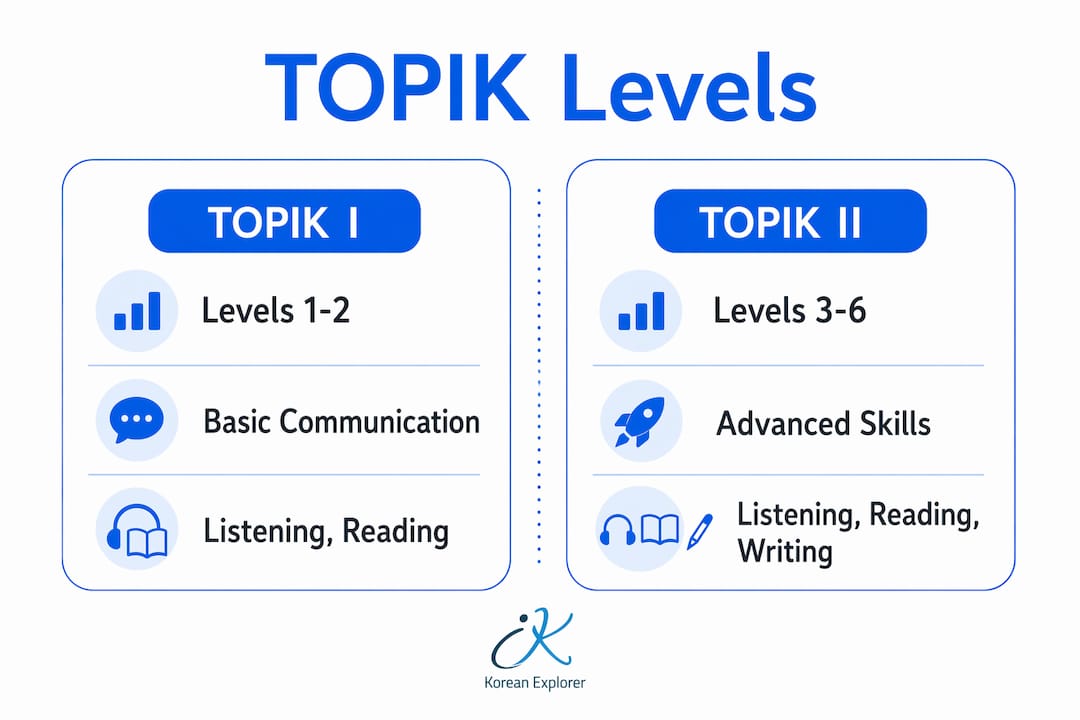
The TOPIK exam is administered by the National Institute for International Education (NIIED), a branch of South Korea’s Ministry of Education. NIIED lists university admission, job seeking, visa qualification, and scholarship programs among the primary official uses of TOPIK results. The exam divides into two tiers.
TOPIK I covers Levels 1 and 2. It tests listening and reading only, and it qualifies candidates for basic communication contexts. No writing section is included. For professional employment purposes, TOPIK I is largely insufficient on its own. Level 2 may satisfy some manufacturing visa categories (E-9), but corporate roles almost universally require more.
TOPIK II covers Levels 3 through 6 and adds a writing section alongside listening and reading. The total score is 300 points across 180 minutes of testing. The writing section is where many candidates stumble. The long essay question alone accounts for 50 points, and evaluators in 2026 have tightened standards on logical flow and advanced grammar. Passing TOPIK II at a high level is the real credential employers want to see.
TOPIK levels, scores, and career relevance
| TOPIK Level | Minimum Score (out of 300) | Practical Ability | Career and Visa Use |
|---|---|---|---|
| Level 1 | — | Basic greetings, simple sentences | Limited; personal use only |
| Level 2 | — | Short passages, everyday communication | Some manufacturing/labor visas (E-9) |
| Level 3 | — | Functional work and social communication | Korean university admission; entry-level roles |
| Level 4 | — | Professional language, formal documents, meetings | Office jobs, E-series work visas, master’s/PhD programs |
| Level 5 | — | Fluent in formal contexts, conferences, negotiations | Senior roles, F-2 long-term residency |
| Level 6 | — | Near-native; no professional or academic limitations | Leadership roles, F-5 permanent residency |
Key level-to-career correspondences worth knowing:
- Level 3 is the floor for Korean university admission and entry-level office consideration, but most companies sponsoring work visas will push for Level 4 or 5 in practice.
- Level 4 is the standard for most professional office positions. Candidates at this level can handle meetings, write formal correspondence, and follow complex instructions without constant support.
- Level 5 opens doors to senior professional roles and satisfies requirements for long-term residency visas such as the F-2.
- Level 6 is the entry ticket for roles requiring persuasion, client management, and executive communication. Finance and legal sectors typically treat it as the minimum for client-facing work.
- Technical exceptions exist. Developers and engineers with elite skills in Python, Java, or C++ may be hired at Level 2 or 3, but product managers and UX designers in the same companies often need Level 5 to articulate user nuances effectively.
For a clear breakdown of which exam tier fits your goals, the TOPIK I vs TOPIK II comparison is worth reading before you register.
Why Korean cultural competence is just as important as your score
Language certification and cultural literacy are not the same thing, and Korean employers know the difference. Cultural literacy is essential alongside TOPIK proficiency to navigate Korean workplace norms for effective career advancement. A candidate who scores Level 5 but misreads a senior colleague’s indirect communication style can damage relationships that take months to repair.
Korean professional culture runs on hierarchy, and that hierarchy is encoded in language. Honorifics are not optional politeness. They are the operating system of Korean workplace communication. Using the wrong speech level with a manager, even accidentally, signals a lack of cultural awareness that no test score can immediately fix. Understanding when to use formal speech versus polite informal registers, and reading the room to know which is appropriate, is a skill that takes deliberate practice beyond grammar drills.
Cultural knowledge areas that directly affect career outcomes:
- Honorifics and speech levels. Korean has distinct formal, polite, and informal registers. Professional settings demand consistent use of formal or polite speech with colleagues above your level.
- Nunchi. This concept refers to social intuition, the ability to read unspoken cues, emotional atmosphere, and group dynamics. Finance and sales roles in particular test candidates on nunchi during interviews.
- Workplace hierarchy and titles. Korean organizations use title-based address rather than first names. Knowing how to address a 부장 (department head) versus a 대리 (assistant manager) matters from day one.
- Indirect communication. Korean professional culture often favors indirect refusals and suggestions over blunt statements. Misreading “that might be difficult” as a maybe rather than a no is a common and costly mistake.
- Meeting etiquette. Speaking out of turn, challenging a senior colleague publicly, or skipping after-work social events (hoesik) can all affect your standing regardless of your language score.
- Written communication norms. Business emails and reports follow specific structural conventions. A well-written document in Korean that violates these conventions still reads as unprofessional.
Pro Tip: Pair your TOPIK study with deliberate cultural immersion. Watch Korean business dramas, read Korean news commentary, and if possible, join a Korean professional network or language exchange group. The cultural context you absorb this way fills gaps that no textbook covers.
Hind Rbigui, a Moroccan engineer who became a naturalized Korean citizen, put it plainly in an interview with The Korea Times: “If you become fluent, many doors will open.” Her path included Korean-language speech contests, campus clubs, and active participation in professional networks, not just classroom study. The combination of certified proficiency and genuine cultural engagement was what made the difference for her career in Korea.
Practical ways to leverage TOPIK and Korean skills for career growth
Certification alone does not advance your career. What you do with it determines how far it takes you. The professionals who see the biggest returns from their TOPIK scores are the ones who actively position those skills in the job market and keep building on them after the exam.
Building your professional network with Korean language skills
Korean professional communities in the US are active and well-connected, particularly in cities with large Korean American populations and in industries where Korean investment is concentrated, such as tech, automotive manufacturing, and consumer electronics. Attending Korean Chamber of Commerce events, Korean American professional associations, and industry meetups where Korean is spoken gives you practice and visibility simultaneously. Networking through Korean-language communities unlocks opportunities that certification alone cannot guarantee.

Positioning TOPIK on your resume and in interviews
List your TOPIK level with the score and the exam date. Hiring managers at Korean companies know exactly what each level means, so specificity matters. “TOPIK Level 4 (Score: 162/300, October 2025)” communicates far more than “Korean proficiency.” In interviews, be ready to demonstrate your skills. Many Korean company interviews include a brief Korean-language segment, even for roles where English is the primary working language.
Practical career advancement tactics:
- Add your TOPIK score to LinkedIn under certifications, with the issuing organization listed as NIIED.
- Seek out roles at Korean-owned subsidiaries, joint ventures, and US offices of Korean conglomerates where bilingual staff are consistently valued.
- Use Korean in your cover letter opening paragraph when applying to Korean companies. It signals genuine commitment before the interview.
- Negotiate salary by referencing the verified proficiency your TOPIK score represents. In industries where Korean-speaking staff are scarce, this is a concrete differentiator.
- Pursue continuous improvement after certification. Reaching Level 4 is a milestone, not a finish line. Candidates who push to Level 5 or 6 access a much smaller talent pool and correspondingly better opportunities.
- In tech roles, combine your TOPIK score with domain-specific Korean vocabulary. A developer who can discuss product requirements in Korean with Seoul-based teams is worth considerably more than one who cannot.
- For manufacturing and engineering roles, Korean language skills help you work directly with Korean technical supervisors and documentation, reducing errors and accelerating integration.
Industries in the US where TOPIK certification carries particular weight include semiconductor manufacturing (companies like Samsung and SK Hynix have US operations), automotive supply chains tied to Hyundai and Kia, K-beauty and consumer goods distribution, Korean media and entertainment localization, and financial services firms with Korean corporate clients. In each of these sectors, a verified TOPIK score moves you from the general applicant pool into a much shorter list.
What effective Korean learning looks like when your goal is career advancement
The gap between passing TOPIK and actually thriving in a Korean professional environment comes down to how you learned. Rote memorization of grammar rules and vocabulary lists gets you through the exam. Conversation-focused, culturally grounded study gets you through the job.
Korean Explorer’s curriculum is built on the Seoul National University framework and aligned with TOPIK standards, which means the language you learn maps directly onto what the exam tests and what Korean workplaces expect. Native Korean instructors who are also fluent in English can explain the cultural logic behind grammar choices, not just the rules themselves. That context is what makes the difference between technically correct Korean and Korean that actually lands well with native speakers.
What structured, career-focused Korean learning looks like in practice:
- Conversation-first methodology. Grammar is taught in the context of real communication scenarios, not as isolated rules. You practice the kinds of exchanges that happen in meetings, emails, and client calls.
- TOPIK-aligned progression. Each course level corresponds to TOPIK benchmarks, so your classroom progress translates directly into exam readiness. You are not studying two separate things.
- Cultural integration throughout. Honorifics, workplace norms, and social conventions are woven into lessons from the beginning, not added as an afterthought at advanced levels.
- Mock exam practice. Timed practice under exam conditions, particularly for the TOPIK II writing section, builds the speed and accuracy the test demands.
- Flexible formats. Group classes, private sessions, and online Zoom options mean you can maintain consistent study even with a demanding work schedule. Consistency matters more than intensity for long-term retention.
Structured study plans using diverse resources and mock exams significantly improve TOPIK exam success and prepare candidates for professional use of Korean. The most effective learners combine textbook foundations with real-world listening practice, whether through Korean news, podcasts, or workplace simulations.
Pro Tip: Do not wait until you reach an advanced level to start using Korean professionally. Even at Level 3, you can join Korean-language professional groups, follow Korean industry news, and correspond in Korean with colleagues who appreciate the effort. Early real-world use accelerates your progress faster than additional study hours alone.

Hind Rbigui’s experience, referenced earlier, illustrates this directly. She competed in Korean-language speech contests hosted by institutions including Kookmin University and Inha University. Those achievements strengthened her resume and her confidence simultaneously. The lesson is that public use of Korean, even imperfect Korean, builds the kind of fluency that classroom study alone cannot replicate.
For professionals ready to build toward TOPIK certification with a curriculum that connects directly to career outcomes, Korean Explorer offers adult Korean courses ranging from conversational to business-level, with both in-person and online options. The school’s location at 10 Anson Road, Level 22, International Plaza, Singapore 079903, right above Tanjong Pagar MRT, makes it accessible for working professionals. Online Zoom classes are available for learners outside Singapore or those with schedules that make commuting impractical.
If you are specifically preparing for the TOPIK exam, the TOPIK preparation tips guide covers the exam strategies that actually move scores, including how to approach the writing section that trips up most candidates at the TOPIK II level.
Key Takeaways
TOPIK certification at Level 4 or higher is the single most effective credential for accessing professional Korean-related roles, with higher levels unlocking visa eligibility, leadership positions, and salary advantages that lower scores cannot reach.
| Point | Details |
|---|---|
| Level 4 is the professional threshold | Most Korean companies require TOPIK Level 4+ for office roles, linking it to faster promotions and better pay. |
| Cultural competence multiplies your score | Language certification without cultural literacy, including honorifics and nunchi, leaves gaps Korean employers notice immediately. |
| Networking amplifies certification | Participating in Korean professional communities unlocks opportunities that a TOPIK score alone cannot guarantee. |
| Writing section is the key differentiator | TOPIK II’s long essay question carries 50 points, and 2026 evaluators apply stricter standards on logical flow and grammar. |
| — | Reaching Level 4 or above reflects significant commitment and study, which Korean employers interpret as evidence of long-term intent and cultural awareness. |
FAQ
What is the purpose of the TOPIK exam?
TOPIK measures Korean language proficiency for non-native speakers and is used for university admission, work visas, permanent residency applications, and proof of competency for employers worldwide. It is administered by NIIED, a branch of South Korea’s Ministry of Education.
Which TOPIK level do most professional jobs require?
Most office and corporate roles require TOPIK Level 4 or higher, with Level 5 or 6 expected for senior, client-facing, or leadership positions. Technical roles in IT or engineering may accept Level 2 or 3 if specialized skills are exceptional.
Which TOPIK level corresponds to B2 proficiency?
TOPIK Level 4 is broadly comparable to a B2 level on the Common European Framework of Reference (CEFR), reflecting the ability to handle professional conversations, formal documents, and workplace communication with confidence.
How does TOPIK certification affect salary and promotion?
Holding TOPIK Level 4 or higher is linked to faster career growth, salary increases, and access to leadership positions at Korean companies, because it demonstrates both language ability and the discipline required to achieve it.
Does TOPIK certification guarantee a job at a Korean company?
TOPIK is strong evidence of proficiency but not a guaranteed hiring outcome. Treat it as a key qualifying credential that gets you past initial screening, combined with relevant work experience, cultural competence, and a demonstrated ability to communicate in professional Korean contexts.