TOPIK standards are the official framework set by South Korea’s National Institute for International Education (NIIED) to measure and certify Korean language proficiency for non-native speakers. Launched in 1997, the Test of Proficiency in Korean gives learners, universities, and employers a shared, government-backed benchmark for assessing Korean ability. The standards cover everything from how the exam is structured to how scores translate into certified proficiency levels.
At their core, TOPIK standards define three things: the test’s format and sections, the six proficiency levels and their score bands, and the criteria for passing each level. Two main tiers exist within the framework:
- TOPIK I covers Levels 1 and 2, testing Listening and Reading only, and is designed for beginners.
- TOPIK II covers Levels 3 through 6, adding a Writing section, and targets intermediate to advanced learners.
- TOPIK Speaking is a separate evaluation with its own six-level scoring scale.
- Scores are valid for two years from the official announcement date.
- Results are used for university admission, employment qualification, visa applications, and scholarship eligibility.
Understanding these standards precisely matters because institutions reference specific levels and score bands tied to the exact test format taken. Getting that wrong can cost you an admission or a job offer.
How is the TOPIK exam structured?
The TOPIK exam runs in two operationally distinct tiers, each with its own sections, question counts, and time limits. Both a paper-based test (PBT) and an internet-based test (IBT) are available, and both carry the same official validity and grading system.
TOPIK I tests Listening and Reading only. The Listening and Reading sections together form the full score of 200 points. This tier is built for learners who are still building foundational Korean skills.
TOPIK II adds a Writing section to Listening and Reading. Listening and Reading each carry their own point allocations, and Writing adds 4 items, bringing the total to 300 points. Reaching Level 3 or above requires sitting TOPIK II, not TOPIK I.

TOPIK Speaking is a completely separate test. It consists of 6 questions scored out of 200 points and awards its own levels on an independent scale. It does not replace or overlap with the written test levels.
| Test | Sections | Items | Total Points | Format |
|---|---|---|---|---|
| TOPIK I | Listening, Reading | — | 200 | PBT / IBT |
| TOPIK II | Listening, Reading, Writing | varies + 4 writing | 300 | PBT / IBT |
| TOPIK Speaking | Speaking | 6 | 200 | IBT only |
Key format distinctions worth knowing:
- PBT and IBT share the same grading system and official validity.
- IBT makes the test accessible to Korean learners worldwide without traveling to a test center.
- Score bands for level determination can differ between PBT and IBT, so you must check which format applies to your results.
- TOPIK Speaking is administered only as an internet-based test.
What do the six TOPIK levels actually mean?
The six TOPIK proficiency levels form a ladder from basic survival Korean at Level 1 to near-native fluency at Level 6. Levels 1 and 2 come from TOPIK I; Levels 3 through 6 come from TOPIK II. Each level has a defined score band and a set of competencies that describe what a test-taker at that level can actually do in Korean.
Here is how the levels break down by score band and core ability:
| Level | Test | Score Band (PBT) | Core Competency |
|---|---|---|---|
| Level 1 | TOPIK I | 80–139 | Basic survival communication; simple daily vocabulary |
| Level 2 | TOPIK I | 140–200 | Simple personal and familiar topics; basic social interaction |
| Level 3 | TOPIK II | 120–139 | Everyday social contexts; understanding of common idioms |
| Level 4 | TOPIK II | 140–179 | Social and cultural content; idiomatic expressions |
| Level 5 | TOPIK II | 180–229 | Professional and research contexts; politics, economics, society |
| Level 6 | TOPIK II | 230–300 | Near-native fluency; official, literary, and unfamiliar themes |
TOPIK Speaking uses a separate scoring scale. Scores of 20–49 correspond to Speaking Level 1, while scores of 160–200 correspond to Speaking Level 6. The speaking levels do not map directly onto the written test levels; they are assessed independently.
What each level signals in practice:
- Levels 1–2: You can handle basic transactions, read simple signs, and introduce yourself. Think airport navigation and ordering food.
- Levels 3–4: You can discuss familiar social topics, understand Korean cultural references, and express opinions on everyday matters.
- Levels 5–6: You can function in professional or academic Korean, engage with complex topics like economics or law, and use language naturally across formal and informal registers.
For learners targeting university admission in Korea, Level 3 is a common minimum requirement. Many graduate programs and competitive employers ask for Level 4 or higher. Level 6 signals the kind of fluency that requires no accommodation from native speakers.
How TOPIK scoring and passing standards work
TOPIK scoring aggregates raw scores across sections, and the combined total determines your certified level. There is no single passing score for the exam as a whole. Instead, each level has a defined score threshold, and your result is the highest level whose band your total score meets.
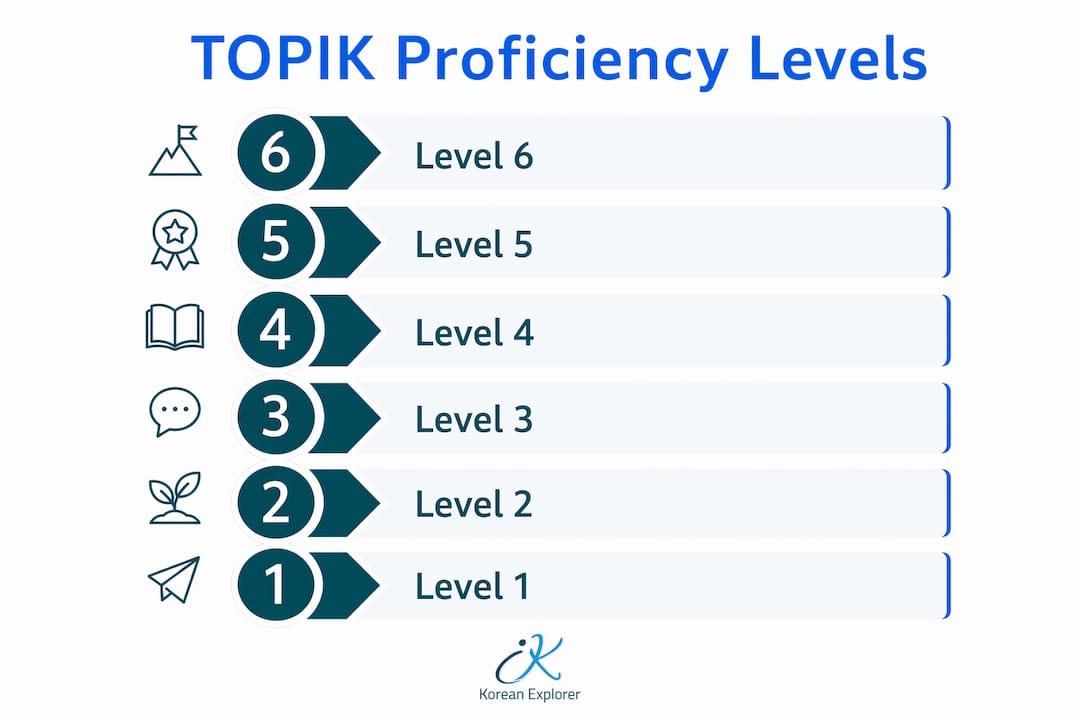
For TOPIK I, a total of 80–139 points earns Level 1, and 140–200 earns Level 2. For TOPIK II, the thresholds run from 120 points for Level 3 up to 230 points for Level 6. Scoring below 120 on TOPIK II means no level is awarded for that sitting.
The Writing section in TOPIK II is crucial because balanced skills across all sections are needed to reach higher levels; neglecting Writing often lowers the overall level.
Key scoring points:
- TOPIK I total: 200 points (Listening 100 + Reading 100).
- TOPIK II total: 300 points (Listening, Reading, and Writing combined).
- TOPIK Speaking total: 200 points, scored independently.
- No minimum per-section score is required for TOPIK I or II; only the total determines the level.
- Scores are valid for two years from the official announcement date.
- PBT and IBT use the same grading system, but score band thresholds for specific levels can vary by format.
One practical implication: if you sit the IBT version and then apply to a university that references PBT score bands, the level assignment may differ. Always confirm which format’s bands the institution uses before you register.
Why TOPIK scores matter beyond the exam room
TOPIK certification is not just a personal milestone. It is a formal credential that institutions in South Korea and internationally use to make concrete decisions about admission, hiring, and residency.
The most common use cases:
- University admission and graduation: Many Korean universities require a minimum TOPIK level for admission of international students, and some require a higher level for graduation.
- Employment: Korean companies and government agencies often list a minimum TOPIK level as a job requirement, particularly for roles involving Korean-language communication.
- Visa and residency: Certain Korean visa categories and permanent residency applications require proof of Korean proficiency, with TOPIK scores serving as the official evidence.
- Scholarships: Programs like the Korean Government Scholarship Program reference TOPIK levels as part of eligibility criteria.
- Academic credit: Some institutions award academic credit or language course exemptions based on TOPIK results.
The official NIIED framework explicitly positions TOPIK as the standard for both entrance to Korean educational institutions and job-seeking purposes. That dual role is what gives the certification real weight. A Level 4 certificate tells an employer something specific and verifiable, not just that you “studied Korean for a few years.”
Knowing the benefits of TOPIK certification before you start preparing also helps you set a realistic target level based on your actual goals, whether that is a graduate program, a corporate role, or a residency application.
Common misconceptions about TOPIK standards
The most frequent errors people make with TOPIK standards come from conflating the two test tiers and misreading score bands across formats.
- TOPIK I does not award Levels 3–6. If you sit TOPIK I and score perfectly, you receive Level 2 at most. Reaching Level 3 requires registering for and passing TOPIK II.
- PBT and IBT score bands are not always identical. The same raw score can correspond to different levels depending on which format you took. Assuming they are interchangeable is a common source of errors when mapping results to institutional requirements.
- TOPIK Speaking levels are independent. A Level 4 on the written TOPIK II does not imply Level 4 speaking ability as measured by the TOPIK Speaking test. The two scales are separate.
- Skipping Writing in TOPIK II preparation is a costly mistake. The Writing section is mandatory for TOPIK II, and its score directly affects your total. Treating it as optional is one of the most common reasons test-takers score lower than expected.
- Not all institutions accept both formats. Some universities and employers specify which test format’s score bands they reference. Check the institution’s requirements before you register.
- Level 6 is not “fluent enough for anything.” Even at Level 6, context matters. A legal firm may require demonstrated writing ability in legal Korean that goes beyond what the test measures.
A practical rule: always read the institution’s requirement as “Level X on TOPIK II, PBT” or “Level X on TOPIK IBT” rather than just “Level X.” The format qualifier changes the score band, and that detail can determine whether your certificate meets the threshold.
How knowing TOPIK standards can sharpen your Korean study
Understanding the exact structure of TOPIK standards before you start studying changes how you allocate your time. Most learners waste months preparing for sections that do not exist in their target test tier, or neglecting the ones that carry the most weight.
Start by identifying your target level and the test tier it belongs to. If you are aiming for Level 3 or above, you are sitting TOPIK II, which means Writing is not optional. Learners who treat TOPIK II like an extended version of TOPIK I consistently underperform on the Writing section because they never practiced it systematically.
Align your study plan with the actual section weights. TOPIK II distributes 300 points across three sections, and Writing is where the most preparation time is typically underinvested. Listening and Reading skills transfer from everyday Korean consumption, but Writing requires deliberate practice with Korean essay structure and formal grammar patterns.
Pro Tip: If your goal is Level 4 or 5, simulate full TOPIK II practice tests under timed conditions at least once a month. The time pressure on Writing is where most intermediate learners lose points, not on knowledge.
Practical steps to align your preparation with TOPIK standards:
- Confirm your target level and which test tier (TOPIK I or II) awards it.
- Study the exact section format, item count, and time limit for your tier.
- For TOPIK II, dedicate specific weekly sessions to Writing practice, not just grammar review.
- Use official NIIED past papers, which reflect the actual test question policy and content range.
- Track your practice scores against the official level thresholds, not just a general sense of progress.
- If Speaking is relevant to your goals, treat TOPIK Speaking as a separate preparation track.
Korean Explorer’s curriculum is built around the Seoul National University framework and closely aligned with TOPIK standards, which means the progression from beginner to advanced mirrors the competency milestones the test actually measures. If you want structured preparation that maps directly to TOPIK exam criteria, that alignment matters more than raw study hours.
Recent updates and changes to TOPIK standards
The most significant structural change to TOPIK took effect from the 35th test sitting, held on July 20, 2014. The original three-tier format (Beginner, Intermediate, Advanced) was replaced by the current two-tier system: TOPIK I and TOPIK II. The old format also included vocabulary and grammar as a separate section, which no longer exists. TOPIK II now tests only Listening, Reading, and Writing.
The Business TOPIK (B-TOPIK), which was a separate track for professional Korean, was also discontinued as part of this restructuring. The current framework consolidates all written proficiency assessment into TOPIK I and TOPIK II.
The IBT format is the more recent addition. The TOPIK IBT carries the same validity and grading system as the paper-based test, but it expands access significantly by allowing test-takers to sit the exam at authorized centers worldwide without traveling to Korea. The Hong Kong Examinations and Assessment Authority, for example, administers the TOPIK IBT for candidates in Hong Kong.
NIIED has not announced a fundamental restructuring of the current two-tier system since 2014. The core framework of six levels, two written test tiers, and a separate Speaking test remains in place. What does evolve periodically is the test question policy, which NIIED updates to reflect a balanced composition of tested areas and to incorporate a wider range of Korean cultural and societal content. Learners preparing with materials older than a few years should verify that the question formats they are practicing still match the current test design.
Key Takeaways
TOPIK standards define a six-level Korean proficiency framework administered by NIIED, with two written test tiers, a separate Speaking test, and scores valid for two years from the announcement date.
| Point | Details |
|---|---|
| Two written test tiers | TOPIK I awards Levels 1–2; TOPIK II awards Levels 3–6 and includes a mandatory Writing section. |
| Score validity | Official TOPIK scores are valid for two years from the announcement date for academic and professional use. |
| Format affects score bands | PBT and IBT share the same grading system, but level score thresholds can differ between formats. |
| Writing is decisive in TOPIK II | Weak Writing scores pull down the total even when Listening and Reading are strong. |
| Speaking is independent | TOPIK Speaking uses its own six-level scale and does not map directly to written test levels. |
FAQ
What is TOPIK?
TOPIK (Test of Proficiency in Korean) is a standardized Korean language proficiency test administered by South Korea’s National Institute for International Education (NIIED) for non-native speakers. It has been running since 1997 and is officially recognized by universities, employers, and government institutions worldwide.
What TOPIK level is considered fluent?
Level 5 and Level 6 are generally considered advanced to near-native fluency. Level 6 indicates the ability to use Korean naturally across formal, literary, and unfamiliar subject areas with no significant difficulty.
What do the TOPIK levels mean?
Levels 1 and 2 cover basic to elementary Korean; Levels 3 and 4 cover intermediate social and cultural communication; Levels 5 and 6 cover professional, academic, and near-native proficiency. Each level corresponds to a defined score band within its test tier.
How hard is the TOPIK test?
TOPIK I is manageable for learners with a few months of structured study, but TOPIK II is significantly more demanding because it adds a Writing section and tests complex grammar, vocabulary, and formal expression. Most learners find the jump from Level 2 to Level 3 the steepest, since it requires switching test tiers entirely.
Does TOPIK IBT give the same certification as the paper-based test?
Yes. The TOPIK IBT carries the same official validity and grading system as the paper-based TOPIK. Both formats award the same six-level certification recognized by NIIED, though score band thresholds for specific levels can differ between formats.