TL;DR:
- Cultural understanding enhances Korean language learning by embedding social norms and context into communication. It significantly improves fluency, confidence, and comprehension across all language skills. Integrating cultural insights early prevents mistakes and accelerates mastery.
Cultural insight in language learning is defined as the understanding of social norms, values, and traditions that shape how a language is actually used in real life. Grammar rules and vocabulary lists get you to the door. Cultural knowledge gets you inside. For Korean learners specifically, missing this layer means speaking technically correct sentences that still confuse or offend native speakers. Learners who study cultural layers improve across all four skills, including listening, speaking, reading, and writing, because they grasp tone, register, and social meaning. Korean Explorer builds this cultural foundation into every adult course it offers, because fluency without cultural literacy is incomplete.
How do cultural insights explain language learning outcomes?
Culture shapes language from the ground up. Every word choice, every greeting, and every pause in a conversation carries a social signal. To explain cultural insights in language learning is to show that language is not a neutral code. It is a living expression of how a community thinks, relates, and organizes itself.
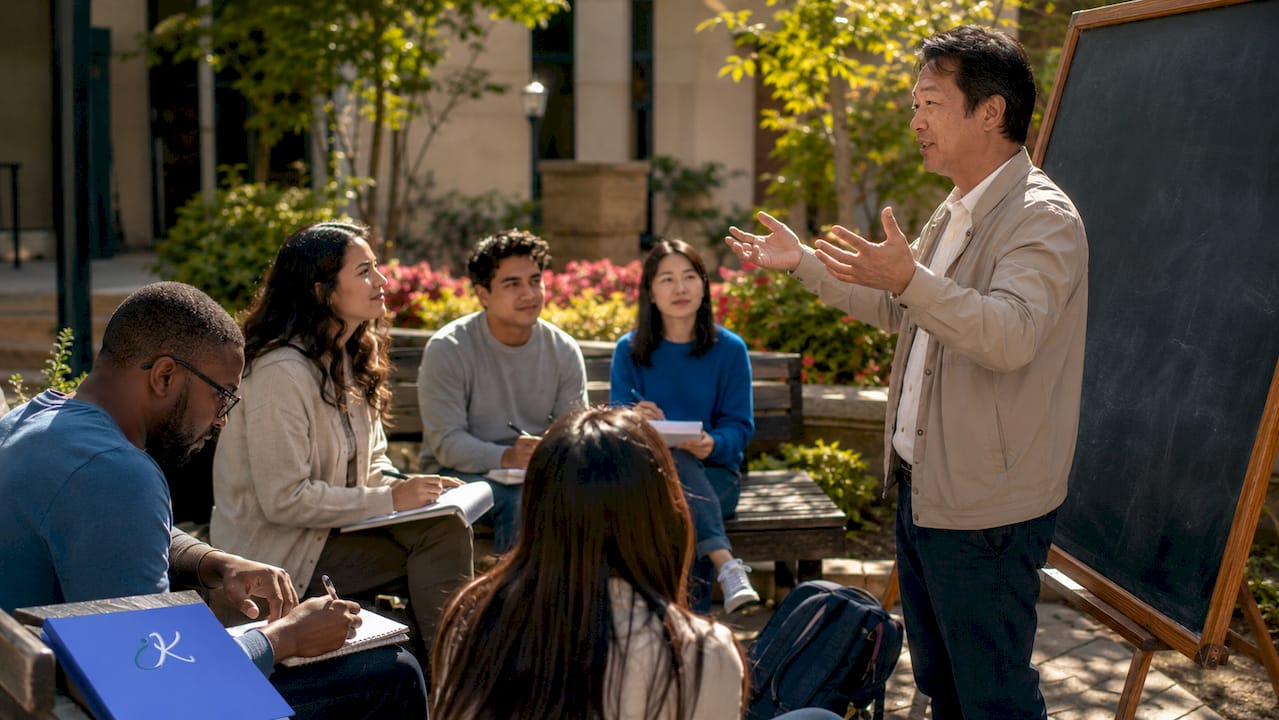
Korean is one of the clearest examples of this principle in action. The language has a fully developed honorific system called gyeongeo, which changes verb endings, pronouns, and even vocabulary depending on the age and social rank of the person you are addressing. You do not simply choose “polite” or “casual.” You navigate a spectrum of formality levels, each tied to specific social relationships. Mastering Korean honorifics requires active social navigation of hierarchy, age, and relationship context, not just grammatical accuracy. That distinction matters enormously for adult learners aiming at real conversation.

High-context communication adds another layer. Korean speakers often rely on shared cultural knowledge to fill gaps that English speakers would spell out explicitly. A Korean colleague who says “it might be difficult” is often saying “no.” Reading that signal correctly requires cultural context, not a dictionary.
How does culture shape Korean language structures?
Korean grammar encodes social relationships in ways that have no direct equivalent in English. The Korean language structure itself reflects a Confucian framework built on hierarchy, respect for elders, and group harmony. These values are not background information. They are baked into the grammar.
Here is what that looks like in practice:
- Honorific verb endings: The verb “to eat” becomes meoknda in casual speech and deuseyo in formal speech. Using the wrong form with a senior colleague is not a minor slip. It signals disrespect.
- Age-based pronouns: Korean has no neutral second-person pronoun like “you.” The word you choose depends entirely on the other person’s age and your relationship with them.
- Indirect communication: Disagreement is rarely stated directly. Learners who expect explicit “yes” or “no” answers regularly misread Korean conversations.
- Non-verbal cues: Bowing depth, eye contact, and the two-handed gesture for receiving objects all carry meaning that spoken words alone cannot convey.
Pro Tip: When you learn a new Korean verb, also learn which speech level it belongs to. Knowing that a word is formal or casual tells you as much about when to use it as the definition itself does.
Cultural cues like honorifics and non-verbal signals must be taught early to prevent social faux pas and build genuine connections with native speakers. Waiting until intermediate level to introduce them leaves learners with deeply ingrained habits that are hard to correct later.
Does cultural knowledge improve language learning results?
The evidence is clear. A study of 901 students found that integrating cultural factors into instructional design significantly boosts language proficiency and student engagement. That is not a marginal effect. It reflects a structural shift in how learners process and retain language when it is taught with social meaning attached.
Cultural integration improves outcomes across several dimensions:
- Memory retention: Words learned in a cultural context stick longer because they are attached to a story, a situation, or a social rule rather than an isolated definition.
- Speaking confidence: Learners who understand the social setting of a conversation feel less anxious about participating. They know what is expected of them.
- Listening comprehension: Recognizing cultural references in speech, such as proverbs, food names, or festival references, dramatically improves how much a learner understands.
- Reading and writing accuracy: Understanding register and tone helps learners choose the right words for the right audience, whether writing a formal email or a casual text message.
Incorporating local cultural elements improves memory retention and learner confidence, particularly during speaking activities. This finding aligns with what experienced Korean language educators observe in the classroom: learners who engage with Korean dramas, news, and social media alongside their textbooks progress faster than those who study grammar in isolation. Culturally responsive teaching also leads to more inclusive and sustainable learning outcomes in adult education settings.
To encourage language learning that lasts, educators need to treat cultural content as core curriculum, not supplementary enrichment.
What cultural challenges do Korean learners face?
The biggest trap for Korean learners is assuming that politeness in English maps directly onto politeness in Korean. It does not. Language shock, the disorientation that comes from lacking the cultural frameworks behind a language, is a real and documented experience. It derives specifically from missing the social logic that explains why certain forms exist.
Common mistakes learners make without cultural grounding include:
- Using casual speech with a new acquaintance because it “sounds friendlier,” when it actually signals a lack of respect.
- Translating English directness into Korean, which reads as blunt or even rude in most social settings.
- Misreading silence as agreement, when it often signals discomfort or polite refusal.
- Ignoring the physical gestures that accompany speech, such as the slight bow when greeting or the two-handed exchange of business cards.
Pro Tip: When you make a cultural mistake in Korean, name it directly and apologize briefly. Native speakers respond well to learners who show awareness of social norms, even when they slip up. Humility is itself a cultural value in Korean society.
Moving beyond vocabulary memorization to authentic cultural materials is the fastest way to close this gap. Learners who engage with real Korean content, not just textbook dialogues, develop an instinct for what sounds right in context. Flexibility and a willingness to be corrected matter as much as study hours.
How can learners integrate cultural context into Korean study?
Practical cultural integration does not require a trip to Seoul. It requires deliberate choices about what materials you use and who you practice with.
- Watch authentic Korean content with intention. Korean dramas, variety shows, and news broadcasts expose you to real speech patterns, slang, and social dynamics. Pay attention to how characters shift their speech level depending on who they are talking to.
- Study culturally specific greetings. Korean greetings are not just phrases. They encode social relationships. Learning the difference between annyeonghaseyo and annyeong is a lesson in Korean social hierarchy, not just vocabulary.
- Practice with native speakers. Language exchange partners expose you to natural rhythm, humor, and indirect communication in ways that no textbook can replicate.
- Use cultural realia in study sessions. Menus, advertisements, social media posts, and packaging labels all contain language in its natural cultural habitat. Authentic materials help learners understand linguistic forms in their real social contexts.
- Learn business etiquette alongside business Korean. If your goal is professional fluency, business Korean etiquette covers the cultural rules for emails, meetings, and workplace hierarchy that make the difference between sounding competent and sounding foreign.
The table below compares two approaches to Korean study and their cultural depth.
| Approach | Cultural depth | Typical outcome |
|---|---|---|
| Grammar-only study | Low: focuses on rules without social context | Technically correct but socially awkward speech |
| Culture-integrated study | High: embeds social norms into every lesson | Natural, contextually appropriate communication |
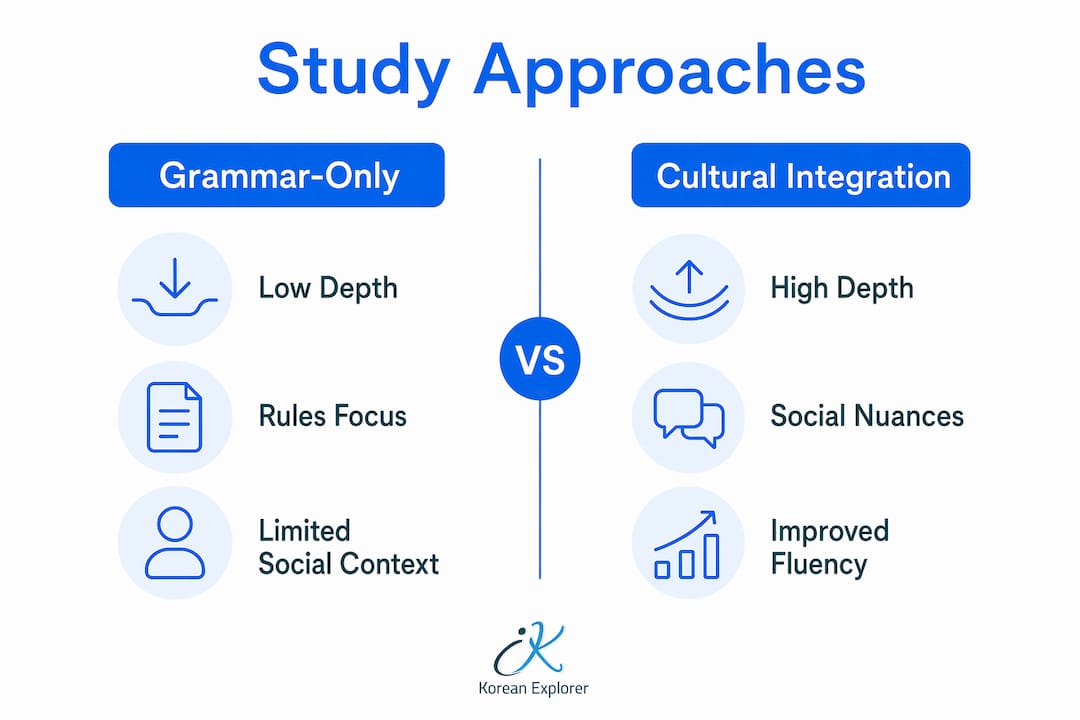
Cultural competence builds learner confidence by helping learners interpret social settings and communicate with the right tone. That confidence is what turns a hesitant student into a fluent speaker. You can also explore cultural factors in learning to understand how broader social dynamics shape language acquisition across different communities.
Key Takeaways
Cultural insight is the missing variable that separates technically correct Korean from genuinely fluent Korean, and integrating it from day one produces faster, more confident learners.
| Point | Details |
|---|---|
| Culture is built into grammar | Korean honorifics and speech levels reflect social hierarchy and must be learned as cultural rules, not just grammar rules. |
| Cultural integration boosts proficiency | A study of 901 students confirmed that cultural factors in instructional design significantly improve language outcomes. |
| Language shock is preventable | Early exposure to cultural cues, including non-verbal signals and indirect communication, prevents common social mistakes. |
| Authentic materials accelerate learning | Real Korean media, greetings, and situational dialogues build cultural instinct faster than textbook exercises alone. |
| Confidence follows cultural competence | Learners who understand social context feel ready to speak, which drives the practice that produces fluency. |
Why cultural literacy is the real test of Korean fluency
I have watched hundreds of adult learners reach intermediate Korean and then plateau. They can conjugate verbs correctly. They pass written exercises. But they freeze in real conversations with native speakers. The reason is almost always the same: they studied the language without studying the culture behind it.
The uncomfortable truth is that cultural awareness is not a bonus module you add after you learn the grammar. It is the framework that makes the grammar make sense. When you understand that Korean society places enormous value on age-based hierarchy and group harmony, the honorific system stops feeling like an arbitrary complication. It becomes logical. And once it is logical, it becomes learnable.
The learners I have seen progress fastest are the ones who treat every cultural encounter as a lesson. They notice how a Korean colleague phrases a request. They pay attention to what topics are avoided in group settings. They ask questions about the social rules behind the language, not just the linguistic rules. That curiosity is what separates a language student from a genuine communicator. Continuous cultural learning matters because Korean society itself evolves. Slang, social norms, and even formality expectations shift over time. The learner who stays curious stays fluent.
— Paul
Korean Explorer’s adult courses: culture built into every lesson
Korean Explorer teaches adult learners in Singapore how to use Korean the way native speakers actually use it, with cultural context embedded from the first lesson.
Every course at Korean Explorer, whether conversational, business-focused, or delivered via online Zoom sessions, is built on a curriculum developed by Seoul National University. Native Korean instructors who are fluent in both Korean and English guide learners through the social rules, speech levels, and real-world situations that textbooks alone cannot cover. Corporate training options are also available for teams that need professional Korean communication skills. If you are ready to learn Korean in Singapore with cultural depth built in, Korean Explorer’s adult Korean courses are the place to start.
FAQ
Why is cultural context important in Korean language learning?
Cultural context explains the social rules behind Korean grammar, including honorifics, speech levels, and indirect communication. Without it, learners produce technically correct sentences that still feel wrong to native speakers.
What is language shock in Korean learning?
Language shock is the disorientation learners experience when they lack the cultural frameworks that explain why a language works the way it does. In Korean, it most often appears when learners encounter the honorific system without prior cultural preparation.
How do honorifics reflect Korean culture?
Korean honorifics encode the Confucian values of age-based hierarchy and social respect directly into grammar. Choosing the wrong speech level is not a grammar error. It is a social signal that communicates disrespect or inappropriate familiarity.
What authentic materials help with cultural language learning?
Korean dramas, variety shows, news broadcasts, menus, and social media posts all expose learners to language in its real cultural context. Situational dialogues and locally produced content build cultural instinct faster than translated textbook exercises.
Can cultural competence improve all four language skills?
Cultural competence improves listening, speaking, reading, and writing because it gives learners the ability to interpret tone, register, and social meaning. Learners who understand the cultural layer behind a conversation comprehend and respond more accurately across every skill.