TL;DR:
- Syllable-block instruction processes Hangul more effectively than letter-by-letter methods for adult learners.
- Structured courses with feedback and cultural immersion significantly outperform self-study in retention and fluency.
- Blended learning offers busy adults flexibility and authentic practice, enhancing long-term Korean language mastery.
Most adults who try to learn Korean give up within the first few months, not because the language is too hard, but because they started the wrong way. Traditional letter-by-letter methods, passive app scrolling, and unstructured self-study create frustration instead of progress. The good news is that research now points to specific teaching approaches that dramatically change outcomes for adult learners, especially here in Singapore. This guide walks you through the evidence-backed strategies that actually work, from mastering Hangul the smart way to choosing the right class format and using Korean culture as a learning accelerator.
Table of Contents
- Why syllable-based Hangul instruction transforms Korean learning
- Structured courses versus self-study: What works best for adults?
- Online, offline, or blended learning: Finding the right fit
- The power of cultural immersion: Leveraging K-media and etiquette
- What most guides miss about learning Korean as an adult in Singapore
- Start your Korean language journey in Singapore today
- Frequently asked questions
Key Takeaways
| Point | Details |
|---|---|
| Syllable-block Hangul works | Learning Hangul in syllable blocks boosts reading accuracy and helps adults progress faster. |
| Structured courses drive success | Interactive classes and feedback reduce dropout risk and improve fluency for Singaporean learners. |
| Blended formats fit busy lives | Combining online flexibility with offline practice offers the best results for professionals. |
| Cultural immersion matters | Integrating media and etiquette in lessons makes Korean skills more useful and relevant. |
| Self-study pitfalls to avoid | Without structure and feedback, most adult learners fail to achieve their goals. |
Why syllable-based Hangul instruction transforms Korean learning
Hangul, the Korean writing system, looks intimidating at first glance. But here is the surprising truth: most learners struggle not because Hangul is complex, but because they are taught it the wrong way.
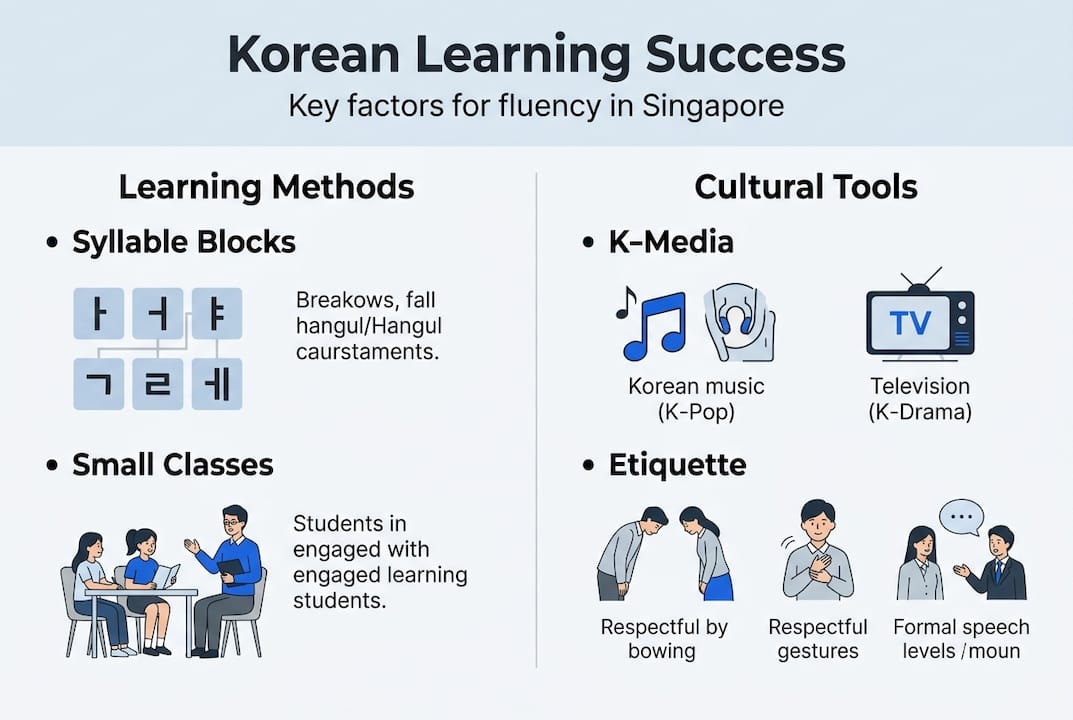
The most common approach teaches Hangul letter by letter, the same way English speakers learn the alphabet. This is called grapheme-based instruction, where each individual character is memorized in isolation. The problem is that Korean does not work that way. Korean characters are grouped into syllable blocks, where consonants and vowels combine to form a single unit of sound. Teaching letters in isolation ignores this fundamental structure.
Syllable-block instruction, by contrast, teaches learners to recognize and produce these blocks as complete units from the very beginning. Syllable-based instruction for Hangul is more effective than grapheme-based methods for English-speaking adult learners, producing better reading accuracy and faster retention. For Singaporean adults who are already multilingual, this approach maps well onto existing phonological awareness skills.
Here is a quick comparison of how the two methods perform:
| Method | Reading accuracy | Retention after 2 weeks | Pronunciation confidence |
|---|---|---|---|
| Grapheme-based (letter-by-letter) | Moderate | Low | Low |
| Syllable-block instruction | High | High | High |
The difference is not subtle. Learners using syllable-block instruction can begin reading simple Korean text within days, not weeks. This early win builds motivation and creates a foundation for everything that follows.
When you start learning Korean in Singapore, look for courses that explicitly teach Hangul through syllable blocks rather than isolated characters. Ask your instructor how they introduce the writing system in the first class.
Pro Tip: Spend your first week practicing syllable blocks, not individual letters. Write out common words like 학교 (school) and 사람 (person) by identifying the blocks, not spelling out each stroke separately. Your reading speed will improve noticeably faster.
Common pitfalls when starting with Hangul include:
- Memorizing consonants and vowels separately before combining them
- Skipping pronunciation practice and focusing only on visual recognition
- Using romanization (writing Korean sounds in English letters) as a crutch
- Neglecting the final consonant position in syllable blocks, which changes pronunciation
- Practicing only with flashcard apps instead of reading real words in context
Understanding how to learn Korean starts with getting this foundation right. Everything else, grammar, vocabulary, conversation, builds on how well you read and hear syllable blocks.
Structured courses versus self-study: What works best for adults?
Self-study feels appealing. You set your own schedule, move at your own pace, and pay less upfront. But for most adult learners in Singapore, it quietly fails.
Structured Korean learning helps Singaporeans achieve fluency at significantly higher rates than self-study, with small interactive classes and cultural immersion proving especially effective for retention. The reasons go beyond simple discipline.
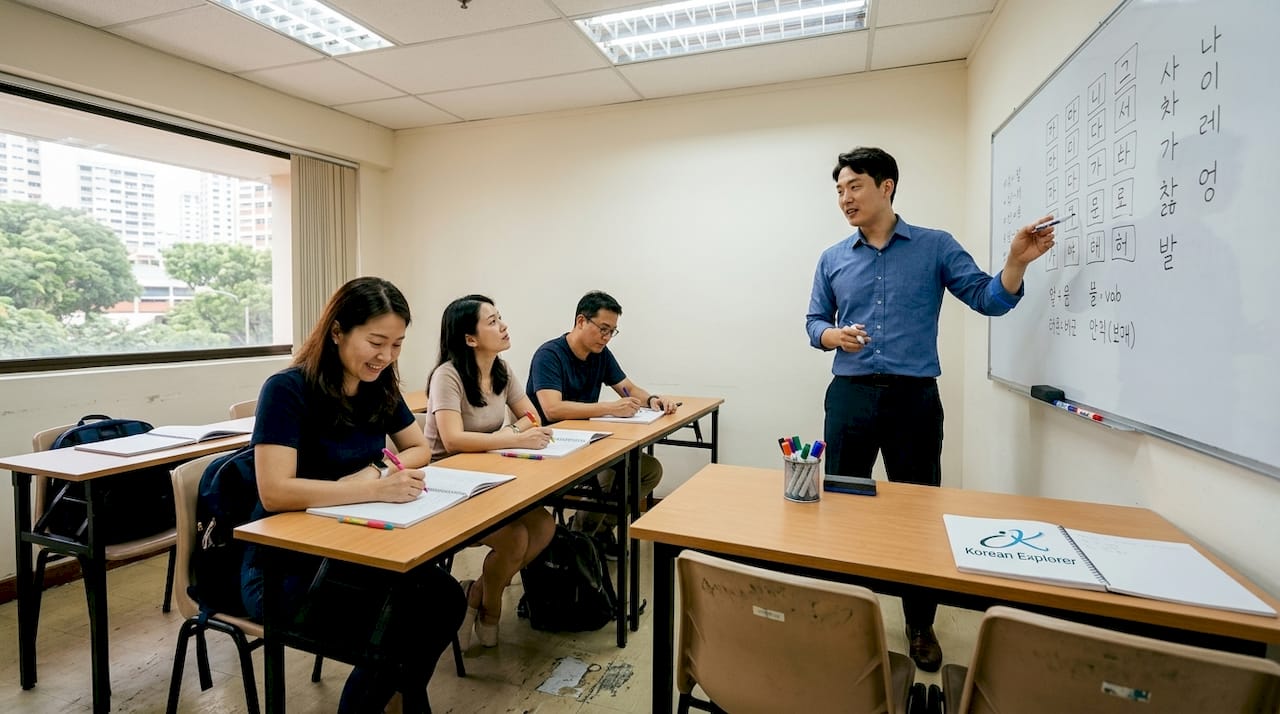
Structured courses provide three things self-study cannot replicate easily: real-time feedback, social accountability, and a sequenced curriculum. When you mispronounce a word or misuse a grammar pattern, an instructor catches it immediately. That correction loop is what builds accuracy. Without it, learners often practice mistakes until they become habits.
Here is how different learning formats compare:
| Format | Retention rate | Fluency progress | Dropout risk |
|---|---|---|---|
| Structured group class | High | Steady | Low |
| Blended (online + in-person) | High | Flexible | Low to moderate |
| Self-study only | Low | Inconsistent | Very high |
To get the most out of a structured class, follow these steps:
- Attend every session, even when you feel unprepared. Consistent exposure matters more than perfect preparation.
- Speak during class, not just listen. Passive attendance does not build conversational skill.
- Review notes within 24 hours of each class to lock in new vocabulary.
- Ask your instructor for specific feedback on pronunciation at least once per week.
- Connect with classmates outside of class for informal practice conversations.
When you browse Korean classes in Singapore, prioritize programs that keep class sizes small and emphasize speaking practice over passive listening. Large lecture-style classes rarely produce conversational fluency.
Pro Tip: Choose interactive classes that weave in cultural context, not just grammar drills. Learners who understand why Koreans speak a certain way in certain situations retain vocabulary far longer than those who memorize rules in isolation.
If you are comparing language schools for Korean, check whether the curriculum is standardized and whether instructors are native speakers. These two factors have an outsized effect on your long-term outcomes.
Online, offline, or blended learning: Finding the right fit
Choosing your learning format is a practical decision, not just a preference. Your work schedule, commute, and learning style all play a role.
Here is a breakdown of each option:
Online classes
- Pros: Maximum schedule flexibility, no commute, accessible from anywhere
- Cons: Less spontaneous conversation practice, easier to disengage, requires strong self-discipline
- Best for: Professionals with unpredictable hours or those living far from a language center
Offline (in-person) classes
- Pros: Immediate instructor feedback, natural conversation flow, stronger social accountability
- Cons: Fixed schedule, commute required, less flexibility if you travel frequently
- Best for: Learners who thrive with structure and face-to-face interaction
Blended learning
- Pros: Combines flexibility with real interaction, allows media integration, suits varied learning paces
- Cons: Requires more self-management to balance both formats
- Best for: Busy adults who want the benefits of both without sacrificing either
“Online classes provide flexibility for busy professionals but offer less spontaneous practice than in-person sessions. Blended approaches are considered optimal for most adult learners in Singapore who want both convenience and genuine fluency.”
For most working adults in Singapore, blended learning hits the sweet spot. You can join a live class twice a week and supplement with online modules, recorded lessons, or conversation practice apps in between. The key is consistency, not format.
When you explore options for learning Korean locally, ask each school whether their online and in-person curricula are integrated or separate. Integrated programs produce better outcomes because the learning builds on itself across formats.
Practical tips for busy adults managing blended learning:
- Block study time on your calendar the same way you would a work meeting
- Use commute time for listening practice with Korean podcasts or drama audio
- Set a weekly goal for new vocabulary rather than a daily one, which feels more manageable
- Review blended class recordings within 48 hours while the material is still fresh
The power of cultural immersion: Leveraging K-media and etiquette
Language and culture are inseparable. You can memorize every grammar rule and still sound robotic in a real conversation if you do not understand the cultural context behind the words.
Cultural integration via media and etiquette in classes enhances real-world application in ways that pure mechanics cannot. This is especially relevant for Singaporean learners who may interact with Korean colleagues, travel to Korea, or engage with Korean media regularly.
“Learners who engage with K-dramas, music, and social etiquette alongside formal study develop a feel for the language that grammar textbooks alone cannot provide. The cultural layer is what makes Korean stick.”
Here are practical ways to integrate K-media into your learning:
- Watch K-dramas with Korean subtitles (not English) once you reach beginner-intermediate level
- Listen to K-pop and try to identify vocabulary from your current lesson unit
- Follow Korean YouTube channels on topics you already enjoy, cooking, travel, or fitness
- Shadow (repeat aloud immediately after) native speakers in short video clips to improve natural rhythm
- Use drama scenes to study speech levels, since Korean has formal and informal registers that shift constantly
Korean etiquette is also a powerful learning tool. Understanding why Koreans use honorifics, how to address someone older than you, and when to use formal versus casual speech gives you a mental framework that makes grammar rules feel logical rather than arbitrary.
For business professionals in Singapore, cultural fluency is not optional. Korean business culture places significant value on hierarchy and relationship-building, and knowing how to navigate those dynamics in Korean creates a genuine professional advantage. The expert Korean learning guide covers these nuances in detail for learners at every stage.
Cultural immersion also sustains motivation. When you understand a joke in a drama without subtitles, or recognize a phrase from class in a song, the learning feels real. That feeling is what keeps you going past the first few months.
What most guides miss about learning Korean as an adult in Singapore
Most Korean learning guides focus on what to study. Very few focus on what actually keeps adults learning long enough to become fluent.
Here is what we have observed consistently: the learners who succeed are not the ones with the most free time or the best apps. They are the ones in feedback-rich environments with real human accountability. Self-study risks a 90% dropout rate, while structured Singapore programs with regular feedback keep learners on track toward both personal and professional goals.
Apps are useful supplements, but they cannot replace the moment when an instructor tells you that your intonation is slightly off, or when a classmate laughs at your joke in Korean. Those moments are what build real confidence.
Cultural immersion is also consistently undervalued. Many learners treat it as a reward for reaching a certain level. In reality, it is a tool that should be used from day one. Drama clips, music, and etiquette lessons do not distract from formal study. They reinforce it.
Pro Tip: When evaluating any Korean program, ask specifically how instructors provide pronunciation and grammar feedback. If the answer is vague, keep looking. Feedback quality is the single biggest predictor of long-term progress.
The learners who plateau are almost always the ones who switched to self-study after an initial structured course, assuming they had enough foundation to go it alone. For most adults, that assumption costs months of stalled progress. Staying in structured Korean programs longer than feels necessary is almost always the right call.
Start your Korean language journey in Singapore today
If you have been putting off starting or feel stuck in your current approach, the strategies in this guide point clearly toward one thing: structured, immersive, feedback-driven learning works. It is not about studying harder. It is about studying smarter with the right support around you.
At Korean Explorer, our Korean language courses are built on a Seoul National University curriculum, taught by native instructors, and designed specifically for adult learners in Singapore. Whether you want flexible scheduling, SkillsFuture funding through our SkillsFuture Korean course, or simply want to find Korean classes near you, we have a format that fits your life and your goals. Your next step starts here.
Frequently asked questions
Is it easier for adults in Singapore to learn Korean in a structured class or through self-study?
Structured classes significantly improve retention and fluency for Singaporean adults compared to self-study. The combination of real-time feedback, social accountability, and a sequenced curriculum makes a measurable difference in how quickly learners progress.
What’s the fastest way to start reading Hangul as a beginner?
Using syllable-block Hangul instruction helps beginners master reading more quickly than grapheme-based methods. Focusing on complete syllable units from the start builds reading accuracy and pronunciation confidence faster.
Can busy professionals benefit from blended Korean language courses?
Yes, blended courses are optimal for working adults because they combine scheduling flexibility with the spontaneous practice that online-only formats lack. Most professionals find the hybrid structure easier to maintain consistently.
Why is cultural immersion important in learning Korean?
Cultural integration via media and etiquette helps learners apply the language in real-life situations and builds intuition for speech levels, tone, and context that grammar study alone cannot provide.
What is the dropout rate for self-study compared to structured learning?
Self-study carries a 90% dropout risk, while structured Singapore programs with consistent instructor feedback dramatically reduce that rate and help learners achieve both personal and professional language goals.