TL;DR:
- Singapore provides a vibrant environment for learning Korean through diverse schools that cater to cultural, professional, and academic goals. Structured courses, cultural immersion, and government subsidies like SkillsFuture make Korean study accessible and practical for learners of all backgrounds. Choosing the right school type and methodology ensures learners develop real fluency, confidence, and meaningful connections with Korean language and culture.
Singapore is one of the most dynamic places in the world to learn Korean. With a thriving K-pop scene, growing Korean business ties, and a multicultural population already primed for language learning, the city-state offers a genuinely unique environment for picking up the language. Yet many people still think language schools are only for nervous beginners cramming grammar rules or professionals chasing a test certificate. The reality is far more interesting. Today’s Korean language schools in Singapore deliver structured fluency, real cultural insight, and practical communication skills that serve learners at every stage of life.
Table of Contents
- Why learn Korean in Singapore?
- Types of Korean language schools and who they serve
- How language schools teach Korean: Methodologies and key features
- Bridging language learning with real-world confidence
- What most people miss about language schools in Singapore
- Ready to start your Korean journey?
- Frequently asked questions
Key Takeaways
| Point | Details |
|---|---|
| Diverse language schools | Singapore offers a range of Korean learning options for every schedule and learning goal. |
| Modern teaching methods | Schools use Korean pop culture, Hangul syllable blocks, and tech to make learning effective and fun. |
| SkillsFuture support | Many courses are SkillsFuture-eligible, reducing tuition costs for most Singaporeans. |
| Practical outcomes | Placement tests, exam prep, and cultural events help learners achieve real-world fluency. |
| Best results with structure | Blending classroom learning with media and peer practice delivers lasting language and cultural confidence. |
Why learn Korean in Singapore?
The reasons people pursue Korean in Singapore have expanded well beyond K-drama fandom, though there is nothing wrong with that being your starting point. Korean culture is everywhere here: in music playlists, restaurant menus, beauty routines, and streaming queues. That cultural familiarity actually gives Singapore learners a head start because they arrive in class already knowing words, rhythms, and cultural references.
Beyond culture, the professional case for Korean is increasingly strong. South Korea is a top trading partner for Singapore, and Korean companies like Samsung, LG, Hyundai, and LOTTE have a visible presence here. Speaking Korean fluently can set you apart in finance, technology, logistics, and hospitality sectors where Korean clients and partners are common. Some learners are also preparing for academic programs in South Korea, where universities are actively recruiting international students.
Here is a quick look at the most common reasons Singapore learners invest in formal Korean study:
- Cultural connection: Deepening enjoyment of K-pop, K-dramas, and Korean cuisine by understanding the language natively
- Career advancement: Communicating directly with Korean colleagues, clients, or partners without relying on translators
- Academic preparation: Meeting language requirements for universities in Korea or pursuing the TOPIK exam
- Travel confidence: Navigating Seoul, Busan, or Jeju with genuine fluency rather than survival phrases
- Personal enrichment: The cognitive benefits of bilingualism and the satisfaction of mastering a new script
For Singaporeans specifically, there is a financial incentive worth knowing about. Options for learning Korean in Singapore include courses that qualify for SkillsFuture credits, which means working adults can offset a meaningful portion of their fees. For example, ITE’s subsidized short courses target practical conversation skills and are SkillsFuture-eligible, making structured Korean learning accessible at lower personal cost. Knowing where to learn Korean and which courses qualify for subsidies is worth researching before you register.
Pro Tip: Before enrolling anywhere, check if the course is listed as SkillsFuture-claimable. Even a partial subsidy on a private school program can reduce your out-of-pocket cost by hundreds of dollars.
Types of Korean language schools and who they serve
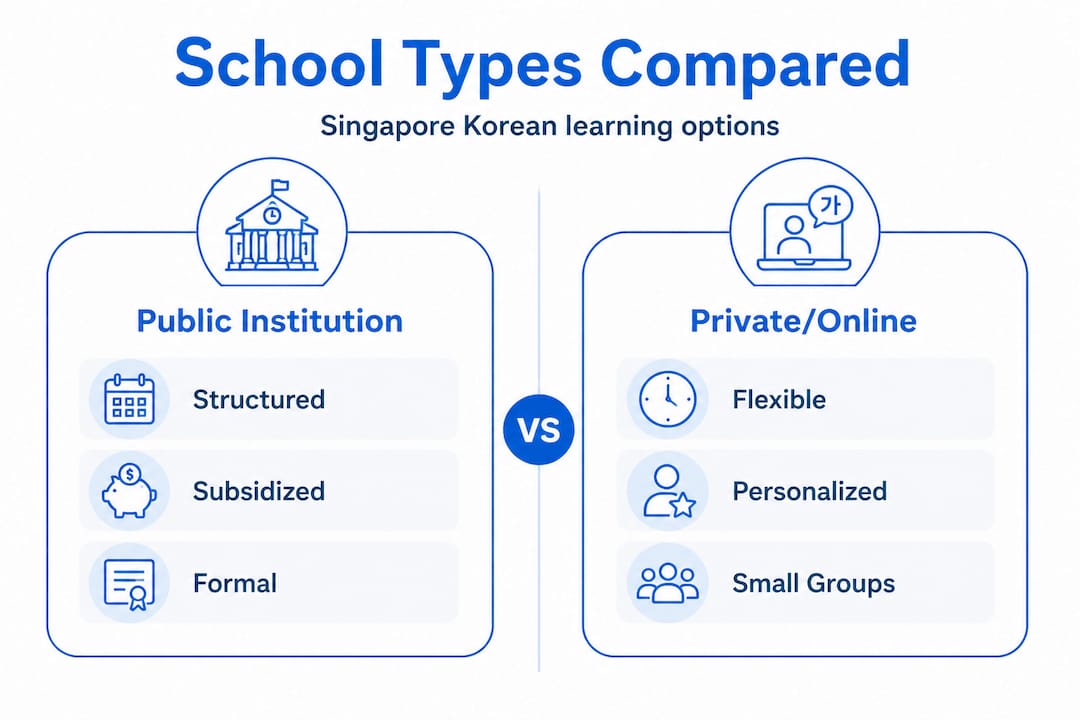
Once you decide to learn Korean formally, the next question is which kind of school fits your life. The landscape in Singapore falls into three broad categories: public institutions, private language schools, and online platforms. Each has a distinct learner profile it serves best.
Here is a side-by-side comparison to help you orient yourself:
| Feature | Public institution | Private school | Online platform |
|---|---|---|---|
| Cost | Lower with subsidies | Moderate to premium | Variable |
| Schedule flexibility | Fixed semesters | Flexible, rolling intake | Fully self-paced |
| Class size | Larger groups | Small groups or 1-on-1 | Self-study or live sessions |
| Speaking practice | Structured | High, interactive | Lower spontaneity |
| Cultural immersion | Moderate | High | Lower |
| SkillsFuture eligible | Often yes | Sometimes | Rarely |
Public institutions like ITE offer a dependable structure and are especially good for learners who prefer a more formal academic rhythm and want to take advantage of government subsidies. These courses tend to follow a semester calendar, which works well for students or early-career adults with predictable schedules.
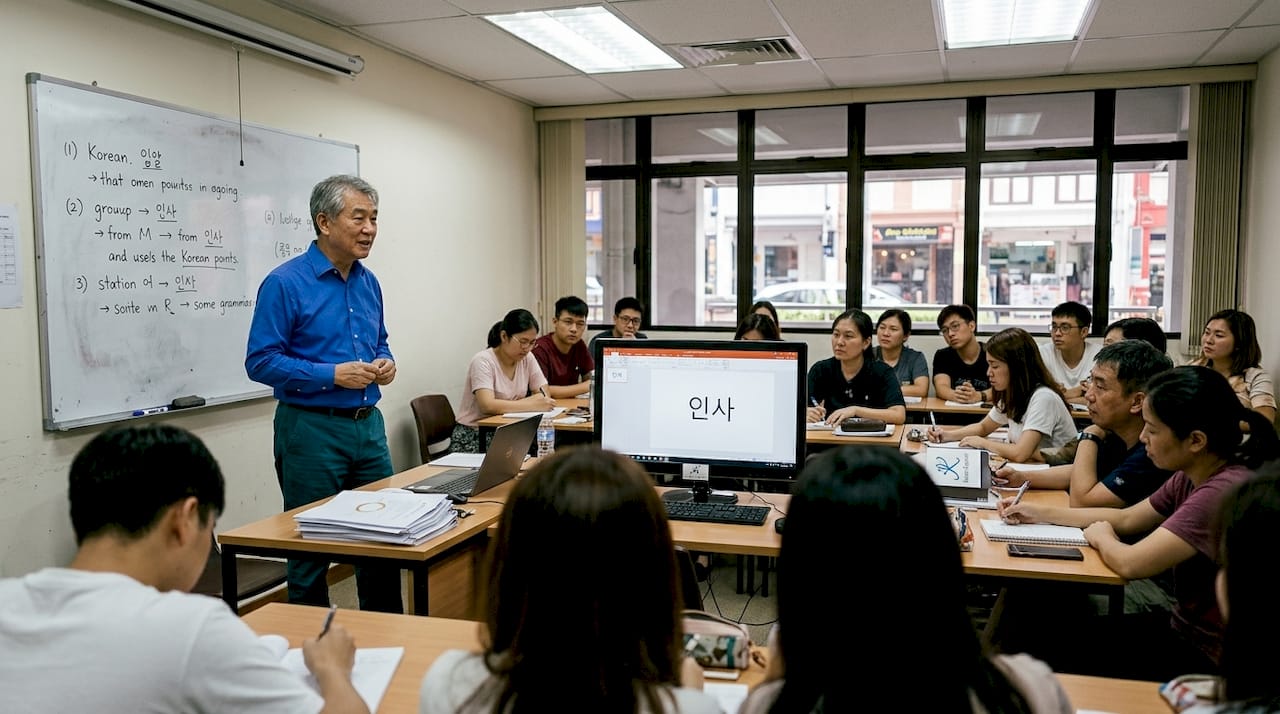
Private language schools are where the real personalization happens. They typically offer rolling intake, meaning you can start almost any month rather than waiting for a semester. This matters a lot for working adults with irregular schedules. Private schools also tend to attract native Korean instructors who bring authentic pronunciation, cultural context, and conversational energy to every lesson. For learners who are shy about speaking in larger groups, private schools often provide smaller class options or even one-on-one tutoring.
Online classes are the most flexible option, and they have improved dramatically since 2020. The trade-off noted in learner reviews of Korean classes is that online formats typically offer less spontaneous speaking practice compared to in-person classes. You can still get great grammar and reading instruction online, but the natural back-and-forth of a live classroom is harder to replicate through a screen.
How do you know which level to join? Most reputable schools across all types of language schools provide a placement test before enrollment. This short assessment checks your reading, listening, and sometimes speaking ability, then recommends the course tier that matches your current skill. For someone who watched K-dramas for three years and absorbed vocabulary passively, a placement test can confirm they are ready to skip the absolute beginner class and join an intermediate group.
Here is how to approach choosing your school type:
- Identify your schedule constraints first. If you can commit to fixed evening classes, almost any option works. If your work schedule shifts weekly, a private school or online option is smarter.
- Assess your learning style. Do you learn faster through conversation or through structured grammar drills? Private schools lean conversational; public institutions lean structural.
- Set a budget including possible SkillsFuture claims. Factor in the subsidy before comparing sticker prices.
- Consider your goals. TOPIK exam preparation benefits from structured, guided study with a teacher who knows the test format well.
Pro Tip: If you are an introvert who clams up in large classes, a private school with groups of four to six students often offers the ideal balance of peer interaction and individual attention without the anxiety of a big classroom.
How language schools teach Korean: Methodologies and key features
Knowing the kind of school to pick is one thing. Understanding what actually happens inside the classroom helps you evaluate quality and stay motivated. Good Korean instruction in 2026 blends linguistic structure, cultural context, and technology in ways that accelerate learning far beyond what a self-study app can deliver.
The starting point for every beginner is Hangul, the Korean writing system. A common misconception is that Hangul is difficult. It is not. It is one of the most logical scripts ever designed, built around syllable blocks rather than isolated letters. You learn that each block combines a consonant, a vowel, and sometimes a final consonant to form a single syllable unit. As outlined in guides to top language schools in Singapore, teaching Hangul through syllable blocks rather than isolated letters speeds up reading acquisition dramatically. Most learners in a quality classroom can read basic Hangul within a week or two.
After Hangul, grammar becomes the focus. Korean follows a subject-object-verb (SOV) word order, which is different from English. Instead of “I eat rice,” Korean says “I rice eat.” This feels unusual at first, but the structure is actually very consistent, which makes it teachable in a systematic way. Teachers who explain SOV clearly from the beginning save learners weeks of confusion later.
Here is where good language schools differentiate themselves from apps: cultural media integration. The best instructors weave in K-drama clips, K-pop lyrics, and Korean news headlines to show how grammar works in real speech. This approach is not just more entertaining. It produces higher retention rates than rote memorization because the learner forms emotional associations with the material.
“When students encounter a grammar point through a scene they already love from a drama, they remember it three to four times longer than when they memorize it from a textbook alone. Emotional context cements language in a way that repetition drills simply cannot.”
Technology also plays a growing role. Many schools now use digital platforms for homework submission, listening exercises, and progress tracking between classes. For online learners, live video tools have made it possible to do role-play exercises and pronunciation drills with instructors in real time. Understanding what it takes to learn Korean as a Singaporean shows that familiarity with other Asian languages does offer some tonal and structural intuition, but Korean still demands dedicated, structured effort to master.
Here is what distinguishes high-quality classroom instruction:
- Native Korean instructors who model authentic pronunciation and natural speech rhythm
- Systematic grammar progression rather than random vocabulary dumps
- Conversational role-plays that simulate real situations like ordering food, asking for directions, or negotiating at work
- Regular pronunciation correction with immediate feedback rather than letting errors solidify
- Cultural context lessons woven into language units so learners understand not just how to say something but when and why
Bridging language learning with real-world confidence
Methods and school types matter, but the real measure of a language school is whether it gets you to actual fluency and confidence. This section is about outcomes, and how good schools build a bridge between classroom knowledge and real-world use.
Placement tests are step one. As confirmed in learner feedback on Korean classes, starting at the right level prevents both boredom and overwhelm. A learner placed too low loses motivation fast. A learner placed too high gets discouraged. Getting this right sets the tone for the entire learning journey.
For learners with professional or academic goals, TOPIK preparation is a structured pathway. TOPIK (Test of Proficiency in Korean) is the internationally recognized standard for Korean language certification. Many Korean universities require it for admission, and Korean companies increasingly look for it when hiring non-native speakers. Schools with dedicated TOPIK preparation in Singapore courses teach not just the language but the specific question formats, time management strategies, and vocabulary banks the exam tests. ITE’s subsidized beginner courses also serve as accessible entry points that can eventually lead learners toward TOPIK-level study.
Here is the progression a well-structured school guides you through:
- Hangul and basic phonics: Building reading and pronunciation from scratch
- Core grammar and vocabulary: Establishing sentence construction with about 500 to 800 base vocabulary words
- Conversational practice: Applying grammar in simulated real-world scenarios
- Cultural context: Understanding formal versus informal speech levels, honorifics, and social norms
- Exam readiness or advanced fluency: Either TOPIK preparation or open-ended advanced conversation and writing
Progress tracking and regular feedback are what convert knowledge into confidence. Weekly quizzes, instructor check-ins, and mock conversations tell you exactly where you are improving and where you still need work. Cultural activities, Korean movie nights, language exchange meetups, and cooking events add a social layer that builds speaking confidence in a low-pressure environment.
Pro Tip: Actively seek schools that combine structured test training with immersive cultural experiences. The combination of both is what produces learners who can pass an exam AND have a real conversation with a native speaker at a Korean BBQ restaurant.
What most people miss about language schools in Singapore
Here is an uncomfortable truth the self-study crowd does not want to hear: apps and YouTube channels are valuable supplements, but they are genuinely poor replacements for guided classroom learning, especially in Korean.
Korean has a social layer that an app simply cannot teach you. The language has multiple formality levels, called speech levels, that govern how you speak to a senior colleague versus a friend versus an elder. Getting these wrong in real life does not just sound odd. It can cause genuine social friction. A skilled instructor who understands both Korean culture and Singapore’s own multicultural norms is the only reliable guide through this complexity. The expert Korean learning guide we follow at Korean Explorer specifically addresses how Singapore learners can navigate these social language layers without the months of confusion that self-study brings.
The second thing people miss is accountability. When you have a class on Thursday at 7 PM, you study before Thursday. When your “class” is an app notification that you mute, you study never. Physical or hybrid classroom formats build the kind of regular engagement that actually moves your skill level forward over months.
Singapore’s diverse classroom environment is also an underrated asset. In a group class here, you might have classmates from Chinese-speaking, Malay-speaking, and Tamil-speaking backgrounds, each bringing different language intuitions to the table. Hearing how different learners decode Korean grammar or remember vocabulary tricks broadens your own understanding in ways that studying alone simply cannot replicate.
Pro Tip: Combine your core school curriculum with 20 to 30 minutes of targeted media exposure daily. Watch one K-drama episode with Korean subtitles, or listen to one Korean podcast on your commute. This dual approach locks in classroom lessons through real-world repetition, and it keeps learning enjoyable over the long haul.
Ready to start your Korean journey?
Learning Korean in Singapore has never been more accessible, more rewarding, or more relevant to everyday life here. Whether your goal is to connect more deeply with Korean culture, advance your career, or earn a recognized language qualification, a structured school gives you the fastest and most reliable path forward.
Korean Explorer offers a full range of Korean language courses designed for learners at every level, from first-time Hangul readers to advanced speakers preparing for professional goals. Our curriculum, built on the Seoul National University framework, aligns directly with TOPIK standards so every lesson moves you toward a real benchmark. Many of our courses are also eligible for SkillsFuture Korean language courses subsidies, reducing the financial barrier for Singapore residents. If exam certification is your goal, explore our dedicated TOPIK test guide to understand exactly what the test covers and how our instructors prepare you for it. Conveniently located above Tanjong Pagar MRT, with additional centers in Jurong and Tampines, Korean Explorer fits into your Singapore life.
Frequently asked questions
Are language schools in Singapore suitable for beginners with no Korean background?
Yes, most schools offer structured beginner classes starting with Hangul and basic conversation to help first-time learners build a strong foundation. Many institutions, including ITE’s beginner Korean courses, are designed specifically for learners with zero prior exposure.
How do I know which Korean language class level is right for me?
Schools commonly provide placement tests to assess your ability and recommend the best course for your skill level. As noted in learner reviews, this step is especially useful if you have picked up some Korean informally and are unsure whether you are a true beginner or not.
Can I take Korean classes online, and will it affect my speaking practice?
Yes, online classes are available and flexible, though in-person classes typically offer more spontaneous speaking opportunities. Online formats work well for grammar and reading but require extra effort to replicate the live conversational practice that in-person structured Korean learning naturally provides.
Are SkillsFuture subsidies available for all Korean language schools?
Not all schools qualify, but many major institutions and specific courses are SkillsFuture-eligible, meaningfully reducing out-of-pocket costs for Singaporeans. Check the SkillsFuture portal or ask the school directly before registering.
Is preparing for the TOPIK exam necessary if I want to use Korean for work or study?
If you aim to work or study in Korea, TOPIK certification is often required or highly beneficial. Even for roles in Singapore with Korean-speaking partners, holding a TOPIK certificate signals a verifiable, internationally recognized level of proficiency that a certificate of course completion alone cannot match.