TL;DR:
- Strong Korean reading scores do not guarantee advanced critical literacy skills such as fact-checking and source evaluation.
- Effective Korean reading involves active, purposeful engagement that connects decoding, comprehension, and critical thinking.
- Beginners benefit most from syllable-block decoding initially, then gradually incorporate grapheme awareness for accuracy.
Reading in Korean feels like a superpower once it clicks. But here’s what surprises most learners: South Korea consistently posts strong international reading scores, yet research shows the country ranks low on advanced critical literacy measures like fact-checking and opinion evaluation. That gap tells a powerful story about how reading works in language learning. Simply picking up more Korean books won’t automatically make you fluent or analytically sharp. This article breaks down the real science of reading in Korean language acquisition, explores how Hangul decoding works, examines policy lessons from Korea, and gives you a practical roadmap for building genuine language mastery through smarter reading habits.
Table of Contents
- Why reading matters for Korean language mastery
- How decoding Hangul works: Syllable-block vs grapheme approaches
- Reading and literacy policy: Lessons from Korea
- Reading vs advanced literacy: Where gaps remain
- Debate: Should Korean reading include Hanja?
- What most guides miss about learning Korean through reading
- Next steps: Take your Korean reading further in Singapore
- Frequently asked questions
Key Takeaways
| Point | Details |
|---|---|
| Reading boosts comprehension | Reading is a key driver of vocabulary and overall language mastery in Korean. |
| Syllable-based Hangul instruction | Focus on syllable blocks for faster reading fluency, but don’t neglect grapheme skills. |
| Discussion enhances literacy | Combining reading with talking and questioning leads to better outcomes than reading alone. |
| Critical skills require more | High reading scores don’t guarantee advanced fact-checking or evaluation abilities. |
| Balance Hangul and Hanja | Start with Hangul, add Hanja for enrichment—most learners benefit from this sequence. |
Why reading matters for Korean language mastery
Reading is foundational to learning any language, and Korean is no exception. When you read Korean regularly, you encounter grammar patterns, natural expressions, and vocabulary in real contexts rather than isolated flashcard drills. That repeated exposure trains your brain to recognize sentence structures automatically, which speeds up both comprehension and speaking.
Research confirms this connection clearly. A Korean reading comprehension study found that reading contributes to Korean learners’ comprehension, and oral language comprehension and vocabulary depth are significant predictors of reading comprehension in Korean learners. Notice what that means: your listening and speaking skills actually feed back into your reading ability. It’s not a one-way street.
“Oral language comprehension and vocabulary depth are significant predictors of reading comprehension in Korean learners.” — ERIC Korean EFL Reading Model
This finding reshapes how you should approach reading practice. If you only read and never listen or speak, you’re building on a weaker foundation. The most effective learners treat reading as one part of an interconnected system.
Here’s what strong reading practice actually gives you:
- Vocabulary depth: You learn how words behave in sentences, not just their dictionary definitions
- Grammar intuition: Repeated exposure to real Korean sentences builds natural pattern recognition
- Idiomatic fluency: Books and articles expose you to expressions that textbooks often skip
- Comprehension stamina: Longer reading sessions train your brain to process Korean for extended periods
Understanding these language proficiency secrets helps you stop treating reading as a passive activity and start using it as an active skill-building tool. The goal isn’t to read more pages. The goal is to read with purpose, connecting what you read to what you hear, speak, and write.
You can accelerate this process by combining reading with the Korean skills techniques that reinforce comprehension through multiple input channels simultaneously.
How decoding Hangul works: Syllable-block vs grapheme approaches
Before you can read Korean for meaning, you need to decode Hangul accurately. And how you learn to decode it matters more than most guides admit.
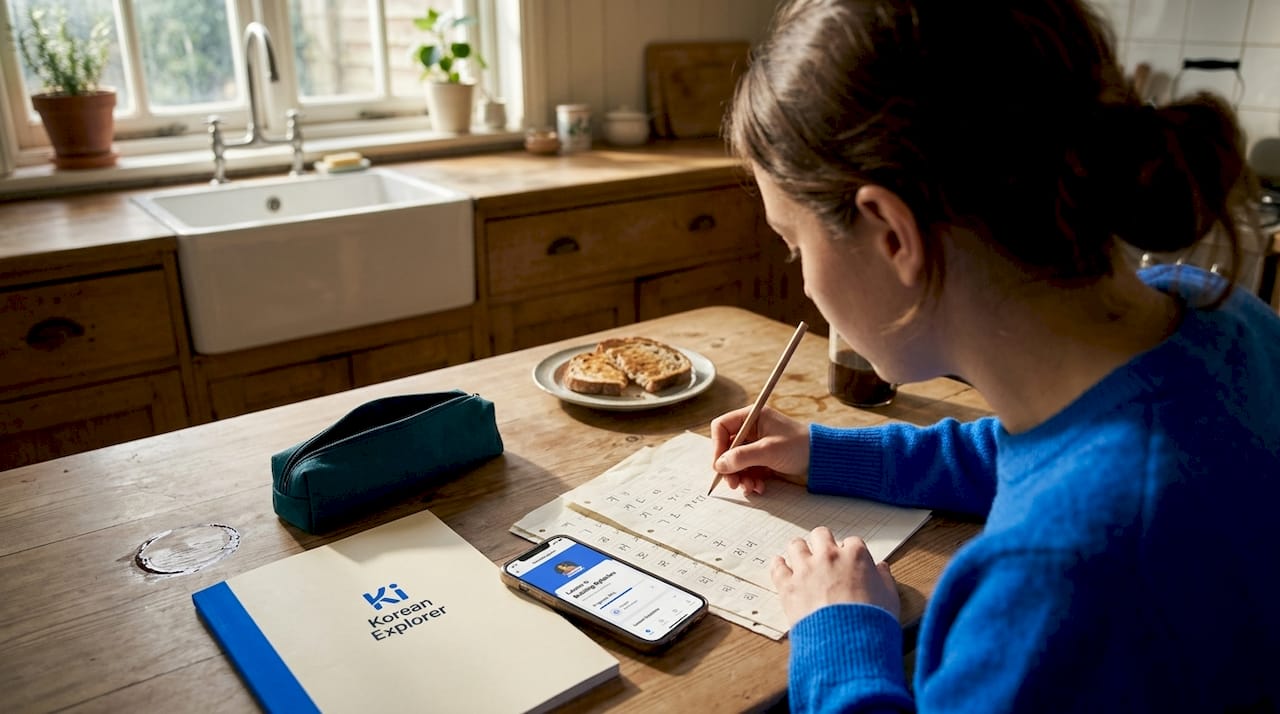
Hangul has two ways it can be taught. The syllable-block approach treats each Korean syllable unit (like 한, 글, or 어) as a whole visual chunk. The grapheme approach focuses on individual letters: consonants like ㅎ, ㄱ, ㄴ and vowels like ㅏ, ㅣ, ㅜ. Both methods have merit, but research reveals a clear winner for initial word recognition.
A recent syllable vs grapheme study found that for English-speaking adults learning to decode Hangul, instruction that emphasizes syllables can outperform grapheme-focused instruction on word recognition outcomes. This is a meaningful finding for Singaporean learners, many of whom are already familiar with syllable-based Asian scripts and may find the block structure of Hangul more intuitive to process as whole units.
Here’s a side-by-side comparison of both approaches:
| Feature | Syllable-block approach | Grapheme approach |
|---|---|---|
| Focus | Whole syllable units | Individual letters and sounds |
| Speed of word recognition | Faster initial progress | Slower at first, deeper precision |
| Best for | Fluency and reading flow | Spelling accuracy and sound mapping |
| Ideal learner | Visual learners, beginners | Analytical learners, advanced students |
| Weakness | May miss phonetic nuance | Can fragment reading fluency |
The practical takeaway is that neither approach is complete on its own. Most learners benefit from starting with syllable blocks to build reading momentum, then sharpening grapheme awareness to improve spelling and pronunciation accuracy.
Here’s a step-by-step approach that works well for most Singaporean learners:
- Learn the 14 basic consonants (자음) as sounds, not just letter names
- Learn the 10 basic vowels (모음) and practice combining them into simple syllable blocks
- Read simple two-syllable words like 나비 (butterfly) or 고양이 (cat) as whole blocks
- Once comfortable with common syllable patterns, study final consonants (받침) and their sound changes
- Practice reading short sentences aloud, which bridges decoding and oral comprehension
- Gradually move to reading paragraphs, using context clues when unfamiliar blocks appear
Pro Tip: Focus on syllable blocks for faster reading fluency early on, but revisit grapheme knowledge when you start writing Korean from memory. Spelling accuracy comes from understanding how individual letters work together, not just recognizing whole blocks visually.
If you want a structured starting point, the Hangul study tips at Korean Explorer are designed to take you through exactly this kind of layered approach. You can also learn Hangul fast with a zero-to-reading framework that builds confidence quickly.
Reading and literacy policy: Lessons from Korea
Korea is actively rethinking how it teaches reading, and those lessons are directly applicable to how you structure your own Korean study in Singapore.
For decades, Korean literacy education focused heavily on multiple-choice evaluation and standardized testing. Students learned to select the right answer from a list but rarely practiced explaining why a text meant what it meant. The result? Strong test scores but limited depth in actual comprehension and critical engagement.
That’s changing. Korean literacy policy in South Korea is now moving toward reading books and discussion-based classes rather than multiple-choice evaluation alone. Schools are introducing sustained silent reading periods, peer book discussions, and open-ended written responses. The evidence shows these methods improve both engagement and actual comprehension over time.
Here’s what that shift looks like in practice, and how you can apply the same principles to your own Korean study:
| Traditional approach | Modern literacy approach |
|---|---|
| Multiple-choice comprehension tests | Open discussion and written reflection |
| Single correct answer focus | Interpretation and reasoning practice |
| Teacher-led only | Peer sharing and collaborative analysis |
| Standardized texts | Diverse genres including fiction, essays, news |
| Passive reading | Active questioning and annotation |
For Singapore learners, this comparison offers a clear blueprint. Don’t just read Korean texts and move on. After you read, ask yourself: What was the main argument? Do I agree? What words did I not understand in context? Can I summarize this in Korean?
Practical habits you can adopt right now:
- Read daily, even 10 to 15 minutes of Korean news, webtoons, or graded readers
- Discuss what you read with a study partner, tutor, or language exchange partner
- Write a short reflection in Korean after each reading session, even two or three sentences
- Question the text actively: look up unfamiliar grammar patterns instead of skipping them
If you’re learning with younger family members, the principles of teaching Korean to kids align strongly with this discussion-based model. And improving Korean vocabulary through diverse reading material is one of the fastest vocabulary-growth strategies available to any learner.
Reading vs advanced literacy: Where gaps remain
South Korea’s reading performance on international assessments is genuinely impressive. But there’s a troubling gap that most people outside Korea never hear about.
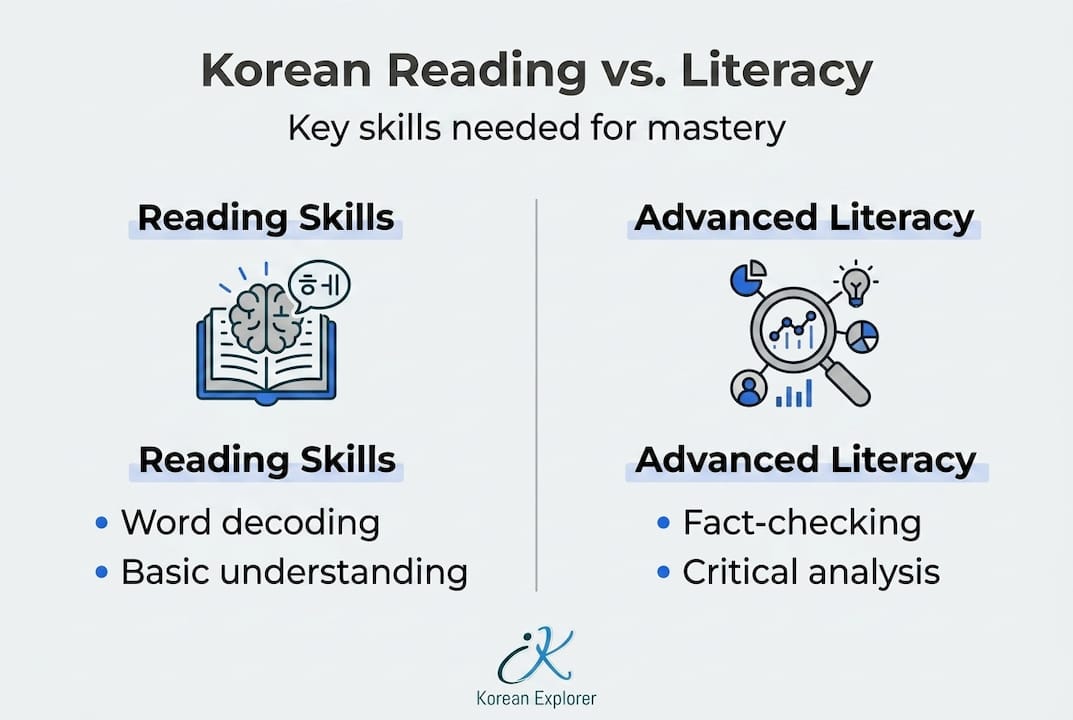
PISA advanced literacy data shows that high reading performance does not necessarily mean advanced critical literacy. South Korea scores low on certain advanced literacy measures despite strong reading scores. The specific skills that lag behind are fact-checking, distinguishing facts from opinions, and evaluating the credibility of sources.
This is a critical finding for Korean language learners too, not just native Korean students. If your Korean reading practice never pushes you to evaluate what you read, you’re building half a skill.
“Strong reading scores in Korea mask a gap in critical literacy skills. Learners who can decode and comprehend text fluently still struggle to evaluate facts, distinguish bias, and assess credibility.” — Chosun PISA Advanced Literacy Report
Here’s the good news: you can deliberately build critical literacy alongside reading comprehension. The two don’t develop automatically together, but they develop quickly when you practice them in parallel.
Steps to build critical literacy while reading Korean:
- Annotate actively: Underline claims in Korean texts and ask whether they are facts or opinions
- Cross-reference: When you read a Korean news article, look up the same story from a different Korean source
- Summarize and challenge: After reading, write a one-sentence summary in Korean, then write one sentence questioning or challenging the text’s main point
- Practice “author’s purpose” thinking: Ask why the author used certain vocabulary or tone
- Use discussion as a check: Share your reading interpretation with someone else to test whether your understanding was accurate
Common Korean learning challenges often involve this exact issue: learners can read Korean fairly well but struggle to engage with the content analytically. Pairing reading practice with boosting Korean listening skills adds another layer of comprehension that makes critical engagement with texts much easier over time.
Debate: Should Korean reading include Hanja?
One of the most interesting and contentious debates in Korean education right now is whether Hanja (Chinese characters) should be reintroduced into Korean reading instruction. This question has direct implications for how you approach advanced Korean vocabulary as a foreign learner in Singapore.
Here’s the context: over 70% of Korean vocabulary is Sino-Korean, meaning it originates from Chinese characters. Words like 학교 (學校, school), 도서관 (圖書館, library), and 경제 (經濟, economy) all have Hanja roots. There is an ongoing policy debate in Korea about whether adding Hanja alongside Hangul in textbooks would improve literacy, though some experts question the potential downsides.
Arguments for including Hanja:
- Helps learners understand word roots and etymology, which accelerates vocabulary acquisition
- Makes distinctions between homophones clearer (Korean has many words that sound identical but mean different things)
- Supports comprehension of classical literature, legal texts, and academic writing
- May benefit Singaporean learners who already know some Chinese characters through Mandarin education
Arguments against including Hanja:
- Adds significant cognitive load, especially for beginners
- May reduce the efficiency of everyday communication, which relies entirely on Hangul
- Creates a two-tier literacy system where classical vocabulary overshadows modern usage
- Could discourage new learners who find Hangul already challenging enough
Pro Tip: For most Singaporean learners, focus entirely on Hangul first. Once you reach intermediate level and want to expand your vocabulary range or understand academic Korean, introduce Hanja as enrichment material, not as core curriculum. If you already read Mandarin, you’ll find Hanja acquisition surprisingly fast and genuinely rewarding as a vocabulary booster.
What most guides miss about learning Korean through reading
Here’s our honest take after working with hundreds of Korean learners in Singapore: most reading advice is incomplete because it treats reading as an endpoint rather than a starting point.
Standard advice tells you to read more Korean, read every day, and use a dictionary when you’re stuck. That’s not wrong. But it misses the deeper truth: reading without reflection is like exercising without stretching. You build strength in one direction while creating rigidity elsewhere.
The learners who make the fastest progress at Korean Explorer are not the ones who read the most pages. They’re the ones who read purposefully, then do something with what they read. They discuss it, write about it, question it, and connect it to what they already know. That active loop between reading and application is where real language acquisition happens.
We’ve also noticed that Singaporean learners have a specific advantage that most guides ignore: many already navigate multiple languages and scripts daily. That cognitive flexibility makes the jump to Korean reading faster than it would be for monolingual learners. But it also means Singaporean learners sometimes rush past the decoding stage without solidifying phonological awareness, which creates problems later when they need to spell accurately or understand fast native speech.
The Korean proficiency secrets that actually work involve balancing reading with speaking practice, listening to native content, and regularly checking whether you understand not just the words but the intent behind them. Reading is the engine. Discussion and critical reflection are the steering wheel.
Pro Tip: Block out a specific 15 minutes after every reading session to do something active with the material: write a sentence summary in Korean, record yourself speaking about the text, or message a study partner with one thought you found interesting. That small habit compounds dramatically over time.
Next steps: Take your Korean reading further in Singapore
Reading is a powerful tool, but it works best inside a structured learning environment where you get feedback, correction, and real conversation practice alongside your independent reading.
Korean Explorer’s Korean language courses are built on the Seoul National University curriculum and aligned with TOPIK standards, which means every lesson reinforces the reading, vocabulary, and comprehension skills that research identifies as most effective. Our native Korean instructors, fluent in both Korean and English, guide you through exactly the kind of discussion-based, active-reading approaches that Korea’s own literacy reforms now champion. Whether you’re just starting with Hangul or ready to tackle advanced Korean texts, explore the best ways to learn Korean and find the format that fits your schedule and goals. Classes are available at Tanjong Pagar, Jurong, Tampines, and online.
Frequently asked questions
How does reading improve Korean vocabulary for learners?
Reading exposes you to new words in context, which helps your brain store vocabulary with richer associations and better recall. Research confirms that vocabulary depth is one of the strongest predictors of Korean reading comprehension.
Is it better to focus on syllables or letters when learning Hangul?
For most English-speaking adults, syllable-focused instruction leads to faster word recognition. However, syllable vs grapheme balance matters for achieving both fluency and accurate spelling over time.
Why doesn’t high reading performance always lead to advanced Korean literacy?
Advanced skills like fact-checking and critical evaluation require deliberate practice beyond simple comprehension. PISA literacy data shows South Korea scores low on these measures despite strong overall reading results.
Should learners in Singapore study Hanja alongside Hangul?
Most learners benefit from mastering Hangul first before exploring Hanja. The Hanja literacy debate in Korea itself highlights concerns about added complexity, so treat it as optional enrichment rather than a requirement.
How can I practice reading Korean daily?
Read diverse materials like books, news, and webtoons, and follow each session with a brief reflection or discussion. Korean literacy policy shifts confirm that discussion-based learning outperforms passive reading alone for long-term comprehension gains.