TL;DR:
- TOPIK is a standardized Korean language exam managed by South Korea’s government for non-native speakers. It has two tiers that assess different proficiency levels and is available in over 80 countries with paper-based and online formats. A TOPIK certificate remains valid for two years and is essential for university admission, visas, and employment in Korea.
TOPIK, the Test of Proficiency in Korean, is the official government-administered standardized exam that measures Korean language skills for non-native speakers. First introduced in 1997, it is managed by the National Institute for International Education (NIIED) under South Korea’s Ministry of Education and offered in over 80 countries worldwide. If you are studying Korean for university admission, a work visa, or personal growth, understanding what is TOPIK and how it works is the first step toward using it effectively.
What is the TOPIK exam structure?
The TOPIK exam divides into two distinct tiers based on proficiency level. TOPIK I covers levels 1 and 2, targeting beginners. TOPIK II covers levels 3 through 6, targeting intermediate to advanced learners. Each tier tests different skills and carries a different total score.
Here is a direct comparison of the two tiers:
| Feature | TOPIK I | TOPIK II |
|---|---|---|
| Levels covered | 1–2 | 3–6 |
| Sections | Listening, Reading | Listening, Reading, Writing |
| Total points | 200 | 300 |
| Target learners | Beginners | Intermediate to advanced |
| Writing section | No | Yes |
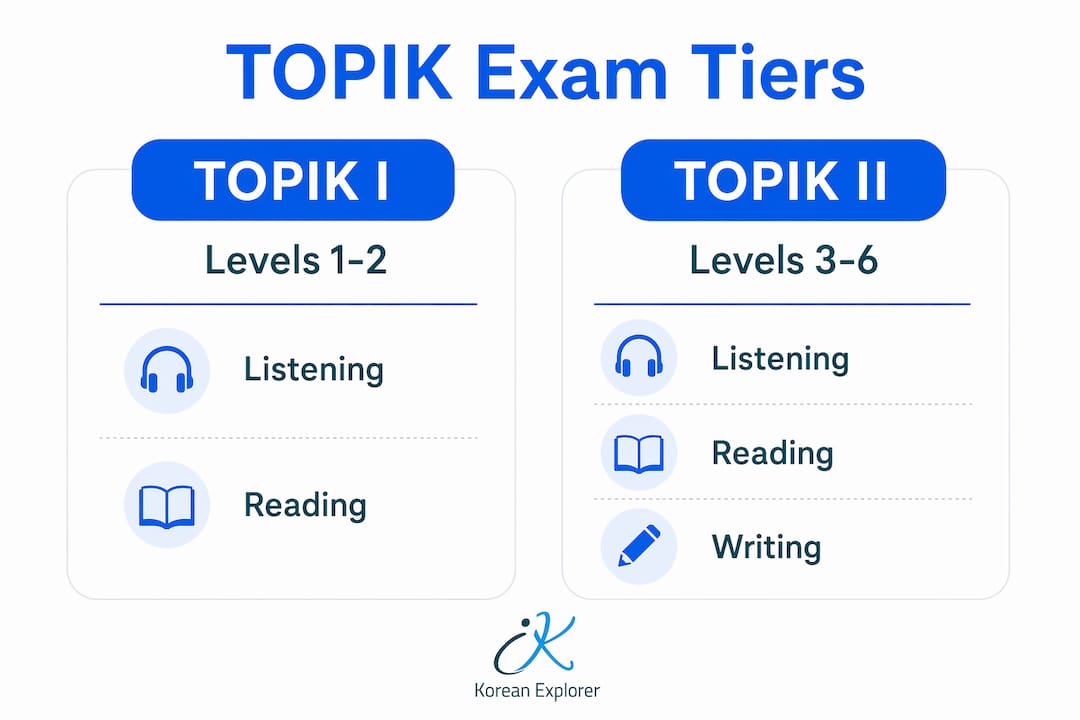
Both tiers are offered six times yearly in paper-based and internet-based formats. That frequency gives you multiple chances per year to sit the exam and plan around application deadlines. The official TOPIK website is topik.go.kr, administered by NIIED, which controls test format, scoring, and certificate validity rules.
Key facts about the exam format:
- Listening: Multiple choice, tests comprehension of spoken Korean in everyday and academic contexts
- Reading: Multiple choice, tests vocabulary, grammar, and text comprehension
- Writing (TOPIK II only): Short answer and essay questions that assess grammar accuracy and coherent expression
- Scoring: Level assignment is based on your total score within the tier you registered for
- Format options: Paper-based tests are available at most international centers; internet-based testing is expanding
Why is TOPIK certification important?
TOPIK certification is the standardized proof of Korean language competency that institutions require. Without it, universities, government agencies, and employers rely on informal self-assessment, which carries no consistent standard. TOPIK removes that ambiguity entirely.
The practical uses of TOPIK certification include:
- University admissions: Most Korean universities require a minimum TOPIK score for international applicants
- Work visas: Certain visa categories require demonstrated Korean proficiency
- Permanent residency (F-5): TOPIK scores factor into the F-5 visa application process
- Korean Government Scholarship Program (KGSP): TOPIK results are a core requirement for this scholarship
- Professional employment: Many Korean companies use TOPIK scores to assess non-native candidates
One detail many learners overlook: TOPIK certificates are valid for 2 years from the date results are announced. That window matters more than most people realize. If your certificate expires before your visa or university application is processed, you will need to retake the exam.
Pro Tip: Plan your test date so that your certificate validity window overlaps with your application deadline and any processing time. Sitting the exam too early is a common and avoidable mistake.
A separate exam called EPS-TOPIK differs significantly from the general TOPIK. EPS-TOPIK is designed for workers entering Korea under the Employment Permit System in specific labor sectors. It does not substitute for the general TOPIK in academic or residency applications. Knowing which exam your institution or visa category requires saves you from preparing for the wrong test entirely.
You can read more about the benefits of TOPIK certification and how it applies to your specific goals.
How do TOPIK levels work?
The TOPIK exam uses six proficiency levels, from beginner to near-native fluency. You register for a tier, not a specific level. Your final level is determined by your score within that tier. This design prevents scoring mismatches and keeps the grading system consistent.
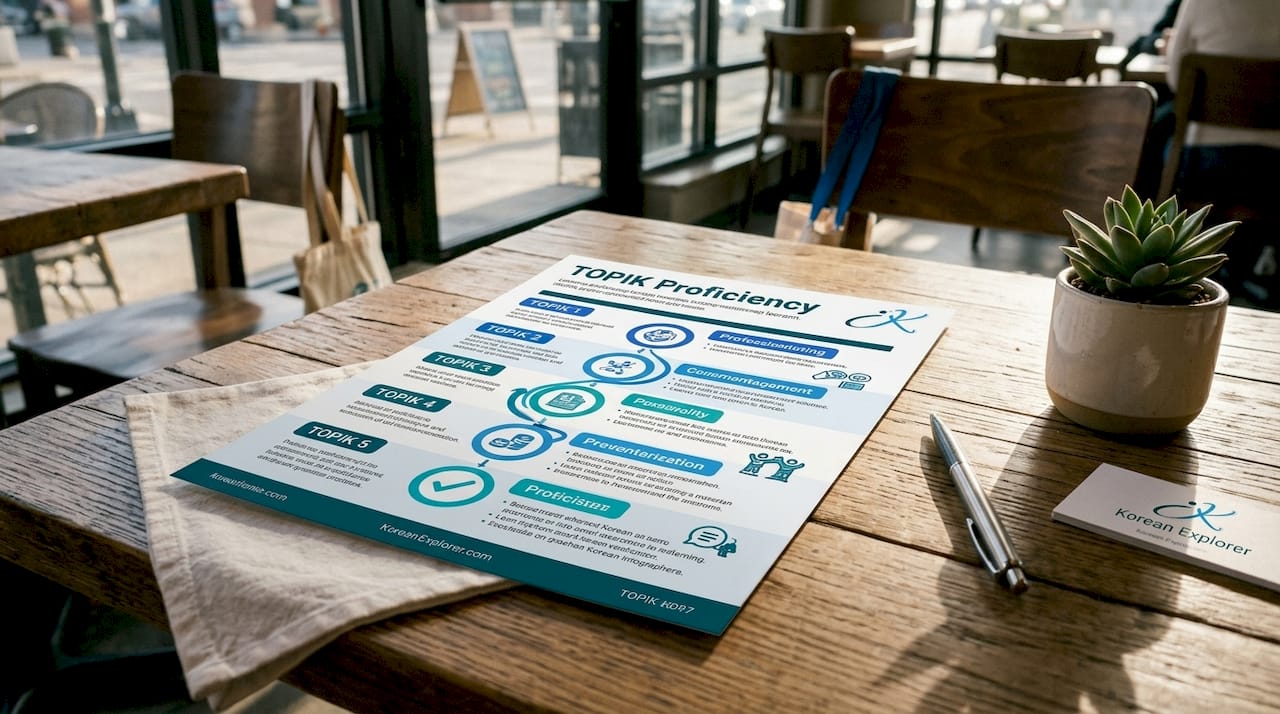
| Level | Tier | Proficiency description |
|---|---|---|
| Level 1 | TOPIK I | Basic survival Korean, simple vocabulary and sentences |
| Level 2 | TOPIK I | Everyday communication on familiar topics |
| Level 3 | TOPIK II | Functional use in most daily and social situations |
| Level 4 | TOPIK II | Comfortable use in professional and academic contexts |
| Level 5 | TOPIK II | Fluent use across complex topics with nuanced expression |
| Level 6 | TOPIK II | Near-native proficiency, suitable for advanced academic work |
Taking TOPIK I cannot yield a level 3 result or above, and vice versa. This is a critical point that many first-time test takers miss. If your target university requires a level 4, registering for TOPIK I is a wasted attempt regardless of how well you perform.
Levels 1 and 2 reflect the ability to handle basic daily interactions, such as shopping, asking for directions, and simple conversations. Levels 3 and 4 represent the range where most adult learners become functionally independent in Korean society. Levels 5 and 6 indicate the kind of fluency needed for graduate study or senior professional roles in Korean organizations. Verifying the specific TOPIK score required by your target institution before you register is the single most important preparation step.
How to prepare for the TOPIK exam effectively
Effective TOPIK preparation starts with knowing your target level and working backward from it. Registering for the wrong tier wastes time and money. Once you confirm your target, structure your study plan around the specific sections of that tier.
- Audit your current level. Take a practice test before committing to a tier. Free sample papers are available on topik.go.kr. Your score on a practice test tells you whether to register for TOPIK I or TOPIK II.
- Study by section, not by topic. Listening, reading, and writing each require different skills. Allocate study time proportionally. TOPIK II test takers should spend extra time on the writing section since it is the most commonly underprepared area.
- Use structured course materials. A curriculum aligned with TOPIK standards, like the Seoul National University-based program used at Korean Explorer, builds the vocabulary and grammar patterns the exam actually tests.
- Practice under timed conditions. The exam has strict time limits per section. Practicing without a timer builds false confidence. Use past papers with a clock running from your first practice session.
- Register early and confirm your test center. Test seats fill quickly, especially at international centers. Late registration can leave you without a seat for your preferred exam date.
Pro Tip: Check the 2026 TOPIK study guide for a structured preparation timeline that maps study milestones to exam dates.
A common error is treating TOPIK preparation as general Korean study. The exam tests specific formats and question types. Knowing the format is as important as knowing the language. Read more about practical TOPIK preparation tips that go beyond standard advice.
How is TOPIK administered outside Korea?
TOPIK is available in over 80 countries, making it one of the most globally accessible language proficiency exams. That reach means learners in Singapore, the United States, Europe, and across Southeast Asia can sit the exam without traveling to Korea.
Key facts for international test takers:
- Registration: Test takers outside Korea register through the official topik.go.kr site or through local administering offices designated by NIIED
- Paper-based format: Available at most international test centers and the most common option globally
- Internet-based format: Expanding internationally but not yet available at all locations; check topik.go.kr for current availability in your country
- Exam frequency: The exam runs up to six times per year in Korea; international locations typically offer fewer sittings, so planning ahead is critical
- EPS-TOPIK distinction: International test takers applying for Korean labor visas need EPS-TOPIK, not the general exam. Confirm which test applies to your situation before registering.
Singapore learners have access to local test centers that administer the paper-based TOPIK. Checking the current schedule on topik.go.kr early in the year gives you the best chance of securing a seat at your preferred date. For a full breakdown of how the TOPIK exam works, including format details by location, Korean Explorer’s guide covers the specifics.
Key Takeaways
TOPIK is a two-tier, six-level standardized exam administered by NIIED in over 80 countries, and your certificate is valid for exactly 2 years from the results announcement date.
| Point | Details |
|---|---|
| Two tiers, six levels | TOPIK I covers levels 1–2; TOPIK II covers levels 3–6 with an added writing section. |
| Register for a tier, not a level | Your final level is determined by your score within the tier you chose at registration. |
| Certificate validity | TOPIK certificates expire 2 years after results are announced; time your exam accordingly. |
| EPS-TOPIK is a separate exam | EPS-TOPIK applies to labor visa applicants only and does not substitute for the general TOPIK. |
| Global availability | TOPIK is offered in over 80 countries via paper-based and internet-based formats. |
Why TOPIK matters more than most learners expect
Most learners treat TOPIK as a box to check. That framing causes real problems. The exam is a precise instrument, and the gap between levels carries concrete consequences. A level 3 result does not satisfy a requirement for level 4, no matter how close the score was.
The detail I find most underestimated is the 2-year certificate validity window. I have seen learners sit the exam a full year before their university application opens, only to find the certificate expires mid-process. Strategic timing is not optional. It is the difference between a valid credential and a retake fee.
The tier registration rule also trips up more people than it should. Many learners assume they can aim for any level by performing well on either test. That is not how TOPIK works. If your target institution requires level 4 and you register for TOPIK I, no score you achieve will satisfy that requirement. Confirming the exact score requirement before you register is a five-minute task that prevents months of wasted preparation.
TOPIK also functions as a genuine signal of communicative ability, not just test-taking skill. Learners who build their Korean through structured, conversation-focused study tend to perform better across all sections because they have internalized the language rather than memorized patterns. That distinction shows up most clearly in the TOPIK II writing section, where formulaic answers score poorly against responses that demonstrate real fluency.
— Paul
Korean Explorer’s TOPIK preparation courses
Korean Explorer offers structured Korean language courses in Singapore built around a Seoul National University curriculum that aligns directly with TOPIK standards. Whether you are preparing for TOPIK I or working toward the advanced levels of TOPIK II, the courses are designed to build the exact skills the exam tests.
Classes are available in group, private, and online Zoom formats, giving you flexibility around work and personal schedules. Corporate training options are also available for teams that need professional Korean proficiency. Korean Explorer’s center is located at 10 Anson Road, Level 22, International Plaza, Singapore 079903, right above Tanjong Pagar MRT. Explore Korean language courses tailored to your level and goals, or check the TOPIK preparation resources to start building your study plan today.
FAQ
What does TOPIK stand for?
TOPIK stands for Test of Proficiency in Korean. It is the official standardized exam administered by NIIED under South Korea’s Ministry of Education for non-native Korean speakers.
What is the difference between TOPIK I and TOPIK II?
TOPIK I tests listening and reading at levels 1 and 2, while TOPIK II adds a writing section and covers levels 3 through 6. You register for one tier, and your score determines which level you achieve within that tier.
How long is a TOPIK certificate valid?
A TOPIK certificate is valid for 2 years from the date results are officially announced. Plan your exam date so the certificate remains valid through your application and processing period.
Can I take TOPIK outside of South Korea?
Yes. TOPIK is administered in over 80 countries through paper-based and internet-based formats. Register through the official topik.go.kr site or a local administering office designated by NIIED.
Is EPS-TOPIK the same as the general TOPIK exam?
No. EPS-TOPIK is a separate exam for workers applying to enter Korea under the Employment Permit System in specific labor sectors. It does not satisfy requirements for university admissions, residency visas, or scholarships that specify the general TOPIK.