If you want a Korean language lesson that supports real speaking ability, start with a placement test, then enroll in a live, instructor-led course that pairs weekly lessons with daily speaking practice. Reading a textbook alone will not get you talking. A structured curriculum with a real teacher, combined with short daily drills, gets you there faster than any app or self-paced module by itself.
Here is what to do this week:
- Take a placement test so you start at the right level, not the one you guess you’re at.
- Decide between in-person and live Zoom based on your commute and schedule, not just price.
- Book a trial or first lesson with a school that uses native instructors and a curriculum tied to a recognized university or institution.
Key Takeaways
Progress in Korean depends less on which app you download and more on combining structured, level-based instruction with daily speaking practice.
| Point | Details |
|---|---|
| Start with a placement test | Confirms your real level so you are not bored or overwhelmed in the wrong class. |
| Choose format by schedule, not just price | Group, private, and live online each trade cost against personalization and flexibility. |
| Build daily micro-practice | Twenty to thirty minutes of shadowing, vocabulary review, or AI conversation compounds fast. |
| Watch for curriculum red flags | Vague course descriptions and no assessment usually mean progress is not being tracked. |
| Korean Explorer offers a curriculum-backed path | Native bilingual instructors teach a Seoul National University developed curriculum across group, private, and Zoom formats. |
Table of Contents
- What a Structured Korean Language Course Actually Covers
- In-Person, Group, Private, or Online: Which Format Fits You?
- What Should You Ask Before Enrolling in a Course?
- How Should You Structure a Weekly Study Plan?
- Which Free and Paid Resources Actually Help?
- Why Korean Explorer Fits Adult Learners Looking for Structure
- How Long Does It Take to Progress Through Each Level?
- What Does a Korean Language Course Typically Cost?
- The Honest Take on What Actually Moves the Needle
- Start Your Korean Lessons With a Clear Curriculum and Real Instructors
- Sources
- FAQ
What a Structured Korean Language Course Actually Covers
A real curriculum moves in a specific order, and knowing that order helps you spot a course that is winging it versus one that has a plan.
- Beginner level: Hangeul (the Korean alphabet), basic pronunciation, survival phrases, and simple sentence grammar like subject-object-verb order.
- Intermediate level: expanded grammar patterns, active speaking drills, listening comprehension with native audio, and the polite-versus-casual speech distinction that trips up most learners.
- Advanced level: fluent conversation, workplace and business vocabulary, presentation skills, and grammar nuances that native speakers use without thinking about them.
Inside a single class, a well-run lesson usually moves through a warm-up, new language input, guided practice, role-play, homework, and a review of the previous session. That input-then-output rhythm matters. Coursera’s Korean 101 curriculum structures its modules the same way, alternating grammar and vocabulary with speaking exercises, because accuracy and fluency need separate practice.
Pro Tip: Ask any course upfront whether they give a placement test before your first class. Schools without one often lump beginners in with people who already know Hangeul, and you end up bored or lost.
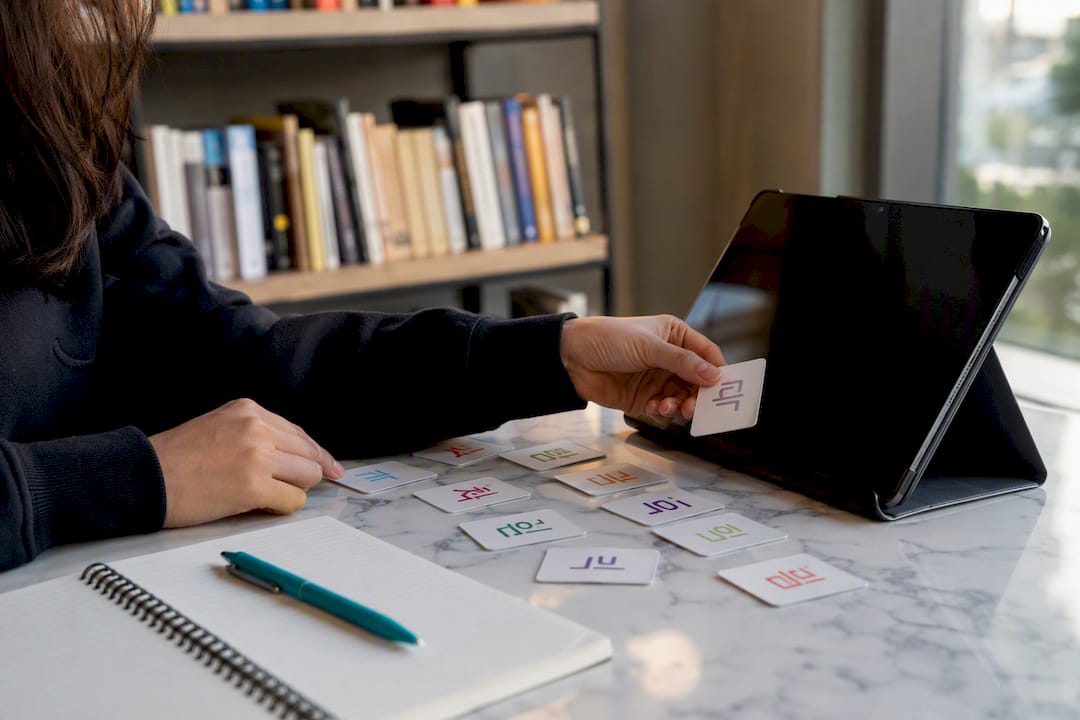
In-Person, Group, Private, or Online: Which Format Fits You?
The lesson format matters as much as the curriculum. Each one trades something for something else.
- Group classes: built-in speaking partners, a set schedule, and the lowest cost per hour, but you move at the class’s pace, not yours.
- Private lessons: the instructor adjusts pace and content to you specifically, with direct feedback every session, at a higher hourly rate.
- Live online (Zoom): real-time interaction with an instructor without a commute, which works well if you travel often or live somewhere without a nearby school.
- Self-paced apps and courses: flexible and cheap, but they risk turning into passive scrolling if you never speak out loud.
- Hybrid formats: live lessons anchored by recorded class access and app-based review in between, giving you structure and flexibility at once.
If your schedule is unpredictable, live online Korean classes solve the commute problem without giving up the real-time correction you get in person. If you want faster individual progress, private lessons let a teacher build around your specific goals, whether that is workplace Korean or conversational fluency for travel.
What Should You Ask Before Enrolling in a Course?
Most course pages look similar on the surface. The differences show up when you ask direct questions.
- Do you offer a placement test before the first lesson?
- How many students are typically in one class?
- Are classes recorded so I can review material I missed?
- What materials come with the course, and are they included in the price?
- How do you track student progress across levels?
Schools that maintain a placement test and a clear level pathway tend to keep students moving forward instead of stalling out, since progress is measured rather than assumed.
Watch for red flags: a curriculum description so vague it could apply to any language, no assessment before placing you in a class, inconsistent information about who is actually teaching, and no trial class or makeup policy if you miss a session. A course that cannot answer “what will I be able to do after eight weeks” in a specific sentence is not tracking outcomes closely enough to help you improve.
Statistic Callout: Schools that build in a placement test and structured level progression are a reliable signal of a course designed to move you forward, not just fill a seat.
How Should You Structure a Weekly Study Plan?
Adult learners rarely fail at Korean because the language is too hard. They fail because their practice is inconsistent. A realistic weekly plan looks like this:
- One live lesson per week with an instructor for correction and new material.
- Twenty to thirty minutes of daily micro-practice: vocabulary review, shadowing native audio, or a short AI conversation session.
- A weekly review session where you revisit what confused you and write a few sentences using new grammar.
Split your practice time deliberately: two days on grammar and sentence structure, three days on speaking and listening, one day on review and writing. This mirrors how structured lesson pathways are built for working adults who cannot commit hours daily but can commit to consistency.
Set four-week milestones instead of vague goals: read Hangeul fluently, hold a three-minute self-introduction, and manage a simple workplace exchange. Each milestone is testable, so you know if the plan is working.
Pro Tip: If speaking out loud makes you anxious, start with low-stakes practice. AI conversation partners let you practice in five to ten minute sessions with no judgment, and platforms like LinguaLive use that format specifically to help learners get past the fear of making mistakes with a real person.
Which Free and Paid Resources Actually Help?
Resources work best when you know exactly what job each one does. None of them replace a live instructor, but each fills a specific gap.
- The Online King Sejong Institute offers free, structured modules from introductory to advanced levels, accessible on PC or mobile, good for self-study between lessons.
- Coursera’s Korean courses provide videos, quizzes, and role-plays when you want a structured module with assignments rather than an unstructured app.
- HelloTalk and similar language exchange apps connect you with native speakers for informal speaking practice, while AI tutors offer scheduled, judgment-free conversation drills.
- Best Korean language apps work best for daily retrieval practice, saving live lessons for feedback and correction.
Language experts consistently point to the same conclusion: pairing structured study with regular speaking practice produces better fluency outcomes than relying on apps alone.
| Resource Type | Best Use |
|---|---|
| King Sejong Institute online | Free structured self-study between lessons |
| Coursera / MOOC courses | Assignments and structured modules for self-paced learners |
| AI conversation tutors | Low-pressure micro-practice for speaking anxiety |
| Language exchange apps | Informal speaking practice with native speakers |
Why Korean Explorer Fits Adult Learners Looking for Structure
A curriculum backed by an actual institution, not just a workbook someone assembled, makes a measurable difference in how fast you progress.
- Korean Explorer builds its courses on a curriculum developed by Seoul National University, aligned to recognized proficiency standards so your progress maps to something concrete.
- Every class is taught by native Korean instructors who are also fluent in English, so explanations land clearly without losing nuance in translation.
- Classes come in group, private, and live online Zoom formats, with recorded class access so you can revisit material you missed or want to review.
That combination, an institutional curriculum plus bilingual native instructors plus flexible delivery, addresses the three things adult learners ask about most: will the material be sound, will I understand the explanations, and can I actually fit this into my week.
How Long Does It Take to Progress Through Each Level?
Pacing depends heavily on how often you attend class and how much you practice outside it, but there are reasonable benchmarks. Beginner level, covering Hangeul through basic conversational patterns, usually takes a few months of consistent weekly lessons combined with daily practice. That is enough time to read comfortably, introduce yourself, and handle simple transactional conversations like ordering food or asking directions.
Intermediate level generally requires continued study over several months, because this is where grammar complexity increases and the polite-versus-casual speech distinction requires repetition to internalize. Many learners underestimate this stage. The vocabulary grows, but the harder part is building the reflexes to switch speech levels appropriately depending on who you are talking to.
Advanced level is open-ended. Fluent workplace conversation, presentation skills, and nuanced grammar develop over sustained months of practice, and pacing slows naturally because the remaining gains are about precision rather than new material. A single weekly lesson typically runs 60 to 90 minutes, long enough to cover new input and guided practice without losing focus. Daily micro-practice sessions of 20 to 30 minutes matter more at this stage than adding extra formal class time, since the bottleneck becomes fluency and speed, not new vocabulary.
The consistent pattern across levels: lessons get less about volume of new material and more about repetition, correction, and real-time use as you advance.
What Does a Korean Language Course Typically Cost?
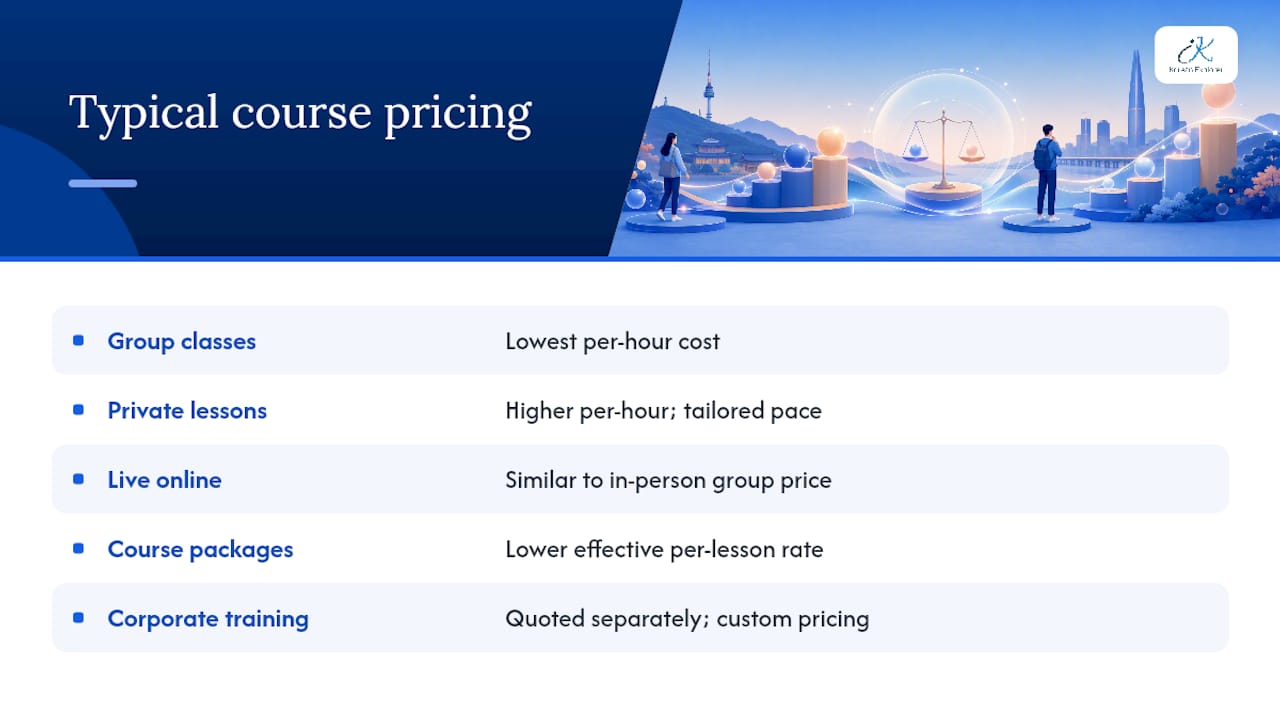
Pricing varies by format, and understanding the model behind each price point helps you compare fairly. Group classes generally offer the lowest per-hour cost because the instructor’s time is shared across several students, making them the most economical entry point for beginners who want structure without a large upfront cost.
Private lessons cost more per hour since you get the instructor’s full attention and a pace built around you specifically. This format tends to suit learners with specific goals, such as business Korean for an upcoming role or accelerated progress before a trip, where the extra cost buys faster, more targeted results.
Live online Zoom classes often sit close to in-person group pricing, since you are still getting scheduled, real-time instruction. The savings usually come from cutting commute time and travel costs rather than the lesson price itself, which matters if you are weighing an in-person versus online course.
Course packages, whether sold in blocks of eight, twelve, or more sessions, typically reduce the effective per-lesson rate compared to paying week by week. Corporate training arrangements for teams are usually quoted separately based on group size and schedule, since the format and materials shift for workplace-focused content. When comparing providers, ask what is included beyond class time: materials, recorded sessions, and progress tracking all affect whether a lower sticker price is actually the better value.
The Honest Take on What Actually Moves the Needle
Most advice about learning Korean fixates on the wrong variable. People obsess over which app has the best interface or which YouTube channel explains grammar most clearly, and they treat the instructor as an afterthought. That gets it backward. Apps are excellent at repetition. They are terrible at correction. Nobody becomes conversational by tapping through flashcards, because a flashcard cannot tell you that your sentence structure just accidentally sounded rude to your boss.
The conventional wisdom also oversells “immersion” as a shortcut, as if moving to Korea or watching enough K-dramas will make grammar click on its own. It will not, not without deliberate practice alongside it. What actually works is unglamorous: a real curriculum that sequences material logically, a native instructor who corrects you in real time, and enough daily repetition that new patterns become automatic. The order matters. Skip the placement test and structured sequencing, and you will spend months relearning things badly.
If you take one thing from this, prioritize finding an instructor and curriculum you trust before you download a single app.
— Paul
Start Your Korean Lessons With a Clear Curriculum and Real Instructors
Choosing between a dozen apps and a handful of course providers gets exhausting fast, especially when most course pages describe themselves in the same vague terms. Korean Explorer gives you a specific alternative: a curriculum developed by Seoul National University, taught by native Korean instructors who are also fluent in English, with group, private, and live Zoom formats so the schedule adapts to you instead of the other way around.
That structure means you are not guessing whether a course will actually move you from beginner to conversational. Every level ties back to a defined curriculum, every class is recorded so you never lose a session to a missed meeting or late flight, and instructors track your progress instead of assuming you will figure it out from a textbook. Our current training center sits at 10 Anson Road, Level 22, International Plaza, Singapore 079903, right above Tanjong Pagar MRT, with additional locations in Jurong and Tampines for learners who want an in-person option closer to home.
If you are ready to stop researching and start speaking, take a placement test and explore Korean Explorer’s course options to find the format and level that fits where you are right now.
Sources
- Online King Sejong Institute — About
- HelloTalk — Learn Korean guidance
- LinguaLive — Korean speaking practice with AI
- First Step Korean | Coursera
FAQ
How much does it cost to learn Korean?
Costs vary by format: group classes are the most economical per hour, private lessons cost more for individualized pacing, and course packages sold in blocks typically lower the per-session rate compared to paying week by week.
How can I learn basic Korean on my own?
Start with Hangeul using a free resource like the Online King Sejong Institute, then add daily speaking practice through language exchange apps or AI conversation tools, since reading alone will not build speaking ability.
Can I learn Korean in seven days?
No. You can learn to read Hangeul and pick up a handful of survival phrases in a week, but real conversational ability requires months of consistent grammar study and speaking practice, not days.
What is the fastest way to build conversational Korean skills?
Pair a live, instructor-led course with daily micro-practice of 20 to 30 minutes, since structured study combined with regular speaking practice consistently outperforms passive app use alone.
Does Korean Explorer offer both in-person and online lessons?
Yes, Korean Explorer offers group, private, and live online Zoom formats, all built on a curriculum developed by Seoul National University and taught by native, bilingual instructors.