Korean verbs conjugate by dropping the dictionary ending -다 to get the stem, then adding endings for tense and politeness. That’s the whole system in one sentence, and once it clicks, you can build almost any sentence you need.
Every verb you’ll ever look up in a dictionary ends in 다. Strip that off and you’re left with the stem, the part that never changes no matter what tense or politeness level you use. Then you layer on endings: tense first, politeness second.
- 가다 (to go) → stem 가 → 가요 (“go” / “I’m going,” polite)
- 먹다 (to eat) → stem 먹 → 먹어요 (“eat” / “I’m eating,” polite)
That’s it. Everything else in this guide is just filling in the details around that one move.
Key Takeaways
Korean verb conjugation works by dropping -다 to isolate the stem, then stacking tense and politeness endings in a fixed, predictable order.
| Point | Details |
|---|---|
| Master the stem first | Drop -다 from any dictionary form before adding any tense or politeness ending. |
| Default to 해요체 | Informal polite endings work safely across most everyday situations until you learn the context better. |
| Learn irregulars as examples | Memorize ㅂ, ㄷ, ㅅ, 르, ㅡ-drop, and ㅎ patterns through sentences, not abstract rules. |
| Separate 안 from -지 못하다 | 안 and -지 않다 express choice; -지 못하다 expresses inability. |
| Practice with structured, spoken drills | Com’s conversational and business Korean courses pair native instructors with recorded lessons for active review. |
Table of Contents
- How Korean Verb Conjugation Handles Politeness and Speech Levels
- Present Tense: -아요, -어요, and 해요 in Practice
- Past Tense: Building -았어요 and -었어요
- Future Forms: -(으)ㄹ 거예요, -(으)ㄹ게요, and -겠-
- Irregular Verbs and Sound Changes You’ll Run Into Constantly
- A Compact Conjugation Table for Quick Lookup
- Negative Forms: 안, -지 않다, and -지 못하다
- Honorific Conjugation: When and How to Show Respect
- Conjugating Adjectives and Descriptive Verbs
- Conjunctive Endings: Contrast, Condition, and Time
- Adnominal Forms: Turning Verbs Into Modifiers
- Sources
- FAQ
How Korean Verb Conjugation Handles Politeness and Speech Levels
Korean doesn’t have one neutral way to say things. The verb ending itself signals how formal you’re being, and picking the wrong one can sound either rude or oddly stiff.
- Casual (반말) — used with close friends, younger siblings, or people you know well. Example: 먹어 (eat/eating).
- Informal polite (해요체) — the everyday default for strangers, coworkers, and most daily interactions. Example: 먹어요.
- Formal polite (합니다체) — used in news broadcasts, presentations, customer service, and with people well above you in rank. Example: 먹습니다.
Adjectives (called descriptive verbs in Korean) conjugate the exact same way as action verbs, so you’re not learning a second system, just applying the one you already know to more words.
One more layer worth knowing early: the subject honorific marker -(으)시- gets inserted when you’re talking about someone senior, as in 가세요 (they go, respectfully) versus plain 가요. If you’re ever unsure which level to use, default to 해요체. It’s polite enough for almost any situation and far less rigid than the formal register.
Present Tense: -아요, -어요, and 해요 in Practice
The rule splits on the last vowel of the stem. If it’s ㅏ or ㅗ, add -아요. Every other vowel takes -어요. Verbs ending in 하다 (like 공부하다, “to study”) become 해요 instead of following either pattern.
- 가다 (go) → 가 + 아요 → 가요
- 오다 (come) → 오 + 아요 → 와요 (contracted)
- 마시다 (drink) → 마시 + 어요 → 마셔요 (contracted)
- 공부하다 (study) → 공부해요
Notice how 가 + 아요 doesn’t become “가아요.” Korean smooths adjacent vowels together in speech, which is why contractions like 와요 and 마셔요 show up constantly once you start listening to native speakers. If you’re relying only on textbook spelling, contracted speech can feel like a different language at first.
Turning any of these into a question takes almost no extra work. In speech, you just raise your intonation at the end: 가요? means “Are you going?” In writing, a question mark does the same job. This is one reason -아요/-어요 works as such a flexible default — the same form covers statements, questions, and even soft suggestions depending on tone.
Pro Tip: Say each contracted form out loud five times before you try to write it. Your mouth learns the shortcut faster than your eyes do.
Past Tense: Building -았어요 and -었어요
Past tense uses the same vowel-harmony logic as the present, just with a tense marker slotted in before the politeness ending. Stems with a final ㅏ or ㅗ take -았-, everything else takes -었-, and 하다 verbs shift to 했-.
- 가다 → 갔어요 (went)
- 먹다 → 먹었어요 (ate)
- 하다 → 했어요 (did)
The same verb can drop down to casual or up to formal without changing the underlying past marker:
- Casual: 먹었어 (ate, to a friend)
- Formal: 갔습니다 (went, in a formal setting)
That -았-/-었- piece is the constant. Only the ending after it moves depending on how formal you’re being, which means once you’ve memorized the past tense marker for a verb, you already know it for every speech level.
Future Forms: -(으)ㄹ 거예요, -(으)ㄹ게요, and -겠-
For everyday plans, Korean leans on -(으)ㄹ 거예요. Vowel-final stems take -ㄹ 거예요 directly (갈 거예요, “will go”); consonant-final stems need the buffer 으 first (먹을 거예요, “will eat”).
Two other forms carry different shades of meaning:
- -(으)ㄹ게요 signals a promise or something you’re deciding to do right now: 제가 할게요 (“I’ll do it,” as a commitment to the listener).
- -겠- expresses intention or a strong assumption, often used for weather forecasts or educated guesses: 비가 오겠어요 (“it looks like it’ll rain”).
Try building your own: 내일 공부할 거예요 (“I’ll study tomorrow,” a plan) versus 이거 제가 할게요 (“I’ll take care of this,” a promise).
Commands and Suggestions You’ll Actually Use
- Casual imperative vs. polite request: 가 (go, blunt) versus 가세요 (please go, polite).
- Negative command: 가지 마세요 (please don’t go).
- Suggestions and requests: -자 (let’s, casual: 가자), -(으)ㄹ까요? (shall we?: 갈까요?), and -아/어 주세요 for asking someone to do something (도와주세요, “please help me”).
Progressive and Connective Forms for Longer Sentences
Add -고 있다 to a stem to say something is happening right now: 먹고 있어요 (“I’m eating”). To link two clauses, -아서/어서 covers both sequence and reason (일어나서 씻어요, “I wake up and wash up”), while -니까 leans more toward reason or cause. Modifier endings turn verbs into adjective-like descriptors before a noun: -는 for present (먹는 사람, “person who eats”), -(으)ㄴ for past (먹은 사람), and -(으)ㄹ for future (먹을 사람).
Irregular Verbs and Sound Changes You’ll Run Into Constantly
Not every verb follows the clean pattern. A handful of consonant-final stems change shape before a vowel-initial ending, and these irregular classes show up in extremely common vocabulary, so you can’t avoid them for long.
- ㅂ irregular: 돕다 (help) → 도와요, not 돕어요
- ㄷ irregular: 듣다 (listen) → 들어요, not 듣어요
- ㅅ irregular: 짓다 (build) → 지어요, the ㅅ disappears entirely
- ㅡ-drop: stems ending in ㅡ drop that vowel before -아/어요 (바쁘다 → 바빠요)
- 르 irregular: 모르다 (not know) → 몰라요, doubling the consonant
- ㅎ irregular: mostly affects color and descriptive verbs, like 하얗다 → 하얘요
Pro Tip: Don’t try to memorize the rules as abstract patterns. Pick five irregular verbs you’ll actually use this week, drill each one in a full sentence, and the sound change will stick faster than any grammar chart.
A Compact Conjugation Table for Quick Lookup
Copy this into a notebook and drill it out loud. These eight verbs cover a huge share of everyday conversation, and once you know their patterns, dozens of similar verbs fall into place.
| Verb | Polite present | Polite past | Polite future | Casual present |
|---|---|---|---|---|
| 가다 (go) | 가요 | 갔어요 | 갈 거예요 | 가 |
| 오다 (come) | 와요 | 왔어요 | 올 거예요 | 와 |
| 먹다 (eat) | 먹어요 | 먹었어요 | 먹을 거예요 | 먹어 |
| 하다 (do) | 해요 | 했어요 | 할 거예요 | 해 |
| 보다 (see) | 봐요 | 봤어요 | 볼 거예요 | 봐 |
| 듣다 (listen) | 들어요 | 들었어요 | 들을 거예요 | 들어 |
| 공부하다 (study) | 공부해요 | 공부했어요 | 공부할 거예요 | 공부해 |
| 마시다 (drink) | 마셔요 | 마셨어요 | 마실 거예요 | 마셔 |
Notice 듣다 breaking the pattern (들어요, not 듣어요) — that’s the ㄷ irregular at work, right there in a verb you’ll use in almost every class.
Negative Forms: 안, -지 않다, and -지 못하다
Korean gives you three main ways to say “not,” and they aren’t interchangeable. The simplest is 안 placed directly before the verb: 안 가요 (“I’m not going”). It works for almost any verb in casual conversation and is by far the most common negative you’ll hear day to day.
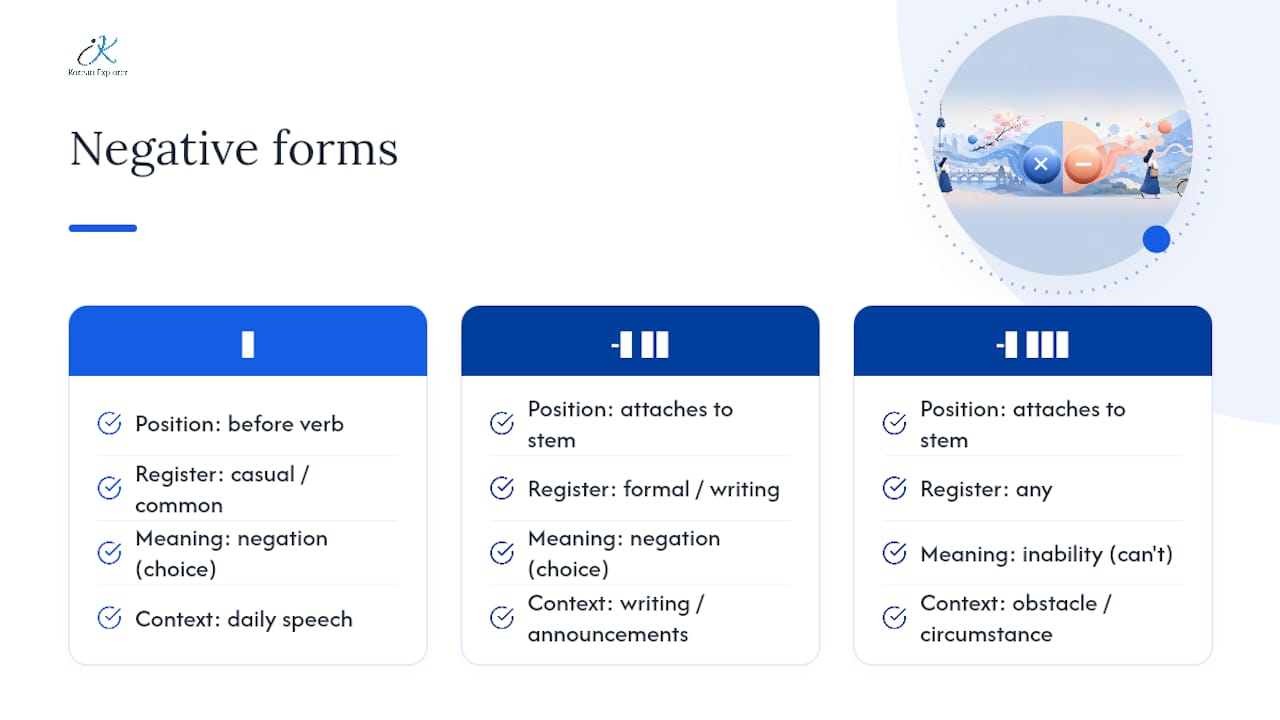
The second option, -지 않다, attaches to the verb stem itself instead of standing in front of it: 가지 않아요 means the same thing as 안 가요, just with a slightly more formal or deliberate feel. You’ll see -지 않다 more often in writing, announcements, or careful speech, while 안 dominates casual talk. Both express a simple negation, a choice not to do something or a state that isn’t the case.
-지 못하다 is different in meaning, not just form. It expresses inability rather than choice. 가지 못해요 doesn’t mean “I’m not going” as a decision. It means “I can’t go,” implying something is stopping you, whether that’s a schedule conflict, a physical limitation, or circumstances outside your control. Mixing up 안 가요 and 가지 못해요 can genuinely confuse a listener about whether you’re choosing not to do something or unable to.
A quick way to keep them straight: ask yourself whether you’re describing a choice or an obstacle. “I’m not eating that” (choice) is 안 먹어요 or 먹지 않아요. “I can’t eat that” (allergy, no time, whatever) is 먹지 못해요. Both forms conjugate for tense and politeness just like their positive counterparts, so 가지 못했어요 (couldn’t go, past) and 가지 못할 거예요 (won’t be able to go, future) follow the same layering rule you’ve already learned.
Honorific Conjugation: When and How to Show Respect
Honorific conjugation goes a step beyond politeness level. Politeness (해요체 vs. 합니다체) is about how formal you sound. Honorifics are about showing respect toward the person you’re talking about, whether or not they’re in the room.
The core marker is -(으)시-, inserted right after the stem and before the tense or politeness ending. 가다 becomes 가시다, then conjugates normally from there: 가세요 (present, from 가 + 시 + 어요, contracted), 가셨어요 (past), 가실 거예요 (future). You use this when talking about a teacher, an older relative, a boss, or anyone you’d naturally want to elevate in conversation.
Here’s where beginners trip up: you generally don’t use -(으)시- to describe your own actions, even in a formal setting. Saying 제가 가세요 to mean “I go” sounds backward, like praising yourself with respect language meant for someone else. The honorific points outward, toward the subject you’re describing, not toward the speaker.
Certain verbs have entirely separate honorific words rather than just adding -(으)시-. 먹다 (eat) becomes 드시다 or 잡수시다 in honorific speech, not 먹으시다. 있다 (to exist/have) becomes 계시다 when describing a respected person’s presence. These irregular honorific verbs are worth memorizing individually since they don’t follow the regular suffix pattern. For a deeper breakdown of when each honorific marker applies, Korean Explorer’s guide on honorific speech walks through the situational rules in more detail.
Conjugating Adjectives and Descriptive Verbs
Korean doesn’t really have a separate adjective category the way English does. Words like 예쁘다 (pretty), 크다 (big), and 맛있다 (delicious) are technically descriptive verbs, and they conjugate through the identical stem and ending system you’ve already learned for action verbs.
Take 예쁘다: drop 다, you get the stem 예쁘. Since the last vowel is ㅡ, the ㅡ-drop irregular kicks in before adding -어요, giving you 예뻐요 (“[it’s] pretty”). Past tense follows the same past marker rule: 예뻤어요 (“it was pretty”). Future works too, though less commonly for static qualities: 예쁠 거예요 (“it’ll probably be pretty”).
Compare that to 크다 (big): stem 크, another ㅡ-drop case, becomes 커요 in the present and 컸어요 in the past. Once you notice how many descriptive verbs end in ㅡ, that irregular pattern stops feeling random and starts feeling like a shortcut.
The one place descriptive verbs diverge slightly from action verbs is the imperative and suggestion forms. You can say 가자 (“let’s go”) because going is an action someone can choose to do. You can’t say “예쁘자” because you can’t command something to be pretty. Outside of imperatives and proposals, though, descriptive verbs conjugate through present, past, and future exactly like 가다 or 먹다, which is genuinely good news since it means you’re not learning two grammar systems, just applying one system to two word categories.
Conjunctive Endings: Contrast, Condition, and Time
Beyond the cause-and-effect connectors like -아서/어서 and -니까, Korean has a small set of conjunctive endings that let you build sentences expressing contrast, condition, and timing, without starting a new sentence every time.
For contrast or “but,” -지만 attaches directly to the stem: 비싸지만 맛있어요 (“it’s expensive, but it’s delicious”). For “even though” or concession, -아도/어도 does the job: 비가 와도 갈 거예요 (“even if it rains, I’ll go”). Notice that “even if” and “but” carry different logical weight in English, yet both map to compact single endings in Korean rather than separate connector words.
Conditional sentences lean on -(으)면: 시간이 있으면 갈게요 (“if I have time, I’ll go”). This is one of the most frequently used endings in everyday speech, showing up in casual plans, hypotheticals, and even proverbs.
For timing, -기 전에 (“before”) and -(으)ㄴ 후에 (“after”) bracket an action in time: 먹기 전에 손을 씻어요 (“I wash my hands before eating”); 먹은 후에 쉬어요 (“I rest after eating”). Notice that -기 전에 attaches to the plain verb stem plus 기, while -(으)ㄴ 후에 uses the past modifier form, a small but consistent distinction worth drilling separately.
Adnominal Forms: Turning Verbs Into Modifiers
Adnominal endings let a verb describe a noun, functioning the way relative clauses do in English (“the food that I ate,” “the person who is coming”). Korean handles this with a compact set of endings attached directly before the noun, no separate relative pronoun required.
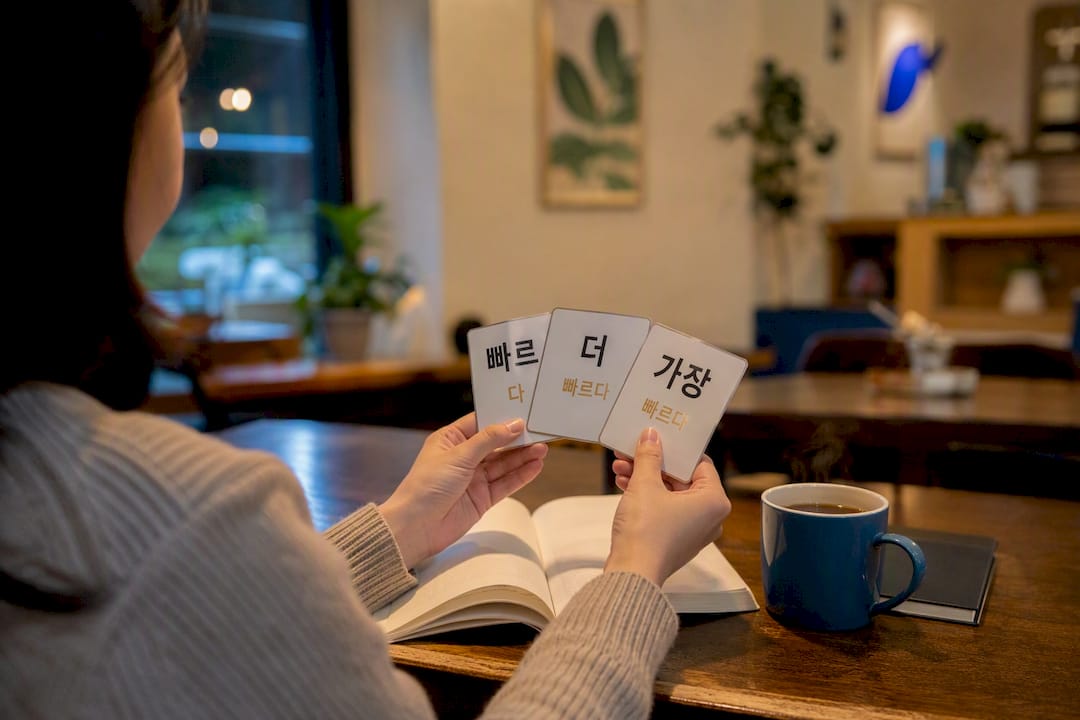
For present or ongoing actions, use -는: 먹는 사람 (“the person who eats” or “is eating”). For completed, past actions, use -(으)ㄴ: 먹은 음식 (“the food [that was] eaten”). For future or hypothetical actions, use -(으)ㄹ: 먹을 음식 (“the food [that will be] eaten”).
Descriptive verbs use a slightly different present form: -(으)ㄴ instead of -는. So 예쁜 사람 (“a pretty person”) uses the adjective pattern, while 가는 사람 (“a person who is going”) uses the action-verb pattern. Mixing these up is one of the most common beginner errors, since both endings look similar on paper but attach to different verb categories.
Once you’re comfortable stacking modifiers onto nouns, entire sentences start compressing naturally: 어제 먹은 음식이 맛있었어요 (“the food I ate yesterday was delicious”) packs a full relative clause into four syllables before the subject even appears. For more on how these clauses fit into overall sentence order, Korean Explorer’s guide on sentence structure breaks down where modifiers sit relative to the main verb.
Teacher’s Take: How to Actually Practice This
Classroom sequences that work best move from stem recognition, to polite present drills, to past and future, then finally to irregulars. Don’t reverse that order.
Try two quick drills: swap-the-ending (take one verb, run it through casual, 해요체, and 합니다체 out loud) and two-line role-play (write a short question-answer exchange using a new ending). For additional support, check out the JSS Audio Portal, which offers extensive audio practice resources to improve your listening and speaking skills. Guided practice with a bilingual instructor, plus reviewing recorded lessons afterward, tends to catch small errors faster than solo study alone.
Practice-Focused Adult Korean Courses at Com
Reading rules on a page only gets you so far. What actually locks in verb conjugation is speaking it out loud, getting corrected in real time, and repeating it until it’s automatic, which is exactly the gap adult learners run into when they try to self-teach from an app.
Com runs adult conversational and business Korean courses, both in person and over online Zoom classes, taught by native instructors who explain grammar in plain English before switching to Korean practice. Private lessons are available for learners who want a pace built around their own schedule, and every class comes with recorded video access so you can review a tricky conjugation point after the session instead of scrambling to write it down mid class. If you’re ready to move past textbook rules and start using these endings in real conversation, browse Korean course options or view the main course page to find a class time that fits your week.
Sources
- Korean Verb Conjugation for Beginners: Present, Past & Future (Crushon Korean)
- Korean verb conjugation (Fluent in 3 Months)
- Verb basics (Practice-Korean)
FAQ
What Is the Basic Rule for Korean Verb Conjugation?
Drop the dictionary ending -다 to get the stem, then add endings for tense and politeness. All Korean verbs and adjectives follow this same pattern.
What’s the Difference Between 해요체 and 합니다체?
해요체 is the informal polite level used in daily conversation, while 합니다체 is the formal polite level used in presentations, news, and customer service settings.
How Do I Know Whether to Use -아요 or -어요?
Check the stem’s last vowel: ㅏ or ㅗ takes -아요, and every other vowel takes -어요, except 하다 verbs, which become 해요.
What’s the Difference Between 안 and -지 못하다?
안 and -지 않다 express a choice not to do something, while -지 못하다 expresses an inability to do it due to circumstances beyond your control.
Where Can I Get Structured Practice with a Real Instructor?
Com offers adult conversational and business Korean courses in person and via online Zoom classes, taught by native instructors with recorded lesson access for review.