Korean Explorer is a Korean language school offering in-person and online adult courses. You can join a group class, book private lessons, or sign up for live Zoom classes today. The school runs its main training center at 10 Anson Road, Level 22, International Plaza, right above Tanjong Pagar MRT, alongside additional locations in Jurong and Tampines for learners who want a campus closer to home.
If you already know you want in, here is where to go right now:
- Book a trial or placement chat: reach the team by email, phone, or WhatsApp through the contact page
- Browse course schedules and pick a format: check the Korean language courses landing page for group, private, and online options
- Start immediately online: sign up for a Zoom-based class through the online Korean classes page
One quick note before you search further: “Korean Explorer” also turns up results about actual Korean adventurers, including mountaineer Hong Sung-taek and yachtsman Kang Dong-suk. This article is strictly about the language school and its adult courses.
Key Takeaways
Choosing the right course format at Korean Explorer, group for structure, private for speed, online for flexibility, matters more than which level you start at.
| Point | Details |
|---|---|
| Pick format by learning style | Group suits peer practice, private suits fast personalized progress, online suits flexible schedules. |
| Curriculum has real backing | The syllabus was developed with Seoul National University input and aligned to proficiency standards. |
| Enrollment is a three-step process | Check schedules, book a trial or placement, then confirm your format and payment. |
| Course length runs 8 to 10 weeks | Most group and online courses run one session weekly across two to three months per level. |
| Korean Explorer offers the full path | Group, private, online, and corporate training options run from a central Tanjong Pagar MRT location. |
Table of Contents
- Group, Private, or Online: Which Korean Explorer Course Fits You?
- What Level Am I Starting At, and Where Does the Curriculum Take Me?
- Where and When Do Classes Actually Happen?
- How Much Do Korean Classes Cost, and How Do You Pay?
- How Do You Enroll in a Korean Explorer Course?
- Why Choose Korean Explorer for Adult Korean Classes?
- How Long Does It Actually Take to Finish a Course?
- What Happens If You Need to Cancel or Reschedule?
- What Support Do You Get Once You’re Enrolled?
- Do You Get a Certificate After Completing a Course?
- A Practical Path Through the Course Options
- Ready to Start? Here’s How Korean Explorer Makes It Simple
- Sources
- FAQ
Group, Private, or Online: Which Korean Explorer Course Fits You?
The three formats solve different problems, and picking the wrong one is the most common reason adult learners stall out after a few weeks.
Group classes run in fixed cohorts, usually capped at a small class size so everyone gets speaking time. Sessions lean heavily on conversational drills, role play, and peer correction, which works well if you learn faster by talking out loud with other people at your level.
Private lessons flip that model entirely. You get a syllabus built around your goals, whether that’s business meetings, an upcoming trip, or catching up with in-laws. Because there’s no group pace to match, private students typically cover more ground per hour, and scheduling bends around your calendar instead of the other way around. Details on format and structure are on the private Korean classes page.
Online Zoom classes deliver the same live instruction as in-person sessions, just through a screen. You’ll need a stable connection and a quiet room, but you gain access to recorded sessions for review, a real advantage if work travel or shift schedules make consistent attendance tough. The online Korean classes program covers the live and recorded mix in more detail.
- Group classes suit learners who want structure, accountability, and conversation practice with peers
- Private lessons suit professionals with tight timelines or very specific goals
- Online classes suit anyone juggling location or schedule constraints
Pro Tip: If you’re not sure which format fits, book a single trial session before committing to a full package. Most hesitation disappears once you sit through one real class.
What Level Am I Starting At, and Where Does the Curriculum Take Me?
Korean Explorer’s curriculum was developed with input from Seoul National University and mapped to internationally recognized proficiency benchmarks, so progress isn’t guesswork. It’s built in stages, and each one has a clear speaking and grammar target.
- Beginner: Hangeul reading and writing, basic sentence structure, everyday greetings and transactions
- Intermediate: connected speech, past and future tense handling, small talk and opinion sharing
- Business conversational: formal register, meeting language, email and phone etiquette in Korean
New students take a short placement conversation or trial class rather than a formal exam. That single session is usually enough for an instructor to place you accurately, which matters more than most people expect: starting one level too low wastes weeks, and starting too high erodes confidence fast.
Instructors are native Korean speakers who teach fluently in English, so grammar explanations don’t get lost in translation, a common frustration with programs that force full-immersion from day one.
Where and When Do Classes Actually Happen?
Scheduling shapes commitment more than most learners realize going in. A typical group course runs 8 sessions over 8 weeks, with some tracks extending to 10 sessions over 10 weeks depending on the level and pacing.
In-person classes meet at the training center at 10 Anson Road, Level 22, International Plaza, right above Tanjong Pagar MRT, making it an easy stop before or after work. Jurong and Tampines locations give learners outside the city center a shorter commute.
Online classes run live over Zoom on a fixed weekly schedule, matching the same session count as in-person courses. Every session gets recorded, so a missed class doesn’t mean a missed lesson; you can review it later before the next one starts. Supplementary materials, usually vocabulary sheets and practice exercises, get shared alongside the recordings.
- In-person: fixed classroom time at a physical campus, ideal for learners who focus better away from home distractions
- Online: same live content, plus recordings and materials you can revisit anytime
- Private lessons: scheduled directly between you and your instructor, with no fixed weekly slot required
How Much Do Korean Classes Cost, and How Do You Pay?
Pricing follows the format. Group courses are sold as a package covering the full session count, so you pay once for the entire term rather than per class, with exact figures varying. Private lessons are billed hourly, which gives you control over total spend but means the number varies with how many hours you book. Corporate training is quoted separately based on group size and program length.
Exact figures shift by level and current promotions, so the most reliable move is requesting a quote directly through the contact page rather than relying on a number you saw elsewhere.
Payment channels typically include standard card and bank transfer options. Some learners may also be eligible for government credit schemes listed on LifeSG, Singapore’s official portal for public benefit programs. Eligibility rules vary by individual, so check directly with the admissions team rather than assuming a credit applies to your situation.
- Group courses: one package fee for the full term
- Private lessons: hourly billing, flexible total cost
- Corporate training: custom quote based on headcount and duration
Pro Tip: Ask about multi-course bundles before you enroll in just one level. Schools often price a beginner-to-intermediate bundle lower than booking each course separately later.
How Do You Enroll in a Korean Explorer Course?
Enrollment follows a short, predictable sequence.
- Check the schedule. Browse current course dates and formats on the course landing page.
- Request a trial or placement. Message the team by email, phone, or WhatsApp through the contact page to book a trial class or a quick placement conversation.
- Pick your format and confirm. Choose group, private, or online, then complete registration and payment to lock in your seat.
Bring a notebook and, if you’re joining online, test your Zoom connection beforehand. First sessions usually open with a level check and light conversation so the instructor can calibrate pace before diving into material.
Why Choose Korean Explorer for Adult Korean Classes?
The strongest reason to trust a language program isn’t marketing copy. It’s who built the curriculum and who’s teaching it.
The curriculum was developed with input from Seoul National University and aligned to internationally recognized proficiency standards, giving structure to what could otherwise be a scattered, ad hoc learning path.
- Native Korean instructors fluent in English, so explanations land clearly without a language barrier getting in the way
- Recorded lessons available for review, useful for anyone balancing work and study
- Flexible delivery across in-person, private, and online formats, plus corporate training experience for teams
That combination, structured curriculum plus bilingual instruction plus format flexibility, is rarer than it sounds in adult language education.
How Long Does It Actually Take to Finish a Course?
Time commitment depends entirely on the format you pick, and this is where a lot of learners underestimate what they’re signing up for.
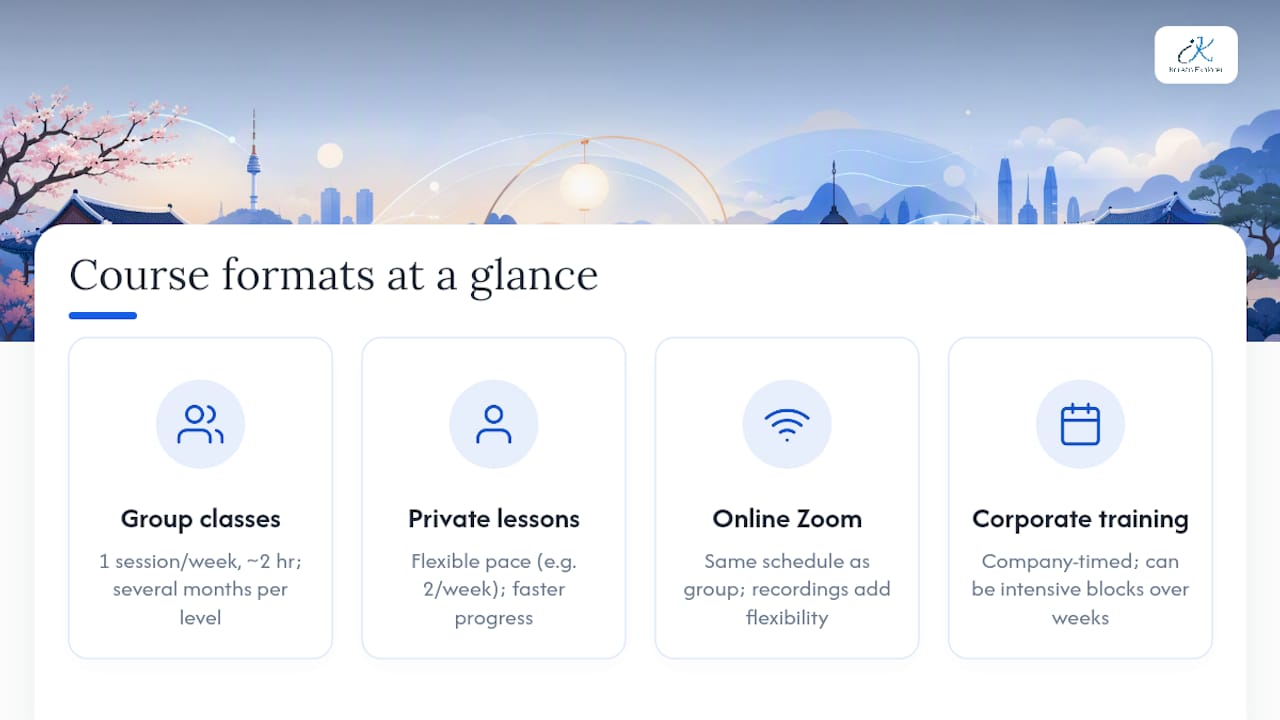
A standard group course runs for several weeks, with one session per week lasting roughly two hours. That’s a manageable pace for someone working full time, but it does mean several months per level. Moving from absolute beginner through intermediate conversational ability realistically takes several consecutive course terms, not one.
Private lessons compress that timeline because pacing is entirely yours. A learner who books two sessions a week and does homework consistently can move through material noticeably faster than someone attending one weekly group class. The tradeoff is cost per hour, not total learning time.
Online Zoom classes run on the same session count as in-person group courses, so the time commitment mirrors the classroom format almost exactly. What changes is flexibility: a missed live session doesn’t cost you the material, since the recording covers it.
Corporate training programs are structured around a company’s own timeline, sometimes compressed into intensive blocks over a few weeks rather than a semester-length term. Whatever format you choose, showing up consistently matters more than which one you pick. A student who attends every session of an 8-week group course usually outpaces one who books private lessons but cancels half of them.
What Happens If You Need to Cancel or Reschedule?
Life gets in the way of even well-planned course commitments, and knowing the policy before you enroll saves a frustrating conversation later.
Group course packages are generally structured around the full session count you purchase, so missing a class typically means catching up through recordings or materials rather than receiving a prorated refund for that single session. Because online classes are recorded, this is less of a loss than it sounds. In-person students who need to skip a physical session should ask about transferring into a corresponding online session where available.
Private lessons offer more flexibility since sessions are booked individually rather than as a locked package. Rescheduling a single private session, with reasonable notice, is usually straightforward since there’s no cohort pace to disrupt.
Refund and cancellation terms can vary depending on how far into a course term you are and which format you booked. Rather than assume a blanket policy applies to your situation, confirm specifics directly with admissions before you pay, particularly if you’re booking a larger package or a corporate training block. Asking this question upfront, before enrollment, is the single easiest way to avoid a dispute later.
What Support Do You Get Once You’re Enrolled?
Signing up for a course is the easy part. Staying on track for two to three months is where most self-taught learners quit, and structured support is the actual value a school provides beyond the lesson content itself.
Every class, whether in-person or online, comes with an instructor available to answer questions in the moment rather than leaving you to figure out grammar quirks alone. Because instructors are native Korean speakers fluent in English, questions about nuance, honorifics, or cultural context get answered clearly instead of getting lost in translation.
Recorded sessions function as a built-in support system on their own. If a concept didn’t click during the live class, you can rewatch the explanation instead of falling behind the next week. This matters more for adult learners than it might seem: work schedules and family obligations mean concentration during any single session varies, and having a fallback reduces the pressure to absorb everything in real time.
Supplementary materials, vocabulary lists, and practice exercises get distributed alongside sessions, giving you something concrete to work through between classes rather than relying purely on memory. For learners in private lessons, this support is even more direct, since the syllabus adjusts based on what’s actually giving you trouble that week rather than following a fixed group timeline regardless of individual pace.
Do You Get a Certificate After Completing a Course?
Completing a course level typically comes with a certificate of completion confirming the course and level finished, useful documentation if you’re tracking progress for personal goals or want a record for professional purposes like a resume line noting conversational Korean ability.
That’s a different thing from a formal proficiency exam result, and it’s worth being clear about the distinction. A completion certificate confirms you finished the coursework at a given level; it doesn’t function as a standardized, government-recognized proficiency credential the way a formal national exam would. If your goal is a widely recognized proficiency benchmark for academic or immigration purposes, that requires sitting a separate, dedicated exam outside the regular course structure.
For most adult learners focused on conversational fluency or workplace communication, a course completion record is exactly the right level of documentation. It shows structured progress through a curriculum built with proficiency standards in mind, without requiring you to sit a separate exam you may not actually need. Ask admissions which certification format applies to the specific course you’re considering before you enroll, since documentation can vary slightly between group, private, and corporate training tracks.
A Practical Path Through the Course Options
Working professionals usually do best starting with an evening group class, then shifting to private lessons once they hit a specific goal, like an upcoming work trip or a promotion requiring Korean fluency. Learners with tight deadlines should skip straight to private lessons. Expect roughly two to three months per level with one class a week, faster with two.
— Paul
Ready to Start? Here’s How Korean Explorer Makes It Simple
Korean Explorer stands out because you get a real curriculum backed by Seoul National University input and native instructors who teach fluently in English, not a generic app or a freelance tutor with no structured syllabus behind them. That structure matters most in the first few weeks, when a scattered self-study approach usually falls apart from lack of direction.
If you’ve been putting off learning Korean because you’re not sure which format fits your schedule, the fastest way to find out is a trial class. You can compare group, private, and online formats side by side once you see the full course catalogue, then confirm your level through a short placement chat before committing to a full package. Head to the primary enrollment page to check current schedules and register for the format that fits your week.
Sources
FAQ
Which Korean Learning App Is Best for Free Practice?
Free apps like Duolingo can help with basic vocabulary and script recognition, but they don’t replace structured speaking practice with a live instructor who corrects pronunciation in real time.
What’s the Korean Word for Singapore?
Singapore is written as 싱가포르 (sing-ga-po-reu) in Korean, a phonetic transliteration rather than a translated word.
Can You Become Conversational in Korean in Three Months?
Reaching basic conversational ability in three months is realistic with consistent private lessons or two group sessions a week, though true fluency typically takes longer and depends on practice outside class.
Can Duolingo Actually Teach You Korean on Its Own?
Duolingo works well for vocabulary building and habit formation, but it lacks the live conversation practice and structured grammar progression that a course with native instructors, like the ones at Korean Explorer, provides.
How Do I Know Which Korean Explorer Course Level to Start At?
A short trial class or placement conversation with an instructor is the fastest way to confirm your starting level before you commit to a full course package.