TL;DR:
- Typing Hangul involves forming syllable blocks by combining consonants and vowels using a specialized input system. Regular practice with the standard 2-set Korean keyboard layout helps learners build quick and accurate typing skills for communication in Korean.
Typing Hangul is the process of forming Korean syllable blocks on a keyboard by combining consonants and vowels, known as jamo, using a specialized input system. Unlike typing in English, where each letter stands alone, Korean input assembles characters into compact blocks automatically. The standard tool for this is the 2-set Korean keyboard layout, supported by an input method editor (IME) on any device. Whether you are a beginner or an adult learner building conversational skills, mastering Hangul typing fundamentals gives you the ability to write, text, and communicate in Korean with real confidence.
What is the Hangul typing system and how do syllables form?
Hangul is a syllabic alphabet, meaning every typed character is a block made of smaller units. Each syllable block follows a fixed structure: a choseong (initial consonant), a jungseong (medial vowel), and an optional jongseong (final consonant). Type the letter ㅎ, then ㅏ, and your IME instantly assembles them into 하. Add ㄴ at the end and it becomes 한. This happens automatically, without any extra commands from you.
Modern Hangul syllables are encoded as precomposed Unicode blocks in the range U+AC00 to U+D7A3. That encoding is what allows your device to display a finished syllable the moment the IME detects a complete initial-medial-final sequence. The IME does the heavy lifting, but you still need to understand the sequence rules to avoid errors.
The jamo sequence rule is strict: initial consonant first, vowel second, final consonant last. Typing out of order produces either a wrong syllable or no syllable at all. Korean IMEs combine consonant, vowel, and optional final consonant into blocks automatically, but they rely entirely on you feeding them the correct order.
- Choseong (initial consonant): Always the first keystroke in a syllable. Examples include ㄱ, ㄴ, ㅅ.
- Jungseong (medial vowel): Always follows the initial consonant. Examples include ㅏ, ㅗ, ㅣ.
- Jongseong (final consonant): Optional. Placed after the vowel to close the syllable. Examples include ㄱ, ㄹ, ㅇ.
- Compound vowels: Vowels like ㅘ (ㅗ + ㅏ) require two keystrokes but appear as one unit in the block.
Pro Tip: Before you practice full words, drill individual syllable blocks. Type 10 to 20 single syllables repeatedly until your fingers recognize the initial-medial-final rhythm without thinking.
How to use the standard 2-set Korean keyboard layout
The 2-set Korean keyboard places all consonants on the left side of the keyboard and all vowels on the right. This separation creates a natural left-right alternation that makes typing faster and more comfortable over time. Most Korean learners and native speakers use this layout as their default.
Here is how to get started with the 2-set layout in practice:
- Enable Korean input on your device. On Windows, go to Settings, then Time and Language, then Language, and add Korean. On macOS, go to System Settings, then Keyboard, then Input Sources, and add Korean. On iOS or Android, add the Korean keyboard in your keyboard settings.
- Learn the key mappings. The key R types ㄱ, E types ㄷ, Q types ㅂ, T types ㅅ, and G types ㅎ on the consonant side. On the vowel side, K types ㅏ, I types ㅛ, O types ㅐ, and H types ㅗ. Print a reference chart and keep it visible during your first week.
- Practice single syllables first. Type the key for ㅎ (G), then ㅏ (K), and watch 하 appear. Add ㄴ (S) to get 한. Repeat this with five to ten common syllables daily.
- Use Shift for tense and aspirated consonants. Shift changes keys to tense consonants like ㅃ, ㅉ, ㄸ, ㄲ, and ㅆ. These sounds appear frequently in Korean, so learning Shift combinations early prevents a major gap in your typing ability.
- Type full words once syllables feel natural. Move from 한 to 한국 to 한국어 as your confidence grows. Speed comes from repetition, not from rushing.
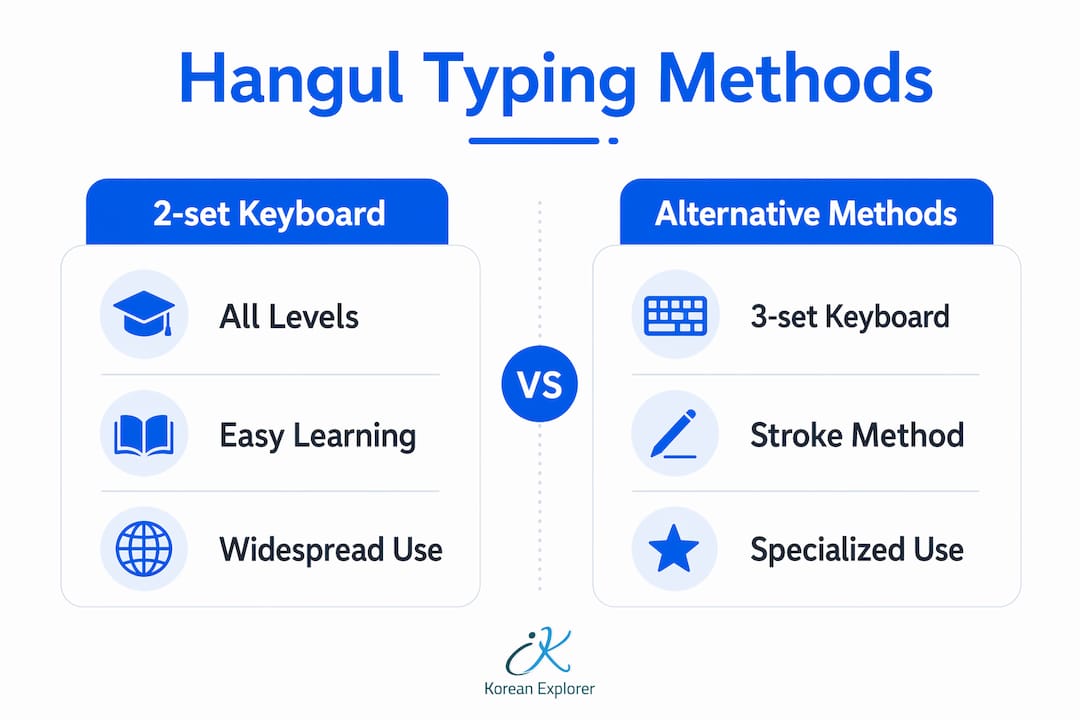
The table below compares the two most common input approaches for learners:
| Input method | Best for | Key advantage | Main limitation |
|---|---|---|---|
| 2-set Korean keyboard | All learners, native standard | Fast, widely supported, full character set | Requires memorizing new key positions |
| Virtual keyboard (e.g., Lexilogos) | Absolute beginners | No setup needed, visual reference | Slower, not practical for real communication |
Pro Tip: Switch your physical keyboard to Korean input mode and place a Hangul sticker set on your keys. The visual reminder cuts the memorization time for key positions significantly.

What online tools can help with Hangul typing practice?
Dedicated practice tools accelerate progress far more than casual typing alone. The best tools for Hangul typing practice track your words per minute (WPM) and accuracy in real time, so you always know where you stand.
- ttyping: A command-line typing practice tool that supports Korean with WPM and accuracy tracking. It also offers a finger-specific practice mode, letting you target weak fingers and restart on error to build consistent muscle memory. This level of detail is rare in free tools.
- Lexilogos Korean keyboard: A browser-based virtual keyboard that lets you click consonants and vowels to form syllable blocks. Typing ‘han guk mal’ in its romanization input yields 한국말 automatically. It also includes a copy-paste panel and a translation feature, making it useful for beginners who are not yet comfortable with the physical keyboard.
- Hancom Taja: A Korean typing speed test platform widely used in South Korea. It offers structured drills using real Korean words and sentences, which is more effective than practicing with random syllables.
Digital Hangul typing tools provide immediate corrective feedback that traditional romanization study cannot offer. When you type the wrong jamo, you see the error instantly in the syllable block. That visual correction loop shortens the time it takes to build accurate habits.
Virtual keyboards on mobile and desktop benefit beginners by mapping QWERTY keys to Hangul characters, giving a clear visual reference while you build familiarity with the layout. Once you can type without looking at the reference, you are ready to move to the physical keyboard full time.
The most effective practice uses real Korean words rather than nonsense syllables. Real words reinforce vocabulary at the same time as typing skill, making every practice session do double duty.
How to fix common Hangul typing mistakes and build speed
The most frequent error in Korean typing is syllable boundary confusion. Final consonants sometimes shift to become the initial consonant of the next syllable when typed in the wrong sequence. For example, if you intend to type 한국 but sequence the keystrokes incorrectly, the ㄴ from 한 can attach to 국 instead, producing a garbled result. Recognizing this pattern is the first step to fixing it.
Here is a structured routine to correct the most common errors:
- Isolate the problem syllable. When a word looks wrong, retype it one syllable at a time. Identify exactly which jamo is out of place before moving on.
- Practice batchim (final consonants) separately. Many learners skip the final consonant because it feels optional. Type 10 words that end in ㄱ, then 10 that end in ㄹ, until the closing keystroke becomes automatic.
- Drill Shift combinations daily. Advanced typists use Shift to input double consonants and aspirated sounds rapidly. Dedicate five minutes each session to Shift-key syllables like 빠, 짜, and 따.
- Increase complexity gradually. Start with two-syllable words, move to three-syllable words, then full sentences. Jumping to sentences too early creates sloppy habits that are hard to unlearn.
- Track your WPM weekly. Use ttyping or Hancom Taja to record your speed every week. A visible upward trend is the strongest motivation to keep practicing.
Consistent 15-minute daily sessions outperform two-hour weekend marathons. Muscle memory builds through frequency, not volume.
Pro Tip: Check your hand posture before every session. Keep your wrists flat and your fingers curved over the home row. Poor posture creates fatigue that slows you down and causes more errors.
Korean lessons for beginners that include structured writing practice also reinforce typing accuracy, because understanding how syllables are written by hand deepens your grasp of how they are assembled on a keyboard.
Key takeaways
Typing Hangul accurately requires understanding the initial-medial-final syllable structure and applying it consistently through the 2-set Korean keyboard layout with daily, focused practice.
| Point | Details |
|---|---|
| Syllable structure is the foundation | Every Hangul block follows initial consonant, medial vowel, optional final consonant order. |
| The 2-set layout is the standard | Consonants on the left, vowels on the right; learn this layout from day one. |
| Use Shift for tense consonants | Shift unlocks ㅃ, ㄸ, ㅆ, and other sounds that appear constantly in Korean. |
| Practice tools accelerate progress | ttyping and Hancom Taja provide WPM tracking and real-word drills that build speed faster. |
| Fix boundary errors early | Syllable boundary confusion is the top mistake; isolate and retype problem syllables immediately. |
Why I think most learners practice Hangul typing the wrong way
Most learners spend their first weeks copying romanized Korean into a translator and never touch a Korean keyboard at all. That approach feels safe, but it creates a ceiling. The moment you need to text a Korean colleague, fill out a form, or type in a language app, you are stuck.
The learners who progress fastest are the ones who switch to the Korean keyboard within their first week, even when it feels painfully slow. The discomfort is the point. Every awkward keystroke is your brain building a new map between a sound and a physical movement. Romanization bypasses that map entirely.
The other mistake I see constantly is treating typing practice as separate from language study. It is not. When you type 감사합니다 twenty times in a row, you are also memorizing how it sounds, what it means, and how its syllables connect. Typing practice and vocabulary practice are the same activity if you use real words.
The tools are genuinely good now. Lexilogos, ttyping, and Hancom Taja are all free and effective. The only thing standing between a learner and functional Korean typing speed is consistent daily practice. Fifteen minutes a day for four weeks produces a result that surprises most people.
— Paul
Korean Explorer can help you build real Korean skills
Korean Explorer is a Korean language school in Singapore with centers above Tanjong Pagar MRT, in Jurong, and in Tampines, plus fully online classes via Zoom for adult learners anywhere.
Typing in Korean is one skill. Using it in real conversation is another. Korean Explorer’s adult Korean courses cover both, with native instructors who teach practical communication skills grounded in a Seoul National University curriculum. Group classes, private sessions, and corporate training programs are all available. If you want to move from typing practice to genuine fluency, learn Korean in Singapore with a structured program that keeps you accountable and progressing. Visit Korean Explorer to see the full course schedule and find the format that fits your life.
FAQ
What is the standard keyboard layout for typing in Korean?
The 2-set Korean keyboard is the standard layout, placing consonants on the left and vowels on the right. Most Korean speakers and learners worldwide use this layout as their default input method.
How does a Korean IME assemble syllable blocks automatically?
A Korean IME reads your keystrokes in initial-medial-final order and combines them into a precomposed Unicode syllable block. The block appears on screen the moment the IME detects a complete or valid partial sequence.
What are the best free tools for Hangul typing practice?
ttyping offers WPM and accuracy tracking with finger-specific drills, while the Lexilogos Korean keyboard provides a browser-based virtual keyboard with instant visual feedback. Hancom Taja adds structured speed tests using real Korean sentences.
Why do my typed syllables look wrong when I type Korean words?
Syllable boundary confusion is the most common cause. A final consonant typed in the wrong sequence can attach to the next syllable instead of closing the current one. Retype the word one syllable at a time to identify and fix the error.
How long does it take to type Korean at a comfortable speed?
With 15 minutes of daily focused practice using real Korean words, most adult learners reach a comfortable typing speed within four to six weeks. Consistency matters far more than session length.