TL;DR:
- TOPIK I assesses listening and reading. TOPIK II adds writing. Check whether you will take the paper or computer format before planning practice.
NIIED administers TOPIK. TOPIK I assesses listening and reading, and TOPIK II adds writing. Start with the level and format accepted by the organisation requesting proof.
How does the TOPIK exam format work?
TOPIK is split into two tiers: TOPIK I covers levels 1 and 2, while TOPIK II covers levels 3 through 6. Each tier tests a different range of skills and demands a different preparation approach.
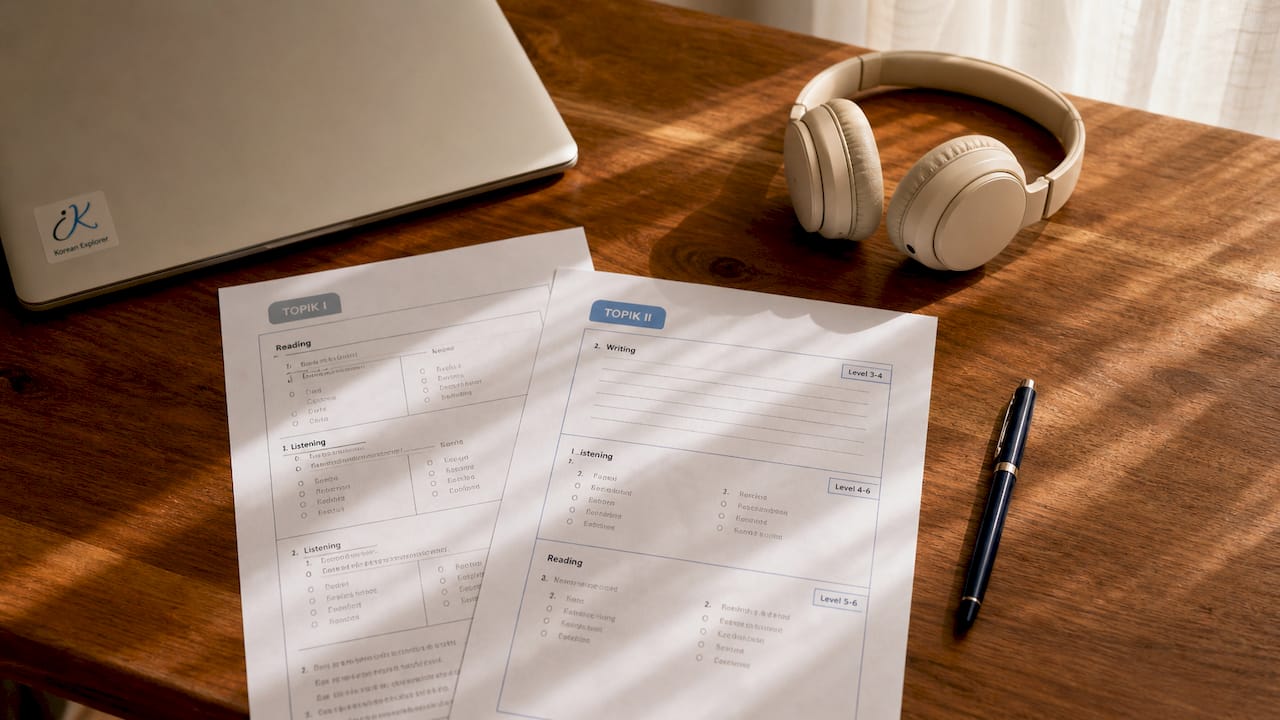
TOPIK I PBT runs for 100 minutes, with 30 listening and 40 reading questions. TOPIK I IBT has 26 questions in each section and takes 70 minutes under NIIED’s test format overview.
TOPIK II PBT has 50 listening questions, four writing tasks and 50 reading questions over 180 minutes. The IBT has 30 listening, three writing and 30 reading tasks over 125 minutes.
| Feature | TOPIK I | TOPIK II |
|---|---|---|
| Levels covered | 1–2 | 3–6 |
| PBT duration | 100 minutes | 180 minutes |
| PBT questions | 70 | 104 |
| Sections | Listening, Reading | Listening, Writing, Reading |
| Question types | Multiple choice | Multiple choice + essay writing |
| PBT listening time | 40 minutes | 60 minutes |
| PBT reading time | 60 minutes | 70 minutes |
| PBT writing time | None | 50 minutes |
Pro Tip: Read through all answer choices in the Listening section before the audio plays. Audio is played only once, so previewing options helps you focus on the right details as you listen.
How is TOPIK scored and what do the levels mean?
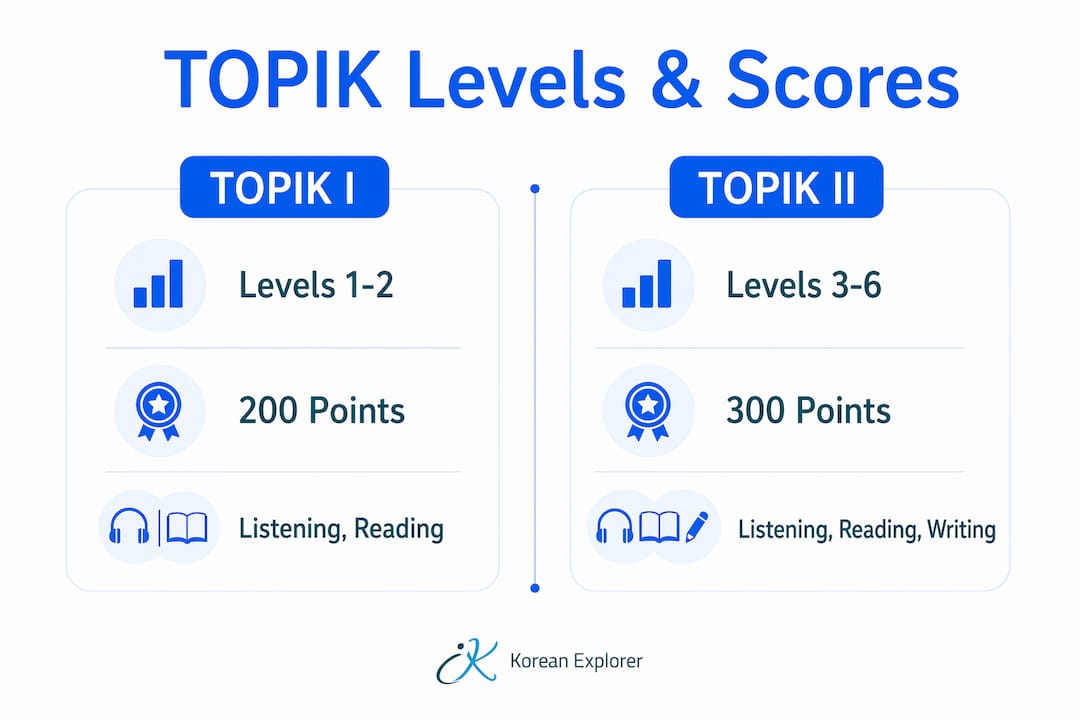
On paper (PBT), TOPIK I is scored out of 200 points and TOPIK II out of 300. On computer (IBT), the totals are 400 and 600 respectively. Your score determines which level you receive, and each level signals a specific degree of real-world Korean ability.
The score thresholds below apply to the paper test. For the computer scale, see the TOPIK score bands by format.
| Level | Exam | Minimum Score | Proficiency Description |
|---|---|---|---|
| Level 1 | TOPIK I | 80 points | Basic survival communication |
| Level 2 | TOPIK I | 140 points | Everyday tasks and simple topics |
| Level 3 | TOPIK II | 120 points | Basic social and professional contexts |
| Level 4 | TOPIK II | 150 points | Functional use in most daily situations |
| Level 5 | TOPIK II | 190 points | Near-fluent use in academic and professional settings |
| Level 6 | TOPIK II | 230 points | Full command of formal and academic Korean |
Writing contributes to the total in TOPIK II. The paper test has four writing tasks and the computer test has three. Use the official examples for your format when you practise.
Check the receiving organisation’s required level and accepted format. Requirements differ by course, employer and application.
Here is what each level signals in practical terms:
- Level 1: You can handle basic greetings, numbers, and simple requests.
- Level 2: You can manage everyday tasks like shopping, directions, and short conversations.
- Level 3: You can discuss familiar topics in social and professional settings with some fluency.
- Level 4: You can use Korean comfortably across most daily and work situations.
- Level 5: You can read and write in formal academic or professional Korean with confidence.
- Level 6: The highest score band awarded by TOPIK II.
How does understanding the TOPIK format improve your study strategy?
Knowing the exam structure tells you exactly where to spend your time. TOPIK I candidates should focus almost entirely on listening comprehension and reading speed. TOPIK II candidates must add structured writing practice to that foundation.
Try a timed sample and plan practice around your current level and exam format.
Most candidates underestimate the time pressure built into the exam. Timed practice tests are the single most effective preparation tool because they train you to work at exam pace, not at your comfortable reading or listening speed. Doing past papers under real conditions reveals exactly where you lose time.
Here is a practical study approach organized by priority:
- Identify your target level first. Choose TOPIK I or TOPIK II based on your current ability and your goal. Studying for the wrong level wastes months.
- Build listening skills with authentic audio. Use Korean news broadcasts, podcasts, and drama dialogue. Train your ear to follow natural speech at speed.
- Practice reading with scanning techniques. Scan first and last sentences of each passage and focus on keywords rather than translating every word. Full translation is too slow for exam conditions.
- Drill writing with formal Korean conventions. TOPIK II essays require argumentative structure and formal register. Practice with timed drills and get feedback from a qualified instructor.
- Run full-length timed mock exams. Simulate the full exam at least once a month in the final three months before your test date.
- Review past papers by section. Identify which question types cost you the most time and target those specifically.
Pro Tip: For the TOPIK II writing section, self-studying without feedback limits your chances of passing. Essay grading is subjective, and only an experienced instructor can tell you whether your formal Korean reads naturally to a native evaluator.
What is the difference between the paper-based and internet-based TOPIK tests?
Paper-based (PBT) and computer-delivered (IBT) sessions use different task counts, timings and score scales. Check NIIED’s 2026 TOPIK notice and the TOPIK score bands by format for the right comparison.
Key differences between the two formats:
- Availability: Check which formats are announced for Singapore. IBT is taken at a participating exam centre.
- Registration: Follow the local organiser’s instructions. Overseas dates and fees can differ from the calendar for Korea.
- Interface: IBT candidates type their writing responses on a computer. PBT candidates write by hand. Typing speed and Korean keyboard familiarity matter for IBT.
- Results: Use the score scale for the exam you took and confirm what the organisation requesting proof accepts.
- Preparation: IBT candidates should practice typing Korean on a standard keyboard layout before the exam. Handwriting practice remains relevant for PBT candidates.
In Singapore, check current session notices from Singapore Korean International School and the official TOPIK site.
Key Takeaways
TOPIK works as a two-tier proficiency exam where your score, section performance, and writing ability together determine which of six levels you earn.
| Point | Details |
|---|---|
| Two-tier structure | TOPIK I tests levels 1–2 with listening and reading; TOPIK II tests levels 3–6 and adds writing. |
| Writing carries real weight | Writing contributes to TOPIK II scores in both formats. Practise the tasks used in your exam. |
| Preparation time varies | Preparation time depends on your starting level and practice time. |
| Timed practice is non-negotiable | Full-length mock exams under real conditions are the most effective preparation tool available. |
| Format choice matters | Check the local format and practise handwriting or typing to match it. |
What I’ve learned from watching candidates approach TOPIK the wrong way
For TOPIK II, try a timed writing task and review the official scoring criteria before choosing what to work on next.
Build a practice plan around your current ability, the test format and the session announced by the organiser.
Prepare listening and reading for TOPIK I, and add writing for TOPIK II. Use the timing and sample tasks for your booked format.
If you are aiming for Level 3 or above, find a qualified instructor for your writing practice. Self-study can carry you far in listening and reading. Writing is where you need expert eyes.
Korean Explorer’s TOPIK preparation courses in Singapore
Korean Explorer publishes one-to-one TOPIK preparation in person or online. Ask which starting level fits your previous Korean and intended exam.
See Korean Explorer’s TOPIK preparation course for one-to-one preparation in person or online. Use the school placement forms if you need help choosing a course level. Follow the official test organiser’s instructions to register for the exam.
FAQ
What is TOPIK and who administers it?
TOPIK, the Test of Proficiency in Korean, is an official government-administered exam that measures Korean language ability across reading, listening, and writing. It is administered by the National Institute for International Education under South Korea’s Ministry of Education.
How many levels does TOPIK have?
TOPIK has six levels total. Levels 1 and 2 fall under TOPIK I, and levels 3 through 6 fall under TOPIK II, with each level reflecting a higher degree of Korean language ability.
How often is the TOPIK exam offered?
NIIED publishes an international calendar. Local organisers announce the formats and dates available in each country. Check the current Singapore notice for your session.
Does the TOPIK writing section affect my level result?
Yes. TOPIK II includes writing in the total score. Check NIIED’s overview for the tasks in your format.
How long does it take to prepare for TOPIK Level 3?
The time varies with your starting level and study time. A timed sample can help you decide what to practise before choosing a session.
Recommended
- How to Pass the TOPIK Exam: Your Practical Guide
- TOPIK Preparation Tips That Actually Move the Needle
- How to Prepare for TOPIK: Your 2026 Study Guide
- Your essential guide to TOPIK: Succeed in Korean proficiency
If this guide is part of your examination preparation, compare the TOPIK preparation course course details. Course tuition and registering for the official examination are separate.