TL;DR:
- Workplace Korean involves using formal speech, titles, and etiquette based on social hierarchy in Korean offices. Mastery of honorifics, job titles, and social cues is essential for effective communication. Cultural awareness, especially nunchi and participation in social events like hoesik, is crucial for professional success.
Workplace Korean is the formal style of language and cultural etiquette used in Korean professional settings, where social hierarchy is directly encoded in speech, titles, and behavior. Unlike everyday conversational Korean, this specialized register governs everything from how you address a senior colleague to how you respond in a meeting. Professionals and students entering Korean business environments need to understand both the linguistic rules and the cultural expectations that sit behind them. Getting the language right without understanding the culture produces the same result as getting neither right. This guide covers the core concepts of business Korean for work, from honorifics and job titles to social rituals like hoesik.
What is workplace Korean, and why does it matter?
Workplace Korean is the term used to describe the formal speech register, title conventions, and professional etiquette that govern communication in Korean offices. The more recognized industry term for this system is “business Korean” or “professional Korean,” but workplace Korean captures the full scope. It includes not just vocabulary but also tone, timing, and social awareness.

Korean offices encode social structure directly in language. Social rank governs speech style and address forms, which means the words you choose signal your understanding of where you stand in the hierarchy. A foreign professional who speaks fluent Korean but uses casual speech with a senior colleague signals a serious misunderstanding of workplace norms. The stakes are real and immediate.
The system rests on three pillars: honorifics, job titles, and nunchi (the ability to read social atmosphere). Master all three and you can communicate effectively in almost any Korean office setting. Neglect even one and you risk damaging professional relationships before they begin.
What linguistic features define workplace Korean?
Korean workplace language is built on a speech level hierarchy that most learners underestimate. The formal polite speech level, known as haeyoche, is the default in Korean offices for all professional interactions. You maintain this level until a senior colleague explicitly initiates a more casual register. Switching to informal speech before that invitation is a clear breach of etiquette.
Job titles carry the most weight in daily communication. Colleagues are addressed by job title plus the honorific suffix 님, so a team leader becomes 팀장님 (timjangnim) and a department head becomes 부장님 (bujangnim). Using someone’s name alone, without a title, reads as disrespectful unless you are close friends outside the office. This is one of the most common mistakes foreign professionals make in their first weeks.
There is also a critical distinction between 직급 (jikgeup, meaning rank) and 직책 (jikchek, meaning functional role). Both influence language use and social deference. A person’s rank determines how you speak to them. Their role tells you what they are responsible for. These two do not always align, and getting them confused leads to awkward interactions.
Key linguistic features of workplace Korean include:
- Haeyoche (formal polite speech): The baseline register for all office communication until a senior changes the tone.
- Title plus 님: The standard address form for every colleague above you, and often for peers as well.
- Indirect requests: Asking for something directly can sound demanding. Framing requests as questions or suggestions is standard practice.
- Formal email language: Written communication follows strict conventions, including set opening and closing phrases.
- Avoidance of first names: Using someone’s given name in a professional context is reserved for close personal relationships.
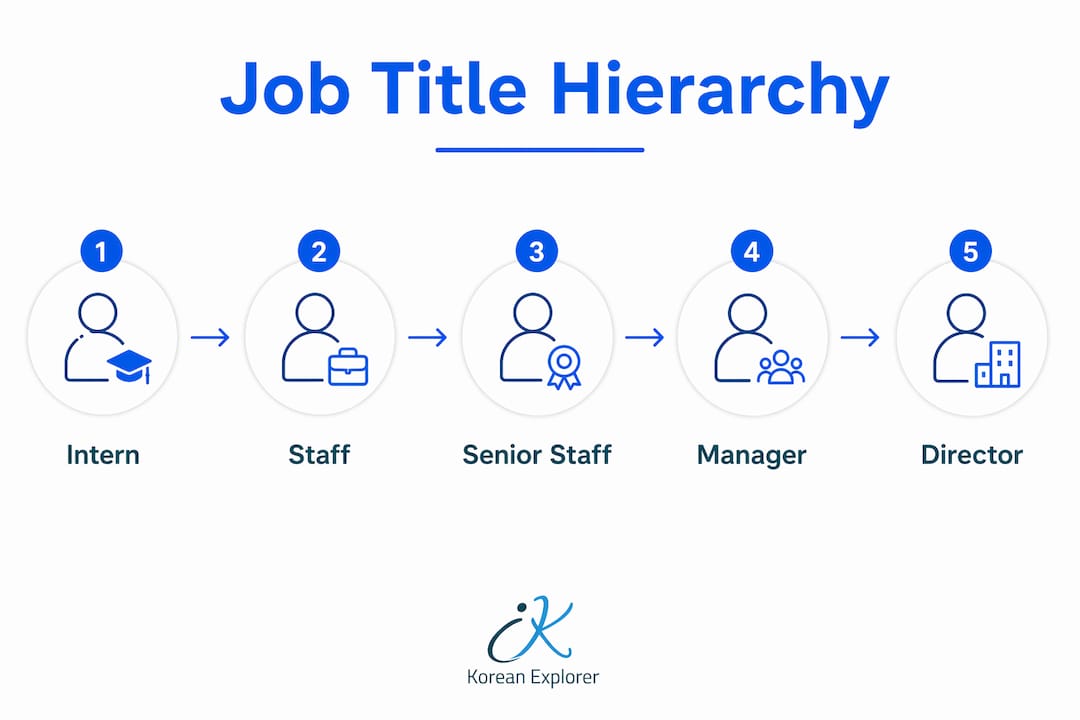
Pro Tip: Learn the full title hierarchy before your first day. Common titles from junior to senior include 사원 (sawon, staff), 대리 (daeri, assistant manager), 과장 (gwajang, manager), 부장 (bujang, department head), and 이사 (isa, director). Knowing these titles lets you address everyone correctly from day one.
How does Korean workplace culture shape communication?
Korean workplace culture is hierarchical in ways that go well beyond org charts. The hierarchy shows up in who speaks first in a meeting, who pours drinks at dinner, and who leaves the office last. Understanding these norms is as important as knowing the right vocabulary.
The concept of nunchi sits at the center of Korean professional communication. Nunchi is the ability to read social atmosphere, and it is arguably more important than perfect grammar. Knowing when to speak, when to stay quiet, and how to sense a colleague’s mood determines whether you are seen as perceptive or oblivious. Foreign professionals who focus only on language accuracy and ignore social cues consistently struggle in Korean offices.
Hoesik, the after-work team dinner or social event, is a defining feature of Korean office culture. Hoesik is semi-mandatory, and new hires are especially expected to attend. Frequent refusal signals a lack of commitment to the team. These events are where relationships are built, trust is established, and informal hierarchies are reinforced. Showing up matters as much as what you say when you are there.
Korean labor law sets the structural context for these long hours. The maximum workweek is 52 hours, consisting of 40 regular hours plus up to 12 overtime hours compensated at 1.5 times the regular rate. That legal ceiling shapes the rhythm of Korean office life, including when hoesik happens and how late meetings run.
Four cultural norms that directly affect communication:
- Defer to seniority in meetings. Junior staff rarely challenge a senior’s position publicly. Disagreement is expressed privately or through indirect language.
- Pour drinks for others before yourself. At hoesik, filling your own glass first signals poor social awareness.
- Stay until senior colleagues leave. Leaving before your manager does is generally seen as disrespectful, even if your work is done.
- Read the room before making requests. Timing a request poorly, such as asking for a favor when a senior is visibly stressed, reflects poor nunchi.
“Nunchi is not a soft skill in Korean workplaces. It is a core professional competency that determines how colleagues perceive your judgment and reliability.” — Seoulstart, 2026
In 2024 and 2025, many Korean companies returned to full in-office attendance, making these cultural norms more relevant than ever for professionals entering Korean work environments.
What are essential Korean workplace phrases and vocabulary?
Practical vocabulary is the foundation of daily office communication. Formal language is standard in emails, meetings, and reports, so building a working vocabulary of professional phrases pays off immediately.
The phrase 수고하셨습니다 (sugohasyeotseumnida, meaning “you have worked hard”) is one of the most used expressions in Korean offices. You say it to colleagues at the end of the day, after a presentation, or when wrapping up a project. It signals respect and acknowledgment. Using it correctly and naturally marks you as someone who understands Korean workplace culture.
Common job titles and their honorific forms
| Korean Title | Romanization | English Equivalent | Honorific Form |
|---|---|---|---|
| 사원 | Sawon | Staff / Entry-level | 사원님 |
| 대리 | Daeri | Assistant Manager | 대리님 |
| 과장 | Gwajang | Manager | 과장님 |
| 부장 | Bujang | Department Head | 부장님 |
| 이사 | Isa | Director | 이사님 |
Job titles dictate how to address colleagues respectfully and navigate the hierarchy. Memorizing this table is one of the fastest ways to build credibility in a Korean office.
Beyond titles, these phrases cover the most common daily interactions:
- 회의 (hoeuyi): Meeting. Used constantly in scheduling and daily conversation.
- 보고서 (bogoseo): Report. Knowing this word is non-negotiable in most office roles.
- 계약 (gyeyak): Contract or agreement. Critical for anyone in a business or legal function.
- 잠깐 시간 있으세요? (jamkkan sigan iseuseyo?): “Do you have a moment?” A polite way to approach a senior colleague.
- 확인해 드리겠습니다 (hwagin hae deurigesseumnida): “I will check on that for you.” A professional response when you need time to verify information.
- 말씀하신 대로 하겠습니다 (malsseum hasin daero hagetseumnida): “I will do as you have said.” Shows deference and professionalism.
Pro Tip: Learn the professional Korean communication patterns for emails separately from spoken phrases. Written Korean in offices follows a distinct structure, with formal openings and closings that differ significantly from spoken conversation.
How to adapt and communicate effectively in Korean workplaces
Adapting to a Korean workplace is a process that combines language learning with behavioral adjustment. The two cannot be separated. Professionals who treat them as separate tasks consistently underperform compared to those who integrate both from the start.
The most effective approach is to observe before acting. Watch how senior colleagues communicate, when they speak up in meetings, and how they interact during hoesik. This observation period gives you a baseline for what is expected before you have to perform it yourself.
Practical steps for effective adaptation:
- Check your business card carefully. Your 직급 (rank) and 직책 (role) appear on your card. Verify both with HR if anything is unclear. These details determine how colleagues address you and how you should address them.
- Attend hoesik consistently, especially in your first months. Proper use of hoesik signals commitment beyond daily tasks and directly affects your social standing within the team.
- Never drop honorifics prematurely. Even if a senior colleague seems relaxed and friendly, maintain formal speech until they explicitly invite a casual register.
- Use indirect language for requests and disagreements. Framing a concern as a question rather than a statement preserves group harmony and shows cultural awareness.
- Practice nunchi actively. Before speaking in a group setting, take a moment to assess the mood of the room. Verbal and non-verbal cues are vital skills that significantly affect workplace success.
Pro Tip: Cultural sensitivity matters more than grammatical perfection in Korean offices. A learner who uses imperfect Korean with correct social behavior will be received far better than one who speaks fluently but ignores hierarchy. Pair your Korean for professionals study with deliberate cultural observation.
Key Takeaways
Workplace Korean combines formal speech, title conventions, and cultural awareness to form the complete communication system used in Korean professional settings.
| Point | Details |
|---|---|
| Haeyoche is the default | Always use formal polite speech in Korean offices until a senior colleague initiates a casual register. |
| Titles plus 님 are mandatory | Address every colleague by job title plus 님 (e.g., 부장님) to show correct understanding of hierarchy. |
| Nunchi outweighs grammar | Reading social atmosphere accurately matters more than speaking perfect Korean in professional contexts. |
| Hoesik attendance builds standing | Participating in after-work team events, especially as a new hire, directly affects your reputation and relationships. |
| Know your 직급 and 직책 | Verify your rank and functional role on your business card with HR to communicate and receive communication correctly. |
Why language alone will not get you far in a Korean office
I have seen professionals arrive in Korean workplaces with solid language skills and still struggle badly in their first three months. The pattern is almost always the same. They studied vocabulary and grammar, but they treated the cultural layer as optional background reading. It is not optional. It is the operating system that the language runs on.
The part that surprises most people is nunchi. You can memorize every phrase in this article and still read a room completely wrong. I have watched fluent Korean speakers make requests at exactly the wrong moment, pour their own drinks before the senior at the table, or leave a hoesik early without reading that the team needed them to stay. Each of those moments costs social capital that takes weeks to rebuild.
What I find genuinely undervalued is the hoesik system. Most foreign professionals see it as an obligation to endure. The ones who thrive see it as the fastest way to build trust with colleagues who would otherwise take months to open up. The informal setting strips away the formality of the office and lets you show who you are as a person. That matters enormously in a culture where professional relationships are deeply personal.
My honest advice is to treat workplace Korean as a dual practice. Study the language with the same seriousness you would apply to any professional certification. And study the culture with equal rigor, not as a curiosity but as a core competency. The professionals I have seen succeed in Korean offices are the ones who understood that the language and the culture are the same thing, just expressed in different forms.
— Paul
Korean Explorer’s adult Korean courses for professionals
Korean Explorer offers structured adult Korean courses built specifically for professionals who need to communicate in business and workplace settings. Whether you are preparing for a role at a Korean company or managing Korean-speaking clients, the curriculum covers the language and cultural context you need.
Courses are available as group classes, private sessions, and online Zoom classes, giving you flexibility around a working schedule. Corporate training options are also available for teams. Korean Explorer’s instructors are native Korean speakers fluent in English, which means explanations are clear and practical from the first lesson. If you are ready to build real workplace communication skills, Korean courses in Singapore at Korean Explorer give you a direct path from classroom to office. You can also learn Korean in Singapore at the International Plaza center, located right above Tanjong Pagar MRT.
FAQ
What is workplace Korean exactly?
Workplace Korean is the formal speech register, title system, and professional etiquette used in Korean business environments. It differs from everyday Korean in its strict use of honorifics, job titles, and hierarchy-based communication norms.
Why are job titles so important in Korean offices?
Job titles determine how you address colleagues and how they address you. Using a title plus the honorific suffix 님 is the standard form of address, and omitting it signals a misunderstanding of workplace hierarchy.
What is nunchi and why does it matter at work?
Nunchi is the ability to read social atmosphere and respond appropriately. It is considered more critical than grammar in Korean professional settings because it governs timing, tone, and social judgment in real interactions.
Do I need to attend hoesik as a foreign professional?
Hoesik attendance is semi-mandatory in most Korean companies, and new hires are especially expected to participate. Frequent refusal can harm your reputation and slow your integration into the team.
What is the difference between 직급 and 직책?
직급 refers to your formal rank in the company hierarchy, while 직책 refers to your functional role or position. Both appear on Korean business cards and both influence how colleagues communicate with you and expect you to communicate with them.