TL;DR:
- The TOPIK exam measures Korean language proficiency through two levels, TOPIK I and TOPIK II, covering reading, listening, and writing skills. Preparing effectively requires understanding the exam structure, focusing on timed practice, and dedicating long-term study, especially for higher levels. The writing section carries significant weight, and passing depends on targeted practice and a fixed study timeline.
The Test of Proficiency in Korean (TOPIK) is an official government-administered exam that measures Korean language ability across reading, listening, and writing through two structured levels. Understanding how TOPIK works before you register saves you months of misdirected study. The exam splits into TOPIK I for beginners and TOPIK II for intermediate to advanced learners, each with distinct sections, time limits, and scoring systems. Certification from TOPIK is recognized globally for university admission, employment, and long-term residency applications in South Korea.
How does the TOPIK exam format work?
TOPIK is split into two tiers: TOPIK I covers levels 1 and 2, while TOPIK II covers levels 3 through 6. Each tier tests a different range of skills and demands a different preparation approach.
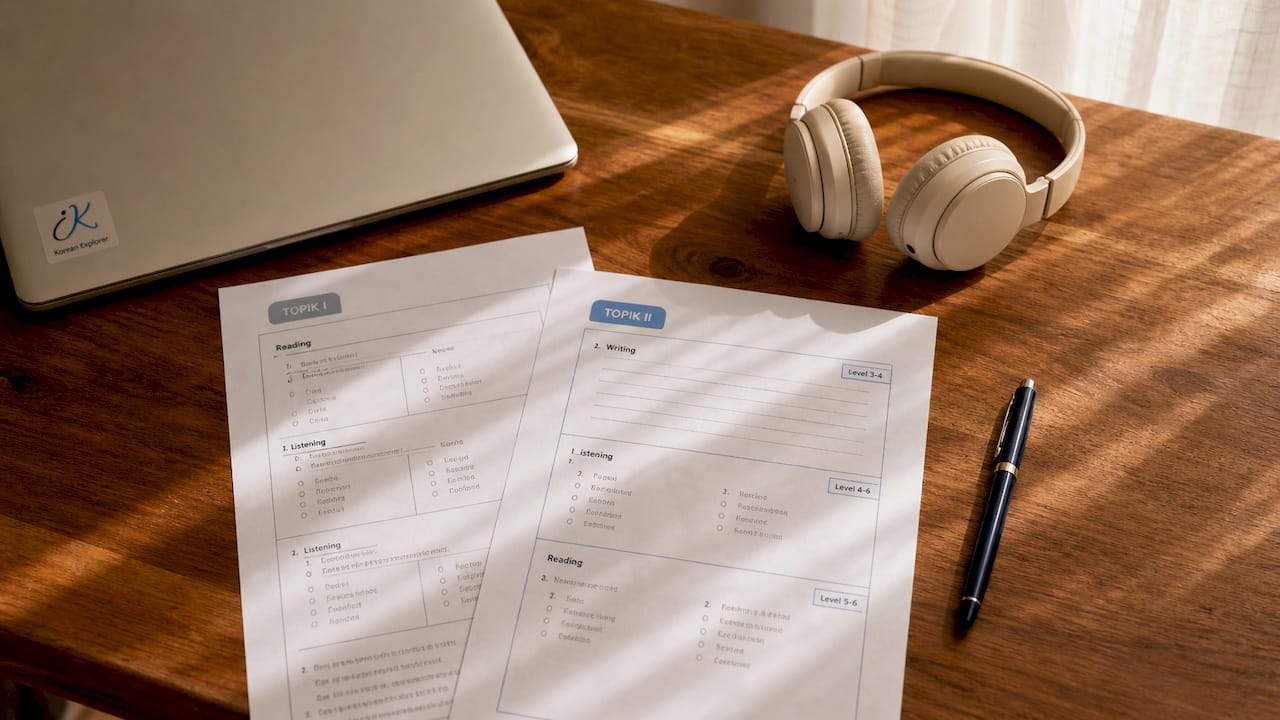
TOPIK I runs for 100 minutes total and contains 70 questions. The Listening section gives you 40 minutes to answer 30 questions. The Reading section follows with 60 minutes for 40 questions. Both sections use multiple-choice questions only. This makes TOPIK I entirely receptive, meaning you recognize and interpret language rather than produce it.
TOPIK II is a different challenge entirely. It runs for 180 minutes and contains 104 questions across three sections. Listening comes first at 60 minutes with 50 questions. Writing follows at 50 minutes with 4 tasks. Reading closes the exam at 70 minutes with 50 questions. The writing section requires you to produce formal Korean, which is a skill that demands active practice, not passive review.
| Feature | TOPIK I | TOPIK II |
|---|---|---|
| Levels covered | 1–2 | 3–6 |
| Total duration | 100 minutes | 180 minutes |
| Total questions | 70 | 104 |
| Sections | Listening, Reading | Listening, Writing, Reading |
| Question types | Multiple choice | Multiple choice + essay writing |
| Listening time | 40 minutes | 60 minutes |
| Reading time | 60 minutes | 70 minutes |
| Writing time | None | 50 minutes |
Pro Tip: Read through all answer choices in the Listening section before the audio plays. Audio is played only once, so previewing options helps you focus on the right details as you listen.
How is TOPIK scored and what do the levels mean?
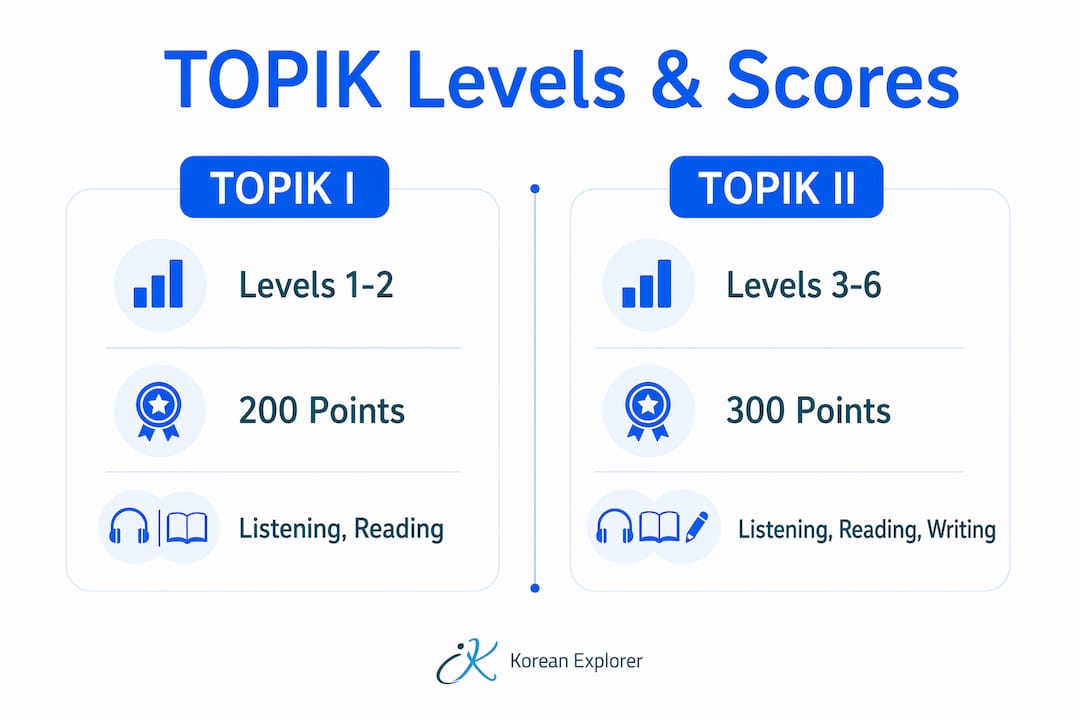
TOPIK I carries a total of 200 points. TOPIK II carries 300 points. Your score determines which level you receive, and each level signals a specific degree of real-world Korean ability.
| Level | Exam | Minimum Score | Proficiency Description |
|---|---|---|---|
| Level 1 | TOPIK I | 80 points | Basic survival communication |
| Level 2 | TOPIK I | 140 points | Everyday tasks and simple topics |
| Level 3 | TOPIK II | 120 points | Basic social and professional contexts |
| Level 4 | TOPIK II | 150 points | Functional use in most daily situations |
| Level 5 | TOPIK II | 190 points | Near-fluent use in academic and professional settings |
| Level 6 | TOPIK II | 230 points | Full command of formal and academic Korean |
The writing section carries significant weight in TOPIK II. Writing accounts for 33% of the total TOPIK II score across four tasks, including short-answer completions and a formal essay. That percentage means a weak writing score can pull your total below the threshold for your target level even if your listening and reading are strong.
Levels 5 and 6 test academic and professional language contexts, including formal essay writing. These levels are required for admission to many Korean universities and for certain professional licenses in South Korea. Levels 3 and 4 satisfy most employment and general residency requirements.
Here is what each level signals in practical terms:
- Level 1: You can handle basic greetings, numbers, and simple requests.
- Level 2: You can manage everyday tasks like shopping, directions, and short conversations.
- Level 3: You can discuss familiar topics in social and professional settings with some fluency.
- Level 4: You can use Korean comfortably across most daily and work situations.
- Level 5: You can read and write in formal academic or professional Korean with confidence.
- Level 6: You demonstrate near-native command of written and spoken formal Korean.
How does understanding the TOPIK format improve your study strategy?
Knowing the exam structure tells you exactly where to spend your time. TOPIK I candidates should focus almost entirely on listening comprehension and reading speed. TOPIK II candidates must add structured writing practice to that foundation.
Preparation timelines reflect this complexity. Level 3 requires 12–18 months of focused study for most learners starting from zero. Levels 5 and 6 require 24–36 months. Advancing by one level typically takes 3–6 months of consistent, targeted work. These are not casual timelines. They assume regular study, not occasional review.
Most candidates underestimate the time pressure built into the exam. Timed practice tests are the single most effective preparation tool because they train you to work at exam pace, not at your comfortable reading or listening speed. Doing past papers under real conditions reveals exactly where you lose time.
Here is a practical study approach organized by priority:
- Identify your target level first. Choose TOPIK I or TOPIK II based on your current ability and your goal. Studying for the wrong level wastes months.
- Build listening skills with authentic audio. Use Korean news broadcasts, podcasts, and drama dialogue. Train your ear to follow natural speech at speed.
- Practice reading with scanning techniques. Scan first and last sentences of each passage and focus on keywords rather than translating every word. Full translation is too slow for exam conditions.
- Drill writing with formal Korean conventions. TOPIK II essays require argumentative structure and formal register. Practice with timed drills and get feedback from a qualified instructor.
- Run full-length timed mock exams. Simulate the full exam at least once a month in the final three months before your test date.
- Review past papers by section. Identify which question types cost you the most time and target those specifically.
Pro Tip: For the TOPIK II writing section, self-studying without feedback limits your chances of passing. Essay grading is subjective, and only an experienced instructor can tell you whether your formal Korean reads naturally to a native evaluator.
What is the difference between the paper-based and internet-based TOPIK tests?
TOPIK is offered 6 times a year in both paper-based (PBT) and internet-based (IBT) formats. The IBT launched in 2023 and is currently available mainly in South Korea, while the PBT runs worldwide at authorized test centers. Both formats carry identical content, scoring, and certificate validity.
Key differences between the two formats:
- Availability: PBT is held at test centers worldwide, including Singapore. IBT is currently limited but expanding.
- Registration: Both formats require advance registration through the official TOPIK website. Registration windows open several months before each exam date.
- Interface: IBT candidates type their writing responses on a computer. PBT candidates write by hand. Typing speed and Korean keyboard familiarity matter for IBT.
- Results: Both formats deliver the same official TOPIK certificate. There is no difference in how employers or universities view the result.
- Preparation: IBT candidates should practice typing Korean on a standard keyboard layout before the exam. Handwriting practice remains relevant for PBT candidates.
The PBT remains the most accessible option for learners outside South Korea. If you are preparing in Singapore, the PBT is your primary route. Check the TOPIK exam schedule well in advance since seats fill quickly at popular test centers.
Key Takeaways
TOPIK works as a two-tier proficiency exam where your score, section performance, and writing ability together determine which of six levels you earn.
| Point | Details |
|---|---|
| Two-tier structure | TOPIK I tests levels 1–2 with listening and reading; TOPIK II tests levels 3–6 and adds writing. |
| Writing carries real weight | Writing accounts for 33% of the TOPIK II score and often decides whether you pass your target level. |
| Preparation timelines are long | Level 3 takes 12–18 months; levels 5–6 take 24–36 months of focused, consistent study. |
| Timed practice is non-negotiable | Full-length mock exams under real conditions are the most effective preparation tool available. |
| Format choice matters | PBT is available worldwide; IBT requires Korean keyboard practice and is currently limited to South Korea. |
What I’ve learned from watching candidates approach TOPIK the wrong way
Most candidates I’ve seen struggle with TOPIK II share one pattern. They treat the writing section as an afterthought. They spend months building vocabulary and drilling listening, then walk into the exam with almost no formal writing practice. Writing accounts for a third of the total score. Ignoring it is not a minor oversight. It is the reason many otherwise capable learners fall short of Level 4 or 5.
The other pattern is studying without a fixed timeline. Viewing TOPIK as a concrete milestone with a specific exam date changes how you study. Candidates who register for an exam date first, then build their study plan backward from that date, consistently outperform those who study indefinitely and register when they feel ready. Feeling ready and being ready are not the same thing.
The exam format itself is not complicated once you understand it. TOPIK I is a clean two-section test. TOPIK II adds one demanding section. The structure is transparent and predictable. What separates passing candidates from failing ones is not intelligence or natural talent. It is whether they practiced under real conditions, got feedback on their writing, and respected the timeline the exam demands.
If you are aiming for Level 3 or above, find a qualified instructor for your writing practice. Self-study can carry you far in listening and reading. Writing is where you need expert eyes.
— Paul
Korean Explorer’s TOPIK preparation courses in Singapore
Korean Explorer offers structured Korean language courses for adult learners in Singapore, designed around the same curriculum framework that TOPIK tests. Whether you are targeting TOPIK I or working toward the upper levels of TOPIK II, the courses are built to develop the specific skills the exam demands.
Courses run in group, private, and online formats, so you can fit preparation around a full work schedule. Native Korean instructors with English fluency guide every class, which means you get clear explanations and direct feedback on your writing. Explore the Korean language courses available at Korean Explorer, or read the TOPIK preparation tips that Korean Explorer’s instructors recommend for focused, efficient study. Classes are held at International Plaza, 10 Anson Road, Level 22, Singapore 079903, right above Tanjong Pagar MRT.
FAQ
What is TOPIK and who administers it?
TOPIK, the Test of Proficiency in Korean, is an official government-administered exam that measures Korean language ability across reading, listening, and writing. It is administered by the National Institute for International Education under South Korea’s Ministry of Education.
How many levels does TOPIK have?
TOPIK has six levels total. Levels 1 and 2 fall under TOPIK I, and levels 3 through 6 fall under TOPIK II, with each level reflecting a higher degree of Korean language ability.
How often is the TOPIK exam offered?
TOPIK is offered 6 times a year in paper-based format at authorized centers worldwide, including Singapore. The internet-based format is currently available mainly in South Korea.
Does the TOPIK writing section affect my level result?
Yes. Writing accounts for 33% of the TOPIK II total score, and a low writing score can prevent you from reaching your target level even with strong listening and reading results.
How long does it take to prepare for TOPIK Level 3?
Most learners need 12–18 months of focused study to reach Level 3 from a beginner starting point. Advancing by one level typically takes 3–6 months of consistent, targeted preparation.