TL;DR:
- Interactive language learning accelerates proficiency by emphasizing real-time communication, negotiation, and feedback over passive study. Digital tools like ChatGPT and structured tasks enhance speaking, cultural skills, and motivation when integrated into pedagogically designed activities, especially through scaffolding and learner ownership. Effective interaction combines authentic social pressure with deliberate correction, making structured engagement essential across all ages and proficiency levels.
Interactive language learning is defined as any instructional approach that places active, feedback-driven communication at the center of language acquisition, rather than passive reception of grammar rules or vocabulary lists. Research in second language acquisition (SLA) consistently shows that learners who engage in real-time dialogue, negotiation of meaning, and structured task completion develop speaking proficiency, cultural competence, and communicative confidence faster than those who rely on traditional methods alone. Tools like ChatGPT, platforms like Zoom, and frameworks like Task-Based Language Teaching (TBLT) have made this approach accessible to learners at every level and age. The role of interactive language learning has never been more clearly supported by evidence, and this guide breaks down exactly how it works and why it matters.
How does interactive language learning enhance speaking proficiency?
Speaking proficiency improves through interaction because conversation forces learners to produce language under real communicative pressure, not just recognize it. This is the core claim of interactionist SLA theory: language acquisition accelerates when learners negotiate meaning, receive corrective feedback, and modify their output in response. The process is not passive. It requires attention, adjustment, and repetition in context.
Negotiation of meaning is the mechanism that makes interaction so powerful. When a learner says something unclear and their conversation partner signals confusion, both parties work together to resolve the breakdown. That moment of repair is where acquisition happens. The learner notices the gap between what they said and what was understood, then adjusts. This is fundamentally different from memorizing a conjugation table.
Task-Based Language Teaching (TBLT) formalizes this process into structured classroom activities. A systematic review of 16 studies found that TBLT significantly improves speaking skills by creating authentic collaborative tasks that reduce anxiety and increase motivation. Learners working toward a shared communicative goal, such as planning an event or solving a problem in the target language, produce more output and receive more feedback than in traditional drills.
Synchronous computer-mediated communication adds another dimension. A study with Saudi EFL learners showed that prompted negotiation-on-form conditions, where learners were structured to clarify and confirm meaning, produced significantly higher rates of corrective feedback and immediate uptake compared to unstructured free conversation. The implication is direct: structure matters even in digital interaction.
The speaking benefits of interactive language acquisition include:
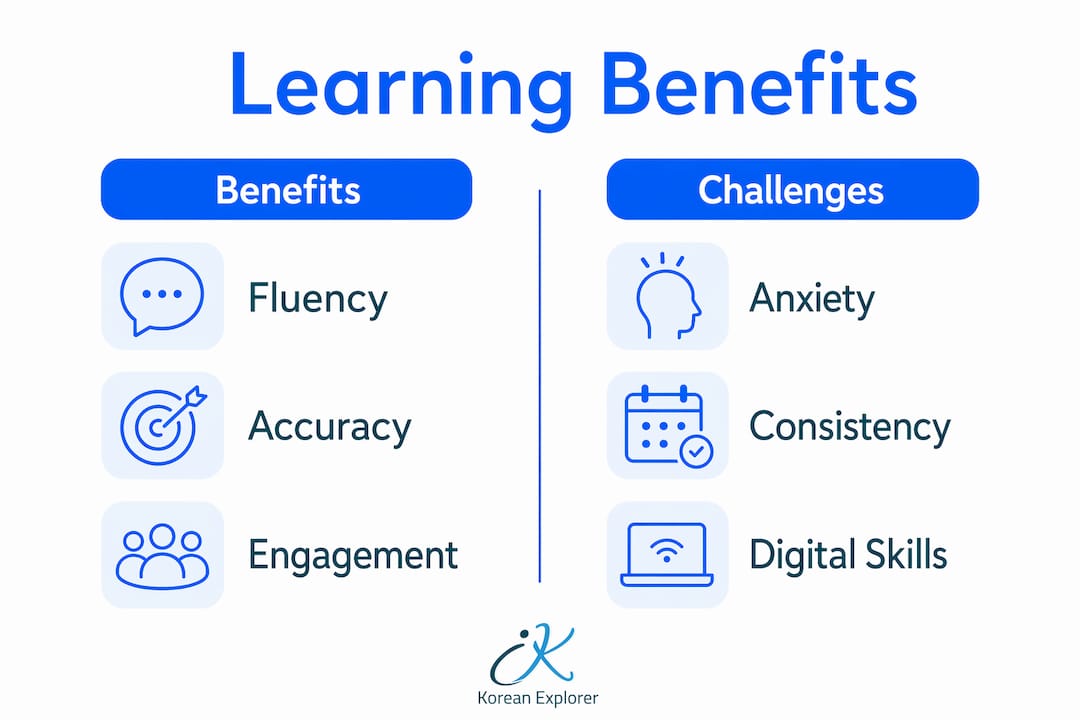
- Fluency: Regular production practice builds automaticity in speech
- Accuracy: Corrective feedback draws attention to form without interrupting communication
- Confidence: Supportive task environments reduce the fear of making mistakes
- Motivation: Authentic tasks give learners a reason to speak beyond the classroom
- Engagement: Peer interaction creates social investment in the learning process
Pro Tip: Seek out structured conversation practice rather than open-ended chat. Ask your teacher or language partner to signal when something is unclear, rather than simply letting errors pass. That moment of clarification is where real learning occurs.
What role does technology play in interactive language learning?
Technology does not automatically make language learning more interactive. The ECML framework on new media in language education makes this explicit: pedagogical design and digital competence are what convert technology from novelty into genuine learning tool. A video call without a communicative task is just a conversation. A video call structured around a collaborative deliverable is interactive language acquisition in action.

Generative AI tools like ChatGPT represent the most significant recent development in this space. GenAI with feedback-driven interaction produces measurable gains across listening, speaking, and writing, aligned with both interactionist and sociocultural learning theories. ChatGPT can simulate conversation partners, provide on-demand corrective feedback, and adapt to a learner’s proficiency level in real time. That combination was previously only available through one-on-one tutoring.
The ECML also highlights structured online tasks, such as blogs, language quests, and virtual learning environments, as effective formats for interactive writing and reading. These are not passive exercises. A language quest, for example, requires learners to navigate authentic digital content, make decisions, and produce language in response. The interactivity is built into the task design.
Here is how major digital tools compare in their interactive features and learning benefits:
| Tool | Interactive feature | Primary learning benefit |
|---|---|---|
| ChatGPT | Real-time adaptive dialogue and feedback | Speaking fluency and writing accuracy |
| Zoom (virtual exchange) | Synchronous peer conversation across cultures | Intercultural competence and speaking confidence |
| Language learning blogs | Asynchronous written production and peer response | Writing accuracy and reflective practice |
| Language quests | Task-driven navigation of authentic content | Reading comprehension and vocabulary in context |
| Virtual learning environments | Structured collaborative tasks with multimedia | Multi-skill development and learner engagement |
You can also explore technology for language learning in more detail to understand which digital formats suit different learning goals.
Pro Tip: Before adopting any new digital tool, ask whether it requires you to produce language or just consume it. Production with feedback is what drives acquisition. Consumption alone builds passive knowledge, not communicative ability.
How does interactive learning support cultural understanding?
Intercultural competence is not a byproduct of language learning. It is a direct outcome of structured interactive practice with speakers from different cultural backgrounds. The distinction matters because cultural understanding requires more than vocabulary. It requires perspective-taking, communication adaptability, and the ability to navigate misunderstanding with curiosity rather than frustration.
Penn State’s pilot program using student-led virtual exchanges demonstrated this clearly. Post-exchange confidence increased measurably, and participants reported deeper intercultural understanding when students owned the direction of their conversations rather than following a rigid script. Student ownership of dialogue is the critical variable. When learners decide what to ask, how to explain their culture, and how to respond to confusion, they practice the exact skills that global communication demands.
A telecollaboration study involving Spanish and Ukrainian students found that jointly created video projects produced measurable gains in global-mindedness. The collaborative deliverable forced both groups to negotiate language, perspective, and creative decisions simultaneously. That combination of linguistic and cultural negotiation is what makes telecollaboration more effective than simply reading about another culture.
The intercultural skills that interactive language learning builds most directly include:
- Active listening: Understanding meaning across accents, registers, and cultural references
- Empathy: Recognizing that communication norms differ and adjusting without judgment
- Communication adaptability: Shifting tone, formality, and directness based on context
- Critical cultural awareness: Questioning assumptions about your own communication style
- Conflict navigation: Resolving misunderstanding through clarification rather than avoidance
Finding a language exchange partner online is one of the most practical ways to build these skills outside of a formal classroom setting.
What are the benefits and challenges across ages and proficiency levels?
Interactive language learning works across age groups, but it does not work the same way for everyone. Anxiety, willingness to communicate, and prior language experience all shape how much a learner benefits from any given interactive method. Supportive task environments reduce anxiety and increase willingness to communicate, which is why the psychological design of a learning activity matters as much as its linguistic content.
Adult learners, in particular, often carry more anxiety about making mistakes than younger learners do. A structured interactive environment, where errors are treated as learning opportunities rather than failures, directly addresses this. Korean Explorer’s conversation-focused classes are built on exactly this principle: native instructors create low-stakes speaking opportunities that build confidence before pushing for accuracy.
Generative AI tools show variation in effectiveness by proficiency level. GenAI outperforms traditional methods most clearly for productive skills like speaking and writing, and its benefits are strongest when aligned with the learner’s current proficiency and specific goals. A beginner using ChatGPT for open-ended conversation may feel overwhelmed. The same learner using ChatGPT to practice a specific task, such as ordering food or describing their daily routine, benefits from the structure.
Here is how free conversation compares to structured negotiation tasks in interactive settings:
| Approach | Corrective feedback rate | Language uptake | Best suited for |
|---|---|---|---|
| Free conversation | Low | Incidental | Fluency building and confidence |
| Structured negotiation-on-form | High | Immediate and deliberate | Accuracy and form-focused learning |
| Task-based collaborative activity | Moderate to high | Contextual | Both fluency and accuracy at intermediate level |
Teacher scaffolding remains the most important variable across all proficiency levels. Digital competences of both teachers and learners determine whether technology-supported interaction produces genuine communicative development or just screen time. A teacher who designs tasks with clear communicative goals, built-in feedback moments, and appropriate challenge levels will consistently outperform one who simply assigns a conversation app and steps back.
Pro Tip: Avoid purely free interaction as your primary practice method. Engineer at least one moment per session where you must clarify, confirm, or repair a misunderstanding. That structured friction is where the most durable learning happens.
Key takeaways
Interactive language learning drives acquisition through negotiation, feedback, and structured communicative tasks, not through passive exposure or repetition alone.
| Point | Details |
|---|---|
| Interaction drives acquisition | Negotiation of meaning and corrective feedback produce faster speaking gains than passive study. |
| Technology requires design | Tools like ChatGPT and Zoom only improve learning when built into pedagogically structured tasks. |
| Cultural competence is learnable | Telecollaboration and virtual exchange build measurable intercultural skills through collaborative deliverables. |
| Structure beats free conversation | Prompted negotiation-on-form produces higher uptake than unstructured dialogue at every proficiency level. |
| Scaffolding is non-negotiable | Teacher and learner digital competence determines whether interactive methods convert engagement into real acquisition. |
Why I think most learners underestimate the role of structure in interaction
Most learners I have worked with assume that more conversation automatically means more learning. They sign up for language exchange apps, chat with native speakers, and wonder why their accuracy does not improve after months of practice. The answer is almost always the same: they are getting fluency practice without feedback, and fluency without accuracy eventually plateaus.
The research on this is unambiguous. Engineered miscommunication followed by structured clarification produces better immediate uptake than free conversation. That does not mean every exchange needs to feel like a grammar lesson. It means that the best interactive learning includes deliberate moments where you are pushed to notice and correct your own output.
I have also seen learners over-rely on AI tools without understanding their limits. ChatGPT is genuinely useful for on-demand practice, but it does not replicate the social stakes of a real conversation with a person who has their own communicative goals. The best approach combines AI-assisted practice for low-stakes repetition with human interaction for authentic communicative pressure. Neither alone is sufficient.
Learner agency matters too. The Penn State virtual exchange results were strongest when students owned their conversations. That ownership, deciding what to ask, how to explain, and how to respond, is what makes interaction feel meaningful rather than mechanical. If you are learning Korean for professional or personal reasons, bring your actual goals into your practice. Talk about your industry, your interests, your questions about Korean culture. That specificity is what turns practice into acquisition.
— Paul
Start speaking Korean with confidence at Korean Explorer
Korean Explorer’s adult courses in Singapore are built around the interactive methods this article describes: conversation-focused instruction, native Korean teachers who provide real corrective feedback, and structured tasks that build both fluency and accuracy. Whether you prefer group classes at the International Plaza center above Tanjong Pagar MRT, or online Zoom sessions that fit your schedule, every format is designed to maximize speaking practice and cultural understanding. Corporate training options are also available for teams building professional Korean communication skills. Explore Korean language courses and find the format that matches your goals.
FAQ
What is interactive language education?
Interactive language education is an instructional approach where learners develop proficiency through active communication, real-time feedback, and collaborative tasks rather than passive study. It is grounded in interactionist SLA theory, which identifies negotiation of meaning as a primary driver of language acquisition.
How does interactive language acquisition differ from traditional methods?
Traditional methods focus on grammar instruction and memorization, while interactive language acquisition prioritizes communicative production and feedback. Research shows that structured interaction, including task-based activities and negotiation-on-form, produces faster and more durable speaking gains.
What are the main benefits of interactive learning for adult language learners?
The primary benefits include improved speaking fluency, greater accuracy through corrective feedback, reduced communication anxiety, and stronger intercultural competence. Supportive interactive environments also increase motivation and willingness to communicate, which are critical for adult learners.
How can technology support interactive language learning?
Tools like ChatGPT provide on-demand adaptive dialogue and feedback, while platforms like Zoom enable synchronous virtual exchanges across cultures. Effectiveness depends on pedagogical design: technology supports interaction only when tasks require learners to produce and respond, not just consume content.
How do I learn languages interactively without a classroom?
Find a structured language exchange partner, use AI conversation tools with specific task goals, or join online courses that include live speaking practice. Pairing language exchange strategies with deliberate feedback moments produces the strongest results outside formal instruction.