TL;DR:
- Certified language schools are independently reviewed to ensure high teaching standards, curriculum quality, and student welfare, providing reliable options for serious learners. Verification of both accreditation and SEVP certification is essential for international students to ensure legal enrollment, credit transfer, and employment prospects. Choosing certified schools with operational practices like small classes, regular assessments, and transparent outcome data enhances the quality and credibility of language education.
Certified language schools are institutions reviewed and validated by independent organizations to meet established standards in teaching quality, curriculum design, and student welfare, giving learners a reliable foundation for serious language study. The question of why choose accredited language schools comes down to one core truth: without external verification, you have no way to confirm that a school’s promises match its actual delivery. Bodies like the Commission on English Language Program Accreditation (CEA) in the United States and EnglishUK in the United Kingdom exist precisely to close that gap. Certification is not a marketing badge. It is an accountability mechanism that protects your time, money, and future opportunities.
Why choose certified language schools for quality outcomes
Certification transforms a school’s internal claims into externally verified facts. An independent body examines the curriculum, evaluates instructor qualifications, reviews student progress data, and checks whether the school’s outcomes match its promises. That process repeats on a schedule. In Victoria, Australia, community language schools must apply for reaccreditation every three years to maintain funding and official status. This means quality is not assessed once and forgotten. It is reviewed continuously, which forces schools to stay current rather than coast on a reputation earned years ago.

The operational details matter as much as the certification itself. University-led intensive English programs demonstrate what genuine quality looks like in practice: structured levels with placement testing, class sizes of 10 to 15 students, pre-course and post-course assessments, and defined semester lengths. These features are not coincidental. They reflect the standards that certification bodies require. When a school meets those benchmarks, you get placed at the right level from day one, your progress is measured at regular intervals, and your instructor is accountable for your results.
Certified programs also build transparency into student support. Academic advising, clear progression pathways, and documented outcome rates are standard expectations under most certification frameworks. Accreditation addresses misconceptions by requiring schools to meet standards beyond marketing claims, including teaching quality and student welfare. That matters because a school’s website can say anything. A certification body’s inspection report cannot.
- Placement testing at enrollment ensures you study at the correct proficiency level, not above or below it.
- Small class sizes, typically under 15 students, allow instructors to give individual feedback consistently.
- Regular assessments throughout the course create measurable evidence of your progress.
- Defined semester schedules let you plan your learning timeline with confidence.
- Documented student outcomes give you a realistic picture of what graduates achieve.
Pro Tip: Before enrolling anywhere, ask the school directly for its certification body’s name and the date of its most recent inspection. A school confident in its quality will answer that question immediately.
How certification affects international students and visa eligibility
For international students, certification carries legal weight that goes beyond academic quality. In the United States, only SEVP-certified schools can issue Form I-20 for F-1 visas, the document required to apply for or maintain a student visa. The Student and Exchange Visitor Program (SEVP) is a separate authorization from academic accreditation, and conflating the two is one of the most expensive mistakes an international student can make.
Here is the critical distinction every international learner must understand:
- SEVP certification is a legal authorization that allows a U.S. school to enroll F-1 visa students and issue immigration documents. Without it, no valid I-20 exists, and no F-1 visa application can proceed.
- Academic accreditation from bodies like CEA is a quality assurance designation. It confirms that the school’s curriculum, instructors, and student services meet recognized educational standards.
- A school can hold one without the other. A school may be SEVP-certified but not academically certified, or vice versa. International students need to verify both independently.
- Visa status maintenance depends on SEVP compliance. Designated School Officials at certified schools are trained to manage SEVIS records and support students in maintaining lawful F-1 status throughout their enrollment.
- Regional frameworks vary. EnglishUK governs language school standards in the United Kingdom, while Australian states each operate their own oversight systems. Knowing which body applies in your destination country is the first step in verifying a school’s legitimacy.
For international students focused on visa eligibility, SEVP authorization may be more immediately critical than pedagogical certification, though both matter for a complete and protected learning experience.
Certified vs. non-certified language schools: what the difference costs you
The gap between certified and non-certified schools is not just about prestige. It is about risk. Non-certified schools lack external oversight, which means their curriculum quality, instructor qualifications, and student outcomes are unverified by any independent party. The certificate you receive at the end of a non-certified program may carry no weight with universities or employers.
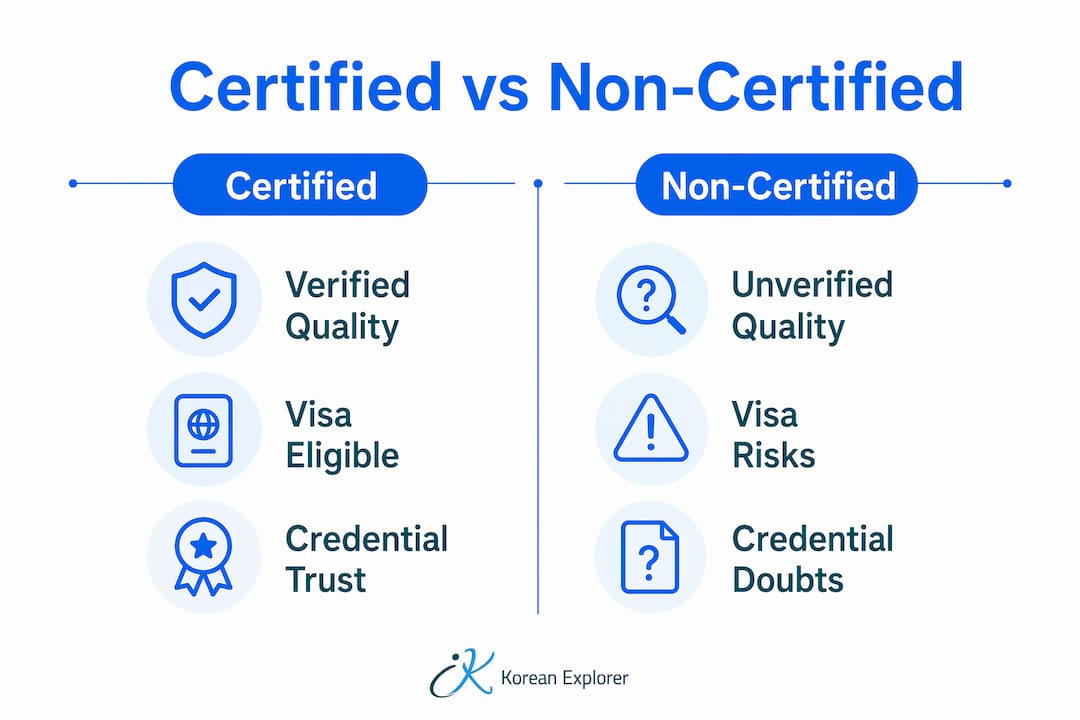
| Factor | Certified school | Non-certified school |
|---|---|---|
| Curriculum quality | Verified by independent body on a regular cycle | Self-reported, no external check |
| Instructor qualifications | Reviewed as part of certification process | Unverified |
| Certificate recognition | Accepted by universities and many employers | May not be recognized for credit transfer |
| Student support | Structured advising and documented outcomes required | Varies widely, no minimum standard |
| Visa document eligibility (U.S.) | SEVP-certified schools can issue Form I-20 | Non-SEVP schools cannot issue valid immigration documents |
Certified institutions are more credible to universities and employers for credential transfer and acceptance because they undergo third-party validation of curriculum and instructor quality. That credibility directly affects whether your language study counts toward a degree program, satisfies an employer’s language requirement, or qualifies you for a professional role.
Pro Tip: Check the certification body’s official website directly, not the school’s own marketing materials. Most certification bodies publish a searchable directory of certified schools. If a school claims certification but does not appear in that directory, treat it as a red flag.
What to look for beyond certification when choosing a language school
Certification sets the floor. The best schools go well above it. Once you have confirmed that a school holds valid certification from a recognized body, shift your evaluation to the operational details that reveal how the school actually teaches.
The University of San Diego’s Intensive English Language Program illustrates what a high-functioning program looks like: six structured proficiency levels, placement testing before the course begins, post-course assessments to measure gains, class sizes capped at 10 to 15 students, and fixed semester schedules. These are not luxury features. They are the mechanics of effective language instruction, and they are what you should demand from any school you consider.
Beyond the classroom structure, look for these indicators of genuine quality:
- Placement testing at enrollment. A school that places every new student in the same beginner class regardless of prior knowledge is not serving learners. It is filling seats.
- Transparent outcome data. Ask what percentage of students advance to the next level within one semester. Ask where graduates go after completing the program. Schools with strong outcomes share this data willingly.
- Cultural integration activities. Most certified programs organize cultural excursions, social events, and conversation exchanges that accelerate real-world language use beyond the classroom.
- University transfer partnerships. If your goal is academic progression, confirm that the school has formal agreements with universities that recognize its language certificates for admission or credit.
- Location and immersion access. A school located in a city with a large community of native speakers gives you daily practice opportunities that no classroom can replicate.
Knowing how to encourage language learning outside the classroom is just as important as what happens inside it. The best certified schools build that into their program design rather than leaving it to chance.
Key takeaways
Choosing a certified language school protects your investment, your credentials, and your visa status by replacing marketing promises with independently verified standards.
| Point | Details |
|---|---|
| Certification means ongoing accountability | Schools must pass regular inspections, not just a one-time review, to maintain certified status. |
| SEVP and academic certification are separate | International students in the U.S. must verify both independently to protect visa eligibility. |
| Non-certified schools carry real risks | Unverified curriculum and unrecognized certificates can block credit transfer and employment. |
| Operational features reveal true quality | Placement tests, small classes, and outcome data show whether certification standards are actually practiced. |
| Cultural and support services matter | Certified programs integrate advising, cultural activities, and progression pathways that improve learning outcomes. |
Certification is the baseline, not the finish line
I have reviewed enough language programs over the years to say this plainly: certification tells you a school clears the minimum bar. It does not tell you the school is exceptional. The most important thing I have learned is that you need to look past the logo on the website and ask operational questions.
The schools that genuinely serve learners are the ones where the certification is visible in every class session. Small groups. Instructors who know where each student started and where they are now. A clear path from one level to the next. Those details are what certification is supposed to produce, but not every certified school delivers them with equal commitment.
I also want to caution against one mistake I see repeatedly. Learners conflate visa authorization with academic quality. A school can be SEVP-certified and still offer mediocre instruction. A school can hold a prestigious quality certification and still not be authorized to issue visa documents. You need both, and you need to check both separately. Treating them as interchangeable is a shortcut that costs people real money and real time.
The schools worth your investment are the ones that treat certification as a floor, not a ceiling. They are the ones where the accountability loop runs through every aspect of the student experience, from the first placement test to the final assessment. That is what you are actually paying for when you choose a quality language school.
— Paul
Learn Korean with a school that takes quality seriously
Korean Explorer delivers structured, adult-focused Korean language education in Singapore with the quality markers that serious learners need. Native Korean instructors fluent in both Korean and English lead small-group and private classes built around a curriculum developed by Seoul National University. Every learner is placed at the right level from the start, with clear progression through structured course levels. Classes are available in-person at International Plaza above Tanjong Pagar MRT, at Jurong and Tampines centers, and online via Zoom for maximum flexibility. Corporate training is also available for teams. Explore Korean language courses for adults and find the format that fits your schedule and goals.
FAQ
What does it mean for a language school to be certified?
A certified language school has been reviewed by an independent body, such as CEA or EnglishUK, and confirmed to meet established standards in curriculum quality, instructor qualifications, and student welfare. Certification requires periodic renewal, so the school must maintain those standards over time.
Is SEVP certification the same as academic certification?
No. SEVP certification is a U.S. government authorization that allows a school to enroll F-1 visa students and issue Form I-20. Academic certification from bodies like CEA is a separate quality assurance designation. International students in the U.S. need to confirm both independently.
Why does certification matter for my certificate or diploma?
Certificates from certified schools carry third-party validation of the curriculum and instruction behind them, making them more likely to be recognized by universities for credit transfer and by employers as proof of genuine proficiency. Non-certified programs lack that external verification.
What class size should I expect at a quality certified language school?
Quality programs typically cap classes at 10 to 15 students, a standard reflected in university-led intensive English programs. Smaller classes allow instructors to track individual progress and provide consistent feedback throughout the course.
How do I verify that a school is genuinely certified?
Check the certification body’s official website directly and search for the school in its published directory. Most recognized bodies, including CEA and EnglishUK, maintain publicly accessible lists of certified institutions. If a school does not appear in that directory, its certification claim is unverified.