A structured curriculum is the fastest, most reliable route to steady language gains for adult learners. Meta-analyses of structured learning interventions find a positive, statistically significant average effect on both engagement and academic achievement. UNESCO confirms that a structured curriculum sets the foundation for consistent, quality learning, especially where instructor experience varies. Korean Explorer, an adult Korean language school, is one practical example of how this research translates into a real program.
- Research signal: Meta-analyses show structured interventions produce statistically meaningful gains in engagement and achievement.
- Learner outcome: Adults following a clear scope and sequence reach measurable milestones faster than those in loosely organized programs.
- When unstructured fits: Immersion or conversation-only approaches can work well as a supplement once you have a foundation, but rarely as a starting point.
Table of Contents
- Why choose a structured curriculum? Start with what it actually means
- What does the research actually say about structured learning?
- Concrete benefits of a structured curriculum for language learners
- Limitations and trade-offs worth knowing
- Who benefits most from a structured program?
- How do you evaluate and choose a structured language program?
- Getting the most from a structured course: an 8-week plan
- What a well-structured adult Korean program looks like in practice
- Key Takeaways
- Structure matters more than most learners expect
- Korean Explorer: a structured program built for adult learners
- Useful sources
- FAQ
Why choose a structured curriculum? Start with what it actually means
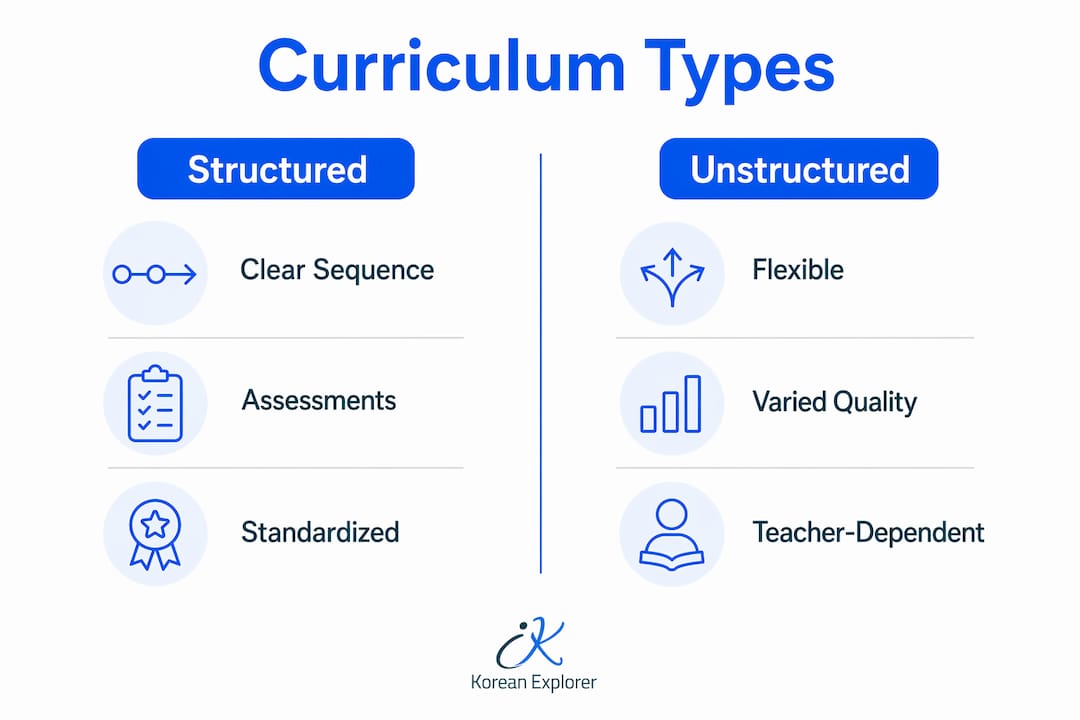
A structured curriculum defines learning objectives, content progression, assessment methods, and materials in a deliberate sequence. The key concept is scope and sequence: scope covers what gets taught, and sequence determines the order. In a Korean language program, that might look like this: Week 1 introduces Hangul and basic pronunciation; Week 2 adds greetings and simple sentence patterns; Week 3 layers in numbers and everyday vocabulary; Week 4 applies all three in a short conversation exercise with a formative check. Each step assumes the previous one.
That is fundamentally different from a teacher-created or loosely organized approach, where lesson content often depends on what feels relevant that week. Loosely organized classes can be engaging, but they tend to leave gaps, especially in pronunciation fundamentals or grammar patterns that learners only discover are missing much later.
The National Academies note that curricula with a clear scope and sequence that build logically on prior lessons tend to be more effective at improving targeted learning outcomes than loosely organized alternatives.
What does the research actually say about structured learning?
The evidence base is solid. Meta-analyses of structured-intervention studies consistently find a statistically significant positive effect on student engagement and academic achievement from structured learning environments.
Key finding: Structured curriculum interventions show statistically significant positive effects on both engagement and achievement across multiple meta-analyses, with the largest gains in lower-baseline learners.
Pearson’s curriculum principles describe vertical integration as the mechanism behind this: later lessons build directly on earlier ones, preventing gaps and supporting progressive challenge. Without it, learners often plateau because they are missing a foundational concept they never formally covered.
UNESCO adds an equity dimension: a structured curriculum standardizes core learning pathways, which means the quality of your experience does not depend entirely on getting a particularly experienced instructor. One caveat worth stating plainly: effects vary by context and implementation quality. A well-designed curriculum delivered poorly still underperforms.
Concrete benefits of a structured curriculum for language learners
The advantages are specific, not abstract:
- Coherent progression (vertical integration): Each lesson assumes the last. You do not accidentally skip pronunciation rules because the teacher moved on to vocabulary.
- Spaced revision: A well-built scope and sequence revisits core grammar and vocabulary at intervals, which is how long-term retention actually works.
- Clearer assessment and feedback: Formative checkpoints tell you and your instructor where you are, not just whether you passed a final test.
- Predictable pacing: For working adults juggling jobs and study, knowing exactly what comes next each week removes a significant source of friction.
- Equity and consistency: UNESCO’s curriculum guidance shows that structure helps less-experienced instructors deliver consistent learning, so cohort quality does not swing wildly between teachers.
The ASCD “Curriculum That Matters” framework adds one more: structure frees learners to focus on deep practice by automating the “what to study next” decision. That cognitive load is real, and eliminating it increases consistency, which is the single strongest predictor of long-term language gains.
Pro Tip: Use the curriculum as a compass, not a cage. If a particular grammar point is clicking faster than expected, your instructor can extend practice depth without abandoning the sequence. The scope and sequence tells you where you are going; it does not dictate exactly how fast you walk.

Limitations and trade-offs worth knowing
Structure is not a universal fix. Common limitations include:
- Perceived rigidity: Learners with specific, narrow goals (say, business email writing only) may find a full scope and sequence covers more than they need. Mitigation: look for programs with modular branches or elective units.
- Over-scaffolding: If the curriculum does not adapt to your pace, you can end up reviewing material you already know. A diagnostic placement test at entry solves most of this.
- Level mismatch: Joining at the wrong level is the most common frustration. Any reputable program offers a placement check before enrollment.
- Implementation quality: A curriculum is only as good as its delivery. Teacher training and ongoing coaching matter as much as the materials themselves, as research on structured pedagogy programs makes clear.
A hybrid model often works best: follow the structured sequence for grammar and vocabulary, then supplement with immersion activities like Korean dramas, podcasts, or conversation meetups. The structure gives you the framework; the immersion gives you the feel.
Who benefits most from a structured program?
Ask yourself these questions:
- Do you need predictable pacing because your schedule is tight?
- Do you want explicit assessments so you know when you are ready to advance?
- Are you starting from zero or returning after a long break?
- Is your organization enrolling a cohort that needs consistent outcomes across all participants?
If you answered yes to any of those, a structured curriculum is likely the right fit. Adult beginners, time-constrained working professionals, corporate training cohorts, and self-directed learners who want measurable milestones all tend to gain the most. The role of structured curriculum in learning is especially pronounced for learners who have tried informal methods and stalled.
One edge case: advanced learners who already have strong foundations sometimes prefer modular or research-led syllabi that let them target specific gaps rather than follow a linear sequence.
How do you evaluate and choose a structured language program?
Must-have features when reviewing any program:
- A published scope and sequence you can read before enrolling
- Measurable learning objectives per unit (not just vague “you will improve your Korean”)
- Formative assessments built into the course, not just a final exam
- A diagnostic placement test
- Clear pacing guides and unit lengths (the U.S. Department of Education’s curriculum toolkit suggests 4–9 weeks as a typical unit length for adult programs)
Red flags: no sample syllabus available, outcomes described only in general terms, no mention of assessments.
Questions to ask a provider: How many hours per level? What does a sample unit look like? How are assessments structured? What are the instructor qualifications? Is online delivery synchronous or asynchronous? Bilingual instructors who can explain grammar in English are a significant advantage for English-speaking adult learners of Korean.
Pearson’s curriculum evaluation criteria add coherence, deliverability, and clarity of learning aims as the three practical checks worth applying to any program you are considering.
Getting the most from a structured course: an 8-week plan
Follow the scope and sequence, use the diagnostic, and track your consistency. That is the short version. Here is what it looks like in practice for an adult beginner:
- Weeks 1–2: Complete core lessons on script and pronunciation. Do a 10-minute daily review of Hangul characters. No skipping ahead.
- Weeks 3–4: Add vocabulary sets from the curriculum’s unit list. Practice speaking each new word aloud, not just reading it.
- Weeks 5–6: Apply grammar patterns in short written sentences. Use the curriculum’s formative checkpoint to identify weak spots.
- Weeks 7–8: Focus on conversation practice using the vocabulary and grammar from Weeks 1–6. Record yourself once and compare to Week 1.
Practical habits that compound over time: treat the teacher guide as a compass for pacing, schedule short daily sessions rather than long weekly ones, and use every formative assessment as a redirect rather than a grade.
Pro Tip: Pre-block your weekly study slots in your calendar at the start of the course, not week by week. Decision fatigue about when to study is one of the quietest reasons adult learners fall behind. The curriculum’s built-in checkpoints then become natural review moments rather than extra tasks.
What a well-structured adult Korean program looks like in practice
Korean Explorer is a useful illustration of how the checklist above maps to a real program. The school bases its curriculum on materials developed by Seoul National University, which provides the vertical integration that Pearson’s design principles describe: each level assumes and builds on the previous one.
| Feature | Learner benefit |
|---|---|
| Seoul National University curriculum base | Logical, gap-free progression from beginner to advanced |
| Native Korean instructors fluent in English | Grammar explained clearly without translation guesswork |
| Formative assessments per unit | Learners know when they are ready to advance, not just when the term ends |
| Group, private, and online Zoom formats | Fits working adult schedules and corporate cohort needs |
| Corporate training delivery | Consistent outcomes across a team, regardless of individual starting points |
Korean Explorer’s online Korean classes run via Zoom and follow the same structured sequence as in-person courses, making them a practical option for learners outside Singapore or those with unpredictable office schedules. Before enrolling, request a sample unit and confirm the placement process. That one step tells you more about a program’s structure than any marketing copy.
Key Takeaways
A structured curriculum, built on a clear scope and sequence with formative assessments, consistently outperforms loosely organized approaches for adult language learners.
| Point | Details |
|---|---|
| Structure beats improvisation | Curricula with a clear scope and sequence produce better outcomes than loosely organized or teacher-created approaches. |
| Research supports it | Meta-analyses find statistically significant positive effects on engagement and achievement from structured learning environments. |
| Equity and consistency | UNESCO shows structured curricula standardize quality, reducing dependence on any single instructor’s experience level. |
| Evaluate before enrolling | Ask for a sample syllabus, a placement diagnostic, and unit-level learning objectives before committing to any program. |
| Korean Explorer as a model | Korean Explorer’s Seoul National University-based curriculum maps directly to the evaluation checklist, with group, private, and online Zoom options for adult learners. |
Structure matters more than most learners expect
The conventional wisdom is that motivation and immersion are what drive language learning. They help, but they are not the mechanism. Consistency is. And consistency is far easier to maintain when someone else has already answered “what do I study today?” A structured curriculum does exactly that, which is why the research keeps pointing in the same direction. Adult learners who commit to a well-sequenced program and show up regularly almost always outpace those who study harder but less systematically. Pick the program, trust the sequence, and measure your progress at every checkpoint.
Korean Explorer: a structured program built for adult learners
If the checklist in this guide describes what you are looking for, Korean Explorer’s adult Korean courses are worth a close look. The curriculum follows a Seoul National University-developed scope and sequence, with native bilingual instructors, formative assessments per unit, and flexible formats including group classes, private lessons, and live online Zoom sessions for learners who need remote access. Corporate training is available for teams that need consistent outcomes across a cohort.
The next step is straightforward: browse the Korean language course catalog, request a sample unit, and take the placement check to confirm the right starting level. That combination tells you everything the checklist asks for before you spend a single dollar.
Useful sources
- Meta-analyses of structured-intervention studies: Primary empirical support for structure improving engagement and achievement.
- UNESCO — Curriculum: what you need to know: Authoritative definition and equity rationale for structured curricula.
- National Academies — curriculum design and sequencing: Evidence that scope-and-sequence curricula outperform loosely organized alternatives.
- Pearson — What makes an effective curriculum?: Practical design checks: coherence, deliverability, measurable aims.
- ASCD — 5 Elements of a Relevant Curriculum: The “Curriculum That Matters” framework, including depth and equity lenses.
- U.S. Department of Education — Curriculum Development Toolkit: Unit length guidance (4–9 weeks) and backward design principles for adult programs.
When evaluating any program, compare sample syllabi side by side, request a placement diagnostic before enrolling, and verify instructor credentials and bilingual teaching capacity.
FAQ
What is a structured curriculum in language learning?
A structured curriculum defines learning objectives, content sequence, assessment methods, and materials in a deliberate order. It tells learners and instructors exactly what to cover, in what sequence, and how to measure progress at each stage.
How does a structured curriculum differ from immersion learning?
Immersion relies on exposure and context to build language instincts; a structured curriculum builds those instincts systematically through a planned scope and sequence. The two work best together: structure provides the framework, immersion provides the feel.
Who benefits most from a structured language program?
Adult beginners, working professionals with limited study time, corporate training cohorts, and self-directed learners who want measurable milestones all tend to gain the most from a structured approach.
What should I look for when choosing a structured Korean course?
Ask for a published scope and sequence, unit-level learning objectives, a diagnostic placement test, and formative assessments built into the course. Red flags include vague outcome descriptions and no sample syllabus available before enrollment.
Does Korean Explorer offer structured adult Korean courses online?
Yes. Korean Explorer offers live online Zoom classes that follow the same Seoul National University-based structured curriculum as its in-person group and private courses, making them accessible for adult learners regardless of location.