TL;DR:
- Many learners believe quick answers or memorized word lists will guarantee success, but recent exam safeguards reveal this is unreliable. Preparing honestly with authentic past papers and targeted practice builds real skills and boosts confidence for the TOPIK exam. Ethical, consistent study methods are more effective and future-proof in light of tightening security measures.
Countless Korean learners arrive at exam day convinced that a set of circulated answers or a hastily memorized word list will carry them through. It won’t. Authorities are continuously adding new measures to prevent leaked answers and malpractice in the TOPIK exam, making shortcut strategies riskier and less reliable than ever. If you’re based in Singapore and serious about proving your Korean language skills, whether for university admission, a career opportunity, or personal achievement, this guide gives you a clear, honest roadmap to earn the score you actually deserve.
Table of Contents
- What is the TOPIK exam and who is it for?
- Structure and content: Understanding TOPIK’s levels and format
- How to prepare for TOPIK in Singapore: Best practices
- Common challenges and how to overcome them
- Our take: Why fair preparation matters more than ever
- Take the next step toward TOPIK mastery
- Frequently asked questions
Key Takeaways
| Point | Details |
|---|---|
| Exam integrity matters | The TOPIK exam is constantly updated to prevent cheating and ensure fairness. |
| Structured prep wins | Consistent, authentic practice and understanding test logistics are key to success. |
| Avoid shortcuts | Relying on leaked answers is risky and less effective than real practice. |
| Know local procedures | Familiarize yourself with Singapore’s test-day logistics for a smooth experience. |
What is the TOPIK exam and who is it for?
TOPIK stands for Test of Proficiency in Korean. It is the globally recognized standard for measuring Korean language ability among non-native speakers, administered by the National Institute for International Education (NIIED) under South Korea’s Ministry of Education. More than 200,000 candidates sit the exam worldwide each year, and the results are accepted by Korean universities, employers, and immigration authorities.
For Singapore learners specifically, TOPIK serves several practical purposes:
- University admission: Many Korean universities require TOPIK Level 3 or higher from international applicants.
- Employment: Korean companies operating in Singapore and elsewhere often list TOPIK certification as a hiring or promotion criterion.
- Visa and residency: Certain Korean visa categories, including the D-4 student visa and F-series residency visas, require a minimum TOPIK score.
- Personal milestones: For fans of Korean culture, drama, or K-pop, a certified score is tangible proof of the real linguistic progress you have made.
Understanding what is the TOPIK test and its broader purpose helps you frame your preparation correctly from the start.
“Exam integrity safeguards for TOPIK are actively being improved by authorities to prevent answer leaks and malpractice, signaling that the days of relying on dubious shortcuts are numbered.”
Singapore hosts regular TOPIK sessions throughout the year, typically at designated universities and examination centers. Because registration slots fill up quickly, you should plan your exam date well in advance and treat it with the same seriousness you would give any professional certification.
Structure and content: Understanding TOPIK’s levels and format
Understanding the exam’s goals helps you decide if it fits your needs. Next, let’s look at the structure you will be preparing for.
TOPIK is divided into two main tiers. TOPIK I targets beginner to elementary learners (Levels 1 and 2), while TOPIK II covers intermediate to advanced learners (Levels 3 through 6). Singapore currently offers two exam sessions per year, usually in April and October, giving candidates two opportunities annually to sit the test.
| Exam tier | Levels | Skills tested | Session duration |
|---|---|---|---|
| TOPIK I | 1 to 2 | Listening, Reading | Approximately 100 minutes |
| TOPIK II | 3 to 6 | Listening, Writing, Reading | Approximately 180 minutes |
Each level represents a significant jump in complexity. Level 1 requires you to handle basic survival conversations, while Level 6 demands near-native fluency in academic and professional contexts. The writing section in TOPIK II is particularly challenging because it requires constructed responses, not just multiple-choice answers, which means rote memorization alone cannot carry you through.
Key facts about the format:
- Standardized question types: Multiple-choice questions dominate TOPIK I, while TOPIK II adds short-answer and essay writing tasks.
- No oral component: The exam does not currently test speaking, so your listening comprehension and written production are the primary focus.
- Strict time limits: Each section is timed separately, and you cannot carry over unused minutes.
Understanding the Korean language levels framework helps you identify exactly which tier to register for and how to benchmark your current ability. The TOPIK format is maintained with strict fairness, particularly after recent cheating incidents, so every candidate worldwide faces the same standardized content.
Pro Tip: Do not aim for the highest possible level on your first attempt. Registering for an appropriate level based on honest self-assessment gives you a realistic target and boosts your confidence for future attempts.
How to prepare for TOPIK in Singapore: Best practices
Now that you know what you are up against, here is how to tackle TOPIK prep the right way in Singapore.
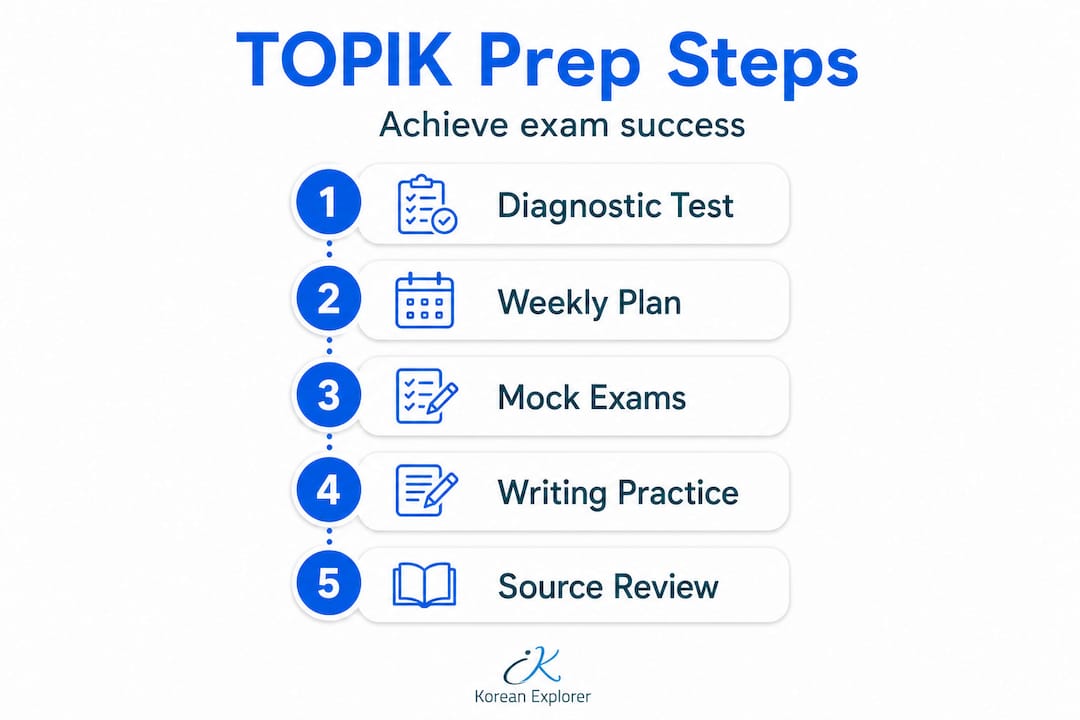
Step 1: Build your baseline with a diagnostic test
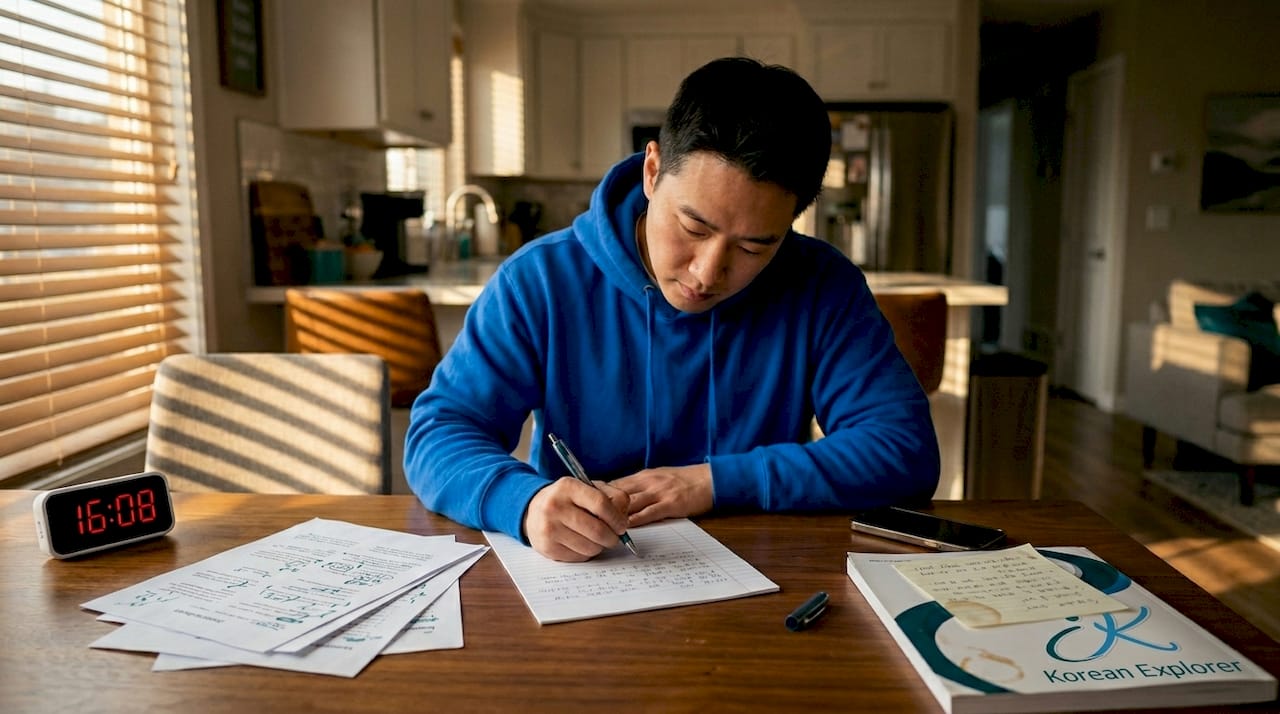
Before you create a study schedule, take a full-length past paper under real exam conditions. Time yourself strictly, use no dictionaries, and score your results honestly. This reveals your actual weak points rather than the ones you assume you have.
Step 2: Create a structured weekly study plan
Cramming in the final two weeks rarely works for a language exam. Aim for consistent, shorter sessions spread across several months. Language acquisition is cumulative; vocabulary and grammar patterns need repeated exposure to stick.
Step 3: Practice with authentic, timed mock tests
Past TOPIK papers are freely available from the official NIIED website. Use them exactly as they are, under full time pressure. Simulating the real exam conditions in Singapore is especially important because the strict proctoring and physical setup can feel unfamiliar if you have never experienced it before. Candidates who have sat the exam locally report that arriving early, having your identification ready, and understanding where to sit reduces stress noticeably on test day.
Step 4: Target the writing section deliberately
Many Singapore candidates struggle most with TOPIK II writing. Unlike reading and listening, where you can make educated guesses, writing demands accurate grammar, appropriate vocabulary range, and logical structure. Practice writing short essays on common topics like education, environment, technology, and social issues, then compare your work to model answers.
Step 5: Avoid shortcuts and unreliable sources
Cheating-related coverage consistently emphasizes that focusing on realistic practice rather than risky shortcuts is not just safer, it is more effective. Circulated answer sheets are frequently incorrect, outdated, or fabricated, and relying on them creates a false sense of security that collapses under actual exam pressure.
Here is a quick comparison of preparation approaches available to Singapore learners:
| Approach | Advantages | Limitations |
|---|---|---|
| Self-study (solo) | Flexible schedule, low cost | No feedback on writing, easy to lose motivation |
| Online courses | Accessible, often affordable | Varies widely in quality and structure |
| Language school (group) | Structured curriculum, peer support | Fixed schedule, requires commuting |
| Private tutoring | Personalized feedback, faster gaps closure | Higher cost per hour |
A dedicated language school that follows a proven Korean curriculum guide offers the most structured path, especially for learners who need accountability and expert feedback on their written work. If you are preparing to learn Korean in Singapore with TOPIK as the goal, choosing a program specifically aligned with TOPIK standards makes a measurable difference.
Pro Tip: Pair every mock test with a review session. Spend at least as much time analyzing your errors as you did taking the test. Understanding why an answer was wrong is worth ten times more than simply moving on to the next paper.
Common challenges and how to overcome them
With preparation covered, let’s tackle the biggest obstacles usually encountered by Singapore candidates.
Time pressure and exam anxiety
The strict, proctored environment of TOPIK can feel intense, especially for first-time test-takers. The listening section plays audio only once, with no opportunity to replay. This makes focused concentration during the test critical. Regular timed practice reduces this anxiety by making the pressure feel familiar.
Writing skills that don’t match the standard
Many learners spend most of their study time on grammar and vocabulary but neglect productive writing practice. The gap between recognizing correct Korean and producing it fluently is significant. Building a habit of writing at least two or three short paragraphs daily, even outside of mock tests, closes this gap faster than most candidates expect.
The temptation to seek unfair shortcuts
This is more common than people admit. When exam stress peaks, the idea of circulating answer sheets feels tempting. But safer, fairness-aligned strategies built on authentic practice materials are not just more ethical. They actually produce better scores because they force you to develop real comprehension rather than memorizing answers you do not understand.
Poor self-assessment habits
Many learners either overestimate or underestimate their readiness. Honest, data-driven self-assessment, using scored past papers and tracking trends over time, gives you a clear picture of whether you are on track. If your practice scores plateau for more than three weeks, it is a signal to change your study approach, not to study more hours doing the same thing.
Key challenges to watch for when reviewing your TOPIK Singapore exam details:
- Assuming your conversational fluency translates directly to exam performance (it often does not)
- Skipping the essay section during practice because it feels difficult
- Ignoring the listening section until the week before the exam
- Registering for a level that is either too ambitious or too easy relative to your current ability
Important statistic: Candidates who complete at least five full-length timed mock tests before exam day consistently report greater confidence and better time management than those who prepare exclusively through vocabulary drills and grammar exercises.
Our take: Why fair preparation matters more than ever
There is a pattern we have observed repeatedly in Korean language education. Learners who try to shortcut the process, through leaked answers, last-minute cramming, or shortcuts marketed as exam hacks, do not just risk disqualification. They arrive at the finish line without the skills they came for.
This matters beyond ethics. If you earn a TOPIK Level 4 certificate through genuine preparation, you can hold a real business conversation in Korean, follow a Korean news broadcast, and write a professional email. If you tried to fake your way to the same score, you cannot. The certificate is identical, but the ability behind it is not, and that gap becomes painfully visible the moment you actually need to use the language.
Cheating scandals have prompted stronger integrity measures in TOPIK, and those measures are only going to tighten further. What this means practically is that the exam will keep evolving to close the gap between what shortcuts can exploit and what genuine knowledge requires. Learners who build real skills will always stay ahead of that curve.
There is also a confidence argument. Candidates who prepare honestly walk into the exam room knowing they are ready. That psychological edge, the sense that you have done the work, is genuinely worth more than any circulated answer sheet. Anxiety drops, focus sharpens, and performance improves. Understanding the benefits of TOPIK beyond just a certificate reinforces why this investment in honest, thorough preparation pays back far more than the score itself.
The short version: fair preparation is not just the right thing to do. It is the smarter strategy.
Take the next step toward TOPIK mastery
You now have a realistic picture of what TOPIK demands and how Singapore-based learners can meet those demands with integrity. The next step is putting that knowledge into a structured, accountable plan.
At Korean Explorer, our courses are built on a Seoul National University curriculum that maps directly to TOPIK standards. Whether you’re targeting TOPIK I as a beginner or pushing toward Level 5 or 6, our experienced native Korean instructors provide the guided practice, writing feedback, and exam strategy you need. Explore our TOPIK Singapore course options, review the TOPIK test benefits to solidify your motivation, or browse all available programs for those who want to learn Korean in Singapore at a pace and format that fits your life. Group classes, private sessions, and online options are all available at our Tanjong Pagar, Jurong, and Tampines centers.
Frequently asked questions
Is there a difference between TOPIK exams held in Singapore and Korea?
No, the format and content are fully standardized to ensure fair assessment across all regions. Authorities are also working to reduce similarities between regional test papers to further close potential security gaps, starting from July.
How are Singapore venues handling the stricter integrity measures?
Venues are enforcing more rigorous proctoring and security checks in direct response to recent cheating scandals, including tighter identification verification and controlled entry procedures. Authorities have strengthened these preventative measures to protect the fairness of every candidate’s results.
Should I use leaked TOPIK answer sheets for practice?
No. Using leaked answers is both risky and counterproductive. Preparing with realistic practice using authentic past papers and official materials is a safer, fairness-aligned strategy that actually builds the skills the exam tests.
What is the best way to simulate the real TOPIK exam setup?
Use full-length, timed past papers in a quiet environment with no interruptions, following the same section order and time limits as the actual exam. Incorporating Singapore-specific test-day habits, such as preparing your identification in advance and practicing without pausing the audio, makes the real experience far less stressful.