TL;DR:
- Mastering business Korean requires understanding both language fundamentals and cultural norms.
- Indirect refusals and hierarchy cues are critical to interpret correctly in Korean business contexts.
- Achieving TOPIK Level 4 or 5 and cultural fluency ensures readiness for professional interactions.
Imagine sitting across from a Korean business partner in a high-stakes negotiation. They smile, nod, and say, “We’ll need to review this internally.” You leave the meeting feeling confident. Three weeks later, you hear nothing. The deal is dead. That phrase was their polite way of saying no, and you missed it entirely. This scenario plays out regularly for Singaporean professionals working with Korean counterparts, and it highlights something critical: indirect refusals in Korean business often involve hierarchy and face-saving phrasing that textbooks rarely prepare you for. Mastering business Korean means mastering both the language and the invisible rules that govern it.
Table of Contents
- What you need before starting: Prerequisites for success
- Step-by-step: Building your business Korean skills
- Troubleshooting and avoiding classic mistakes
- How to know you’re ready: Verifying your business Korean proficiency
- What most courses miss about business Korean for professionals
- Kickstart your business Korean journey with Korean Explorer
- Frequently asked questions
Key Takeaways
| Point | Details |
|---|---|
| Culture and language go hand in hand | Success in business Korean requires blending communication skills with deep cultural understanding. |
| Structured learning makes a difference | Following a benchmark-oriented pathway with clear milestones boosts efficiency and mastery. |
| Scenario practice is essential | Real business simulations prevent costly miscommunication and build confidence for live interactions. |
| Benchmark with recognized tests | Use TOPIK levels to measure progress and ensure your skills are workplace ready. |
What you need before starting: Prerequisites for success
Having established why business Korean is about more than just textbook knowledge, let’s clarify what you need to succeed before your learning journey begins.
Most professionals assume that picking up a Korean language app over the weekend is enough preparation. It isn’t. Business Korean requires a layered foundation, and skipping any layer creates gaps that surface at the worst possible moments, usually mid-negotiation or during a formal dinner with senior executives.
Language fundamentals first
Before touching business vocabulary, you need solid footing in Hangul (the Korean alphabet) and basic sentence structure. Hangul is phonetically consistent, which means once you learn the 24 characters, you can read Korean text almost immediately. This matters enormously in professional settings where you’ll encounter business cards, presentation slides, and signed contracts. Start studying Hangul basics before investing time in any business-specific content.
Basic grammar is equally non-negotiable. Korean uses a Subject-Object-Verb sentence order, which is the reverse of English. Getting comfortable with this early prevents confusion when parsing spoken instructions or written briefs from Korean colleagues.
Cultural competence: The layer most people skip
Language skills alone will not protect you from costly misunderstandings. Korean business culture is deeply shaped by three forces: hierarchy (who outranks whom), nunchi (the ability to read unspoken emotional and situational cues), and a group-centric mindset where preserving harmony often matters more than stating facts directly.
Understanding workplace etiquette in Korean business is not a soft bonus. It’s a hard requirement. Research consistently shows that pairing language learning with workplace culture knowledge prevents the most common and damaging professional missteps.
Readiness checklist before you begin
Here’s what you should have in place before moving to active business Korean learning:
- You can read Hangul characters at a basic level
- You understand that Korean sentence structure differs fundamentally from English
- You’ve researched Korean hierarchy norms (age, title, and seniority all affect speech levels)
- You’ve set a realistic learning goal tied to a specific timeframe
- You’ve identified whether group classes, private tutoring, or online sessions fit your schedule
Pro Tip: Self-assessment is not just about language level. Rate your cultural awareness on a scale of 1 to 10. Most professionals score much lower on cultural readiness than language readiness, and that imbalance is exactly where deals go wrong.
| Prerequisite area | Why it matters | Suggested action |
|---|---|---|
| Hangul literacy | Enables reading in professional contexts | Complete a structured Hangul module |
| Basic grammar | Prevents sentence-level confusion | Enroll in a beginner Korean course |
| Hierarchical awareness | Shapes every professional interaction | Read about Korean workplace norms |
| Nunchi literacy | Helps interpret indirect communication | Practice scenario-based exercises |
| Goal setting | Keeps learning on track | Set a TOPIK level target and timeline |
Step-by-step: Building your business Korean skills
With your prerequisites in place, it’s time to dive into the steps that move you from beginner to effective use of business Korean.
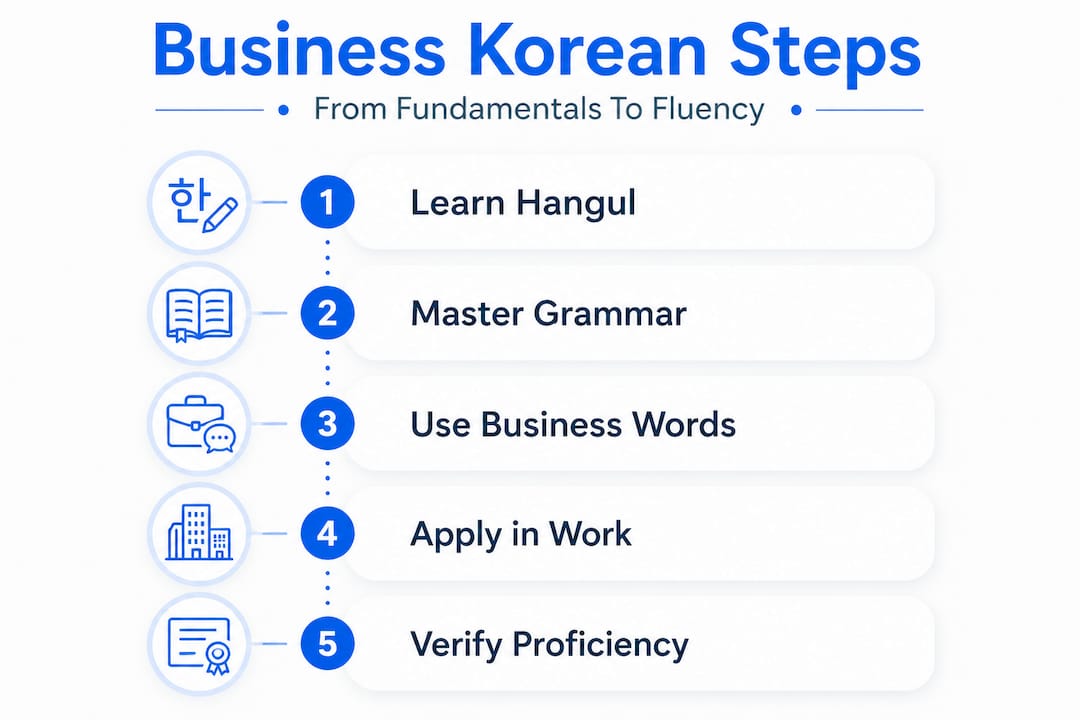
Progress in business Korean is not linear for most learners. But having a clear sequence prevents the trap of endlessly reviewing beginner material while never tackling the professional vocabulary and scenarios that actually move your career forward.
Step 1: Build your language base with Hangul and basic grammar
Use structured resources to move through Hangul systematically. Aim to read basic sentences within two to three weeks of focused study. Then move into beginner Korean grammar, concentrating on verb endings and speech levels. Korean has formal, polite, and informal speech registers, and using the wrong one in a business meeting signals cultural unawareness immediately.
Step 2: Align your milestones to TOPIK levels
TOPIK stands for Test of Proficiency in Korean. It’s the internationally recognized exam for Korean language ability, with levels ranging from 1 (beginner) to 6 (native-like mastery). For professional use, TOPIK-aligned goals set around Level 4 or 5 give you the vocabulary range and grammar control needed for negotiation, formal emails, and presentations. Level 4 requires you to understand nuanced texts and produce coherent professional writing, which is a realistic baseline for frequent business use.
Check out the TOPIK test benefits to understand how a formal certification can also strengthen your resume and signal credibility to Korean partners and employers.
Step 3: Practice business scenarios directly
Vocabulary lists are necessary but not sufficient. You need to practice actual scenarios: writing formal business emails using Korean honorifics, conducting mock negotiations that include indirect communication patterns, presenting proposals in Korean with audience-appropriate speech levels, and navigating hierarchy during group discussions.
Enroll in structured intermediate Korean courses that incorporate these real-world contexts rather than only drilling grammar rules in isolation.
Step 4: Use your workplace as a practice ground
Every email you receive from a Korean colleague is a study resource. Every meeting, every business dinner, every phone call is a chance to apply and test what you’ve learned. Keep a vocabulary journal where you log new business terms from real interactions. Review it weekly.

Step 5: Compare and combine learning tools
| Learning method | Best for | Limitations |
|---|---|---|
| In-person group classes | Interaction, peer practice, cultural discussion | Fixed schedule, group pace |
| Private tutoring | Personalized feedback, faster progress | Higher cost |
| Online classes | Flexibility, access to diverse resources | Less real-time cultural immersion |
| Language exchange apps | Conversation practice, casual use | Limited business context |
| Workplace immersion | Real-world application | Depends on access to Korean speakers |
Pro Tip: Combine at least two methods. Structured classroom instruction gives you grammatical precision, while a language partner or workplace practice gives you fluency and intuition you can’t get from a textbook alone.
Troubleshooting and avoiding classic mistakes
While structured learning brings you far, business Korean comes with hidden traps. Let’s spotlight critical mistakes and how to avoid them.
Most mistakes in business Korean are not grammar errors. Korean professionals generally extend considerable patience to foreign learners who make linguistic slip-ups. The mistakes that damage relationships are cultural. They signal either ignorance or disrespect, and they’re much harder to recover from than a mispronounced syllable.
The most common traps
- Expecting a direct “no”: Korean business culture prioritizes face-saving. A direct refusal is rare and considered blunt. Learners who expect directness often misread polite deflections as agreement.
- Ignoring seniority signals: Addressing a senior executive by first name, failing to bow slightly when greeting, or speaking in an informal register signals poor judgment. These are not small errors.
- Filling silence too quickly: Silence in Korean meetings is not awkward. It signals reflection. Rushing to fill it can come across as impatient or disrespectful.
- Missing nunchi cues: Nunchi is the Korean concept of reading the room, sensing the mood, and adjusting accordingly. Someone with strong nunchi notices when a topic is making the group uncomfortable and pivots gracefully. Without it, you press forward into territory that damages trust.
“Communication edge cases in Korean business often involve indirect refusals and hierarchy and face-saving phrasing, so learners should practice scenarios rather than only memorizing vocabulary.”
Common indirect refusal phrases and what they actually mean
Understanding Korean as a business language means learning to decode subtext. Here are three phrases that frequently trip up non-native speakers:
- “검토해 보겠습니다” (We will review it): Often signals hesitation or a soft no, especially if followed by silence.
- “좀 어렵겠는데요” (That seems a bit difficult): Almost always means the answer is no.
- “나중에 다시 이야기해요” (Let’s talk about it again later): Usually indicates the topic is being shelved indefinitely.
To build fluency in interpreting these signals, use fluency strategies that go beyond vocabulary and include active scenario practice with native speakers who can give you honest, real-time feedback.
Practical fixes
Request feedback explicitly after practice sessions. Observe how Korean colleagues respond in real meetings rather than only studying transcripts. Find a Korean mentor who can debrief cultural moments with you after interactions.
How to know you’re ready: Verifying your business Korean proficiency
Avoiding mistakes is crucial, but you’ll need clear proof of competence before using business Korean in high-stakes settings.
Feeling ready and being ready are not the same thing. Professionals often overestimate their readiness after a period of study, particularly because Korean business partners are too polite to point out errors in real time. You need objective verification.
Formal benchmarks
The benefits of the TOPIK test extend beyond personal satisfaction. A TOPIK Level 4 or 5 certificate is a recognized, benchmark-oriented signal of professional readiness. It demonstrates to Korean partners, clients, and employers that your Korean is not conversational guesswork but structured, tested proficiency.
Real-world validation signals
Beyond formal testing, watch for these readiness signals in your day-to-day interactions:
- You can draft a formal Korean business email without using a translation tool
- You can follow a spoken meeting in Korean and summarize the key decisions afterward
- You recognize indirect refusals in real time and adjust your approach accordingly
- You can use the correct speech level with different seniority levels in the same conversation
- You feel comfortable enough to ask clarifying questions in Korean without losing the thread of the discussion
Verification options at a glance
| Verification method | What it measures | Reliability |
|---|---|---|
| TOPIK exam (Level 4 or 5) | Grammar, reading, writing, listening | Very high, internationally recognized |
| Mock business presentations | Speaking fluency and content accuracy | High with experienced evaluators |
| Peer or mentor feedback | Cultural appropriateness and tone | High if feedback is honest |
| Workplace performance review | Real-world communication effectiveness | High, context-specific |
| Language exchange partner rating | Conversational naturalness | Moderate |
If you can pass multiple forms of this verification, you’re genuinely ready to use business Korean in professional contexts with confidence.
What most courses miss about business Korean for professionals
Here’s a hard truth that most language learning guides sidestep: the biggest gap between textbook-trained professionals and truly effective Korean communicators is not vocabulary. It’s nuance.
Many Singaporean professionals arrive at business meetings with solid grammar, memorized honorifics, and a decent TOPIK score. Then they hit a wall. The conversation moves fast. Subtext appears everywhere. A joke lands flat because its cultural context requires years of lived experience to decode. Silence becomes uncomfortable instead of productive. These are not failures of vocabulary. They are failures of cultural fluency.
Nunchi, that deeply Korean concept of reading the emotional temperature of any room, is rarely taught explicitly in formal courses. Most programs cover it as a footnote, if at all. But in Korean business culture, someone who lacks nunchi is considered socially clumsy regardless of how grammatically correct their Korean is.
We’ve seen this pattern repeatedly at Korean Explorer. Students who focus purely on structured grammar and TOPIK prep are technically strong but sometimes struggle to adapt in real meetings. The ones who gain a real business edge are those who pair rigorous language learning with genuine curiosity about Korean culture, professional context, and interpersonal dynamics. They ask questions like “Why does this meeting feel tense?” rather than only “Did I use the right verb form?”
The takeaway is not that formal courses are useless. They’re essential. But they work best when you treat cultural literacy as a parallel discipline, not an afterthought. Read about Korean business history, watch Korean business documentaries, build relationships with Korean colleagues outside of formal meetings, and stay genuinely curious about the “why” behind every cultural norm you encounter. That curiosity is what separates professionals who speak Korean from professionals who actually connect through it.
Kickstart your business Korean journey with Korean Explorer
If you’re serious about mastering business Korean and sidestepping common pitfalls, discover how a tailored program can accelerate your progress and confidence.
Korean Explorer offers Korean language courses designed around real professional needs, from beginner Hangul foundations all the way to advanced business communication. Our native Korean instructors bring both linguistic precision and cultural context into every class, so you practice the language and learn to read the room at the same time. We offer dedicated TOPIK preparation in Singapore to help you hit verifiable proficiency benchmarks that open doors with Korean partners and employers. And if you’re looking to use SkillsFuture credits, our SkillsFuture Korean courses make professional-level Korean learning both accessible and affordable. Visit us at Tanjong Pagar, Jurong, or Tampines to find the format that fits your schedule.
Frequently asked questions
How long does it take to reach business Korean fluency?
With structured learning and regular practice, professionals can often reach business-level proficiency in 12 to 24 months, particularly when learning is aligned to TOPIK goals and paired with real workplace exposure.
What are TOPIK levels, and why do they matter for business Korean?
TOPIK levels measure Korean proficiency from 1 to 6, and reaching Level 4 or higher is generally considered the threshold for handling professional tasks, formal writing, and business negotiations confidently.
How important is cultural etiquette in Korean business relationships?
Cultural etiquette is critical because indirect communication and hierarchy shape nearly every professional exchange, and misreading these norms can cost you trust, deals, or long-term partnerships far more than a grammatical slip would.
Is self-study enough for learning business Korean?
Self-study builds a useful foundation, but long-term success typically requires interactive practice and feedback because pairing language work with workplace culture knowledge is what prevents costly real-world miscommunication.
What are examples of indirect refusals in Korean business?
Common indirect refusal signals include phrases like “we need to review internally,” “that seems a bit difficult,” and “let’s discuss it again later,” all of which typically mean no in practice rather than an open invitation to follow up.
Recommended
- Business Korean for Work: Emails, Meetings, and Etiquette | Korean Explorer
- Five Tips for Mastering the Korean Language | Korean Explorer
- Get An Edge In The Business World By Learning Korean | Korean Explorer
- Improve Your Korean From Beginner To Pro In A Short Period
- Unlock global job opportunities: why translating your CV matters