TL;DR:
- Passing the TOPIK requires targeted exam preparation, including timed practice with past papers and section-specific strategies. Singapore learners benefit from local resources, structured courses, and cultural immersion to achieve higher proficiency levels. Combining language fluency with exam techniques is essential for reaching advanced TOPIK scores and certifying genuine Korean skills.
Studying Korean and passing the TOPIK are not the same thing. Many learners spend months watching K-dramas, practicing conversation, and building solid vocabulary, only to sit the exam and score far below their actual ability. The reason is straightforward: the TOPIK (Test of Proficiency in Korean) is a structured standardized exam with specific question patterns, timing demands, and scoring logic that rewards preparation, not just fluency. This article walks you through exactly what the TOPIK tests, how it’s structured, and the targeted study methods that Singapore learners use to score well consistently.
Table of Contents
- What is TOPIK and why does it matter in Singapore?
- Understanding the TOPIK exam format and levels
- Proven study strategies: How experts recommend preparing
- Navigating TOPIK preparation in Singapore: Local resources and insights
- What most guides miss about TOPIK preparation
- Ready to elevate your Korean skills? Next steps in Singapore
- Frequently asked questions
Key Takeaways
| Point | Details |
|---|---|
| TOPIK requires targeted prep | Success depends on practicing official past papers and using strategic study methods, not just general language study. |
| Exam format clarity | Understanding TOPIK’s structure and levels helps you plan your study more efficiently. |
| Balance is essential | Combining exam tricks with foundational language skills consistently leads to best results. |
| Use Singapore resources | Leverage local prep centers, courses, and support for more effective TOPIK preparation. |
| Cultural immersion boosts learning | Engaging with Korean culture in daily life accelerates practical language mastery beyond exam outcomes. |
What is TOPIK and why does it matter in Singapore?
TOPIK stands for Test of Proficiency in Korean. It’s the official government-recognized exam used internationally to measure Korean language ability, and it’s administered by the National Institute for International Education (NIIED) in South Korea. In Singapore, the exam is offered at accredited test centers and is taken by students, professionals, and language enthusiasts who need a formal credential to prove their Korean skills.
Understanding the TOPIK test purpose matters because different people take it for very different reasons. Students applying to Korean universities need a minimum TOPIK score to gain admission. Working professionals use it to qualify for jobs with Korean companies operating in Singapore or regionally. Some learners take it simply to benchmark their progress or earn recognition for years of personal study.
Here’s why the TOPIK test in Singapore is more relevant than ever:
- University admission: Many Korean universities require TOPIK Level 3 or higher for international applicants
- Employment advantage: Korean conglomerates like Samsung, LG, and Hyundai have regional offices in Singapore and increasingly value TOPIK certification
- Cultural credibility: For enthusiasts immersed in Korean pop culture, the certificate is a formal marker of genuine proficiency
- Immigration and residency: Some Korean visa pathways recognize TOPIK scores as part of eligibility criteria
- Professional translation work: Freelancers and interpreters benefit from TOPIK certification when bidding for clients
“A pragmatic preparation methodology for TOPIK emphasizes timed practice on past papers and targeted section strategy rather than only general Korean study.”
The benefits of taking the TOPIK test extend beyond a certificate on your wall. It gives you a concrete goal to work toward, which fundamentally changes how you study. Without a target, learners drift between grammar books, apps, and conversation practice without ever building the specific skills the exam tests.
Now that you know why mastering TOPIK is crucial, let’s break down how the exam actually works.
Understanding the TOPIK exam format and levels
The TOPIK exam is divided into two tiers: TOPIK I and TOPIK II. TOPIK I covers Levels 1 and 2, aimed at beginners and elementary learners. TOPIK II covers Levels 3 through 6, designed for intermediate to advanced speakers. Understanding which tier applies to you is the first step in focused preparation.
Here’s a quick breakdown of the levels and what they signal:
| Level | Tier | Description | Typical use case |
|---|---|---|---|
| Level 1 | TOPIK I | Basic survival Korean | Personal milestone |
| Level 2 | TOPIK I | Simple daily communication | Entry-level roles |
| Level 3 | TOPIK II | Moderate fluency | University admission |
| Level 4 | TOPIK II | General social tasks | Professional settings |
| Level 5 | TOPIK II | Near-native proficiency | Academic research |
| Level 6 | TOPIK II | Expert-level fluency | Translation, teaching |
TOPIK I tests two sections: listening and reading. TOPIK II tests three: listening, reading, and writing. Scores in each section are combined, and your total determines the level you achieve within that tier.
The scoring bands look like this:
- TOPIK I: 80 points minimum for Level 1, 140 points for Level 2 (out of 200)
- TOPIK II: 120 points for Level 3, 150 for Level 4, 190 for Level 5, and 230 for Level 6 (out of 300)
- Writing in TOPIK II carries significant weight, so neglecting it is one of the most common mistakes test-takers make
Understanding your Korean proficiency level before you register helps you choose the right tier and avoid overreaching or undershooting. A full TOPIK format overview is worth reviewing before you commit to a study schedule, as question types differ considerably between sections and between tiers.
One critical insight: targeted section strategy and familiarity with question patterns are essential for TOPIK exam preparation. Knowing that certain reading questions always test inference skills, or that listening tracks follow predictable speaker-exchange formats, lets you build habits that pay off under timed exam conditions.
With the exam’s structure clear, it’s time to dive into the most effective study strategies proven to work.
Proven study strategies: How experts recommend preparing
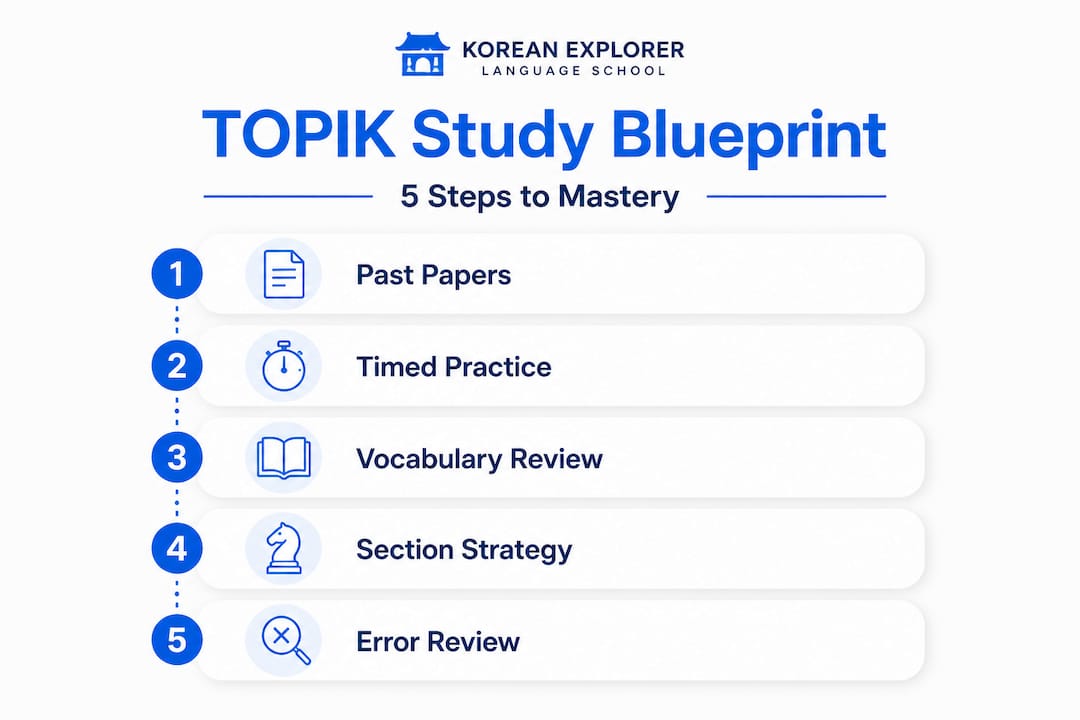
The most impactful thing you can do for your TOPIK score is work through official past papers under real exam conditions. This is not the same as casually reading through old questions. You sit down with a timer, replicate the test environment, and commit to finishing each section within the allotted time. The discomfort you feel early on is exactly where your improvement begins.

Why does this work so well? Because official past papers, vocabulary flashcards, skimming and scanning techniques, and real exam condition simulations are consistently identified as the core tools that drive score improvement. You’re training your brain to process Korean under pressure, not just in comfortable study sessions.
Here’s a comparison of two common preparation approaches:
| Approach | What it builds | Where it falls short |
|---|---|---|
| General Korean study only | Conversational fluency, broad vocabulary | Poor exam timing, unfamiliar question formats |
| Timed past-paper practice | Exam strategy, question recognition | Can lack depth in grammar or advanced vocabulary |
| Combined method | Both fluency and exam readiness | Requires disciplined scheduling |
The combined method wins every time. Here’s how to apply it section by section:
Listening section
Play audio at full speed from day one. Many learners make the mistake of slowing down recordings to catch every word. The actual exam doesn’t give you that option. Practice with the real speed recordings from official TOPIK test archives. Focus on catching the main idea and key details, not transcribing every syllable.
Reading section
Use skimming and scanning as your default strategy. TOPIK reading passages are dense and time pressure is real. Skimming the first and last sentences of each paragraph before reading deeply helps you locate answers faster. For top Korean learning resources, look for materials that specifically address TOPIK reading speed, not just comprehension.
Writing section (TOPIK II only)
This section trips up even strong speakers. TOPIK writing requires formal written Korean, which is structurally different from casual or spoken Korean. Practice with sentence completion tasks and short essay prompts. Use model answers from official guides and study the specific grammar patterns and connectors that appear repeatedly. Check out structured scoring strategies for Korean exams to understand what graders actually look for.
Vocabulary building
Flashcards remain one of the most efficient tools for vocabulary growth, but only when done with spaced repetition. Apps like Anki let you review words at the optimal forgetting interval. Focus your vocabulary study on the TOPIK word list rather than random words from K-dramas. The exam has a predictable lexical range, especially at Levels 3 and 4. Pair vocabulary study with a solid Korean curriculum to make sure your grammar foundations support the words you’re learning.
Pro Tip: After every practice test, spend at least as much time reviewing wrong answers as you spent taking the test. Understanding why you got something wrong teaches more than answering 10 new questions correctly.
Once your strategy is set, it pays to understand the unique Singapore context for TOPIK preparation.
Navigating TOPIK preparation in Singapore: Local resources and insights
Singapore has a well-developed Korean learning ecosystem that goes far beyond self-study. The TOPIK exam is held in Singapore multiple times a year, typically at designated test centers affiliated with Korean education bodies. Checking the official NIIED website and local Korean cultural organizations for test dates is essential, as registration windows close early.
Here’s what Singapore-based learners should know before they start:
- Test venues: The Korean Cultural Center in Singapore and affiliated centers handle most TOPIK registrations and may host or direct you to the nearest testing location
- Course options: Structured Korean language schools offer TOPIK prep tracks that align with specific exam levels rather than general conversation classes
- Online communities: Singapore-based Korean learner groups on platforms like Telegram and Facebook actively share study schedules, past-paper links, and exam-day logistics
- Placement before prep: Starting your TOPIK journey with a Korean placement test helps you identify your current level so your preparation targets the right tier from the beginning
- Library resources: National Library Board branches carry Korean language study guides that are worth supplementing your practice paper work
If you’re unsure where to study, exploring where to learn Korean in Singapore gives you a practical overview of reputable learning centers and their course formats. Singapore’s Korean-learning community is active, and group study sessions with fellow TOPIK candidates can significantly boost motivation and accountability.
Combining targeted section strategy with past-paper practice is most effective, and local resources in Singapore directly support this by providing structured environments and expert feedback that self-study alone cannot replicate.
Pro Tip: Register for TOPIK at least six to eight weeks before your target exam date. Test spots in Singapore fill up faster than many learners expect, especially for the mid-year sitting.
These local insights can be game-changers. Now, let’s look at what most guides miss and what actually works for TOPIK mastery.
What most guides miss about TOPIK preparation
Here’s the honest take after working with hundreds of Korean learners in Singapore: most TOPIK guides sell you a false choice. On one side, you have the “just learn Korean naturally” camp that dismisses exam strategy as shallow. On the other, you have the exam tricks and time allocation camp that treats the TOPIK like a puzzle to crack through pattern memorization alone. Both camps miss the bigger picture.
Relying purely on exam tricks works up to a point, usually Level 3. Beyond that, you can’t shortcut your way through a Level 5 or 6 reading passage. The vocabulary is too advanced, the grammar constructions too nuanced, and the writing demands too specific for tricks to carry you. We’ve seen learners plateau frustratingly at Level 3 because they memorized question formats without ever building the vocabulary depth or grammar range to handle harder texts.
But here’s the flip side, which the “just study Korean” crowd doesn’t like to admit: foundational fluency without exam practice consistently leads to underperformance. You can be genuinely conversational and still struggle with the formal, written register that TOPIK rewards, especially in the writing section. The exam tests a specific kind of Korean, and ignoring that reality wastes real ability.
The piece that almost no guide mentions is cultural immersion. Advanced TOPIK candidates in Singapore who consume Korean media, read Korean news articles, and engage with native speakers in structured settings consistently outperform those who study only from textbooks. This matters because the TOPIK test’s purpose is to measure real-world proficiency, and the exam’s content reflects authentic Korean communication contexts. When you recognize the cultural references in a reading passage or the social register shifts in a listening track, you answer faster and more accurately.
The smartest approach is unapologetically both: build real language competence through structured study and immersion, then sharpen your exam skills through timed, targeted practice. Neither side alone gets you to Level 5 or 6.
Ready to elevate your Korean skills? Next steps in Singapore
Taking on the TOPIK is a meaningful commitment, and having the right support structure makes a measurable difference in how quickly you progress and how confidently you walk into the exam room.
Korean Explorer offers structured TOPIK courses in Singapore designed specifically around the exam’s format and levels, taught by native Korean instructors who understand both the language and what the test actually rewards. Whether you’re just starting to learn Korean in Singapore or you’re a returning learner aiming to push from Level 3 to Level 5, there’s a course pathway built for your goals. Explore the full range of TOPIK test benefits and take a placement test to find exactly where your preparation should begin. With centers at Tanjong Pagar, Jurong, and Tampines, getting started has never been more accessible.
Frequently asked questions
What are the sections in the TOPIK exam?
TOPIK I includes listening and reading sections, while TOPIK II adds a writing section. Each section assesses a different dimension of proficiency, and targeted section strategy for all three is essential for a strong overall score.
How can I quickly improve my TOPIK score?
The fastest improvements come from consistent timed practice with official past papers and daily vocabulary review through spaced repetition flashcards targeting the TOPIK word range.
Are there Korean language classes in Singapore for TOPIK prep?
Yes, several language schools in Singapore offer structured TOPIK preparation courses aligned to specific exam levels, with experienced instructors who guide learners through both content and exam strategy.
Can cultural immersion help with TOPIK?
Absolutely. Exposure to authentic Korean media, news, and conversation sharpens the comprehension and register awareness that advanced TOPIK levels specifically test, giving immersion learners a meaningful edge over those who study only from textbooks.