TL;DR:
- Mastering Korean communication requires live practice to understand social cues, honorifics, and speech nuances that textbooks alone cannot teach. Engaging in real conversations, whether through role plays, native interactions, or unscripted content, significantly improves fluency, pragmatic awareness, and cultural competence. Consistent, practical speaking experiences bridge the gap between textbook knowledge and natural, confident Korean communication.
You can pass a Korean grammar test and still freeze the moment a native speaker talks to you. That frustration is real, and it affects learners at every level. Understanding why focus on real-life Korean conversation matters so much requires a closer look at what Korean actually demands in practice. Grammar rules and vocabulary lists are tools, not fluency. Korean carries layers of social hierarchy, honorifics, and unspoken cultural signals that only reveal themselves when you are actually speaking with someone. This article breaks down what makes real-life Korean communication different, what research says about how you learn it best, and how to build the kind of skills that work outside a textbook.
Table of Contents
- Key takeaways
- Why real-life Korean conversation is different
- Research insights on conversational Korean practice
- Common challenges when skipping conversational practice
- Practical ways to build real-life Korean speaking skills
- Textbook Korean vs. real conversational practice
- My take on what real Korean practice actually does
- Build real Korean fluency with Korean Explorer
- FAQ
Key takeaways
| Point | Details |
|---|---|
| Textbooks only take you so far | Real Korean conversation requires social and cultural awareness that scripted dialogues cannot teach. |
| Honorifics need live practice | Pragmatic studies show honorific usage depends on context, status, and setting, not just grammar rules. |
| Acoustic cues shape perception | Pitch and vocal intensity in spoken Korean signal politeness, making spoken practice non-negotiable. |
| Social signals outweigh vocabulary | Fluent grammar speakers still fail in Korean workplaces due to missing relational and hierarchy cues. |
| Structured conversation practice works | AI and live conversational practice both show measurable gains in speaking and listening at all levels. |
Why real-life Korean conversation is different
The phrase “what is real-life Korean communication” gets asked a lot by learners who feel they are studying hard but not progressing. Here is the core distinction: scripted Korean, the kind in textbooks, is clean, predictable, and neutral. Real Korean is none of those things.
Natural spoken Korean reflects a deeply high-context communication style. Meaning is often carried by what is not said, by the relationship between speakers, and by the setting. A native speaker shifts their tone, word choice, and even their sentence endings based on whether they are talking to a colleague, a client, or a close friend. You will not find those shifts labeled in a vocabulary list.
Consider these features that define real-life Korean usage:
- Honorifics and speech levels. Korean has multiple speech levels tied to social hierarchy, and switching between them fluidly is a live skill, not a memorization task.
- Indirect communication. Saying “no” directly is often avoided. Learners who miss this pattern can create friction without realizing why.
- Nonverbal and tonal cues. Silence, pause length, and eye contact all carry meaning in Korean conversation.
- Nunchi. This untranslatable concept refers to the social awareness of reading a room, picking up emotional and relational signals in real time. Without it, even grammatically perfect sentences can land wrong.
- Rapid informal speech. Syllables get contracted, sounds get dropped, and the rhythm shifts dramatically compared to textbook recordings.
Knowing these features exist is one thing. Developing the instinct to respond to them in real time requires actual practice in real Korean scenarios, not just study.
Research insights on conversational Korean practice
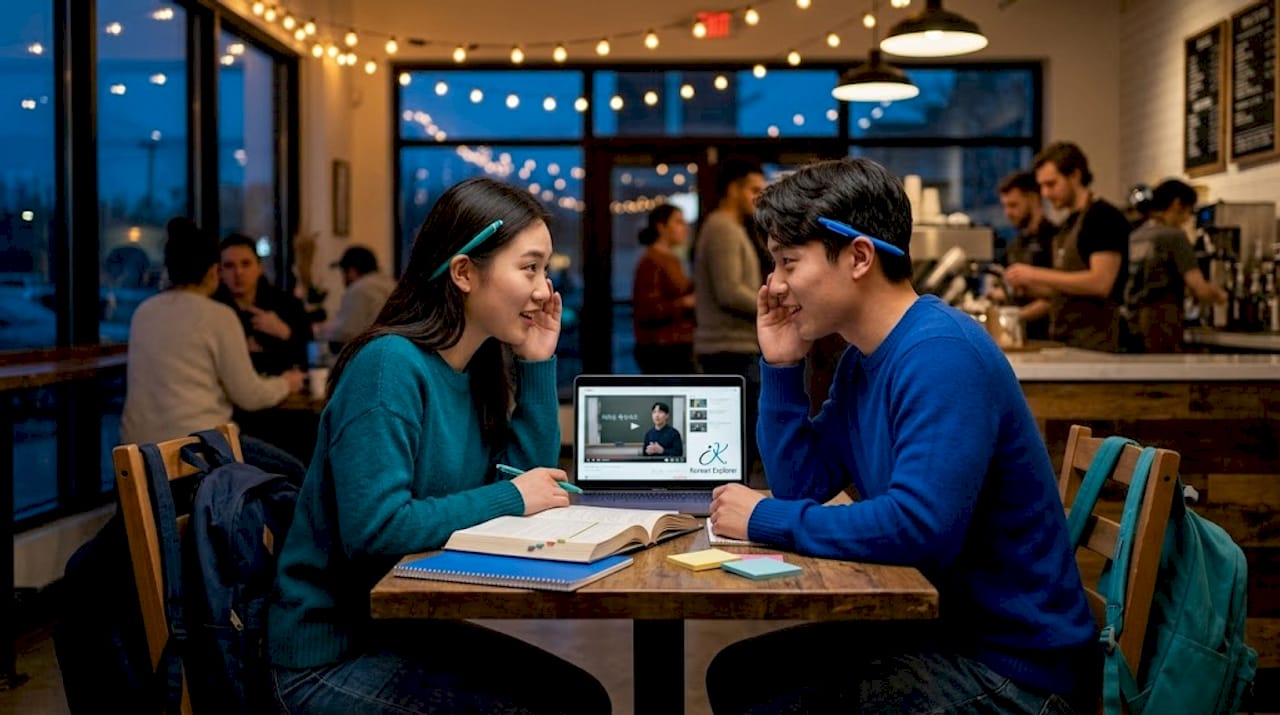
The evidence for prioritizing spoken practice over passive study is not just anecdotal. Research gives us a clearer picture of what actually moves the needle.
A study on AI conversational practice found statistically significant improvements in both speaking and listening scores across proficiency levels when learners used conversational methods, even with AI chatbots. That result matters because it tells you that the act of producing and responding to spoken language, even in a semi-structured setting, creates measurable gains that reading alone cannot.
Brain processing research adds another layer. ERP studies on Korean honorifics showed that when listeners encounter honorific mismatches, their brains trigger what is known as an N400 effect. This is the same neural response linked to semantic violations. The implication is that the brain processes honorific errors as pragmatic failures, not simple grammar mistakes. You cannot train that kind of sensitivity by memorizing a table of endings.
Acoustic research reveals something even more specific about sounding natural. Politeness in spoken Korean is marked at particular hotspots in speech, especially vocative address terms, with measurable differences in pitch, intensity, and vocal quality. Lower fundamental frequency and distinct vocal patterns signal deference in ways that printed text cannot convey. Learners who never practice speaking will simply not develop these patterns.
| Learning Method | Speaking Gains | Pragmatic Development | Cultural Fluency |
|---|---|---|---|
| Textbook study only | Low | Minimal | Limited |
| AI conversational practice | Moderate | Moderate | Low |
| Live conversation with native speakers | High | High | High |
| Structured role play with cultural context | High | High | High |
Pro Tip: Record yourself speaking Korean and listen back. Compare your pitch and pace to native speakers in unscripted videos. The gap you hear between you and them is exactly what conversational practice is designed to close.
Common challenges when skipping conversational practice
Learners who focus almost entirely on reading and writing often hit the same walls. These are not random frustrations. They are predictable outcomes of a study approach that treats Korean as a written code rather than a living spoken interaction.
Honorific errors that grammar rules do not prevent. Honorific usage requires you to calibrate your speech level based on the addressee’s status, your own role, and the setting, all at the same time. Pragmatic studies confirm that this is a dynamic live skill, not a fixed rule set. Getting it wrong in a workplace context creates relational damage, even when your grammar is technically correct.
Sounding unnatural despite correct sentences. Learners who only study honorific labels on paper may not produce the pitch and intensity patterns that signal politeness to native ears. You can say the right words and still come across as cold, flat, or even dismissive.
Missing cultural signals and social cues. Foreign professionals fluent in Korean grammar regularly struggle with what experts describe as a hidden social operating system. Hierarchy, indirectness, and relational norms shape every exchange. Missing them causes miscommunication that vocabulary alone cannot fix.
Over-reliance on AI practice without real interaction. AI conversational tools do show measurable gains, but both low and high proficiency learners report that AI lacks the spontaneity and emotional engagement of real human interaction. It is a useful supplement, not a replacement.
Cultural avoidance patterns catching learners off guard. Koreans generally avoid small talk with strangers due to norms around privacy and social hierarchy. A learner trained only on textbook dialogues that simulate casual chitchat will misread silence and reserve as rudeness rather than cultural courtesy.
Understanding these common Korean learning challenges helps you design a study approach that actually prepares you for real interaction.
Practical ways to build real-life Korean speaking skills
Getting serious about conversational practice does not require you to move to Seoul. It requires intention, the right resources, and consistency. Here is what actually works.
Use role plays based on real scenarios. Practice ordering at a restaurant, introducing yourself to a senior colleague, or navigating a job interview. These situations force you to engage with speech levels and social dynamics, not just vocabulary.
Listen to unscripted Korean content. Podcasts, variety shows, and reality programs expose you to contracted speech, informal phrasing, and natural rhythm. Note what sounds different from what you have studied and look it up.
Practice honorifics dynamically, not in isolation. Instead of memorizing endings as a list, practice full exchanges where the relationship between speakers changes. Switch from talking to a friend to talking to a manager. Feel how the language shifts.
Work with a native-speaking tutor or language exchange partner. Reading about how Koreans give feedback indirectly is not the same as receiving indirect feedback and having to interpret it. Live interaction builds the neural pathways that make responses automatic.
Develop your nunchi. Pay attention to silences, hesitations, and topic changes in Korean conversations you observe. These are data points, not pauses. The concept of interactive Korean teaching builds exactly this kind of social responsiveness into structured lessons.
Pro Tip: When practicing with a partner, deliberately make a social or honorific mistake and ask them to correct you in the moment. That kind of immediate feedback creates stronger memory than any written correction.
Textbook Korean vs. real conversational practice
Understanding the difference between the two approaches helps you stop feeling guilty for “not knowing enough grammar yet” and start prioritizing what actually builds fluency.
| Skill Area | Textbook Learning | Real Conversational Practice |
|---|---|---|
| Vocabulary and grammar rules | Strong | Reinforced in context |
| Honorific calibration | Rule-based, static | Dynamic, situation-aware |
| Speech prosody and tone | Not addressed | Developed through production |
| Cultural and relational signals | Minimal | Central to every exchange |
| Spontaneous response ability | Low | High |
| Confidence in native speaker interaction | Low | High |
Textbooks give you the scaffolding. Real conversation practice builds the building. The mistake most learners make is staying in the scaffolding phase too long. Communicating fluently in Korean requires you to move into messy, imperfect, real exchanges where you have to think on your feet.
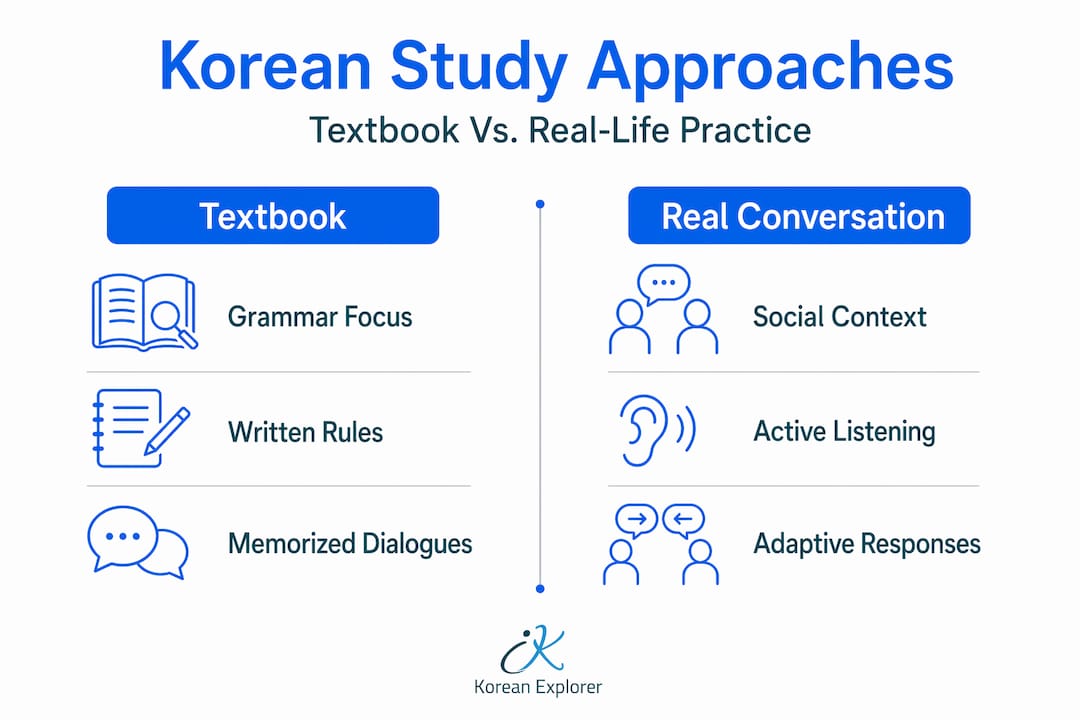
Memorized dialogues will get you through a specific scenario once. Adaptive, context-aware speaking gets you through every scenario. That is the difference between a learner who sounds rehearsed and one who sounds genuinely confident.
My take on what real Korean practice actually does
I have watched learners go through months of structured study, pass written assessments confidently, and then completely freeze in a real Korean conversation. The grammar is there. The vocabulary is there. What is missing is the instinct.
In my experience, the learners who progress fastest are not the ones who study the most. They are the ones who spend the most time in discomfort, specifically the productive discomfort of real interaction where they do not always know what to say next. That gap between understanding Korean and producing Korean in real time is where actual fluency gets built.
What I find most often underestimated is the cultural load that comes with Korean. You are not just learning words. You are learning when to speak, how much to say, and what your relationship to the other person requires of you in that moment. Grammar cannot teach you that. Only practice with real human beings in real situations can.
My honest advice: use structured study to build your foundation, but treat every real spoken exchange as the actual lesson. The textbook prepares you for the conversation. The conversation makes you fluent.
— Paul
Build real Korean fluency with Korean Explorer
Korean Explorer’s adult courses are built around exactly this principle. Lessons are conversation-focused, led by native Korean instructors who bring cultural context into every class, not just language rules. Whether you are learning for daily life in Korea, professional communication, or business settings, the speaking and listening focus means you practice the kind of Korean that actually works in real exchanges.
Flexible formats include group classes, private sessions, and live Zoom lessons, making it accessible regardless of your schedule. The curriculum covers speech levels, pragmatics, and real-life scenarios so you build confidence that holds up outside the classroom. Explore adult Korean courses designed for conversational and business fluency, or learn more about how to start by visiting learn Korean in Singapore.
FAQ
Why is real-life Korean conversation harder than studying grammar?
Korean grammar rules do not cover the social, relational, and tonal signals that shape every real exchange. Honorific calibration, cultural indirectness, and speech prosody all require live practice to develop, not just memorization.
What is the importance of honorifics in spoken Korean?
Honorifics in Korean require simultaneous awareness of the other person’s status, your own role, and the context of the conversation. ERP research confirms the brain processes honorific mismatches as pragmatic failures, meaning incorrect usage damages the relationship, not just the grammar.
How does AI practice compare to real Korean conversation?
AI conversational practice shows measurable gains in speaking and listening skills at all proficiency levels, but learners consistently note that it lacks the spontaneity and emotional depth of real human interaction. It works best as a supplement, not a replacement.
What is nunchi and why does it matter for Korean learners?
Nunchi is the Korean concept of reading social and emotional signals in a conversation in real time. It shapes how you interpret silence, indirect answers, and tone shifts, and missing it is one of the most common reasons grammatically correct Korean still fails in real situations.
How can I practice conversational Korean without living in Korea?
Use role plays based on real-world scenarios, work with native-speaking tutors, listen to unscripted Korean content like podcasts and variety shows, and take conversation-focused classes that prioritize speaking and cultural pragmatics over written exercises.