TL;DR:
- TOPIK certification verifies Korean language ability for academic, employment, and visa purposes worldwide. It offers objective proof of proficiency, influencing university admission, scholarships, job eligibility, and immigration points.
TOPIK qualification is the standardized certification that proves Korean language ability for university admission, employment, and visa eligibility worldwide. Administered by the National Institute for International Education (NIIED) under South Korea’s Ministry of Education, TOPIK tests listening, reading, and writing across six levels. The Korean Immigration Service and universities in over 80 countries recognize these scores as the official measure of Korean proficiency. Certificates remain valid for two years from the score announcement date. If you are a student or working professional weighing whether to sit the exam, understanding why pursue TOPIK qualification matters more in 2026 than ever before.
What are the main benefits of pursuing a TOPIK qualification?
TOPIK transforms subjective language claims into objective, transferable certification that institutions can trust internationally. That single shift from “I speak Korean” to “I hold TOPIK Level 4” changes how universities, employers, and immigration officers evaluate your file.
The benefits of TOPIK certification fall across three clear areas:
- University admission. Most Korean universities require a minimum of TOPIK Level 3 or 4 for admission. Competitive programs and graduate schools often set the bar at Level 5 or above.
- Scholarship eligibility. Higher TOPIK levels unlock larger awards. Level 5 or 6 holders qualify for up to 100% tuition waivers at select Korean universities. That is a direct financial return on exam preparation time.
- Employment. Office roles at Korean companies typically require Level 4. Government positions and specialized professional roles often demand Level 5 or higher. A certificate removes ambiguity from your resume and gives hiring managers a clear benchmark.
- Visa points. TOPIK Level 5 or 6 grants 20 points toward the F-2-7 skilled worker residency visa. Those 20 points represent a quarter of the 80 needed for eligibility.
- Global portability. The certification is recognized across more than 80 countries, so the credential travels with you regardless of where your career takes you.
| Goal | Minimum TOPIK level | Key benefit |
|---|---|---|
| University admission | Level 3–4 | Meets general entry requirements |
| Competitive programs | Level 5+ | Meets selective department thresholds |
| Office employment | Level 4 | Satisfies standard corporate hiring criteria |
| Scholarship (full tuition) | Level 5–6 | Qualifies for maximum award tiers |
| F-2-7 visa language points | Level 5–6 | Earns maximum 20 language points |
Pro Tip: If your goal is a full scholarship at a Korean university, aim for Level 5 before applying. Level 3 may get you through the door, but Level 5 or 6 is where the financial rewards concentrate.

The importance of TOPIK certification also lies in what it replaces: years of informal language study that no institution can verify. A single score report does the work of a dozen reference letters.
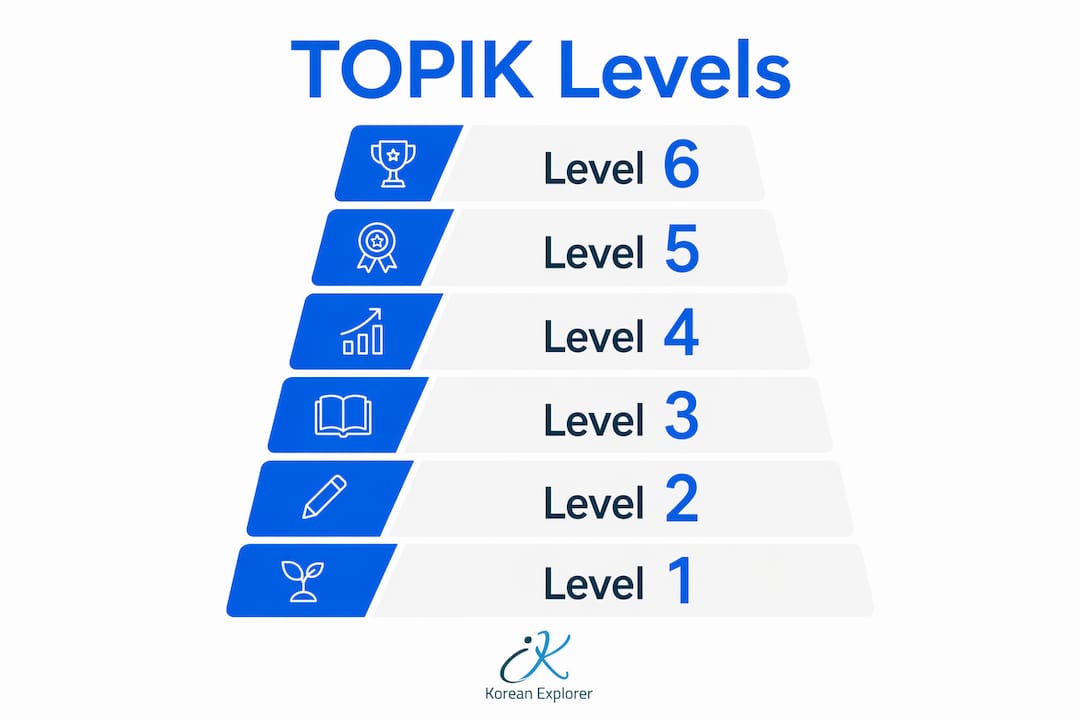
Which TOPIK levels matter most for academic and career goals?
TOPIK divides into two tiers, and knowing which tier aligns with your goal saves you from over-preparing or under-targeting.
TOPIK I: Levels 1 and 2
TOPIK I covers basic proficiency. Level 1 demonstrates survival-level Korean. Level 2 shows the ability to handle simple daily tasks and conversations. These levels suit learners who are building a foundation or preparing for entry-level language study programs. They do not meet the thresholds for university admission or professional employment in Korea.
TOPIK II: Levels 3 through 6
TOPIK II is where academic and career opportunities open up. The exam format guide at Korean Explorer breaks down exactly what each level tests, but here is the practical breakdown:
- Level 3 is the minimum for general university admission and most scholarship applications. It signals functional proficiency in academic and social contexts.
- Level 4 meets the standard for office jobs at Korean companies. Candidates at this level can read business documents, participate in meetings, and handle professional correspondence.
- Level 5 is the threshold for specialized roles, competitive graduate programs, and maximum visa language points. Many government positions require Level 5 as a floor, not a target.
- Level 6 is the highest designation. It signals near-native proficiency and carries the strongest weight in both employment and immigration contexts.
The gap between Level 2 and Level 3 is significant. TOPIK II introduces writing tasks and more complex reading passages. Learners who treat the jump casually often stall at this transition. Setting a clear level target before you begin studying shapes your entire preparation strategy.
How does TOPIK certification affect visa eligibility?
TOPIK qualification carries real weight in South Korea’s immigration point system, but the rules are specific and easy to misread.
For the F-2-7 skilled worker residency visa, TOPIK Level 5 or 6 grants 20 points toward the 80 needed for eligibility. That is the maximum language credit available through TOPIK. No other Korean language exam delivers the same point value in this system.
A critical detail many applicants miss: TOPIK no longer fulfills the Korean language requirement for the F-5 permanent residency visa. The F-5 now requires completion of the Korea Immigration and Integration Program (KIIP) instead. Submitting a TOPIK certificate for an F-5 application will not satisfy the language condition.
Here is how to use both credentials together for the best immigration outcome:
- Sit TOPIK at Level 5 or 6 to secure the 20 language points for your F-2-7 application.
- Enroll in KIIP concurrently or immediately after. KIIP Level 5 completion adds 10 bonus points and, unlike TOPIK, those points do not expire.
- Time your TOPIK exam carefully. Certificates expire after two years. A certificate that lapses during your visa application window forces a retake. Plan your exam date to align with your expected application date, not the earliest available sitting.
- Verify current requirements before submitting any visa application. Immigration policy changes regularly, and institutional requirements vary by visa category and applicant profile.
Pro Tip: Combining TOPIK and KIIP gives you both immediate point value and a permanent credential. Relying on TOPIK alone for long-term residency planning leaves a gap that KIIP fills.
Prudent applicants use TOPIK as initial qualification and layer KIIP on top to maximize total visa points and protect their residency path over time.
What challenges do candidates face preparing for TOPIK?
Difficulty increases sharply after Level 2, and most candidates who stall do so because of the writing section, not vocabulary or grammar. Understanding where the exam gets hard is the first step to getting past it.
High-scoring TOPIK candidates recommend extensive practice with past papers, with particular focus on test format and writing strategies. That advice is consistent across Level 5 and Level 6 achievers. The writing section at advanced levels includes essay tasks and graph interpretation, both of which require a specific structural approach that differs from everyday Korean writing.
Common preparation challenges include:
- Writing format unfamiliarity. Candidates often fail to reach higher levels because they do not practice the specific essay and analysis formats the exam uses. Knowing the content is not enough. You need to know how to present it within the exam’s structure.
- Time pressure. The TOPIK II writing section demands both speed and precision. Candidates who have not practiced under timed conditions consistently underperform relative to their actual ability.
- Study isolation. Advanced level preparation is harder to sustain alone. Free resources like the Seoul Global Center offer study groups and prep materials that address this directly.
- Inconsistent practice. Sporadic study sessions produce inconsistent results. Candidates who schedule regular, structured practice sessions with past papers outperform those who study reactively.
Pro Tip: Work through at least five full past papers under timed conditions before your exam date. The exam format becomes predictable with repetition, and predictability reduces test-day anxiety significantly.
The benefits of TOPIK certification are clearest when candidates enter the exam with a realistic level target and a structured preparation plan. Aiming for Level 6 without first consolidating Level 4 skills is the most common strategic error.
Key Takeaways
TOPIK qualification is the single most recognized credential for proving Korean language ability across academic, professional, and immigration contexts worldwide.
| Point | Details |
|---|---|
| Level thresholds matter | Universities require Level 3–4 minimum; office jobs require Level 4; visa maximum points require Level 5–6. |
| Certificates expire | All TOPIK certificates are valid for two years, so time your exam to match your application window. |
| F-5 visa requires KIIP | TOPIK no longer satisfies the F-5 permanent residency language requirement; KIIP completion is mandatory. |
| Writing is the main hurdle | Advanced level candidates most often stall on the writing section; structured format practice is the fix. |
| Combine TOPIK with KIIP | Using both credentials together maximizes visa points and provides a permanent language credential alongside TOPIK. |
TOPIK as a career investment, not just a language test
I have worked with adult Korean learners across a wide range of goals, from professionals seeking Korean-speaking roles in Singapore to individuals planning long-term relocation to Korea. The pattern I see most often is this: learners who treat TOPIK as a milestone within a broader language goal do far better than those who treat it as the finish line.
The certification is genuinely valuable. A Level 5 or 6 score opens doors that no amount of informal study can. But I have also seen candidates pass Level 4 and then stop studying, only to find their certificate lapsed before they used it. The two-year validity window is short when life gets busy.
My honest advice is to align your TOPIK target with a specific, near-term goal before you start preparing. If you are applying to a Korean university in 18 months, Level 3 or 4 is your target. If you are building toward an F-2-7 visa application, Level 5 is the floor. Vague goals produce vague preparation.
Stay updated on visa and institutional policy changes. The shift away from TOPIK for F-5 eligibility caught many applicants off guard. Policies move faster than most learners expect. Check current requirements directly with the relevant institution or immigration authority before committing to a level target.
TOPIK is one milestone in a longer language journey. The candidates who get the most from it are those who keep studying after they pass.
— Paul
Korean Explorer can help you reach your TOPIK target
Korean Explorer is a Korean language school in Singapore with courses built around the Seoul National University curriculum, closely aligned with TOPIK standards. Whether you are working toward conversational fluency or preparing for a specific exam level, the school’s native Korean instructors bring both language expertise and exam insight to every class.
Korean Explorer offers group classes, private sessions, and online Korean classes via Zoom, giving you flexibility to study around a full work schedule. Corporate training is also available for teams building Korean language capability for business use. The school’s structured curriculum covers the writing strategies and exam formats that advanced TOPIK candidates need most. Explore Korean language courses in Singapore at Korean Explorer and find the format that fits your schedule and your goal.
FAQ
What does TOPIK stand for?
TOPIK stands for Test of Proficiency in Korean. It is administered by the National Institute for International Education (NIIED) and recognized in over 80 countries as the official measure of Korean language ability.
How long is a TOPIK certificate valid?
All TOPIK certificates are valid for two years from the date of score announcement. Candidates must retake the exam if their certificate expires before they use it for an application.
What TOPIK level do I need for a Korean university?
Most Korean universities require a minimum of Level 3 or 4 for general admission. Competitive programs and graduate departments typically require Level 5 or above.
Does TOPIK help with permanent residency in Korea?
TOPIK grants 20 language points toward the F-2-7 skilled worker visa at Level 5 or 6, but it no longer satisfies the language requirement for the F-5 permanent residency visa. F-5 applicants must complete the KIIP program instead.
What is the hardest part of the TOPIK exam?
The writing section is the primary obstacle for candidates attempting Level 4 and above. Structured practice with past exam papers and familiarity with the essay and graph interpretation formats are the most effective ways to improve your score.