TL;DR:
- Passing the TOPIK exam requires a structured approach focused on exam format, targeted practice, and smart test-day habits.
- Understanding the distinct formats, scoring thresholds, and study hours for each level ensures effective preparation and progression.
Figuring out how to pass the TOPIK exam is a goal shared by thousands of Korean learners worldwide, yet most preparation advice stops at “study more vocabulary.” The reality is that passing TOPIK requires a structured approach covering exam format, realistic study timelines, targeted practice, and smart test day habits. Whether you are aiming for TOPIK I Level 2 or pushing toward TOPIK II Level 5, this guide walks you through every stage of preparation with concrete strategies that actually move the needle.
Table of Contents
- Key takeaways
- How to pass the TOPIK exam: start with the structure
- Building a study plan that actually works
- Resources and techniques for each exam section
- Test day strategies and pitfalls to avoid
- Verifying your progress before test day
- My honest take on TOPIK preparation
- Ready to prepare with structured Korean courses?
- FAQ
Key takeaways
| Point | Details |
|---|---|
| Know your exam structure | TOPIK I and TOPIK II have distinct formats, time limits, and scoring thresholds you must target specifically. |
| Match study hours to your goal | Reaching Level 2 takes roughly 200 hours; Levels 5 and 6 require 800 or more hours of focused practice. |
| Daily practice beats cramming | Consistent 1 to 2 hours daily produces better retention than intensive last-minute sessions. |
| Use mock tests strategically | Practice tests reveal weak areas and simulate real exam pressure so you adjust before test day. |
| Prepare your mindset and materials | Arriving early, sleeping well, and knowing the no-penalty rule for wrong answers all protect your score. |
How to pass the TOPIK exam: start with the structure
Before you study a single vocabulary list, you need to understand exactly what you are preparing for. The exam format details break down as follows: TOPIK I covers Levels 1 and 2, runs for 100 minutes, and contains 70 questions across Listening and Reading. TOPIK II covers Levels 3 through 6, runs for 180 minutes, and contains 104 multiple-choice questions plus 2 written essays.
Scoring thresholds are precise and non-negotiable. You need 80 points or more for Level 1, and the bar rises to 230 points or more for Level 6. That means walking in without knowing your target score is like training for a race without knowing the distance.
What each section tests
The Listening section plays audio clips once. You do not get a second chance to hear a recording, so active, focused listening is a skill you build over months, not days. Reading tests your ability to interpret texts ranging from signage and advertisements at the beginner level to academic and editorial passages at the advanced level.
TOPIK II adds the Writing section, which is where many candidates lose points they could have kept. It includes short-answer fill-in questions and two extended essays. The essays are scored on content relevance, vocabulary range, and grammatical accuracy. If you are targeting Level 4 or above, writing practice is non-negotiable.
Test day logistics
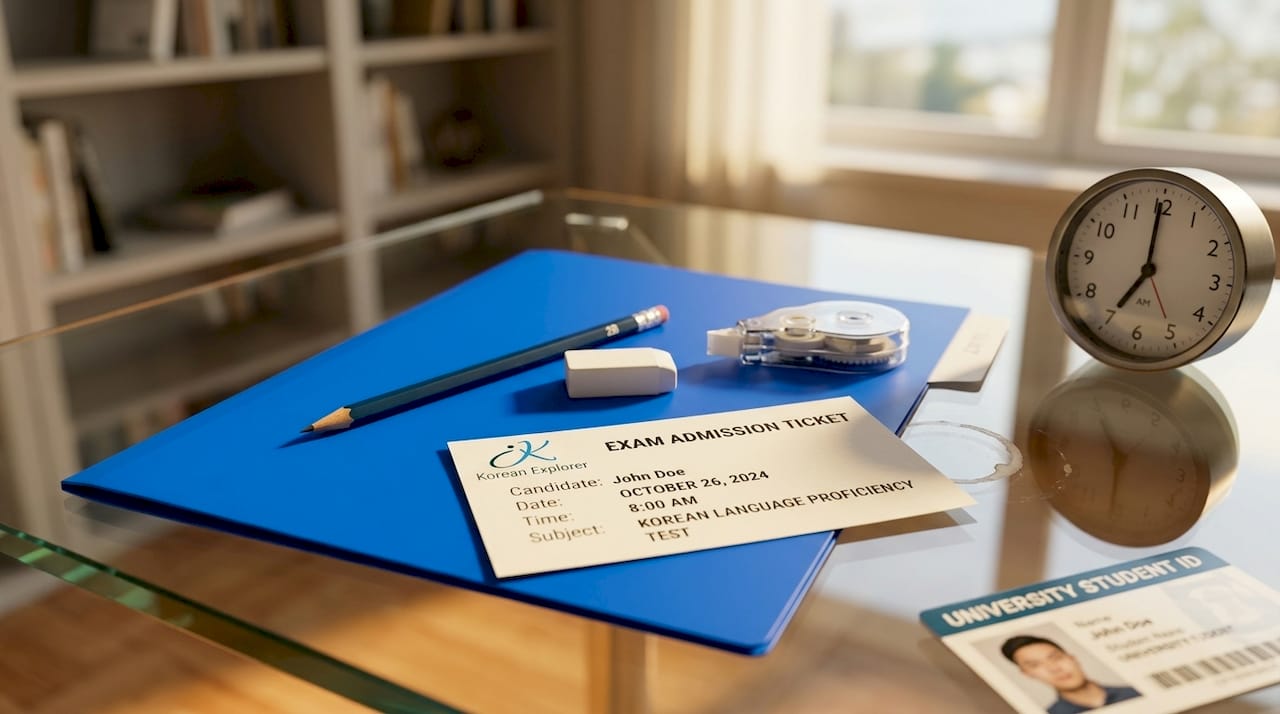
On exam day, you are required to bring valid ID, your admission ticket, a 2B pencil, an eraser, and correction tape. Missing any of these items can disqualify your entry. Plan to arrive 30 to 45 minutes early to register without stress. The exam hall environment matters more than most candidates realize, and settling in before the rush gives you a calmer starting position.
Building a study plan that actually works
The most common reason candidates fail is not lack of ability. It is lack of structure. Knowing how long to study for TOPIK at each level changes how you approach your calendar entirely.
Here is a realistic study hour guide by target level:
- Level 1: 80 to 120 hours. Focus on foundational vocabulary, basic sentence patterns, and simple listening.
- Level 2: Approximately 200 hours. Add more complex grammar and reading comprehension passages.
- Level 3: 300 to 400 hours. Introduce writing practice and expand vocabulary into daily life topics.
- Level 4: 400 to 600 hours. Work on nuanced grammar, longer reading texts, and structured essay writing.
- Level 5: 600 to 800 hours. Tackle academic and professional vocabulary, complex argument writing, and speed reading.
- Level 6: 800 or more hours. Refine every skill to near-native comprehension and production.
These are total accumulated hours, not just formal study time. Watching Korean content, speaking with natives, and reading Korean articles all count toward your total.
Structuring your daily sessions
Daily consistency matters far more than occasional marathon sessions. A 90-minute session each day, split between vocabulary review, grammar drills, and one focused listening or reading exercise, builds the neural pathways that stick. Cramming the night before an exam overloads short-term memory and collapses under pressure.
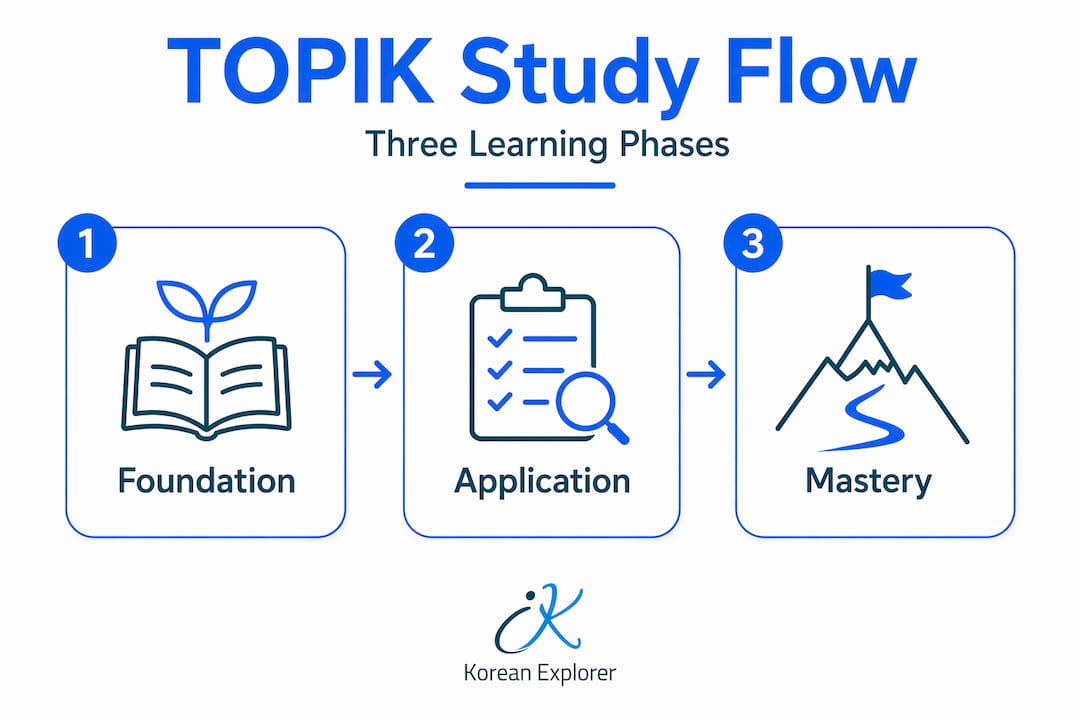
Think of your study plan in three phases. The first phase builds your foundation through grammar and vocabulary. The second phase shifts to timed practice and mock tests. The third phase, the two weeks before the exam, focuses on reviewing mistakes and consolidating what you already know rather than introducing new material.
Pro Tip: Set a weekly mock test schedule rather than treating practice tests as optional. Taking a timed practice exam every weekend from six weeks out trains your brain to perform under real conditions and shows you exactly where your score sits.
Resources and techniques for each exam section
Choosing the right TOPIK exam resources separates candidates who plateau from those who improve steadily. The official TOPIK website provides past papers going back several years, and these are your single most valuable resource. Every question type, every difficulty curve, every timing challenge you will face is represented in those papers.
Here are the most effective techniques by section:
- Listening: Use Korean podcasts, news broadcasts, and conversational content daily. Focused listening means you write down what you hear, then check your accuracy. Passive background listening does not build the discrimination skills the exam demands.
- Reading: Practice skimming for main ideas and scanning for specific information. At higher levels, reading every word is not a viable strategy given the time pressure.
- Vocabulary: Learning in context beats memorizing word lists in isolation. When you encounter a word in a passage, note the sentence around it. You will recognize it faster under exam conditions.
- Writing (TOPIK II): Practice with essay outlines before you write full drafts. A clear structure (introduction, body, conclusion) with topic sentences scores better than a fluent but disorganized response.
- Grammar: TOPIK recycles grammatical patterns across years. Study past papers and you will notice the same structures appearing repeatedly. Prioritize those over obscure grammar points.
Pro Tip: Search for TOPIK practice tests online through official sources and language learning platforms. Timed practice under realistic conditions beats untimed casual review every time.
The best strategies for TOPIK combine official past papers with targeted daily practice rather than relying on a single app or textbook. Apps are useful for vocabulary drilling, but they rarely replicate the reading or listening complexity of actual exam materials.
Test day strategies and pitfalls to avoid
Knowing the content is only half the battle. How you manage your 100 or 180 minutes determines whether that knowledge translates into points.
The consistent question patterns in TOPIK’s paper-based format mean you can plan your approach before you even open the exam booklet. For example, the first two questions in Listening typically involve matching images to audio. Knowing this lets you preview answer choices before the audio plays.
Follow these test day principles:
- Answer what you know first and skip difficult questions. Return to them with remaining time.
- Fill in your answer sheet as you go. Do not plan to transfer all answers at the end. Time runs out faster than you expect.
- Since there is no penalty for wrong answers, never leave a question blank. Use elimination to make your best guess and move on.
- For the Writing section, allocate time before the exam ends to review your essays for obvious grammatical errors and incomplete sentences.
- Keep track of time at regular intervals rather than checking the clock constantly. Set mental checkpoints at the halfway mark.
“Review systematically before the exam instead of learning new material, prioritize sleep, maintain your diet, and manage anxiety for optimal performance.” — Exam preparation research
Physical readiness is not a soft consideration. Sleep deprivation and high anxiety directly reduce your cognitive processing speed and accuracy on test day. The week before your exam is not the time to push late-night study sessions.
Verifying your progress before test day
Tracking your readiness is a separate skill from studying. Many candidates put in hours and assume they are ready. Mock tests give you data instead of assumptions.
Here is how to interpret your practice scores against passing benchmarks:
| Mock test result | What it means | What to do next |
|---|---|---|
| 15 to 20 points below target | You are close. Minor gaps remain. | Focus review on your two weakest question categories. |
| 20 to 40 points below target | Significant gaps exist in one or more sections. | Spend two weeks on intensive practice for the weakest section only. |
| 40+ points below target | Readiness is not there yet. | Consider delaying the exam and extending your study phase. |
| At or above passing threshold | You are on track. | Shift to light review and exam-day preparation only. |
When you review mistakes from mock tests, categorize them. Did you get the question wrong because you did not know the vocabulary, because you misread the question, or because you ran out of time? Each error type has a different fix. Misreading errors improve with slowing down during practice. Vocabulary gaps require targeted drilling. Time issues require more timed practice runs.
Tracking small wins also matters. Jumping from 68 to 74 points on a section is progress worth noting. Motivation sustains preparation over months, and seeing your scores improve, even incrementally, keeps you moving forward.
My honest take on TOPIK preparation
From my experience working with Korean language learners at various stages, the biggest mistake I see is candidates treating TOPIK as a vocabulary test. They fill notebooks with word lists, spend weeks on Anki decks, and then freeze on reading passages because they have never practiced reading under time pressure.
What I have found actually works is pattern recognition over breadth. TOPIK reuses question structures consistently. The candidate who has done 15 past papers understands intuitively how questions are framed, which is a significant advantage over someone who studied twice as many vocabulary cards but never sat with an actual past paper.
I also think the fluency misconception holds people back. You do not need to be conversationally fluent to pass Level 4. You need to be exam-fluent. Those are related but different skills. Someone who watches Korean dramas daily but never practices reading timed passages will underperform relative to their actual Korean ability.
My advice: treat the TOPIK exam benefits as a reason to engage more deeply with the language, not just a certification to collect. The preparation process, done well, genuinely improves your Korean. The exam score just confirms it.
— Paul
Ready to prepare with structured Korean courses?
Getting ready for the TOPIK exam is significantly easier with the right instruction behind you. Korean Explorer offers adult-focused Korean language courses in Singapore built on a curriculum developed by Seoul National University, closely aligned with TOPIK standards at every level.
Whether you prefer in-person classes at the International Plaza center above Tanjong Pagar MRT, online Zoom sessions, or corporate training for your team, Korean Explorer’s native Korean instructors provide clear, structured guidance that accelerates your progress. Explore the full range of Korean language courses to find the right fit for your proficiency level and TOPIK goals. The structured learning environment removes the guesswork from your preparation so you can focus on results.
FAQ
What is the difference between TOPIK I and TOPIK II?
TOPIK I covers Levels 1 and 2, runs 100 minutes, and includes only Listening and Reading. TOPIK II covers Levels 3 through 6, runs 180 minutes, and adds a Writing section with two essays.
How many hours do I need to study for TOPIK?
You need approximately 200 hours to reach Level 2 and over 800 hours for Levels 5 or 6, with daily sessions of 1 to 2 hours recommended over cramming.
Are there penalties for wrong answers on TOPIK?
No. There is no penalty for incorrect answers, so you should attempt every question and use elimination to make educated guesses on items you are unsure about.
What are the best free resources for TOPIK practice?
Official past papers from the TOPIK website are the most reliable free resource. They accurately reflect the question types, difficulty, and timing you will face on the actual exam.
How far in advance should I start preparing for TOPIK?
For Level 2, starting three to six months ahead with daily practice is realistic. For Levels 5 or 6, you should plan for one to two years of structured study depending on your current proficiency level.