TL;DR:
- Understanding and respecting hierarchy, indirect communication, and layered workflows are crucial for effective Korean professional interaction.
- Building trust requires patience, pre-meeting preparation, and precise use of formal channels like email and structured meetings.
Working inside a Korean corporate structure without understanding its professional Korean communication workflow is like reading a map upside down. You can see all the words clearly, yet nothing quite leads where you expect. For business professionals and expats in Singapore who regularly work with Korean counterparts, the challenge is rarely the language itself. It is the invisible system underneath: who speaks first, when silence signals respect, and why a decision that seemed settled yesterday has not moved forward today. This guide gives you the practical framework to stop guessing and start communicating with precision.
Table of Contents
- Key Takeaways
- Your professional Korean communication workflow starts here
- The Korean business meeting workflow, step by step
- Writing professional emails in Korean business settings
- Managing multi-channel workflows and decision delays
- My take on what actually works in Korean professional settings
- Build your Korean professional communication skills with Korean Explorer
- FAQ
Key Takeaways
| Point | Details |
|---|---|
| Hierarchy drives every interaction | Adjust your tone, speech level, and communication approach based on the rank of your Korean counterpart. |
| Pre-meeting preparation is non-negotiable | Share background documents early and brief team leaders privately before any formal meeting begins. |
| Silence is not disengagement | In Korean meetings, pauses and quiet responses often signal thoughtful consideration, not disagreement. |
| Email structure reflects organizational respect | Use formal greetings, logical structure, and appropriate CC usage to match Korean workplace expectations. |
| Multi-channel workflows run in parallel | Meetings, emails, and messaging apps complement each other in Korean workplaces rather than replacing one another. |
Your professional Korean communication workflow starts here
Before you send a single email or walk into a meeting room, you need to understand one foundational truth about Korean professional culture. Relational correctness outweighs grammatical accuracy in almost every workplace interaction. Foreign professionals who focus on saying the right words but ignore rank, tone, and relational signals consistently leave Korean colleagues with the wrong impression.
Korean workplaces operate on a clearly defined hierarchy. Your speech level, the words you choose, and even how long you wait before responding all communicate whether you understand this hierarchy or are blundering through it. There are three key principles that govern all professional communication in this context:
- Rank determines tone. Korean uses distinct speech levels for different relationships. Using informal speech with a senior colleague is not casual. It reads as disrespectful.
- Indirectness is a skill, not a weakness. Direct refusals or blunt disagreements put people in an uncomfortable position publicly. Korean professionals soften requests and express concerns through conditional language or private conversation.
- Patience signals competence. Expecting immediate decisions or pushing for fast responses will not accelerate anything. It signals that you do not understand how decisions get made.
The main communication channels you will work across are formal meetings, structured emails, and messaging apps such as KakaoTalk or internal platforms. Understanding how each functions within the broader workflow is what separates professionals who get things done from those who keep wondering why their proposals stall.
Pro Tip: Build your Korean listening skills specifically for professional contexts. Catching the subtle shift in tone or a hesitant pause tells you far more than the literal words being spoken.
The Korean business meeting workflow, step by step
Meetings in Korean corporate culture function very differently from the open-debate format common in Western workplaces. Understanding this specific workflow will change how you prepare, participate, and follow up.
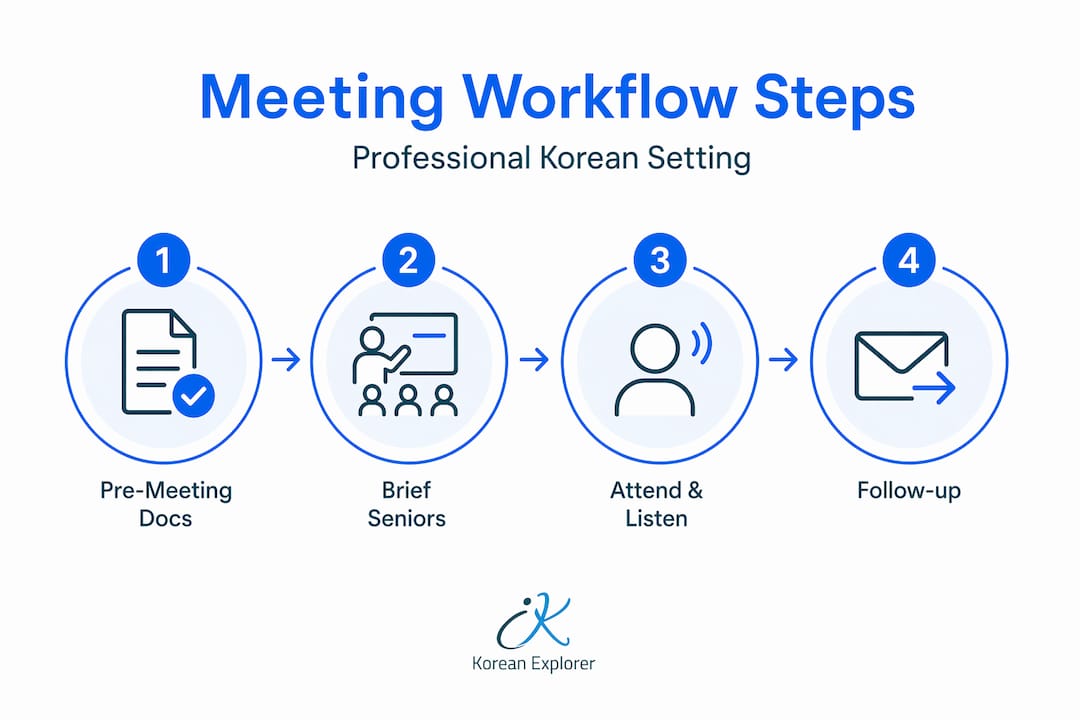
Before the meeting
The most important work happens before anyone enters the room. Share your PPT or background documents at least a full day in advance. Korean teams need time to review materials internally and align before a formal meeting. Sending documents the morning of a 2 p.m. meeting does not give decision-makers the runway they need.

Beyond documents, privately briefing the most senior Korean team member before the meeting is one of the highest-value steps you can take. This is not a shortcut. It is a recognized practice within Korean organizations. Informal pre-meeting alignment often determines how a proposal lands long before anyone sits down together. Expats who skip this step frequently find themselves confused when a seemingly well-received proposal hits unexpected resistance.
During the meeting
- Observe seating order. Korean meeting rooms organize seating to reflect rank, with senior members typically positioned centrally or at the head. Follow the lead of your Korean host rather than choosing a seat independently.
- Wait your turn to speak. Juniors typically do not open discussion unprompted. Speaking order reflects hierarchy, and senior members signal when contributions from others are welcome.
- Read silence correctly. A pause or quiet response does not mean your proposal is being rejected. Silence signals thoughtful consideration, not absence of agreement. Rushing to fill every pause with more talking disrupts the natural pace of the room.
- Express disagreement indirectly. If you have concerns, use softened conditional language rather than direct contradiction. Phrasing such as “It may be worth considering…” creates space for discussion without creating public conflict.
- Recognize that meetings confirm, not debate. Korean meetings often function as a ratification point rather than an open problem-solving session. The real deliberation has usually happened before the formal meeting starts.
Pro Tip: If you receive a vague or non-committal response during a meeting, do not push for clarity on the spot. Follow up in writing afterward, which gives your Korean counterpart a professional way to provide a considered response.
Here is a quick-reference guide to meeting phases and your role in each:
| Meeting Phase | Your Action | Common Expat Mistake |
|---|---|---|
| Pre-meeting | Share documents, brief senior contact | Sending materials same day |
| Opening | Greet in rank order, follow seating | Choosing seats randomly |
| Discussion | Contribute when invited, use indirect language | Filling silences, debating directly |
| Closing | Confirm key points clearly, do not rush | Pushing for immediate final decisions |
| Post-meeting | Document decisions, allow review time | Expecting instant written confirmation |
Writing professional emails in Korean business settings
Email remains the formal backbone of Korean professional communication. Despite the widespread use of messaging apps, formal email documentation preserves the organizational record and signals that you take the relationship seriously.
Here is what effective Korean business email practice looks like in action:
- Start with a formal greeting that acknowledges rank. Address the recipient by their title and position. “Dear Manager Kim” is standard. Using only a first name reads as presumptuous unless you have been explicitly invited to do so.
- Structure your email with a clear purpose in the first paragraph. Korean business emails typically open with context, state the request or update in the middle, and close with a polite statement of gratitude or next steps.
- Use indirect language for requests. Instead of “Please send the report by Friday,” a phrase like “If possible, it would be greatly appreciated if the report could be shared by Friday” preserves face and allows your counterpart some flexibility.
- CC strategically. CC in Korean workplaces reflects organizational transparency. Including supervisors on an email is not a sign of distrust. It signals awareness of hierarchy and keeps the right people informed. Omitting someone who should be included is a far bigger misstep than over-including.
- Close with a polite formula. Ending with a phrase equivalent to “Thank you for your time and consideration” is expected, not optional.
Common mistakes to avoid, especially for expats coming from direct communication cultures:
| Expat Habit | Korean Professional Expectation |
|---|---|
| Subject lines that are too casual | Clear, formal subject lines stating the exact topic |
| Opening without context | Brief background on why you are writing |
| Direct requests without softening | Conditional or polite phrasing for any ask |
| Omitting supervisors from CC | Including relevant senior contacts as a standard practice |
| Short, abrupt closings | Formal closing with appreciation |
Managing multi-channel workflows and decision delays
One of the most disorienting aspects of optimizing communication workflows in Korea for outsiders is realizing that channels do not replace each other. They layer on top of each other. A decision discussed in a meeting will be followed up by email, confirmed through a messaging app, and may loop back to another meeting before it is final.
This is not inefficiency. It is how Korean organizations build consensus and maintain transparency across levels of hierarchy.
Here is how to work with this reality rather than against it:
- Expect at least one full business day before receiving a decision on any significant proposal. Korean teams confer internally before finalizing responses. Sending a follow-up email a few hours after a meeting signals impatience, not urgency.
- Use messaging apps for relationship maintenance, not formal decisions. Platforms like KakaoTalk are appropriate for checking in, sharing updates informally, or confirming logistics. Major decisions should always be documented by email.
- Document after every significant interaction. Sending a brief summary email after a meeting (“Thank you for today’s discussion. To confirm our understanding…”) serves two functions. It protects your professional record and gives Korean counterparts a chance to clarify anything before it becomes an assumption.
- Clarify without pressuring. If a decision is running longer than expected, a single polite email referencing your timeline is appropriate. Frame it as providing helpful context, not a demand. Continuous polite clarification aligns with Korean professional norms far better than direct follow-up pressure.
- Know which channel carries authority. In most Korean organizations, email carries more formal weight than messaging apps for professional documentation. When something matters, email it.
My take on what actually works in Korean professional settings
I have watched a lot of professionals from Singapore and elsewhere arrive in Korean business environments fully prepared to communicate clearly, only to find that their clarity reads as abruptness. The single biggest shift that changes outcomes is understanding that in Korean professional culture, how you say something carries as much weight as what you say.
The expats who adapt fastest are not the ones who speak the most Korean. They are the ones who learn to read indirect cues well. They notice when a meeting goes quiet. They send background materials in advance without being reminded. They brief the right person before the formal discussion and then treat the formal meeting as confirmation rather than negotiation.
What I tell professionals is this: patience is not a soft skill here. It is a core professional competency. Waiting for a decision to travel through the proper internal channels, then documenting it correctly across the right communication channels, is how trust gets built. Rush that process and you are not being efficient. You are signaling that you do not understand the system you are working within.
One more thing. The biggest misconception I see is that language fluency alone will solve the problem. It helps. But a professional who knows a hundred business Korean phrases yet does not understand how to navigate Korean workplace communication will still stumble. The language and the workflow have to develop together.
— Paul
Build your Korean professional communication skills with Korean Explorer
If this article has made one thing clear, it is that effective professional Korean communication is both a language skill and a cultural competency. The two cannot be separated, especially for business professionals in Singapore working with Korean companies or teams.
Korean Explorer offers adult Korean courses purpose-built for exactly this kind of professional context. Whether you are preparing for meetings with Korean partners, writing formal business emails, or building the relational fluency that makes real collaboration possible, Korean Explorer’s business-focused programs at Korean language courses give you both the language and the cultural framework together. Classes are available in group, private, and online Zoom formats, making it accessible whether you are in the office or working remotely. Corporate training programs are also available for teams. Korean Explorer is located at 10 Anson Road, level 22, International Plaza, right above Tanjong Pagar MRT. Explore the full range of programs at Korean Explorer and find the format that fits your professional goals.
FAQ
What is a professional Korean communication workflow?
A professional Korean communication workflow is the structured sequence of preparation, participation, and follow-up steps used to communicate effectively within Korean corporate culture. It accounts for hierarchy, indirect communication styles, and the layered use of meetings, email, and messaging channels.
Why does hierarchy matter so much in Korean workplace communication?
Korean workplaces prioritize relational correctness, meaning that speech level, tone, and timing all shift based on rank. Getting hierarchy wrong, even with perfect grammar, can create unintended impressions of disrespect or overstepping.
How should I handle silence in Korean business meetings?
Silence in Korean meetings typically signals respectful consideration rather than confusion or disagreement. Allow pauses to run their course and resist the urge to fill them. Following up in writing after the meeting is the appropriate way to seek clarity.
How far in advance should I send materials before a Korean business meeting?
Send any background documents or presentation materials at least one full business day before the meeting. Korean teams need time to review internally and align before formal discussions begin.
How can I improve my Korean professional communication skills in Singapore?
Structured language courses focused on business Korean are the fastest path forward. Korean Explorer offers courses in Singapore covering formal writing, meeting etiquette, and professional conversation, with flexible formats including online Zoom classes and corporate training programs.