TL;DR:
- Learning Korean in Singapore has shifted from casual entertainment to structured courses aimed at career, academic, and cultural proficiency. Students and professionals benefit from Singapore’s strong Korea-Singapore ties, with opportunities to achieve fluency through tailored classes, immersion, and certification like TOPIK. A strategic combination of structured learning, cultural engagement, and community participation accelerates progress toward confident, practical Korean language skills.
Learning Korean in Singapore has moved well beyond K-drama marathons and memorizing song lyrics. A growing number of students, working professionals, and lifelong learners are enrolling in structured Korean classes to advance their careers at Korean-owned multinationals, qualify for exchange programs at Korean universities, or simply communicate more meaningfully when traveling to Seoul. The demand is real, the opportunities are expanding, and the pathway to fluency is more accessible in Singapore than most people realize. This guide walks you through every major decision, from picking the right course to preparing for formal certification.
Table of Contents
- Why learn Korean in Singapore?
- Choosing the right Korean language course
- Essential skills to master when learning Korean
- Integrating Korean culture into your language journey
- Testing your Korean proficiency: placement and certification
- Our perspective: what most guides miss about Korean learning in Singapore
- How Korean Explorer can support your learning journey
- Frequently asked questions
Key Takeaways
| Point | Details |
|---|---|
| Broader benefits | Learning Korean in Singapore opens academic, career, and cultural opportunities. |
| Find your perfect course | Compare group, private, and online courses to match your learning style and goals. |
| Skill mastery | Focus on pronunciation, grammar, and conversational skills for lasting fluency. |
| Culture accelerates learning | Engaging with Korean culture deepens motivation and retention. |
| Certification matters | Placement and proficiency tests help track progress and unlock new opportunities. |
Why learn Korean in Singapore?
South Korea and Singapore share strong economic and diplomatic ties, which creates practical demand for Korean language skills that extends far beyond cultural enthusiasm. Bilateral trade between the two countries has grown steadily over the past decade, and Korean firms like Samsung, LG, Hyundai, and a wide network of Korean small and medium enterprises operate actively in Singapore. For job seekers or employees at these companies, learning Korean in Singapore offers a genuine professional edge that fluency in a third language often delivers.
Beyond employment, the academic case is compelling. Several universities in Korea rank among the top institutions in Asia, and Korean exchange programs increasingly require at least basic language proficiency. Students pursuing business, engineering, or design may find that Korean language skills open doors to internships and dual-degree options that simply are not available to monolingual applicants.
Cultural access is another motivator that serious learners describe again and again. When you read Korean literature, watch films without subtitles, or navigate a local neighborhood in Seoul, you access layers of meaning that translation simply cannot carry. Idioms, humor, social relationships, and historical context are all embedded in the language itself.
Here is a quick snapshot of why Singapore residents are making the investment:
- Career advancement at Korean multinational companies operating in Singapore
- Academic opportunities including exchange programs and research partnerships with Korean universities
- Travel confidence when visiting Korea for tourism, family, or business
- Cultural access to film, literature, music, and culinary traditions in their original form
- Personal connections with Korean friends, family members, or partners
“Language learning is no longer a soft skill. For the globally connected professional, it is a strategic advantage that compounds over a career.” This reflects what many Korean language learners in Singapore are discovering firsthand.
Choosing the right Korean language course
Once you understand your reasons for learning, the next decision is how to structure your education. Several options exist, each with distinct advantages depending on your schedule, budget, and learning style.
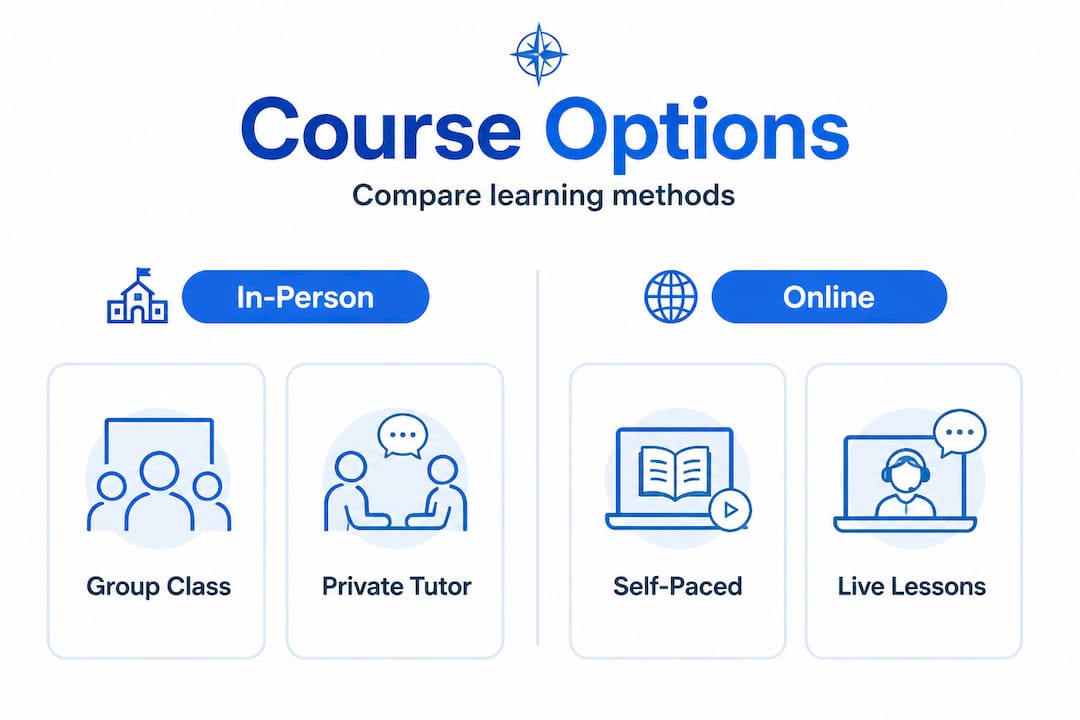
Group classes are the most popular entry point. They offer structured progression through grammar and vocabulary, regular interaction with peers at a similar level, and the motivation that comes from a shared learning environment. Costs are generally lower per hour than private lessons, and group settings create natural opportunities to practice conversational Korean in real time.
Private tutoring works well for learners who need a highly customized pace, have an irregular schedule, or want to focus on a specific skill like business Korean or exam preparation. Private Korean tutoring tends to cost more per session but often produces faster results for motivated learners because every minute of instruction is tailored to their exact gaps.
Online courses offer the greatest flexibility. You can study from home, at your own pace, and often access recorded materials that reinforce classroom content. The trade-off is that without a live instructor, it is easy to develop bad pronunciation habits or stall on grammar concepts that need real-time correction.
| Format | Best for | Cost level | Certification pathway |
|---|---|---|---|
| Group classes | Structured beginners and intermediate learners | Low to moderate | Yes, with proficiency-aligned curriculum |
| Private tutoring | Fast-track or specialized learners | High | Yes, customized to goals |
| Online courses | Flexible schedule learners | Low | Varies by provider |
| Hybrid programs | Learners wanting both structure and flexibility | Moderate | Yes, with school enrollment |
When evaluating your options, follow this sequence:
- Define your goal clearly: conversational fluency, TOPIK certification, business Korean, or academic preparation.
- Check whether the school uses a recognized curriculum, such as the one developed by Seoul National University.
- Look for placement testing so you start at the right level, not too easy and not frustratingly advanced.
- Confirm that instructors are native Korean speakers with formal teaching qualifications.
- Read reviews from past students with goals similar to yours, not just general satisfaction ratings.
Exploring the best ways to learn Korean and comparing Korean language schools in Singapore side by side will help you make a confident, informed choice.
Pro Tip: Always ask a school whether their curriculum aligns with TOPIK standards. This alignment ensures that what you learn in class directly supports your performance on internationally recognized proficiency tests, which matters enormously if you ever need certified proof of your Korean ability.
Essential skills to master when learning Korean
After choosing a course, you need to know where to focus your energy. Korean has four core skill domains, and neglecting any one of them creates an imbalance that slows your overall progress.
Pronunciation is the foundation. Korean uses Hangul, a phonetically consistent alphabet that most learners can read within a few days. But reading Hangul accurately and speaking it naturally are two different things. Sounds like ㅓ, ㅡ, and the aspirated consonants (ㅋ, ㅌ, ㅍ) have no direct equivalent in English and require deliberate practice. Investing time in improving Korean pronunciation early means you avoid reinforcing errors that become harder to correct at higher levels.
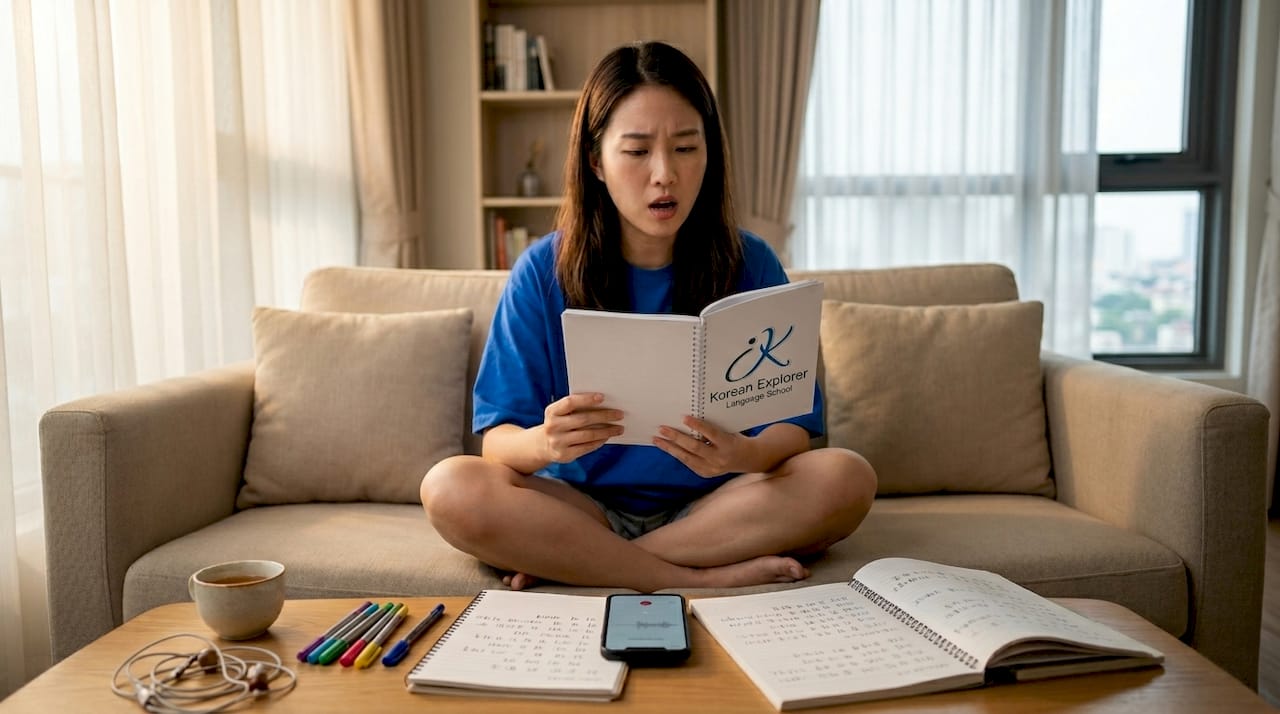
Grammar in Korean follows a subject-object-verb structure, which is the opposite of English. Verbs come at the end of sentences, particles attach to nouns to indicate their grammatical role, and honorific levels change depending on who you are speaking to. Mixing up formal and informal speech registers is one of the most common mistakes learners make, and it can come across as rude to native speakers even when the vocabulary is correct.
Vocabulary builds faster when you connect words to real contexts. Learning “restaurant vocabulary” as a cluster is more efficient than memorizing a random word list. Korean also has a large proportion of vocabulary borrowed from Chinese (Sino-Korean words) and a growing number of English loanwords, which gives English speakers more familiar footholds than they might expect.
Conversational fluency is where everything connects. Many learners study for months and still freeze when a native speaker responds faster than expected or uses informal slang. Regular speaking practice with real people, not just textbook dialogs, is what bridges the gap between classroom knowledge and real-world confidence.
Here are the key skill-building habits that consistently produce results:
- Listen to Korean podcasts or drama audio daily, even passively, to train your ear to natural speech rhythms
- Speak out loud during every study session, not just when practicing with others
- Write short Korean sentences from memory to reinforce grammar patterns without copying
- Review new vocabulary in context, using full sentences rather than isolated flashcards
- Record yourself speaking and compare it to native speaker audio to self-correct pronunciation
Pro Tip: Watching Korean dramas or variety shows with Korean subtitles, not English ones, forces your brain to process both audio and text in the target language simultaneously. This habit significantly accelerates listening comprehension and vocabulary retention.
Integrating Korean culture into your language journey
Language and culture are inseparable. Research consistently shows that learners who engage with a culture while studying a language retain vocabulary longer, understand grammar intuitively, and feel more motivated to continue when progress slows. Singapore actually offers more Korean cultural touchpoints than most learners realize.
Exploring facts about Korean culture is a great starting point for understanding the social customs and values that shape how Korean people communicate. Concepts like nunchi (reading the room) and jeong (deep emotional attachment) are not just interesting trivia. They explain why certain polite phrases exist and why context matters so much in Korean conversation.
| Cultural activity | Learning value | Where to find it in Singapore |
|---|---|---|
| Korean film screenings | Listening comprehension, informal speech | Shaw Theatres, Korean Cultural Center events |
| Korean cuisine exploration | Food vocabulary, cultural rituals | Tanjong Pagar, Bugis Korean restaurant clusters |
| K-pop or traditional music events | Pronunciation patterns, rhythm, vocabulary | Esplanade, school-organized cultural events |
| Language exchange meetups | Conversational practice, peer correction | Meetup groups, university Korean clubs |
| Korean drama viewing groups | Natural speech patterns, idioms | Community centers, online communities |
Practical ways to weave culture into your weekly study routine:
- Follow Korean social media accounts and read captions without translation aids
- Cook a Korean dish each week using a recipe written in Korean
- Watch one Korean film or drama episode per week and journal two new expressions you learned
- Attend at least one Korean cultural event per month to practice vocabulary in a social setting
- Connect with the Korean community in Singapore through language exchange partnerships
Testing your Korean proficiency: placement and certification
As your skills develop, assessment becomes an important tool for both direction and credibility. Two types of testing matter most for Korean learners in Singapore: placement tests and formal certification.
Placement tests are offered by language schools before enrollment. They prevent a frustratingly common problem: starting in a class that is too easy (boring and wasteful) or too advanced (confusing and discouraging). A good placement test evaluates reading, grammar, and speaking to match you with the right level from day one.
TOPIK (Test of Proficiency in Korean) is the globally recognized standard for Korean language certification. Understanding what the TOPIK test involves is essential if you plan to study in Korea, apply for jobs at Korean companies, or support a visa application. TOPIK I covers beginner levels 1 and 2, while TOPIK II tests intermediate through advanced learners at levels 3 through 6.
The test format focuses on reading, listening, and writing. Speaking is not currently included in the standardized exam, which means your spoken fluency is built through classroom practice rather than tested formally. Preparation for TOPIK includes:
- Taking a diagnostic test to identify your current level and target band
- Studying grammar patterns commonly tested at your target level
- Building vocabulary through topic-based clusters aligned with TOPIK themes
- Practicing timed reading comprehension with past TOPIK papers
- Focusing heavily on listening practice using official TOPIK audio recordings
“TOPIK certification is increasingly appearing in job postings and university admission requirements, making it a credential worth pursuing for anyone serious about Korean language skills.” Whether your goal is work, study, or migration, formal certification adds weight to your language investment.
Our perspective: what most guides miss about Korean learning in Singapore
Most online guides treat Korean language learning as a purely technical challenge. They focus on apps, textbooks, and grammar tables, and they miss what actually separates learners who reach fluency from those who plateau after a year of study.
The real bottleneck is almost never knowledge. It is application without feedback. Self-guided learners can accumulate hundreds of hours of input through apps and YouTube videos, but without consistent correction from qualified instructors and practice with real speakers, errors calcify into permanent habits. We have seen this pattern repeatedly: enthusiastic beginners who make rapid early progress, then hit an intermediate plateau where self-study tools stop being adequate.
What breaks the plateau? Structured environments with live instruction, peer accountability, and regular assessment. Exploring effective learning methods consistently points back to the same insight: a combination of structured curriculum, cultural immersion, and measurable progress milestones outperforms any single approach taken in isolation.
The other thing most guides underestimate is community. Language is social by nature. Learners who join study groups, attend cultural events, and have regular conversations with Korean speakers progress faster and stay motivated longer than those who study alone. In Singapore, you have access to a genuine Korean community, Korean-owned businesses, and culturally active language schools. Use all of it.
Our honest advice: build a personal action plan that includes a structured course, regular cultural engagement, and a clear certification target. Check your progress every three months, not just when you feel uncertain. Small, consistent effort tracked against real milestones builds fluency in a way that binge-studying for two weeks and then stopping never will.
Pro Tip: Join a Korean language learning group on social media or in person within your first month of study. Peer support and shared accountability are proven motivators that keep you consistent through the inevitable slow periods.
How Korean Explorer can support your learning journey
If you are ready to move from casual interest to real, measurable progress, Korean Explorer offers the structure and support to get you there.
Korean Explorer’s Korean language courses range from complete beginner to advanced proficiency, all built on the Seoul National University curriculum and aligned with TOPIK standards. Whether you prefer group classes, private lessons, or online formats, there is a pathway suited to your schedule and goals. The school’s Korean placement test ensures you start at the right level so your first class feels productive, not frustrating. Singapore residents interested in government training credits should verify course eligibility on MySkillsFuture before enrolling. The City campus is above Tanjong Pagar MRT. Confirm the campus for your preferred class on the current timetable.
Frequently asked questions
What course levels are available for Korean learners in Singapore?
Most language schools offer beginner through advanced levels, typically structured across six or more tiers that align with TOPIK proficiency bands and are adapted for different age groups and backgrounds.
How can I find private Korean tutors in Singapore?
You can contact language centers directly for referrals to certified teachers, or search private tutoring options through reputable schools that vet their instructors for qualifications and teaching experience.
Is the TOPIK test necessary for Korean language learners?
The TOPIK test is strongly recommended if you need official proof of proficiency for university enrollment, job applications, or visa purposes, but it is optional for learners focused purely on personal or conversational goals.
Where can I attend cultural events to practice Korean in Singapore?
Korean cultural centers, annual festivals, university Korean language clubs, and Korean cultural events organized by language schools are all active venues in Singapore where you can practice the language in a social, immersive setting.