TL;DR:
- Small class sizes between 6 to 15 students enhance learning speed and personalized feedback.
- Instructor quality, especially native speakers with bilingual skills, is crucial for effective learning.
- Alignment with recognized standards like TOPIK and a supportive learning environment determine course effectiveness.
Most Singaporeans assume that enrolling in any Korean class will get them to fluency. That assumption is expensive in both time and money. The reality is that small class sizes enable twice as fast level completion compared to self-study or large classes. Structure, instructor quality, and curriculum alignment are not bonus features. They are the core ingredients that separate courses that actually work from ones that leave you stuck at “annyeonghaseyo” after six months. This guide breaks down every factor you need to evaluate before committing to a program.
Table of Contents
- Core pillars of a high-quality Korean course
- Structured learning vs. self-study: What works best?
- The Singapore standard: What top-rated Korean courses deliver
- How to evaluate and choose your ideal Korean course
- What most course seekers miss and why it matters
- Ready to experience a high-quality Korean course?
- Frequently asked questions
Key Takeaways
| Point | Details |
|---|---|
| Small class sizes | Classes of 6–15 students lead to more interaction and faster Korean language progress. |
| Structured curriculum matters | Courses with systematic grammar and reading progression outperform self-study for sustained learning. |
| Certified instructors | Native or trained teachers deliver authentic language, feedback, and cultural insights. |
| Global standards | Programs aligned with King Sejong or TOPIK offer recognized quality benchmarks and satisfaction. |
| Student outcomes | Track record of high completion rates and positive student reviews signals course quality. |
Core pillars of a high-quality Korean course
Not all Korean courses are built the same. Some focus on casual conversation without a structured progression. Others teach grammar in isolation without real-world context. A genuinely high-quality program is built on several non-negotiable pillars that work together to produce measurable results.
Class size matters more than you think. The sweet spot is 6 to 15 students. Below that range, group dynamics and peer-to-peer practice suffer. Above it, instructors lose the ability to correct individual errors in real time. Structured Korean learning in small groups creates a feedback loop that speeds up acquisition at every stage.
Instructor quality is the single biggest variable. A trained native Korean speaker who is also fluent in English brings two things to the classroom that no app or textbook can replicate: authentic pronunciation modeling and the ability to explain nuance across both languages. Without that dual fluency, explanations often fall flat for Singapore learners.
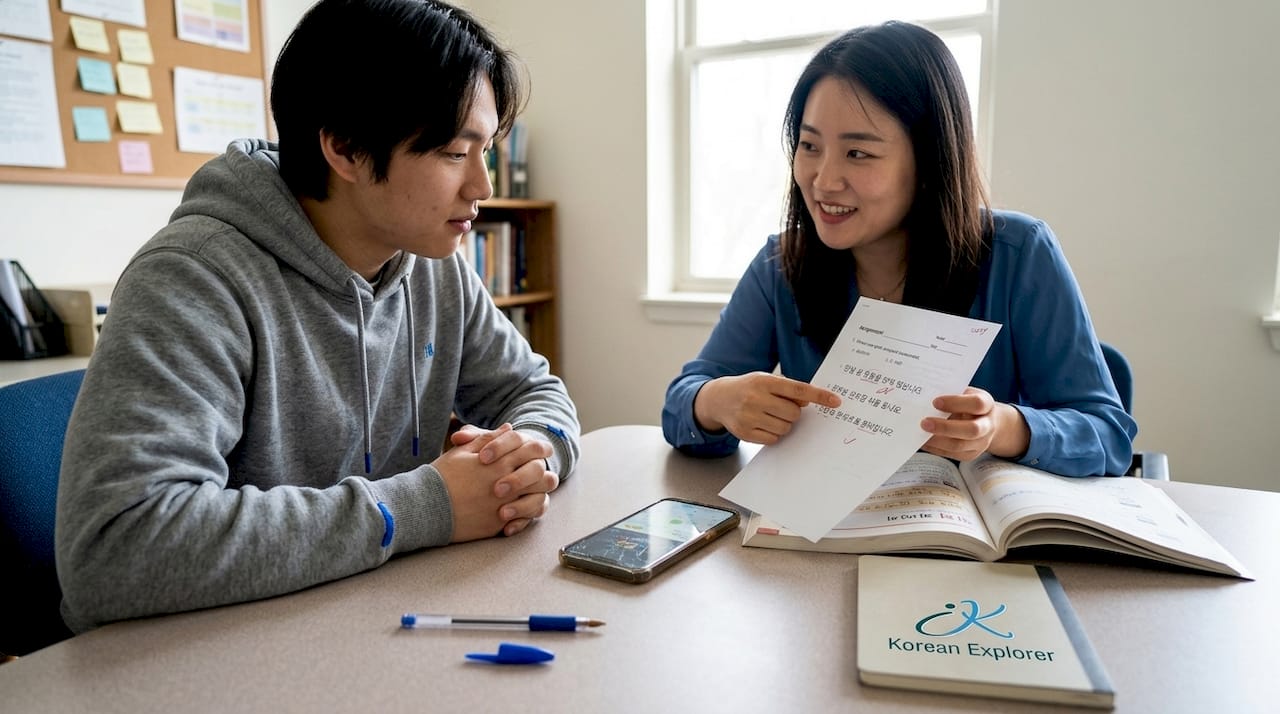
Curriculum alignment signals global credibility. Courses tied to recognized standards such as TOPIK (Test of Proficiency in Korean) or the King Sejong Institute framework give you a clear progression path. King Sejong Institutes report a 92.5/100 student satisfaction score, with particularly strong ratings for curricula, textbooks, and cultural programs. That benchmark matters when evaluating any school’s claims.
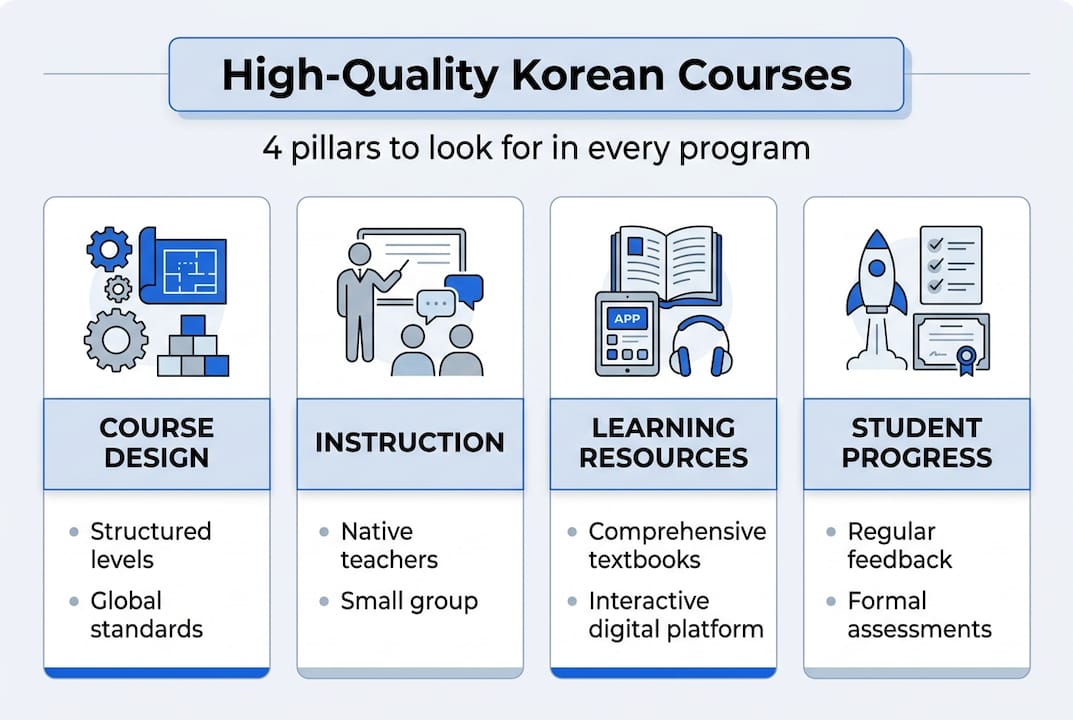
Here is a quick comparison of what separates strong programs from weak ones:
| Feature | High-quality course | Low-quality course |
|---|---|---|
| Class size | 6 to 15 students | 20 or more students |
| Instructor | Native speaker, bilingual | Non-native or monolingual |
| Curriculum | TOPIK or King Sejong aligned | No recognized framework |
| Progress tracking | Regular assessments | No formal checkpoints |
| Cultural integration | Embedded in lessons | Absent or optional |
Key pillars to look for when evaluating any program:
- Structured curriculum with clear level progression
- Native instructors who can explain in English
- Alignment with TOPIK or internationally recognized standards
- Cultural content woven into lessons, not tacked on
- Transparent progress tracking and certification pathways
Pro Tip: Always ask a school for real student outcomes, not just course descriptions. Completion rates, average time to level-up, and TOPIK pass rates tell you far more than a brochure ever will. Strong Korean course structure is always backed by data.
Structured learning vs. self-study: What works best?
Self-study has obvious appeal. You set the schedule, choose the resources, and move at your own pace. Korean apps, YouTube channels, and grammar books are everywhere. So why do so many learners stall?
The data is sobering. 90% self-study dropout rate is the harsh reality for independent learners, compared to significantly higher fluency and completion rates in structured classes. That is not a minor gap. It reflects a fundamental mismatch between how motivated learners start and how sustainable their methods actually are.
Here is how a structured course progresses versus the typical self-study path:
| Stage | Structured course | Self-study |
|---|---|---|
| Hangul | Syllable-block method, guided | Random video tutorials |
| Grammar | Stepwise, with corrections | Inconsistent, no feedback |
| Speaking | Regular practice with peers | Rare, often delayed |
| Reading accuracy | High, with drills | Often slow to develop |
| Accountability | Instructor and classmates | None |
The structured approach wins at each stage because of design, not luck. Classroom Korean lessons use syllable-block Hangul instruction, which is proven to improve reading accuracy faster than the trial-and-error method most self-studiers rely on.
A step-by-step look at how quality programs build fluency:
- Introduce Hangul through syllable blocks, not just romanization
- Layer grammar rules in a logical sequence with immediate practice
- Use peer conversation exercises to build speaking confidence early
- Provide instructor feedback on pronunciation and sentence structure
- Assess progress at the end of each level before advancing
“After two months of self-study, I could barely read a menu. After one month in a structured class, I was forming full sentences.” This kind of turnaround is common among Singapore learners who switch from apps to formal classes.
For anyone serious about achieving real-world fluency, the comparison is not close. Reviewing Hangul learning tips before starting a course can help you hit the ground running once you enroll.
The Singapore standard: What top-rated Korean courses deliver
Singapore’s best Korean language programs do not just follow global frameworks. They adapt those frameworks to a local learner profile: multilingual, goal-oriented, and often balancing study with professional commitments. That distinction matters.
Alignment with TOPIK is a practical priority for Singapore learners eyeing Korean universities, multinational workplaces, or K-entertainment industry roles. TOPIK-aligned courses from established providers with native instructors are specifically recommended for career and academic advancement, because these credentials are recognized by Korean institutions and global employers alike.
What Singapore’s top programs typically offer:
- Beginner to advanced levels with clear entry and exit criteria
- Exam prep tracks for TOPIK I and TOPIK II
- Flexible scheduling including weekday, weekend, and online formats
- Regular level assessments with documented progress
- Cultural immersion built into coursework, not just optional events
Student satisfaction at globally recognized institutions using King Sejong-aligned curricula averages 92.5 out of 100, with cultural programs scoring 92.2 and curricula scoring 90.5. These are not marketing numbers. They represent learner experience across dozens of countries.
As a general guide, quality courses in Singapore typically range from SGD 300 to SGD 600 per term, depending on class size, level, and format. Private lessons run higher. That price range reflects the cost of trained native instructors, proper materials, and structured assessments. Unusually cheap courses are often cheap for a reason.
Pro Tip: Before enrolling, ask whether the school offers official certification opportunities and how often students sit for TOPIK. A school that actively prepares students for that exam is a school confident in its teaching. Working with professional Korean teachers makes a measurable difference in exam outcomes. Also check whether Korean course levels are standardized across the curriculum.
How to evaluate and choose your ideal Korean course
Knowing what quality looks like is only useful if you can actually spot it when comparing schools. Here is a practical process for making a confident decision.
Step-by-step evaluation process:
- Shortlist three to five schools based on location, format (group, private, online), and schedule compatibility
- Verify each school’s curriculum framework. Ask directly: Is this aligned with TOPIK or King Sejong standards?
- Check instructor qualifications. Native speaker status alone is not enough. Ask whether teachers are trained educators with experience in second-language instruction
- Review class structure. Confirm the student-to-teacher ratio falls in the 6 to 15 range, since small class sizes lead directly to faster progress and more personalized feedback
- Request student outcome data. Ask for level completion rates, average progression timelines, and TOPIK results if applicable
Questions to ask every provider before enrolling:
- What is your average class size?
- Are all instructors native Korean speakers trained in language education?
- Which curriculum framework do you follow, and is it TOPIK aligned?
- How do you track and document student progress?
- Do you offer trial lessons before full enrollment?
- Can I speak to current students or read verified reviews?
Once you have answers, compare them side by side. A school that hesitates on any of these questions is worth watching. A school that answers confidently and provides evidence is worth enrolling in. Use tools like Google Reviews and language learning forums to cross-check claims before you commit.
If you are still unsure where to start, find Korean classes that match your schedule and goals. For a deeper breakdown by level and learning style, the expert Korean course guide covers the full landscape of options available in Singapore right now.
What most course seekers miss and why it matters
Most people hunting for a Korean course spend hours comparing class sizes, prices, and accreditations. Those things matter. But in our experience working with Singapore learners, the factor that most often determines long-term success is something harder to measure: the learning environment culture.
A school where students feel comfortable making mistakes is a school where students actually improve. A peer group that celebrates small wins pushes everyone forward. These dynamics are invisible on a course comparison spreadsheet but they show up clearly in retention and results.
Our honest advice: visit the classroom, even virtually, before committing. Sit in on a trial lesson. Talk to someone currently enrolled, not just alumni testimonials on the school’s website. Ask them whether they feel supported between lessons. The answers reveal more than any brochure.
Shiny facilities and a long list of certifications are useful signals. But real course results come from consistent engagement, a teacher who remembers your name, and a class where showing up feels worth it every single week.
Ready to experience a high-quality Korean course?
You now have a clear picture of what separates a truly effective Korean course from one that just looks good on paper. The next step is putting that knowledge to work.
At Korean Explorer, we offer Korean language courses built on a Seoul National University curriculum that is fully aligned with TOPIK standards. Whether you are starting from zero, preparing for an exam, or advancing your career, we have structured programs for every level. Our native instructors keep classes small and focused, so you progress faster. SkillsFuture Korean courses are also available for eligible learners, and our dedicated TOPIK test preparation track gives you the best shot at certification success. Book a trial lesson today.
Frequently asked questions
What is the ideal class size for effective Korean learning?
A class size of 6 to 15 students allows for personalized feedback and much faster progress than larger groups or self-study. Smaller classes give instructors the time to correct errors and keep every student actively engaged.
Why do structured programs outperform self-study for Korean?
Structured programs provide a clear curriculum, expert feedback, and built-in accountability. The 90% self-study dropout rate versus higher fluency in structured classes shows the gap is significant, not marginal.
Are King Sejong model schools considered high quality?
Yes. King Sejong Institutes consistently earn strong learner ratings, with an average satisfaction of 92.5/100 across curricula, textbooks, and cultural programs. That benchmark sets the standard globally.
What should I look for when choosing a Korean class in Singapore?
Prioritize small class size, native or trained teachers, and TOPIK-aligned programs from established providers. Verified student outcomes are the most reliable signal of a school’s true quality.