TL;DR:
- Learning Korean begins with mastering Hangul, which can be achieved quickly and removes major pronunciation barriers.
- Setting clear goals guides resource selection, study focus, and progression pace, ensuring efficient learning.
Learning Korean feels exciting until you sit down to start and realize you have no idea where to begin. Vocabulary apps, YouTube channels, grammar books, and conversation classes all compete for your attention. For busy learners in Singapore juggling work, school, and social commitments, that noise quickly becomes paralysis. The good news is that Korean mastery is not a mystery. It follows a predictable sequence, and when you understand that sequence, every hour you invest compounds into real, lasting skill. This guide lays out exactly what to do, in what order, and how to stay on track long enough to reach fluency.
Table of Contents
- Understanding the foundations of Korean language learning
- Step-by-step roadmap: Core milestones to fluency
- Common challenges and how to overcome them
- How to stay on track: Verifying progress and next steps
- A realistic perspective: What most guides won’t tell you about mastering Korean
- Take your next step with guided Korean learning in Singapore
- Frequently asked questions
Key Takeaways
| Point | Details |
|---|---|
| Start with Hangul | Learning the Korean alphabet first jumpstarts your overall progress. |
| Follow clear steps | Breaking your learning into milestones keeps you motivated and focused. |
| Balance structure and flexibility | Mixing structured classes with self-study helps you adapt to your own needs. |
| Track your progress | Tools like the TOPIK test help you verify achievement and set new goals. |
Understanding the foundations of Korean language learning
Before you write a single word of Korean, you need two things in place: a clear personal goal and a basic understanding of how the language is structured. These two factors shape every decision you make afterward, from choosing your learning format to knowing when to move on from one skill to the next.
Start with Hangul, the Korean alphabet. Most learners are surprised to discover that Hangul takes only a few days to read and write with basic fluency. Unlike Chinese characters or Japanese kanji, Hangul is a phonetic alphabet built on logical rules. Each letter represents a specific sound, and the system was deliberately designed to be learnable quickly. Once you can read Hangul, you stop guessing at pronunciations and start actually hearing the language. This single step removes one of the biggest mental barriers for new learners.
Define your goal before you choose your tools. A learner who wants to pass TOPIK Level 4 for a university application needs a very different plan than someone who wants to chat with Korean friends at a café or impress a client on a business trip. Your goal determines how much grammar depth you need, which vocabulary sets to prioritize, and whether formal test preparation is worth your time.
| Goal type | Focus areas | Estimated time to basic competency |
|---|---|---|
| Casual conversation | Speaking, listening, everyday phrases | 6 to 9 months |
| Travel and tourism | Essential phrases, reading signs | 3 to 6 months |
| TOPIK certification | Grammar, reading, writing, vocabulary lists | 12 to 24 months |
| Professional Korean | Formal language, industry vocabulary | 18 to 36 months |
Gather your core resources before you start. A solid curriculum, access to a knowledgeable teacher, and some form of community support are not optional extras. They are the three legs that keep your learning stable. Without curriculum, you study randomly. Without feedback, errors solidify into habits. Without community, motivation fades when life gets busy. Check out these getting started steps and the beginner lessons guide before picking your first class.
Common barriers learners face include:
- Unrealistic timelines, expecting fluency in three months
- Skipping Hangul and trying to learn with romanized text
- Studying grammar in isolation without speaking practice
- Losing motivation after the initial excitement fades
- Comparing progress to others instead of their own past performance
“Some online resources and community discussions present TOPIK-prep courses and structured pathways as helpful, but note variability by learner preference, including the importance of teacher feedback and classroom structure.”
Pro Tip: Do not wait until you feel “ready” to start speaking. Learners who speak from day one, even badly, build confidence that purely grammar-focused learners never develop.
Step-by-step roadmap: Core milestones to fluency
With your goal set and your resources lined up, the path forward becomes much clearer. The five milestones below follow a natural progression where each stage builds directly on the previous one. Skipping stages is possible, but it usually creates gaps that slow you down later.
Master Hangul and basic phonetics. Spend your first one to two weeks on nothing but reading and writing Hangul. Use audio alongside written practice so your eyes and ears connect to the same sounds. By the end, you should read a Korean sentence aloud even without knowing what it means.
Learn essential greetings and survival phrases. These include introducing yourself, expressing basic needs, asking for directions, ordering food, and simple conversational turns. This stage builds real-world confidence fast. Even a handful of sentences opens doors in Korean communities across Singapore.
Build vocabulary and grammar systematically. This is the longest phase and the one where most learners lose steam. The key is structured repetition through spaced repetition systems (software tools that show you words right before you are about to forget them) combined with grammar explanations in context. Aim for around 1,500 to 2,000 words before moving on, covering common verbs, adjectives, particles, and sentence endings.
Practice listening and speaking continuously. From Stage 2 onward, listening and speaking should run in parallel with everything else. Watch Korean shows with Korean subtitles. Listen to podcasts during your commute. Find a language exchange partner or join a conversation group. Speaking improvement often requires different kinds of support than book study, and some learners thrive with self-study while others need weekly guided practice to make real gains.
Prepare for TOPIK if it fits your goals. TOPIK (Test of Proficiency in Korean) is an internationally recognized exam that measures reading, listening, and writing. It is a credible benchmark whether you want to study in Korea, work for a Korean company, or simply prove your level. Check out proven TOPIK strategies and explore the best ways to learn Korean in formats that suit your schedule.
| Format | Best for | Pros | Cons |
|---|---|---|---|
| Group classes | Social learners, structured schedules | Peer accountability, lower cost | Fixed pace, less individual feedback |
| Private tutoring | Fast progress, specific goals | Personalized content, flexible timing | Higher cost |
| Self-study | Highly disciplined learners | Maximum flexibility, low cost | Easy to stall, no speaking feedback |
| Online classes | Busy learners, remote schedules | Convenient, often affordable | Screen fatigue, requires self-motivation |
Pro Tip: Set a milestone date for each stage. Attach something meaningful to it, like a Korean drama you will finally understand without subtitles or a trip to Korea where you will use what you have learned. External anchors keep long-term goals alive.
Common challenges and how to overcome them
While the roadmap sets the pathway, learners should also be equipped for common hurdles along the way. These obstacles do not signal failure. They signal that you are deep enough into the process for real learning to happen.
Progress plateaus are normal and universal. Almost every Korean learner hits a wall somewhere between intermediate and advanced study. Vocabulary growth slows down. Grammar starts to feel repetitive. Speaking feels stuck even when reading is improving. The fix is almost always to change the input. Switch from textbook grammar to authentic Korean content. Read a news article instead of a practice exercise. Watch a Korean movie without any English subtitles for a day.

Motivation management matters as much as study time. Motivation is not something you either have or do not have. It is something you actively maintain. Short-term rewards, like treating yourself after hitting a milestone, and long-term anchors, like a clear career or travel goal, both serve different motivational functions. Learners who plan for motivation dips stay in the game far longer than those who rely purely on initial enthusiasm.
Balancing study with Singapore life requires strategy. Between long working hours, family commitments, and the general pace of life in Singapore, carving out consistent study time is genuinely hard. Micro-study sessions of fifteen to twenty minutes work well when longer blocks are impossible. Commute time, lunch breaks, and the thirty minutes before bed are underused study slots for most learners.
Here are the most common challenges and practical responses:
- Fear of speaking: Start with low-stakes practice, like recording yourself or chatting with an app, before speaking with real people.
- Rigid structure fatigue: Mix structured grammar lessons with free exploration like K-dramas or Korean music to keep learning enjoyable.
- Overly flexible self-study: Add a weekly check-in, either with a teacher or a study partner, to maintain accountability.
- Slow reading speed: Read out loud daily for five minutes. Speed comes from repetition, not from studying more rules.
“Speaking improvement may require different support than general structured study, and finding the right environment for your specific goal is key to sustained progress.”
When you feel stuck, revisiting your resource selection often helps. Browse how to choose the right Korean class for your needs, and check out well-researched learning resources that go beyond basic apps.
How to stay on track: Verifying progress and next steps
Once you know how to handle challenges, your focus should turn to measuring and celebrating progress. Many learners study for months without ever checking whether they are actually advancing. Regular self-assessment is what separates learners who plateau from those who keep growing.
Use TOPIK as a benchmark, even if you never plan to officially sit the exam. TOPIK practice tests are freely available and map directly to internationally recognized skill levels. Taking a practice test every three to four months tells you exactly where you stand and what to work on next. Read the essential guide to TOPIK and explore the benefits of taking the TOPIK test for academic or career purposes.
Review and adjust your study method every two months. What worked in your first month may not work in your sixth. Your speaking might be strong but your writing weak. Your grammar comprehension might be ahead of your listening. Adjust your time allocation to match your actual gaps, not just your comfort zones.
Set specific intermediate and advanced goals. “Get better at Korean” is not a goal. “Hold a five-minute unscripted conversation on a familiar topic by June” is a goal. Specific targets give you something to measure and celebrate. For context on what TOPIK levels mean for your real-world skill, check out what the TOPIK test is and what it is for.
Plan your next chapter before you finish the current one. As you approach intermediate fluency, options open up. Korean language clubs and meetups in Singapore give you real conversation practice. A short trip to Korea becomes a learning accelerator. Advanced grammar courses or TOPIK Level 5 and 6 preparation becomes the new horizon.
Celebrate visible wins, not just final goals. Finishing your first Korean book, having your first full conversation without switching to English, or understanding a song lyric without looking it up — these are real wins. Treat them as such. Positive reinforcement is not childish. It is neurologically sound.
Pro Tip: Keep a simple learning journal. Write three sentences in Korean each day about what you studied and how it felt. This builds writing skills, tracks progress, and shows you how far you have come on hard days.
A realistic perspective: What most guides won’t tell you about mastering Korean
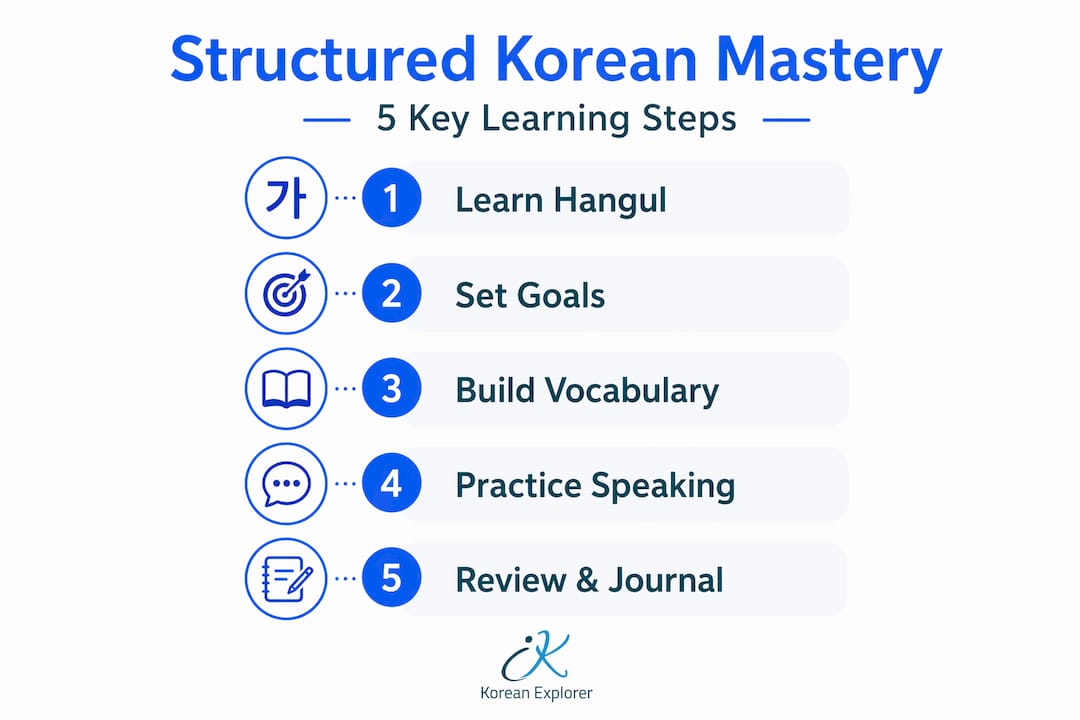
Here is something most step-by-step guides skip: the map is not the territory. You can follow every stage perfectly and still feel like you are moving slowly. That feeling is not a sign you are doing it wrong. It is a sign that language learning is an organic process, not a software installation.
Not every learner thrives in structured classroom settings, and that is completely valid. Some people absorb language most naturally through immersion, entertainment, or relationship. As online discussions confirm, flexible and personalized approaches often work best because structure alone does not fit every learner’s personality or lifestyle.
What this means in practice is that you should treat any roadmap, including this one, as a suggestion framework rather than a rigid prescription. If you hit Step 3 and realize that speaking practice is more energizing for you than grammar drills, shift the balance. If you discover that watching Korean reality shows teaches you vocabulary faster than flashcard apps, lean into that. The goal is fluency, not compliance with a study schedule.
Progress also is rarely linear. You will have weeks that feel electric, where everything clicks. Then you will have weeks where you feel like you have forgotten everything you knew. Both are part of the same process. Learners who accept this ride it out. Learners who interpret slow weeks as failure often quit right before a breakthrough.
Balance matters more than intensity. A learner who studies for thirty minutes every single day for a year will almost always outperform one who studies intensively for two months and then burns out. Consistency beats heroics every time. The learners we see succeed at Korean language learning myths and common misconceptions — their persistence is what sets them apart, not their natural aptitude.
Finally, give yourself permission to enjoy the journey. Korean is a genuinely fascinating language with a logical structure, a rich cultural context, and a global community of learners you can connect with. The more you find personal meaning in what you are studying — whether that is K-pop, Korean cooking, Korean cinema, or career opportunity — the more sustainable your progress becomes.
Take your next step with guided Korean learning in Singapore
You now have a clear picture of the road ahead: Hangul first, goals next, structured milestones, challenge management, and consistent progress tracking. The question is how to put all of this into action with the right support around you.
Korean Explorer offers structured classes for every stage of your journey, from complete beginner programs to advanced TOPIK preparation, all taught by native Korean instructors fluent in both Korean and English. Whether you prefer group classes for community energy, private sessions for personalized speed, or online formats for maximum flexibility, there is a format designed around your life. Explore your options for Korean classes in Singapore, step into the Intermediate Korean Course when you are ready to push further, or use the TOPIK proficiency guide to chart your certification path. The next step is closer than you think.
Frequently asked questions
How long does it take to become fluent in Korean with a step-by-step program?
Most learners in structured programs reach conversational proficiency within 12 to 24 months, depending on consistency, weekly study hours, and whether they complement classroom learning with daily practice outside of class.
Do I need to attend classes, or can I succeed through self-study?
Both paths can work, but some learners thrive with self-study while others benefit more from guided weekly classes, especially for speaking and listening where real-time feedback accelerates progress significantly.
What is TOPIK, and should I take it?
TOPIK is an internationally recognized Korean proficiency test useful for academic admissions, job applications, and immigration; while TOPIK-prep pathways suit many learners, casual learners can use it as a motivating benchmark without any obligation to formally register.
What is the best way to practice speaking Korean in Singapore?
Joining group classes with conversation components, finding a Korean language exchange partner, attending Korean cultural community events, and practicing with native-speaking instructors are all highly effective options for building real-world speaking confidence in Singapore.