TL;DR:
- A comprehensive Korean course develops all four language skills aligned with TOPIK and CEFR standards.
- Small class sizes and structured curricula accelerate progress through feedback and real-world practice.
- Formal benchmarks and teaching methods like syllable-based Hangul support effective and measurable learning outcomes.
Many learners assume that a Korean course is “comprehensive” if it covers a lot of vocabulary or grammar rules. That assumption leads to a frustrating plateau: you can memorize hundreds of words but still freeze in a real conversation. A truly comprehensive course builds all four core skills simultaneously — reading, writing, listening, and speaking — and anchors them to recognized proficiency frameworks like TOPIK (Test of Proficiency in Korean) and CEFR (Common European Framework of Reference for Languages). For learners in Singapore, understanding this distinction is the first step toward choosing a course that actually gets you to your goal.
Table of Contents
- Defining a comprehensive Korean course
- Course structure: How does it work in Singapore?
- Teaching methodology: What approaches build real proficiency?
- Progress tracking and real outcomes: The role of benchmarks
- The real reason structure outperforms self-study in mastering Korean
- Take the next step with a comprehensive Korean course in Singapore
- Frequently asked questions
Key Takeaways
| Point | Details |
|---|---|
| Holistic skill development | True comprehensive Korean courses build proficiency in reading, writing, listening, and speaking. |
| Benchmarked progress | Courses aligned with TOPIK or CEFR provide measurable, recognized milestones from beginner to advanced. |
| Small class advantage | Learning in small groups doubles your progress and boosts speaking confidence compared to larger classes. |
| Modern teaching methods | Communicative and syllable-first approaches are proven to improve accuracy and fluency, especially for English speakers. |
| Real-world outcomes | Comprehensive courses open doors for study, work, and cultural engagement in Korean-speaking contexts. |
Defining a comprehensive Korean course
A comprehensive Korean course is not simply a long course or an expensive one. It is a structured program that develops every dimension of language ability in an integrated way. That means starting with Hangul (the Korean alphabet), building grammar and vocabulary systematically, and practicing all four skills — listening, speaking, reading, and writing — at every level.
The clearest way to measure this is through recognized benchmarks. TOPIK runs from Level 1 (beginner) to Level 6 (advanced), and CEFR spans A1 through C2. Comprehensive courses are mapped to these proficiency levels and cover all skills, so your progress is measurable, not just felt.
Here is a quick look at how TOPIK and CEFR levels align:
| TOPIK Level | CEFR Equivalent | Typical Ability |
|---|---|---|
| Level 1–2 | A1–A2 | Basic survival Korean |
| Level 3–4 | B1–B2 | Intermediate, everyday use |
| Level 5–6 | C1–C2 | Advanced, professional use |
The benefits of this integrated approach go beyond test scores. When you practice grammar and speaking and listening together, the knowledge sticks. You are not just memorizing rules in isolation — you are applying them in context, which is how fluency actually forms.
For Singaporean learners, this alignment matters because your goals are usually concrete. You might be preparing for university admission in Korea, applying for a job that requires Korean, or simply wanting to communicate confidently with Korean-speaking colleagues and friends. A structured guide to learning Korean can help you understand which level maps to your specific goal before you even enroll.
“A comprehensive course does not teach skills in silos. It weaves them together so that every lesson builds real communicative ability, not just isolated knowledge.”
Key skills covered in a comprehensive course:
- Hangul and phonetics — the foundation for everything else
- Grammar and sentence structure — how the language is built
- Vocabulary in context — not isolated word lists
- Listening comprehension — tuned to natural speech speed
- Speaking and conversation — the skill most courses underdeliver on
- Reading and writing — essential for academic and professional goals
Course structure: How does it work in Singapore?
Knowing what a comprehensive course covers is one thing. Understanding how it is delivered in Singapore is another. Most structured Korean courses here run for 10 to 12 weeks per level, with fees typically ranging from S$300 to S$400 per term. That makes it accessible for students and working adults alike.
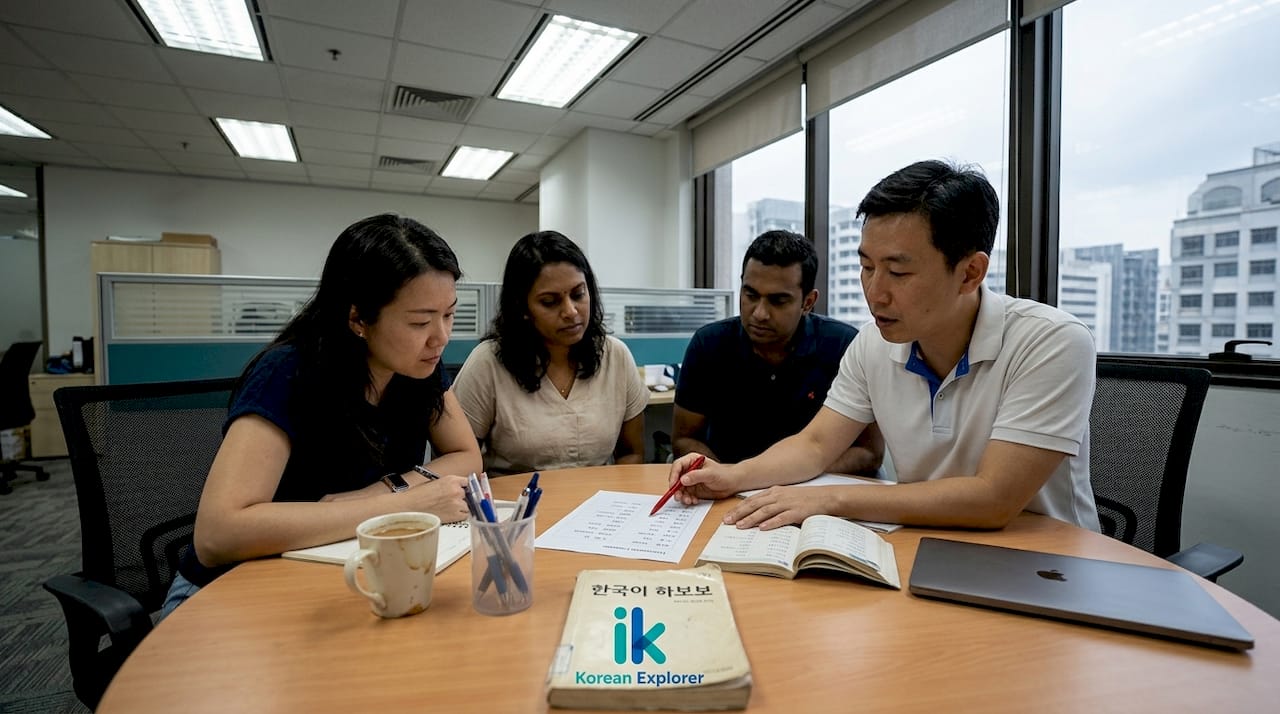
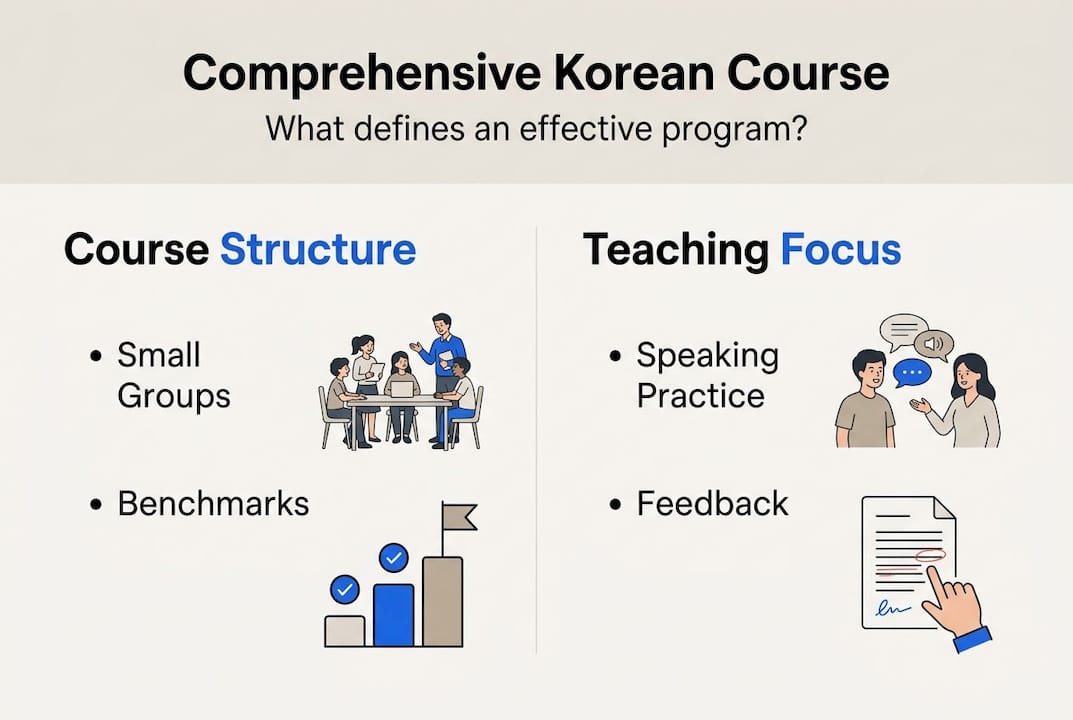
Class sizes matter more than most people realize. Schools that keep groups to 8 to 15 students allow instructors to give real feedback on your pronunciation and speaking. Small classes enable faster learning and greater speaking confidence, which is why they are a standard feature at quality schools in Singapore.
Here is how onsite and online formats compare:
| Feature | Onsite classes | Online classes |
|---|---|---|
| Speaking practice | Face-to-face, immediate feedback | Live video, slightly less spontaneous |
| Flexibility | Fixed schedule, set location | More flexible, learn from anywhere |
| Community feel | Strong group dynamics | Depends on platform and instructor |
| TOPIK/CEFR alignment | Yes | Yes |
Both formats can be effective if they follow a structured curriculum. The key is that the course tracks your progress against TOPIK or CEFR benchmarks, not just attendance.
For working adults in Singapore, another practical consideration is SkillsFuture eligibility. Some Korean language courses qualify for SkillsFuture credits, which reduces out-of-pocket costs significantly. When you are learning Korean in Singapore, it is worth checking whether your chosen school offers this option.
Here is what to look for when evaluating a course:
- Class size of 8 to 15 students maximum
- Native Korean instructors fluent in English
- Curriculum aligned to TOPIK or CEFR levels
- Regular speaking and listening practice, not just grammar drills
- Clear progression pathway from one level to the next
If you are unsure whether to go with group vs one-to-one classes, consider your learning style and budget. Group classes build conversational confidence through peer interaction, while private lessons allow for a fully customized pace.
Pro Tip: Before enrolling, ask the school directly: “Which TOPIK or CEFR level does this course prepare me for, and how much class time is dedicated to speaking practice?” The answer will tell you a lot about the course’s quality.
Teaching methodology: What approaches build real proficiency?
Class structure sets the stage, but teaching methodology determines whether you actually become proficient. There is a big difference between a course that walks you through grammar tables and one that gets you speaking from the very first lesson.
The communicative approach is the gold standard in modern language teaching. Instead of translating sentences from a textbook, you practice real-world tasks: ordering food, describing your day, asking for directions. This mirrors how you actually use language, which makes the learning transfer to real situations far more effectively.
For English-speaking adults learning Korean, one specific method stands out for building reading accuracy. Syllable-based Hangul instruction produces higher word reading accuracy than other methods for English L1 learners. Instead of learning individual letters in isolation, you learn them as syllable blocks — which is exactly how Korean words are constructed. This approach reduces confusion and speeds up the transition from sounding out letters to reading naturally.
Key markers of a strong teaching methodology:
- Syllable-first Hangul instruction for accurate reading from the start
- Communicative tasks over grammar-translation drills
- Regular speaking feedback to prevent bad habits from becoming permanent
- Listening practice with natural-speed audio, not just slow, scripted recordings
- Cultural context woven into lessons, so language feels alive
Another factor that is often overlooked is accountability. In a small, structured group, you cannot hide. You are expected to speak, respond, and participate. That gentle pressure is actually one of the most powerful drivers of progress. Interactive Korean classes that prioritize speaking from day one prevent a common problem called fossilization, where incorrect habits become so ingrained that they are very hard to correct later.
Pro Tip: When visiting a school, ask to sit in on a trial class. Watch whether students are speaking more than the teacher. If the instructor is doing most of the talking, that is a red flag.
Progress tracking and real outcomes: The role of benchmarks
A good course does not just teach you Korean. It shows you exactly where you are and where you are going. That is the role of benchmarks like TOPIK and CEFR.
TOPIK uses a score-based system, not just completion certificates. TOPIK levels directly correspond to real-world outcomes, with Level 3 and above often required for university admission or work visas in Korea. This is not just a test. It is a passport to specific opportunities.
Here is a practical breakdown:
| TOPIK Level | What it unlocks |
|---|---|
| Level 1–2 | Everyday conversations, travel, K-drama comprehension |
| Level 3–4 | University admission, entry-level Korean-facing jobs |
| Level 5–6 | Professional roles, advanced academic study |
For a deeper look at how the test works, a guide to TOPIK can walk you through the format and scoring in detail.
How progress is typically tracked in a structured course:
- Placement test at enrollment to find your starting level
- In-class assessments after each unit to catch gaps early
- End-of-term review against TOPIK or CEFR benchmarks
- Mock TOPIK exams at higher levels to simulate real test conditions
- Instructor feedback sessions to set goals for the next term
Understanding what is the TOPIK test and how it is scored helps you set realistic timelines. Most learners reach Level 2 within 6 to 12 months of consistent study, and Level 3 to 4 within 18 to 24 months.
“Progress in language learning is not linear, but structured benchmarks give you clear checkpoints so you always know what to work on next.”
The real reason structure outperforms self-study in mastering Korean
Here is something most language learning articles will not tell you directly: the biggest barrier to Korean fluency for most Singaporean learners is not vocabulary or grammar. It is the absence of accountability and real-time feedback.
Self-paced apps are convenient. But convenience is not the same as effectiveness. Apps cannot correct your pronunciation in the moment. They cannot push you to speak when you feel hesitant. They do not create the social pressure that forces you to actually use the language.
Structured courses lead to 2x faster progress than self-study, especially for speaking skills. That gap exists because structured environments provide what apps cannot: a qualified instructor who catches errors before they become habits, peers who motivate you to show up and participate, and a clear curriculum that removes the paralysis of not knowing what to study next.
The confidence factor is also real. Speaking a new language in front of others feels vulnerable. But that discomfort, managed well in a small class, is exactly what builds the fluency that self-study never reaches. If you want an honest, experience-backed starting point, the expert guide for learning Korean lays out why structured learning consistently outperforms the go-it-alone approach.
Choose feedback-rich environments over convenient but incomplete methods. Your future self will thank you.
Take the next step with a comprehensive Korean course in Singapore
Knowing what to look for in a comprehensive course, you are ready to take practical action toward fluency.
Korean Explorer offers comprehensive Korean language courses built on a Seoul National University curriculum, closely aligned with TOPIK standards, and taught by experienced native instructors in small groups. Whether you are a complete beginner or looking to push past intermediate level, there is a clear pathway for you. Working adults can also explore SkillsFuture Korean language options to offset course fees. With centers at Tanjong Pagar, Jurong, and Tampines, getting started has never been more convenient. Take a placement test and find the right level for you today.
Frequently asked questions
What does ‘comprehensive’ mean in a Korean course?
It means the course develops all core skills — reading, writing, listening, and speaking — aligned with recognized standards like TOPIK or CEFR from beginner to advanced level.
How long does it take to complete a comprehensive Korean course in Singapore?
Most structured courses run 10 to 12 weeks per level; reaching intermediate fluency typically takes 1 to 2 years depending on your pace and commitment.
Are online Korean courses as effective as on-site options?
Yes, if they include interaction, real-time feedback, and follow TOPIK or CEFR frameworks. Many Singapore schools offer both online and onsite structured options.
What is TOPIK and why does it matter?
TOPIK is an internationally recognized Korean proficiency test. Many universities and employers require a specific level for admission or work visa applications in Korea.
Is there a recommended teaching method for English speakers learning Korean?
Research shows that syllable-based Hangul instruction helps English-speaking adults read Korean words more accurately than other approaches, making it the preferred method for English L1 learners.