TL;DR:
- TOPIK I tests beginner Korean skills through Listening and Reading, certifying levels 1 and 2. TOPIK II assesses intermediate to advanced abilities by including a Writing section and certifies levels 3 through 6. Choosing the correct exam based on your goals and skill level is essential to avoid delays and failed attempts.
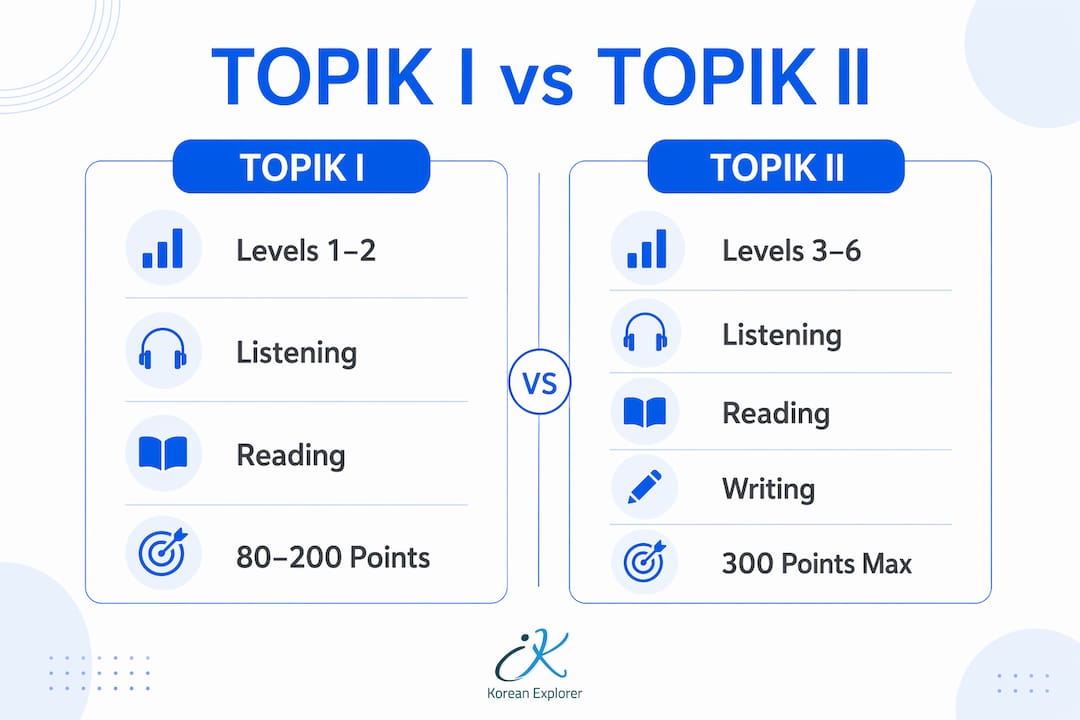
TOPIK I tests beginner Korean skills through Listening and Reading only, while TOPIK II assesses intermediate to advanced proficiency by adding a Writing section to the exam format. Understanding what is TOPIK I vs TOPIK II is the single most important decision you make before registering, because choosing the wrong tier wastes your registration fee and delays your goals. TOPIK I covers levels 1 and 2, while TOPIK II covers levels 3 through 6. Your target level, whether for a visa, university admission, or a job, determines which exam you need.
What is TOPIK I vs TOPIK II in terms of level coverage?
TOPIK I and TOPIK II are not simply an easy and hard version of the same test. They are two distinct exams designed to certify completely different ranges of Korean proficiency.
TOPIK I awards levels 1 and 2, with level 1 requiring a score of 80–139 points and level 2 requiring 140–200 points. These levels correspond to basic everyday language: introducing yourself, asking for directions, ordering food, and handling simple transactions. If you can hold a short conversation on familiar topics, you are likely in the TOPIK I range.
TOPIK II covers levels 3 through 6. Level 3 starts at 120 points, level 4 at 150, level 5 at 190, and level 6 at 230 out of a maximum 300 points. Level 6 represents near-native fluency, including the ability to discuss abstract topics, read formal documents, and write structured arguments. The gap between level 2 and level 3 is significant, both in skill and in exam format.
TOPIK I cannot produce a level 3 or above certification, no matter how well you score. This matters because many formal requirements, including Korean university admission, certain visa categories, and professional job applications, specify level 3 or higher. Registering for TOPIK I when your goal requires level 3+ is a guaranteed dead end.
| Exam | Levels Certified | Score Range | Practical Ability |
|---|---|---|---|
| TOPIK I | 1–2 | 80–200 points | Basic everyday communication |
| TOPIK II | 3–6 | 120–300 points | Intermediate to near-native fluency |
Pro Tip: Before registering, check the exact level requirement on your university, visa, or employer’s official documentation. “Passing TOPIK” is not enough. The required level number is what counts.
How do the exam formats differ between TOPIK I and TOPIK II?
The structural difference between the two exams is where most test takers get surprised. TOPIK I is a shorter, two-section test. TOPIK II is a longer, three-section exam that demands a completely different set of skills.

TOPIK I consists of Listening and Reading: 40 minutes and 30 questions for Listening, then 60 minutes and 40 questions for Reading. The total exam time is 100 minutes, and the maximum score is 200 points. Every question is multiple choice. There is no writing, no open-ended response, and no essay.
TOPIK II runs for 180 minutes and carries a maximum of 300 points across three sections: Listening, Reading, and Writing. The Writing section is where the exam becomes genuinely demanding. It includes two essay tasks: one short response of approximately 200–300 characters and one longer essay of approximately 600–700 characters. Both require structured argumentation, not just vocabulary recall.
Here is a direct comparison of the two exam formats:
| Feature | TOPIK I | TOPIK II |
|---|---|---|
| Sections | Listening, Reading | Listening, Reading, Writing |
| Total time | 100 minutes | 180 minutes |
| Maximum score | 200 points | 300 points |
| Question types | Multiple choice only | Multiple choice + written essays |
| Levels certified | 1–2 | 3–6 |
Key facts about the TOPIK II Writing section:
- The short essay (200–300 characters) typically asks you to complete or respond to a prompt using specific grammar patterns.
- The long essay (600–700 characters) requires a structured argument with an introduction, body, and conclusion.
- Spelling, grammar, and logical flow all affect your writing score.
- Candidates frequently fail TOPIK II specifically because of the Writing section, not the Listening or Reading portions.
The Writing section is the defining challenge of TOPIK II. Test takers who prepare only for multiple choice questions consistently underperform on exam day. Understanding the full exam format before you begin studying saves months of misdirected effort.
How do you choose between TOPIK I and TOPIK II?
Choosing the right exam tier is not about confidence. It is about matching your goal to the correct certification. Here is a clear framework for making that decision.
- Identify your required level first. Check your university, employer, or immigration authority’s official requirements. If they specify level 3 or above, TOPIK II is the only valid option.
- Assess your current vocabulary range. TOPIK II preparation requires mastery of approximately 3,000–5,000 vocabulary words plus intermediate grammar including passive and causative forms. If you are still building core vocabulary below that range, TOPIK I is the right starting point.
- Take a mock test before registering. Free past papers are available through the official TOPIK website. Score yourself honestly. If you consistently score below level 3 on TOPIK II practice papers, register for TOPIK I first.
- Factor in your writing ability. If you have never practiced structured Korean essay writing, TOPIK II is a significant risk. Writing cannot be crammed in a few weeks.
- Consider your timeline. TOPIK is held six times per year. If you need a certification quickly and are not yet at level 3, earning a level 2 now and retaking TOPIK II in a later session is a smarter path than failing TOPIK II and waiting another cycle.
Pro Tip: Treat TOPIK I as a legitimate credential, not a consolation prize. Level 2 demonstrates real communicative ability and is recognized by many employers and institutions for entry-level Korean roles.
Taking a test beyond your current level leads to failure, lost fees, and a delay in your certification timeline. Starting at the appropriate level builds momentum and gives you a credential you can use while preparing for the next tier. If you want structured guidance on how to prepare for TOPIK, a clear study plan aligned to your target level makes the biggest difference.
What are the registration fees and formats for TOPIK in 2026?
Registration costs and formats differ between the two exams, and knowing these details prevents last-minute surprises.
- TOPIK I paper-based test (PBT): 40,000 KRW
- TOPIK II paper-based test (PBT): 55,000 KRW
- TOPIK I internet-based test (IBT): 70,000 KRW
- TOPIK II internet-based test (IBT): 95,000 KRW
Both exam types are scheduled six times annually in 2026. The IBT format offers more flexibility in scheduling but costs significantly more. The PBT format is the traditional paper exam held at designated test centers.
Practical registration tips:
- Use a desktop or standard laptop during online registration. Mobile devices and tablets frequently cause compatibility errors on the official registration portal, which can result in failed transactions.
- Register early. Popular test sessions fill quickly, especially in cities with large Korean language communities.
- TOPIK scores are valid for two years from the official announcement date, for both PBT and IBT formats. Plan your exam timing so your score remains valid when you need it.
- Double-check the test center location and session time before submitting payment. Changes after registration are not always possible.
Key Takeaways
TOPIK I and TOPIK II are separate exams certifying different proficiency levels, and choosing the correct one based on your specific goal is the most critical step before registration.
| Point | Details |
|---|---|
| Two distinct exams | TOPIK I certifies levels 1–2; TOPIK II certifies levels 3–6. They are not interchangeable. |
| Format difference | TOPIK I is multiple choice only; TOPIK II adds two written essays totaling up to 700 characters. |
| Level 3 requires TOPIK II | University admission, many visas, and professional roles require level 3 or above, which only TOPIK II can certify. |
| Registration costs vary | TOPIK II PBT costs 55,000 KRW vs. 40,000 KRW for TOPIK I PBT; IBT formats cost more for both. |
| Score validity | All TOPIK scores are valid for two years from the announcement date, regardless of format. |
What I have learned from watching TOPIK candidates choose the wrong exam
The most common mistake I see is test takers registering for TOPIK II because they feel ready, without ever attempting a timed mock Writing section. Listening and Reading practice gives a false sense of security. You can score well on both and still fail TOPIK II because the Writing section pulls your total score below the level 3 threshold.
The second mistake is treating TOPIK I as a lesser achievement. Learners who earn level 2 and use that time to build structured writing habits consistently outperform those who rushed into TOPIK II unprepared. Level 2 is a real credential. Use it strategically.
Integrated study methods that combine grammar patterns, daily listening, and feedback-driven essay writing produce the strongest results for TOPIK II candidates. Focusing only on vocabulary plateaus your progress. The Writing section rewards learners who have practiced organizing ideas in Korean, not just memorizing words.
My honest recommendation: take one full timed mock exam for the tier you are considering before you pay the registration fee. That single practice session will tell you more than weeks of passive study.
— Paul
Korean Explorer’s adult Korean courses for TOPIK preparation
Korean Explorer offers structured adult Korean courses in Singapore aligned with the proficiency levels tested in both TOPIK I and TOPIK II. Whether you are building foundational skills for levels 1 and 2 or working toward the intermediate and advanced range, the curriculum follows Seoul National University standards and maps directly to exam requirements.
Courses are available in group, private, and online Zoom formats, making it practical to study around a full work schedule. Corporate training programs are also available for teams building business Korean proficiency. Korean Explorer’s native Korean instructors, fluent in both Korean and English, provide the kind of feedback-driven instruction that makes the TOPIK II Writing section manageable. Explore Korean language courses and find the right level to start preparing with a clear plan.
FAQ
What is the main difference between TOPIK I and TOPIK II?
TOPIK I certifies levels 1 and 2 through Listening and Reading only, while TOPIK II certifies levels 3 through 6 and includes a Writing section. They are separate exams, not difficulty tiers of the same test.
Can I get a level 3 certificate by scoring very high on TOPIK I?
No. TOPIK I can only award level 1 or level 2 regardless of your score. Level 3 and above require sitting TOPIK II.
How long are TOPIK scores valid?
TOPIK scores are valid for two years from the official announcement date, for both paper-based and internet-based formats.
Which section do most people fail in TOPIK II?
The Writing section is the most common reason candidates fail TOPIK II. It requires two structured essays and rewards deliberate practice, not last-minute preparation.
How many times is TOPIK offered in 2026?
Both TOPIK I and TOPIK II are scheduled six times in 2026, in both paper-based and internet-based formats.