TL;DR:
- Flexible learning offers adults control over when, where, and how they study Korean without disrupting other responsibilities. It maintains high standards through active engagement, diverse formats, and clear progress tracking, fostering motivation and transferable skills. Successful programs require disciplined self-regulation, regular interaction, and flexible, multimodal content aligned with learners’ goals.
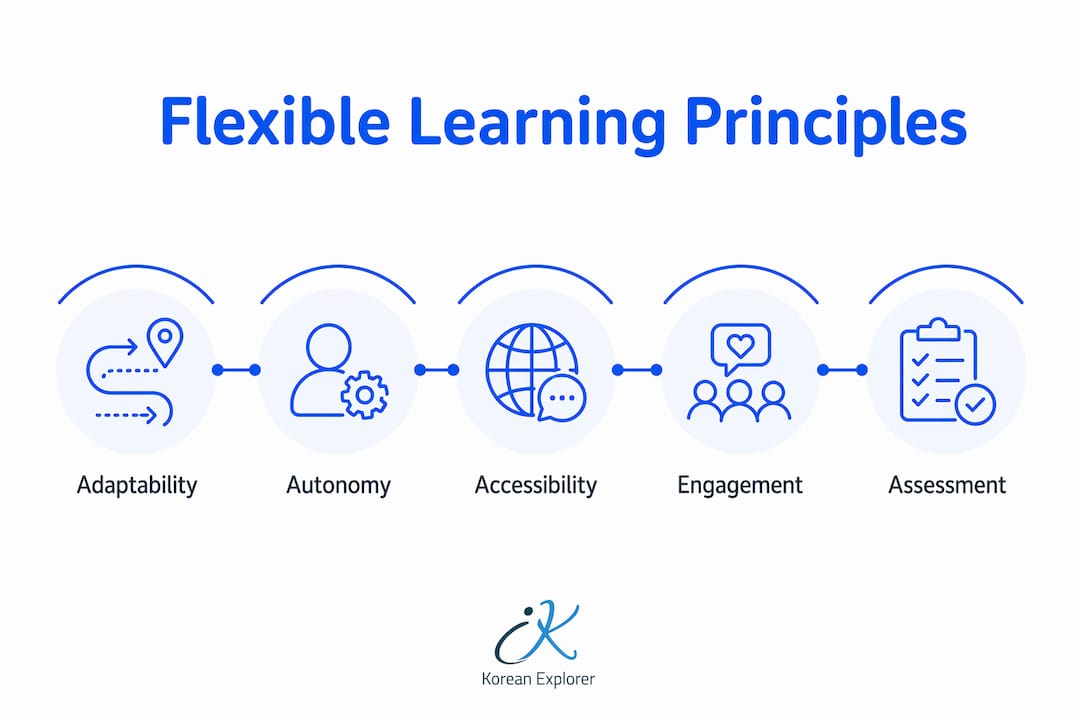
Flexible learning options are educational approaches that give you the autonomy to choose when, where, and how you acquire new skills. The OECD identifies four core dimensions of this model: adaptability in time, place, mode, and content. These dimensions make the role of flexible learning options especially powerful for adult Korean language learners who are managing jobs, families, and other commitments. Whether you are learning Korean for travel, career advancement, or personal enrichment, flexible education gives you a real path forward without forcing you to reshape your entire life around a fixed class schedule.
What are the core principles of flexible learning options?
Flexible learning is not simply a looser version of traditional education. It is a structured approach built on four principles: vision, understanding, clarity, and agility. Vision means the program has clear learning goals. Understanding means the design reflects how adults actually learn. Clarity means learners always know what is expected of them. Agility means the program can adapt when life gets complicated.
The four structural dimensions that support these principles are:
- Schedule adaptability: You choose class times that fit your work hours or family routine, rather than the reverse.
- Location choice: You attend in person, online via Zoom, or through a hybrid format depending on your week.
- Mode variety: Content is delivered through live sessions, recorded video, audio, and written materials so you can learn in the way that sticks best.
- Modular content: Lessons are broken into self-contained units, so missing one session does not derail your entire progress.
One common misconception is that flexibility means lower standards. True flexible learning removes rigid structural barriers while maintaining learning outcomes and assessment standards. The difference is that success depends on active engagement with your instructor rather than passive attendance. For Korean language learners, this means showing up prepared for conversation practice, not just logging in.
Pro Tip: Look for programs that offer extended assessment windows of 3 to 5 days for assignments. Flexible submission deadlines reduce anxiety and improve completion rates, especially for learners balancing employment and caregiving.
How do flexible learning options benefit Korean language learners?
The benefits of flexible learning go well beyond convenience. They directly affect how well you absorb and retain a new language.
Improved access. Adults with non-traditional schedules, caregiving duties, or demanding jobs can participate in Korean language study without sacrificing other responsibilities. Enrollment in flexible programs has more than doubled over the past 20 years, reflecting how many learners need this model to participate at all.
Stronger motivation. Flexibility satisfies three core psychological needs: autonomy, competence, and connectedness. Research from Erasmus University Rotterdam confirms that flexibility promotes autonomous motivation, which is the kind of motivation that sustains language learning over months and years rather than weeks.
Transferable skills. Learning Korean in a flexible environment builds time management, self-discipline, and independent problem-solving. These are skills with direct workplace value. Mapúa Malayan Colleges Mindanao notes that flexible learning builds transferable skills that extend far beyond the classroom.
Reduced anxiety. Fixed-schedule classes can create pressure that works against language acquisition. When you control your pace, you practice more freely, make mistakes without fear, and build the confidence needed for real Korean conversations.
Better skill transfer. Multimodal formats, including video, audio, and live conversation sessions, reinforce vocabulary and grammar across multiple contexts. That repetition across formats is what moves Korean from short-term memory into long-term use.
The psychological benefit is worth emphasizing. Language learning requires you to be willing to sound imperfect. A flexible, lower-pressure environment makes that willingness far easier to maintain. You can find practical strategies for building that mindset in this guide on encouraging language learning.
What challenges exist in flexible learning, and how do you overcome them?

Flexible learning demands more from you, not less. The biggest challenge is self-regulation. Without a fixed schedule holding you accountable, it is easy to postpone study sessions until they disappear entirely.
Common pitfalls and how to address them:
- Procrastination: Set a non-negotiable weekly study block in your calendar. Treat it the same way you treat a work meeting.
- Loss of momentum after a break: Modular, stackable content minimizes the cognitive challenge of re-entry. Choose programs that organize lessons into short, self-contained units so you can pick up exactly where you left off.
- Isolation: Flexible does not have to mean solitary. Join a study group, attend live Zoom sessions, or use peer forums to maintain the social dimension of language learning.
- Technology barriers: Limited digital skills are a real barrier for many adult learners. Choose a program that provides technical onboarding and ongoing instructor support, not just a login link.
- Unclear expectations: Programs without clear milestones leave learners uncertain about their progress. Ask any school you consider how they track advancement and communicate feedback.
The deeper issue is that passive participation does not work in flexible structures. You need to proactively communicate with your instructor, flag confusion early, and take ownership of your learning pace. That active stance is what separates learners who finish with strong Korean skills from those who drift away after a few weeks.
Pro Tip: Before enrolling, ask the school how instructors respond to learner questions outside of class time. Strong digital infrastructure and responsive faculty are the two clearest signs of a well-designed flexible program.
How do modern Korean language courses integrate flexible learning?
Korean language education has moved well beyond the single-format classroom. The best adult programs now combine multiple delivery modes to match how working adults actually live.

| Format | How it works | Best for |
|---|---|---|
| Live online Zoom classes | Real-time instruction with a native Korean teacher via video | Learners who want structure with location freedom |
| In-person group classes | Scheduled sessions at a physical center | Learners who prefer face-to-face interaction |
| Private lessons | One-on-one sessions scheduled around your calendar | Learners with specific goals or irregular schedules |
| Hybrid learning | Mix of online and in-person sessions within one course | Learners who travel or have variable weekly routines |
Multimodal learning environments combining online and face-to-face teaching increase engagement and accommodate learners with multiple commitments. That combination also addresses different learning styles within the same course.
Digital tools extend flexibility even further. Audio lessons, short video clips, and mobile apps let you practice Korean during a commute or lunch break. Digital resources in multiple formats allow learners to access content across devices at varied times, which is critical for anyone whose schedule changes week to week. For a practical overview of tools that support this, see this guide on apps for language learning.
Personalized curriculum pathways are another key feature. Rather than moving every learner through the same content at the same speed, well-designed programs let you focus on conversational Korean, business Korean, or a blend of both depending on your goals. A modular and personalized curriculum accelerates progress because you spend time on what actually matters to you.
Key Takeaways
Flexible learning options accelerate Korean language acquisition by giving adult learners control over time, place, mode, and content while maintaining clear academic standards and instructor support.
| Point | Details |
|---|---|
| Four core dimensions | Adaptability in time, place, mode, and content defines genuine flexible learning. |
| Motivation and autonomy | Flexibility satisfies psychological needs that sustain long-term language learning. |
| Transferable skills | Flexible study builds time management and self-discipline alongside Korean language ability. |
| Self-regulation is required | Active engagement and proactive instructor communication determine success in flexible programs. |
| Multimodal formats work | Combining live sessions, video, audio, and mobile access reinforces Korean across multiple contexts. |
Why I think most learners underestimate what flexibility actually demands
Most people approach flexible learning as a convenience feature. They sign up because the schedule fits, then discover three months in that the schedule was never the hard part.
The learners I have seen make the fastest progress in Korean are not the ones with the most free time. They are the ones who treat their flexible program with the same discipline they bring to work. They block study time, they message their instructor when something is unclear, and they show up to live sessions even when it would be easier to skip. Flexibility gives you the structure to fit Korean into your life. It does not remove the need for effort.
The second thing most learners miss is the value of community within a flexible program. Language acquisition is fundamentally social. You need to hear Korean spoken, respond in real time, and get corrected by someone who knows the language. A fully self-paced, fully asynchronous program can give you grammar knowledge but rarely gives you fluency. The best flexible programs balance freedom of schedule with regular live interaction, and that balance is worth prioritizing when you choose where to study.
My honest advice: pick a program with native Korean instructors, live sessions you can attend consistently, and a curriculum that has clear milestones. Flexibility should make Korean more accessible, not more ambiguous.
— Paul
Korean Explorer’s flexible adult Korean courses
Korean Explorer offers adult Korean language courses designed around the realities of working life in Singapore. Group classes, private lessons, and live online Zoom sessions are all available, so you can choose the format that fits your week without sacrificing instruction quality.
Courses cover conversational Korean, business Korean, and corporate training, all taught by native Korean instructors fluent in both Korean and English. The curriculum is built for adults who want practical results, not just textbook knowledge. Whether you are starting from zero or building on existing skills, you can explore Korean language courses that match your schedule, goals, and preferred learning format. Private lessons are also available for learners who want a fully personalized pace through private Korean classes tailored to their specific needs.
FAQ
What is the role of flexible learning options in language education?
Flexible learning options give adult learners control over when, where, and how they study, making it possible to acquire a language like Korean without disrupting work or family commitments. The OECD identifies time, place, mode, and content as the four core dimensions of this approach.
Does flexible learning mean lower academic standards?
No. Flexible learning removes structural barriers like fixed schedules and single-location attendance, but it maintains the same learning outcomes and assessment standards as traditional programs. Success requires higher learner self-regulation, not less effort.
How does flexible learning help with Korean specifically?
Flexible formats reduce the anxiety that often blocks language practice, allowing you to speak and make mistakes in a lower-pressure setting. Multimodal resources, including audio, video, and live sessions, reinforce Korean vocabulary and grammar across multiple contexts for stronger retention.
What should I look for in a flexible Korean language program?
Prioritize programs with native instructors, live interactive sessions, modular course design, and responsive instructor support outside of class time. These features distinguish well-structured flexible programs from loosely organized ones.
Can I learn Korean online and still become conversational?
Yes, provided the online program includes regular live speaking practice with a qualified instructor. Fully asynchronous programs build reading and grammar skills but rarely develop the real-time fluency needed for conversation.