TL;DR:
- Multicultural language learning combines multiple languages and cultural contexts to enhance both language skills and cultural understanding. It improves cognitive functions and social skills by embedding cultural knowledge into language instruction. Consistent engagement with authentic cultural content and full linguistic repertoire accelerates long-term fluency and brain development.
Multicultural language learning is the intentional integration of multiple languages and cultural contexts into education to build linguistic skills and cultural competence at the same time. The formal term used by educators and researchers is multilingual education, and it goes far beyond memorizing vocabulary lists. UNESCO defines this approach as one that recognizes multilingualism as a fundamental human trait and promotes inclusive learning environments where cultural diversity is a resource, not an obstacle. Critically, 40% of people worldwide lack access to education in their home language, which shows just how urgent this approach has become. For adult learners in Singapore and beyond, multicultural language education offers a path to express identity, communicate with confidence, and engage with the world on a deeper level.
What is multicultural language learning and why does it matter?
Multicultural language learning treats language not as an isolated academic subject but as a living system tied to culture, identity, and community. When you learn a language through this lens, you gain the ability to understand how people think, not just what they say. That shift changes everything about how quickly and deeply you absorb a new language.

The approach matters because monolingual education leaves learners with a narrow toolkit. A learner who studies Korean grammar in isolation, for example, misses the social context that gives Korean phrases their actual meaning. Multicultural language education fills that gap by weaving cultural knowledge directly into language instruction.

This is especially relevant in Singapore, where learners already navigate English, Mandarin, Malay, and Tamil in daily life. That existing multilingual experience is an asset, not a complication. Multicultural language education teaches you to use that full repertoire rather than suppress it.
How does multicultural language learning improve cognitive and social skills?
The cognitive benefits of multilingual engagement are well documented and go beyond language itself. Multilingualism builds cognitive reserve, slowing brain aging and strengthening executive functions like multitasking, decision-making, and memory retention. That means learning Korean as an adult is not just a career move. It is a measurable investment in long-term brain health.
A 2025 study of 1,259 students found that culturally responsive materials produced higher engagement and language proficiency compared to standard monolingual instruction. Engagement is the key word here. When learners see their own cultural references in the material, they stay motivated longer and retain more.
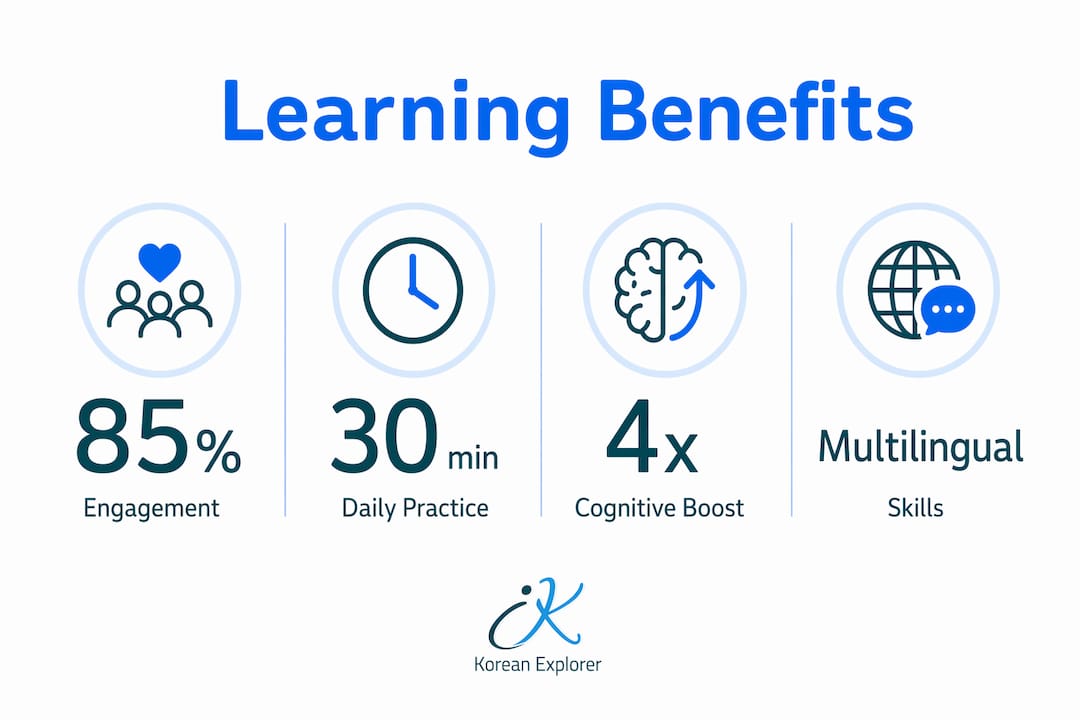
The social benefits are just as significant. Multilingual learners consistently report stronger cross-cultural empathy and greater self-confidence in unfamiliar social situations. Neuro-linguists confirm that language learning develops brain plasticity beyond language skills, shaping identity and social confidence in ways that single-subject study cannot replicate.
Here is what these benefits look like in practice:
- Critical thinking: Switching between languages forces the brain to evaluate context before choosing words, which sharpens analytical reasoning.
- Cross-cultural adaptability: Learners who study language with cultural context adjust faster to new professional and social environments.
- Memory retention: Regular multilingual engagement strengthens the same neural pathways used for long-term memory storage.
- Reduced cognitive decline: Studies link consistent multilingual practice to a lower risk of neurodegenerative conditions later in life.
Pro Tip: If you want the cognitive benefits of multilingual learning, consistency matters more than volume. Thirty minutes of culturally engaged Korean practice daily outperforms a three-hour grammar session once a week.
What are the key strategies used in multicultural language education?
Effective multicultural language education relies on a set of proven pedagogical methods. These are not abstract theories. They are practical frameworks that experienced instructors use every day.
Translanguaging. This is the strategic use of a learner’s full linguistic repertoire to build understanding. Rather than keeping languages in separate mental compartments, translanguaging enables fluid language use to accelerate comprehension and foster inclusivity in multilingual classrooms. A Korean instructor who explains a grammar point by drawing on a learner’s English intuition is practicing translanguaging.
Mother-tongue-based instruction. UNESCO experts emphasize that starting from a learner’s strongest language builds a “strong bridge” to additional languages. Learners who understand a concept in their first language acquire the second-language version of that concept faster and with greater confidence.
Language awakening. This method exposes learners to a wide range of languages and scripts early in the learning process, building curiosity and openness rather than anxiety. It removes the fear of unfamiliar sounds and writing systems, which is one of the biggest barriers adult learners face.
Cultural immersion integrated into instruction. Grammar taught in isolation fades quickly. Grammar taught through Korean drama scenes, music, or business conversations sticks because it carries emotional and cultural weight. The role of cultural immersion in language acquisition is not supplementary. It is central.
Language openness as a mindset. Educational experts advocate focusing on engagement over perfect fluency. Viewing language as a tool for connection rather than a test to pass sustains motivation over the long term.
Pro Tip: When studying Korean, try explaining a new grammar point to yourself in English first, then reconstruct it in Korean. This translanguaging technique reinforces both comprehension and recall simultaneously.
Multicultural language education also benefits from thoughtful curriculum design, which sequences cultural content alongside linguistic content so neither feels like an afterthought. For a broader look at how multicultural principles apply across educational settings, the insights from Nowa Szkoła Sopot offer a useful comparative perspective.
What are the common misconceptions about multilingual learning?
The biggest myth is that learning multiple languages at once dilutes each one. Research says the opposite. Multilingualism builds a strong foundation for further language acquisition and literacy rather than weakening it. Each language you know makes the next one easier to acquire because your brain has already built the cognitive infrastructure.
A second misconception is that feeling stuck means you are failing. In reality, the cognitive effort of switching between languages is exactly what strengthens executive brain function. Those “stuck” moments signal active neuroplasticity. Your brain is adapting, not stalling.
“The goal of multilingual education is language openness and cultural pride, not perfect fluency in all languages acquired. Learners who release the pressure of perfection engage more deeply and progress faster.”
A third pitfall is treating language learning as a grammar exercise. Learners who focus exclusively on rules without engaging with real cultural content burn out faster and plateau earlier. Language is a tool for human connection. When you use it that way from the start, motivation becomes self-sustaining rather than something you have to manufacture.
The strategies for encouraging language learning that work best are always rooted in genuine cultural curiosity, not obligation.
How can you practice multicultural language learning every day?
Applying multilingual education principles outside the classroom is where real fluency develops. The following steps work for adult learners at any level.
Engage with native media daily. Watch Korean variety shows, listen to Korean podcasts, or read Korean news headlines for 15 minutes each day. Cultural immersion through authentic content prevents burnout and builds intrinsic motivation far more effectively than textbook drills.
Use technology as a learning partner. Digital tools that offer spaced repetition, pronunciation feedback, and cultural context accelerate progress. Technology makes second-language learning more accessible and more personalized than traditional methods alone.
Connect with diverse linguistic communities. Join Korean language exchange groups, attend cultural events, or participate in online conversation forums. Real interaction with native speakers exposes you to register, humor, and social nuance that no textbook captures.
Use your full linguistic repertoire. Do not suppress your other languages when studying Korean. Draw on English, Mandarin, or any other language you know to build bridges to new Korean concepts. This is translanguaging in practice, and it works.
Build cultural pride into your motivation. Learn why Korean culture matters to you personally, whether through K-drama, Korean cuisine, business connections, or travel plans. Intrinsic motivation tied to cultural identity sustains learning through the difficult stages that external pressure cannot.
Take structured courses with cultural integration. Self-study works best when paired with expert instruction that sequences cultural and linguistic content together. Practical tips for adult learners taking a new language course can help you get the most from structured learning environments.
Key Takeaways
Multicultural language learning works because it combines linguistic instruction with cultural context, cognitive engagement, and learner identity to produce faster, deeper, and more durable language acquisition than monolingual methods.
| Point | Details |
|---|---|
| Core definition | Multicultural language learning integrates multiple languages and cultural contexts to build both linguistic and cultural competence. |
| Cognitive benefits | Regular multilingual engagement strengthens executive function, memory, and long-term brain health. |
| Translanguaging is central | Using your full linguistic repertoire, not keeping languages separate, accelerates comprehension and retention. |
| Misconceptions cost progress | Multilingualism strengthens, not dilutes, language acquisition; feeling stuck is a sign of healthy brain adaptation. |
| Cultural immersion is non-negotiable | Authentic cultural engagement prevents burnout and sustains the intrinsic motivation needed for long-term fluency. |
Why language openness matters more than fluency targets
I have watched adult learners in Singapore set rigid fluency goals and then quit within three months because the gap between where they started and where they wanted to be felt too wide. The learners who stick with it are almost never the ones chasing perfection. They are the ones who genuinely enjoy the culture they are learning about.
What the research on multilingual education confirms, and what I have seen play out repeatedly, is that the brain responds to meaning. When a Korean phrase connects to something you actually care about, whether it is a line from a drama you love or a phrase you need for a business meeting, it embeds itself in a way that rote repetition never achieves. The cognitive science backs this up. The mental effort of switching between languages is not a bug in the system. It is the feature that makes your brain stronger.
The learners who make the most progress are also the ones who stop treating their other languages as interference. A Mandarin speaker learning Korean has a structural advantage in reading Hanja-derived vocabulary. An English speaker has an advantage with loanwords. Multicultural language education teaches you to see those connections rather than fight them.
My honest advice: release the fluency target for the first six months. Focus on cultural curiosity and consistent exposure instead. The fluency follows. The curiosity has to come first.
— Paul
Korean Explorer: where multicultural language learning comes to life
Korean Explorer brings the principles of multicultural language education into every adult Korean course it offers. Instruction is delivered by native Korean speakers who are fluent in English, which means cultural context and clear explanation come together in every lesson.
Whether you prefer group classes, private sessions, or online Korean classes via Zoom, Korean Explorer structures each course around real conversation and cultural immersion rather than grammar drills alone. Corporate training options are also available for professionals who need Korean for business contexts. Courses are based on a curriculum developed by Seoul National University and are designed for adult learners at every level. If you are ready to experience what learning Korean in Singapore looks like when culture and language are taught together, Korean Explorer is the place to start.
FAQ
What is the difference between multilingual and multicultural language learning?
Multilingual education focuses on using multiple languages as the medium of instruction. Multicultural language learning adds cultural integration, teaching learners to understand and navigate the cultural contexts that give language its meaning.
Does learning multiple languages at once slow you down?
No. Research confirms that multilingualism strengthens the foundation for further language acquisition rather than diluting it. Each language you know makes the next one easier to learn.
What is translanguaging and how does it help?
Translanguaging is the practice of using your full linguistic repertoire fluidly across languages. Educational reviews show it accelerates comprehension and fosters inclusivity, especially in multilingual classrooms.
How long does it take to see results from multicultural language learning?
Results vary by learner, but consistent daily engagement with both language and cultural content produces noticeable gains within three to six months. Intrinsic motivation tied to cultural interest significantly speeds up the process.
Is multicultural language education only for children?
No. Adult learners benefit equally from multicultural language education principles. Cognitive benefits like improved executive function and memory retention apply at every age, and adult learners often have stronger cultural motivation to sustain long-term practice.